Kloster Bergen: A Benedictine Nunnery and Holy Cross Church
Site at a Glance
- Popularity
- Medium
- Country
- Germany
- Primary era
- Early Modern
- Eras represented
- Medieval, Early Modern, Modern
- Civilizations
- Duchy of Bavaria, Electorate of Bavaria, German, Holy Roman Empire
- Site type
- Religious
- Remains
- Church
On this page13 sections
History
Kloster Bergen is a former Benedictine nunnery near Neuburg in Bavaria, Germany. Biletrud, widow of Duke Berthold of Bavaria, founded it around 976; its nuns followed the Rule of Saint Benedict. The community belonged to the Diocese of Eichstätt, an ecclesiastical district governed by a bishop. Its present Holy Cross Church is Rococo, an ornate style associated with the eighteenth century.
Foundation and medieval reforms
A church at Bergen was mentioned in 787, before the nunnery was founded. In 995, Pope John XV confirmed the convent, which was dedicated to Mary and John the Evangelist. Its dedication probably changed to the Holy Cross during the thirteenth century. In 1007, King Henry II, later Holy Roman Emperor, placed the monastery under the Diocese of Bamberg. A new church was consecrated in 1095 by Ulrich I, Bishop of Eichstätt. Fire destroyed much of it in 1155, but after repairs Bishop Otto consecrated it again in 1190.
Monastic life later declined, before a renewal associated with Admont, another Benedictine monastery, took hold in the mid-twelfth century. Rilindis, a reforming abbess from Admont, led Bergen’s community from 1156 to 1163 and then moved to Hohenburg Abbey. Later convent tradition named Biletrud as the first abbess, or head of the nuns, although documentary evidence weighs against that identification.
Territorial rule and reform
Around 1200, the Wittelsbach dukes of Bavaria took on the monastery’s secular protectorship, a lay role responsible for its protection, and brought Bergen into their territory. The monastery formed part of the Neuburg bailiwick, an administrative district overseen by a bailiff. As Bavarian lands were divided and reorganized, Bergen came under Upper Bavaria-Munich, then the sub-duchy of Ingolstadt in 1392, Lower Bavaria-Landshut in 1447, and Palatinate-Neuburg in 1505.
The convent drew income from land and other rights in several dozen settlements, mostly between the Danube and Altmühl rivers. Its holdings also included property around Hersbruck, where a branch community operated in the eleventh and twelfth centuries. The Hersbruck provostry, an outlying religious house and administrative center, was sold in 1529.
In the mid-fifteenth century, Bergen adopted the Melk reform, a movement to renew Benedictine monastic life associated with Melk Abbey. Its convent rule later served as a model for the communities at Geisenfeld, Kühbach, Hohenwart, and Holzen. Barbara Eckher, who died in 1472, is remembered as another reforming abbess. In 1494, the parish of Bergen was incorporated into the monastery.
Suppression and transfer
The Reformation, a sixteenth-century movement that brought religious change and the formation of Protestant churches in Europe, led to the seizure of Bergen’s property. In 1542, Ottheinrich of Palatinate-Neuburg confiscated the monastery’s estates. The convent was first suppressed during the 1540s. Of nearly forty nuns, only a few remained, and their small community continued until they had died. The convent was re-established in 1547, then suppressed for good in 1552. Euphemia Pirckheimer was abbess before the first suppression and again after the convent’s revival; Catharina Haberrein was its final abbess.
A history of the monastery written in 1561 recounted the oxen miracle. In this story, two oxen carried quarry stones to the church-building site without a driver, returning for further loads until enough stone had arrived.
After Bergen returned to Catholic practice in 1618, Wolfgang Wilhelm of Palatinate-Neuburg transferred the former monastery and part of its estate to the Jesuits of Neuburg in 1635. The Jesuits, members of the Catholic Society of Jesus, partly demolished the convent buildings and reused their materials for a seminary in Neuburg an der Donau.
Pilgrimage and later church
Around 1700, devotion to the Holy Cross relic, venerated as a fragment associated with Jesus’ crucifixion, grew rapidly. Families brought sick children and asked that the relic be placed upon them. One woman from Egweil brought two ill children; one died, while the other recovered. The story spread, and a book of miracles soon listed more than two hundred children brought to Bergen with various illnesses. Around the same time, the church and its crypt, a chamber beneath a church, were renovated, and seven altars were added.
Pilgrimage increased further in 1709 amid reports of healings. A brickmaker from Rain who had suffered a stroke was taken to Bergen by wagon and was said to have walked out of the church without help. Pilgrims came from places including Augsburg, Scheyern, Landshut, Bettbrunn, and Fünfstetten. Processions from Ingolstadt, Eichstätt, and Neuburg arrived in 1710; Alexander Sigismund, son of Prince Philipp Wilhelm of Neuburg and a prince-bishop of Augsburg, also made the pilgrimage. By 1726, 834 miracles had been attributed to the relic.
In 1718, Karl Philipp, Elector Palatine and one of the princes entitled to elect the Holy Roman Emperor, gave the church a gold monstrance, a vessel for displaying a consecrated host or relic. It held 772 diamonds and was intended to display the cross relic alongside relics of the Passion, Jesus’ suffering and death. Karl Philipp carried it to Bergen on foot. His other gifts included a silver tabernacle, two silver angels, six candlesticks, a canopy, a silver heart, and a wedding dress woven from gold fabric. The monstrance was sold in 1806 during secularization, the transfer of church property to secular owners.
Pilgrimage had declined by around 1726, and by 1730 offerings no longer covered the church’s upkeep. The downturn was blamed on innkeeper Ferdinand Anton Waibel, who was hanged in 1719 after accusations of robbery and break-ins. He was also accused of killing pilgrims who lodged with him and serving them human flesh. The medieval church was eventually replaced by the present building, consecrated by Bishop Raimund Anton of Eichstätt. A renovation took place around 1920. In 2020, the Diocese of Eichstätt revived the church’s former minster designation, a title for a major church that does not necessarily mean it is a cathedral.
Remains
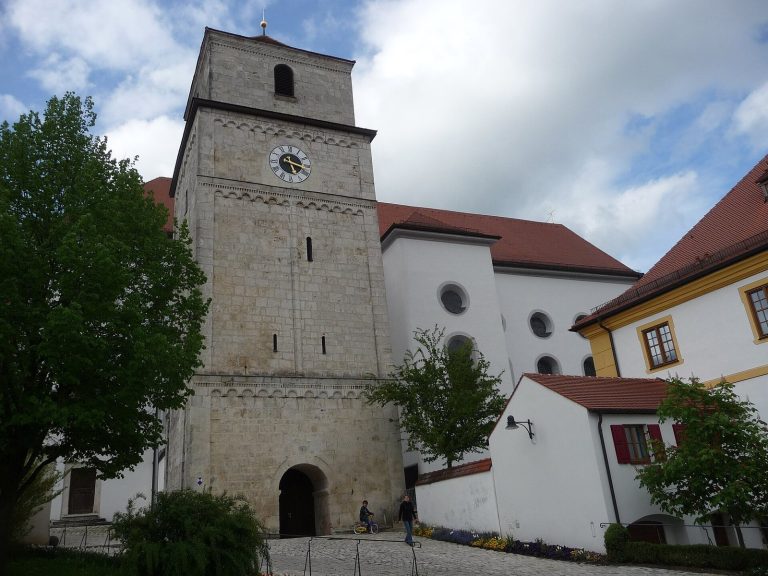
The surviving complex brings together the later church and features of its medieval predecessor, especially the crypt and tower. Other remains include a former chaplaincy building and a long natural-stone monastery wall.
Church and crypt
Holy Cross Church
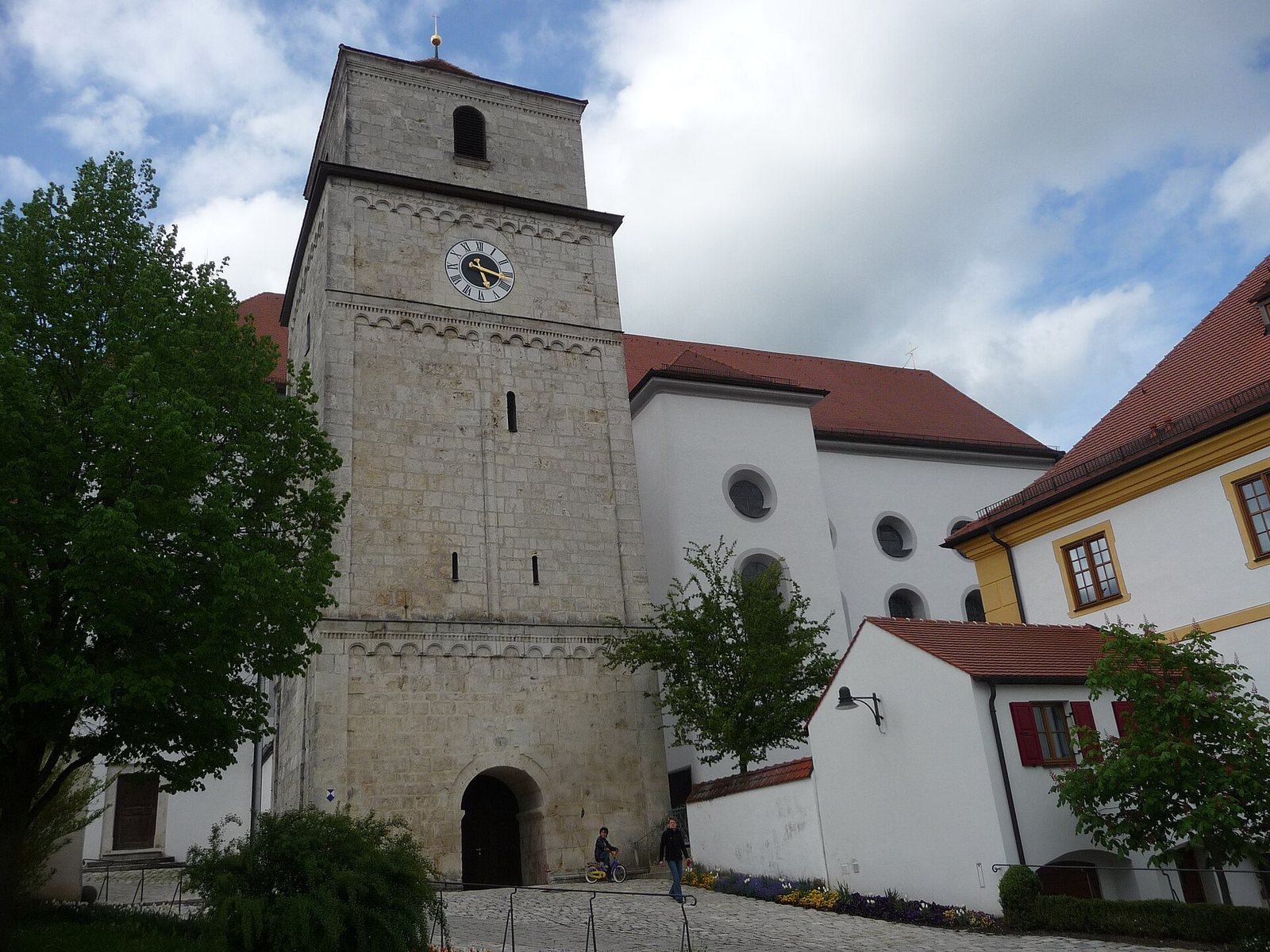
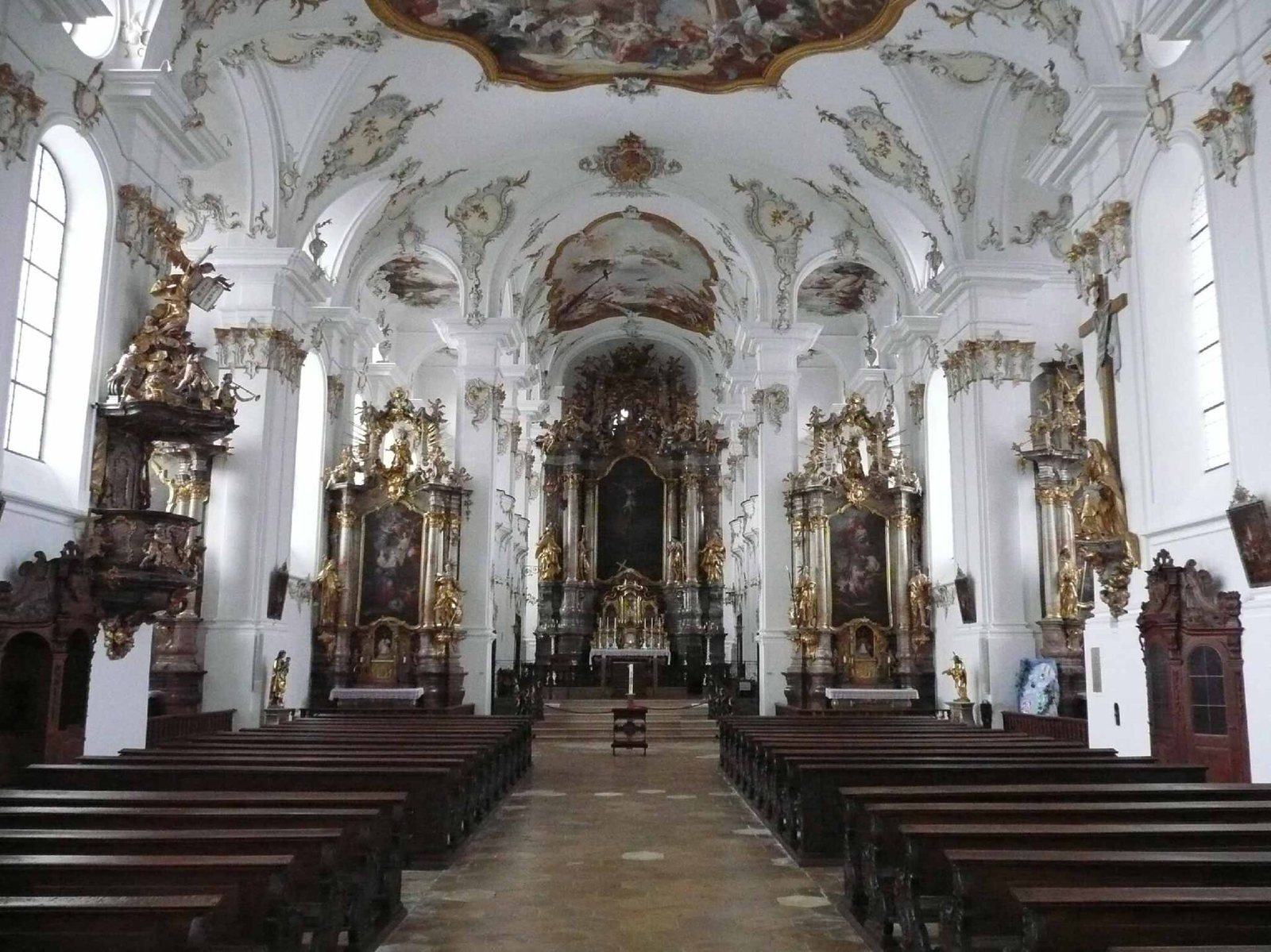
The present Holy Cross Church was built from 1755 to 1758 to plans by Giovanni Domenico Barbieri, an architect from Eichstätt. Its nave and choir form the principal interior spaces. Johann Wolfgang Baumgartner, a painter from Augsburg, created the ceiling frescoes, regarded as his most important work. The tower survives from the earlier church, though it was altered in 1799.
Romanesque crypt
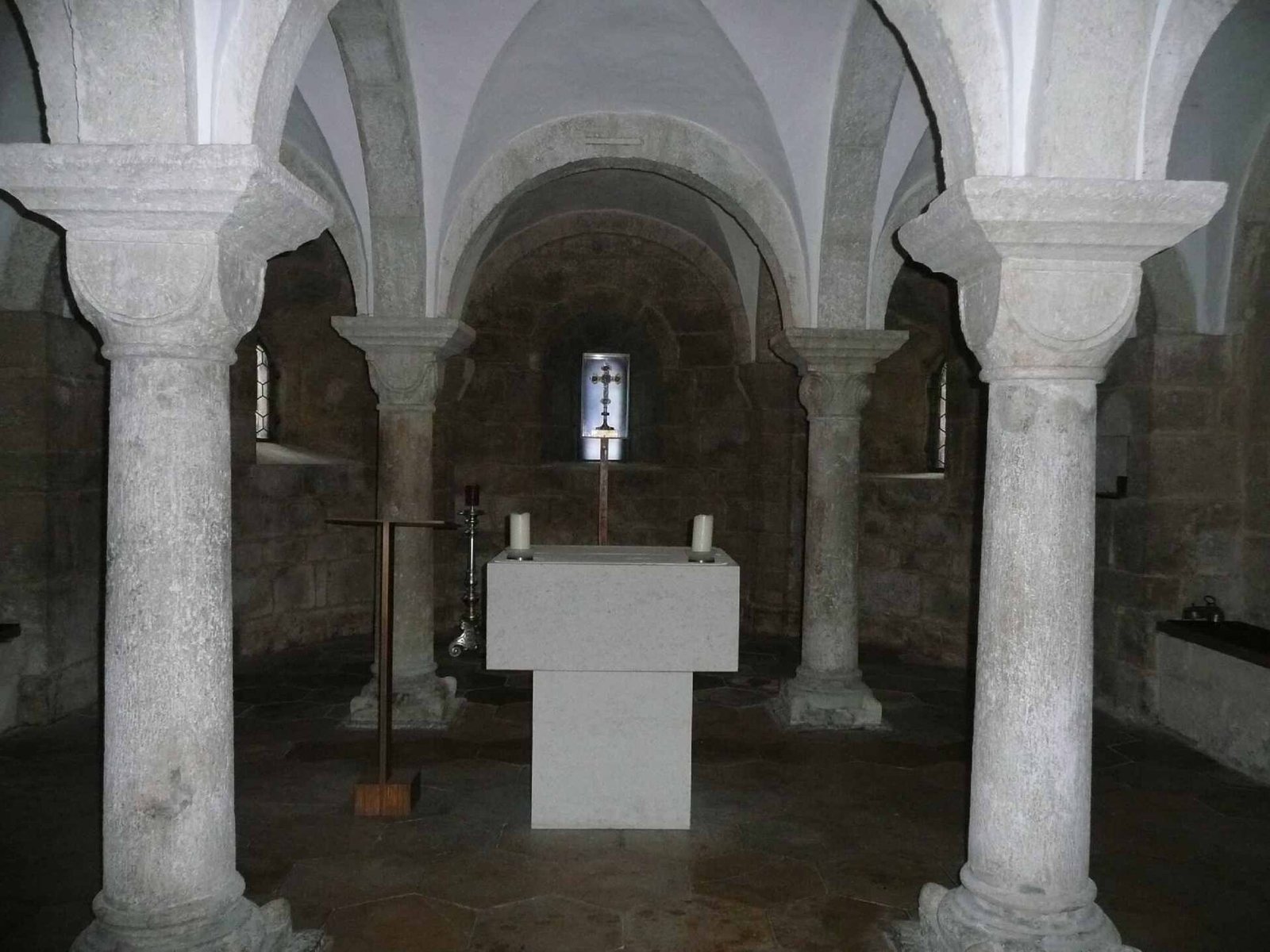
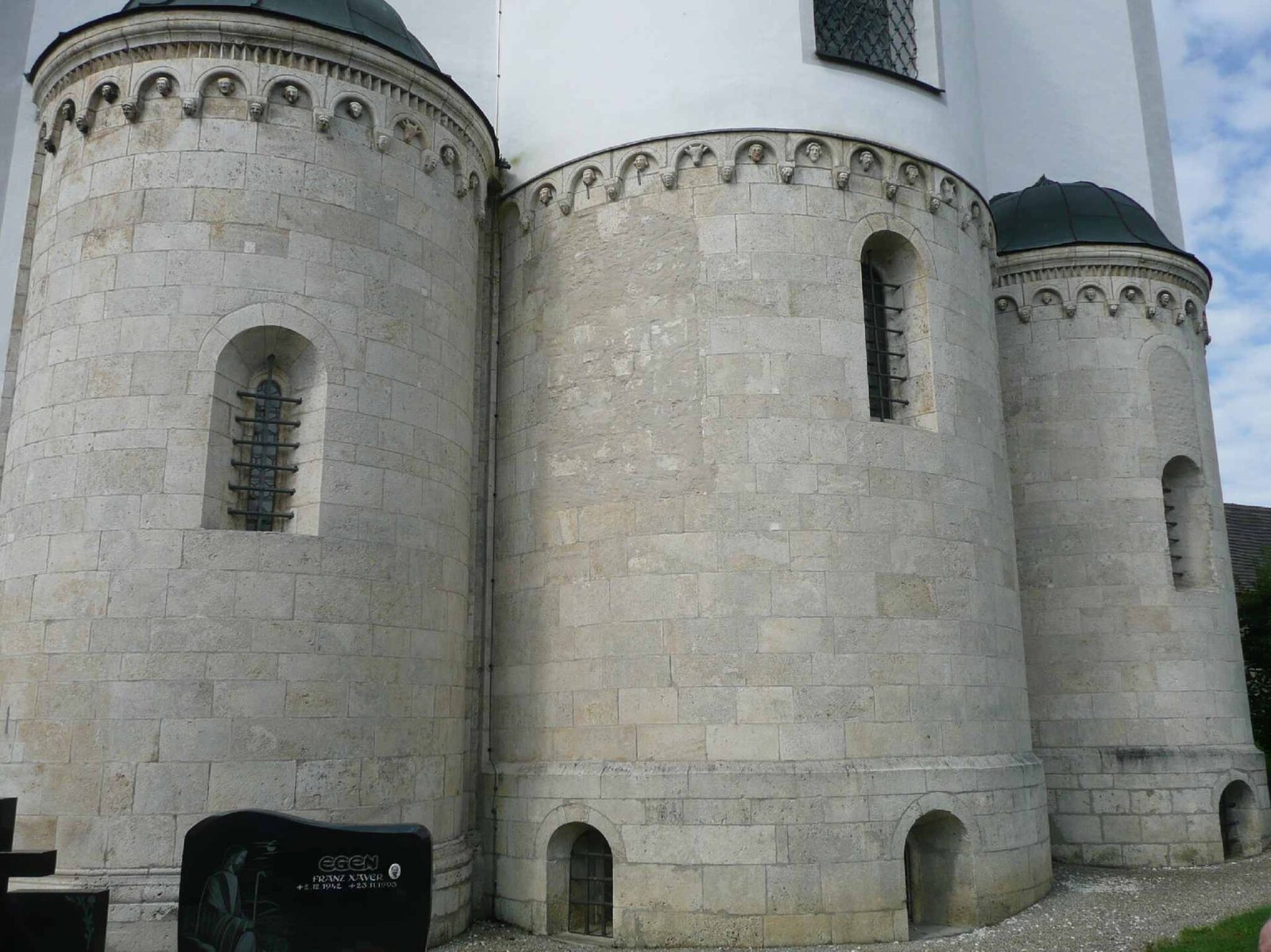
The earlier monastery church was an eleventh-century Romanesque hall church, a church with a central nave and side aisles of roughly equal height. Its remains include the crypt’s Romanesque apses, rounded ends of the church. Two stairways descend from the church interior to the crypt, a three-aisled hall with groin vaulting, ceilings formed by intersecting vaults.
In 1927, the crypt’s Romanesque masonry was repointed throughout with cement mortar, which damaged the walls. Work from 2001 to 2003 used lime mortar instead and reshaped the altar areas, giving the space the character of a chapel centered on a sacred object. A large, plain, cube-shaped walnut altar faces the congregation, while an upright display slab presents the cross relic.
Well and relic
A nine-metre-deep Romanesque draw well stands in a northern side room of the crypt. Tradition holds that, when the monastery was suppressed, the nuns sealed the cross fragment inside an oak block and sank it in the well. The Jesuits of Neuburg recovered the relic in 1618, after which a handcrafted strongbox was set deep into a church wall to contain it.
By 1846, only part of the oak block remained. Pilgrims had cut away much of the wood because they believed it helped toothache. People with eye ailments also used water from the well to wash their eyes.
Other monastic remains
Former chaplaincy
The former chaplaincy building dates to 1431.
Monastery wall
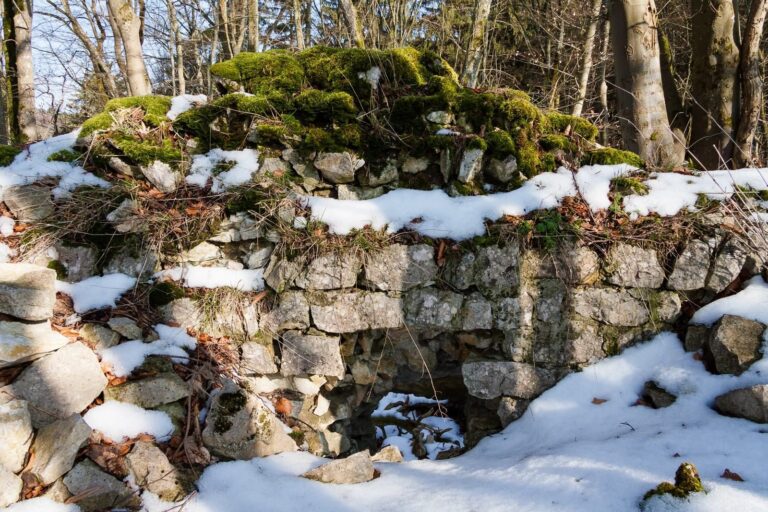
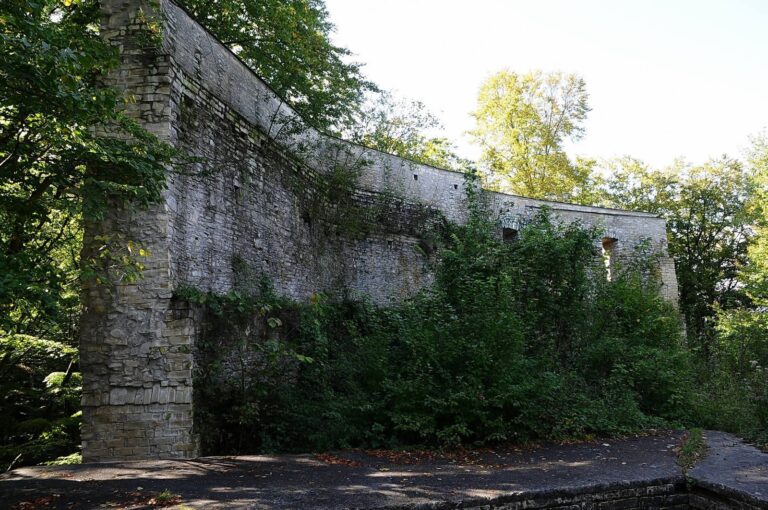
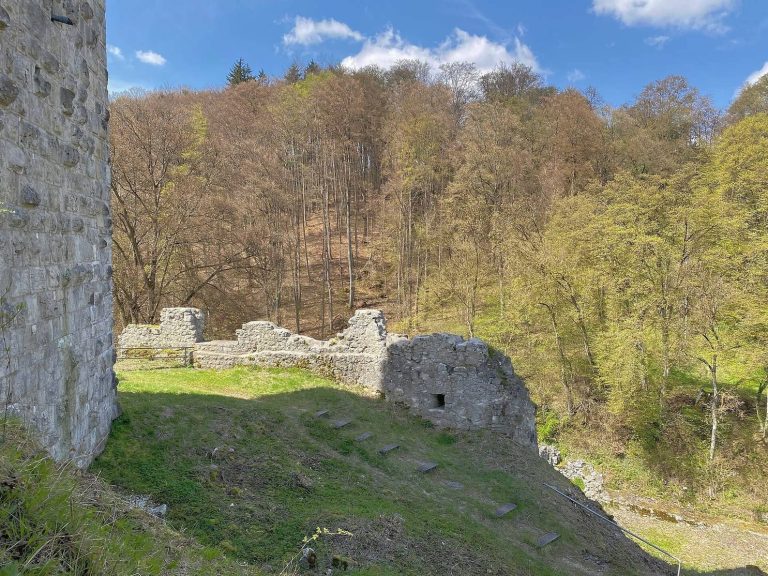
A one-kilometre-long wall built of natural stone dates to the fourteenth century.