Baumgarten Castle in Dietersburg: A Bavarian Fortress and Estate
Site at a Glance
- Rating
- 4.7
- Popularity
- Medium
- Country
- Germany
- Primary era
- Early Modern
- Eras represented
- Early Modern, Modern
- Civilizations
- Duchy of Bavaria, Electorate of Bavaria, Holy Roman Empire, Kingdom of Bavaria
- Site type
- Military
- Remains
- Castle
On this page9 sections
History
Baumgarten Castle is a historic fortress and estate in Baumgarten, within the municipality of Dietersburg, Germany. A fortress there is known from the twelfth century onward, while the present complex dates to the sixteenth century. The estate changed hands among local nobles, Bavarian dukes, and several aristocratic families, who also held jurisdiction over its lands and inhabitants.
The Baumgarten and Hals families
The fortress is associated with the nobles of Baumgarten, who held the surrounding territory from the twelfth century. In 1323, Alram, the last of his family line, transferred his house, dependants, and estate to his uncles, Counts Alram and Albrecht of Hals, in return for their house at Haidenburg.
In 1375, the Landgraves of Leuchtenberg took possession of the holdings of the Counts of Hals, including Baumgarten. Agnes, Countess of Ortenburg and daughter of Count Alram of Hals, also asserted a claim to the inheritance. An agreement mediated by Duke Friedrich of Bavaria on 26 May 1379 divided the lordships of Leonsberg, Gangkofen, and Baumgarten between the disputing parties. On 30 November, Johann, Landgrave of Leuchtenberg and Count of Hals, sold the estates to Count Heinrich IV of Ortenburg, Agnes, and their sons Alram I and Georg I.
Bavarian ducal control
In 1385, Heinrich IV and Agnes sold Baumgarten Castle and its lordship to the Bavarian dukes Otto, Friedrich, Johann, and Stephan. Reickger Sigenhamer, also known as Reicker von Siegenheim, appears as the first local steward in 1406. In 1417, Reicker transferred the high-court jurisdiction and the power to impose capital punishment to Duke Heinrich, who confirmed Reicker’s other rights at Baumgarten.
Duke Heinrich granted the fortress and residence at Baumgartenberg to Erhard Vorster zu Pützen for life in 1429. Vorster had to maintain the fortress and keep it open to the duke. Because of debts, he issued documents and rights concerning the castle to creditors, including Peter Gruber, who undertook to return the further rights to the duke. The Bavarian dukes later sought to recover the lordship.
The Pienzenau family and later owners
In 1456, Duke Ludwig of Bavaria granted the fortress and Hofmark Baumgarten to Friedrich Pienzenau zu Hartmannsberg as a fief, land held under feudal obligations. A Hofmark was a Bavarian estate whose lord held jurisdiction over its land and inhabitants. Friedrich’s wife, Magdalena Siegenheimer, had transferred to him claims against the duke that she had inherited from her father, Reicker von Siegenheim. Baumgarten remained with the Pienzenau family until the seventeenth century.
After Christoph Friedrich, the last Pienzenau, died, his estate was divided among his three daughters and his sister Maria Euphrosina, wife of Hans Bernhard von Perlaching. The division of the family’s fiefs took place in 1628. After Maria Euphrosina’s death, her half was divided among her five children; their father received the fief on 29 January 1632. Gottlieb’s share of the Hofmark passed to his father in return for compensation. Genofa’s marriage to Hans Georg von Hienheim helped reunite the divided estate, and after his death Gottfried von Perlaching acquired the remaining portion. The Pienzenau heirs also received lower-court jurisdiction over the manorial estates of Peterskirchen and Asenham.
In 1671, Johann Heinrich von Hienheim acquired the Hofmark after the deaths of his father and brother Gottlieb, settling his sisters’ claims to their shares. He sold the estate in 1673 to Gottfried Wilhelm, Count of Rheinstein and Tattenbach, and his wife Maria Barbara, née Countess of Valley. Their family held it until 1821. When its last member died without children, the estate passed under his will to his nephew Maximilian, Count of Arco-Valley. From 1821 to 1848, the Counts of Arco-Valley exercised a Class II patrimonial court, a landowning family’s court over its estate. The castle remains in the possession of the Arco-Valley family and is protected as both an architectural monument and an archaeological monument.
Remains
Castle and courtyard
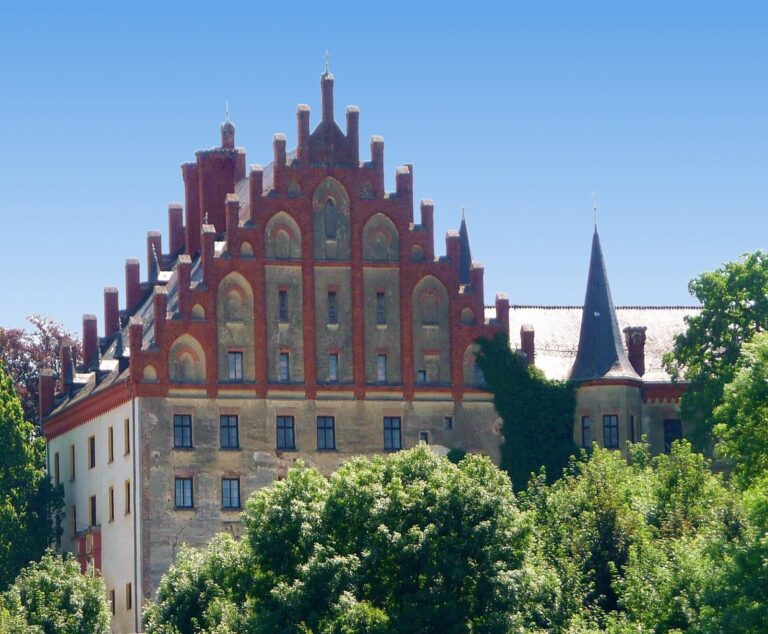
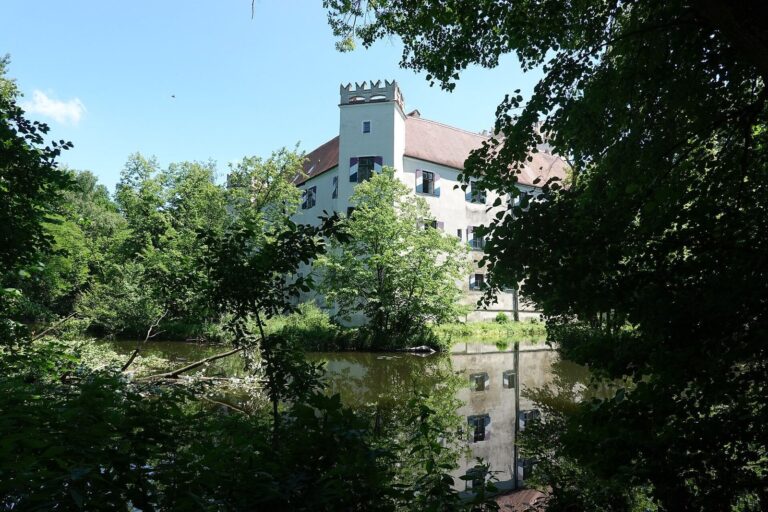
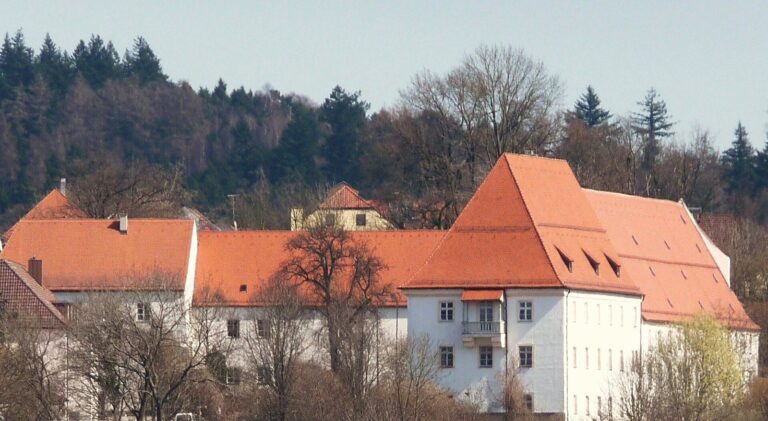
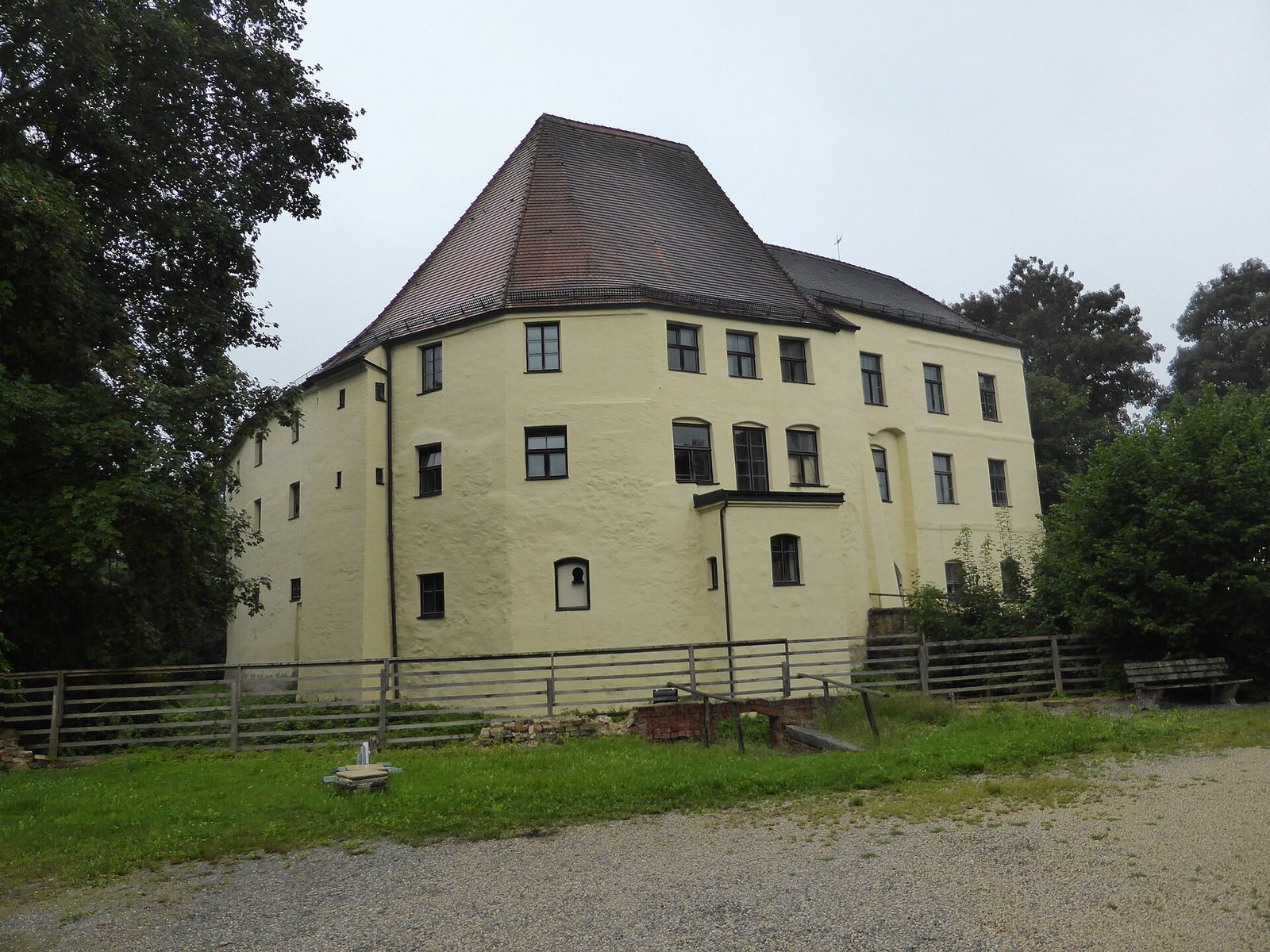
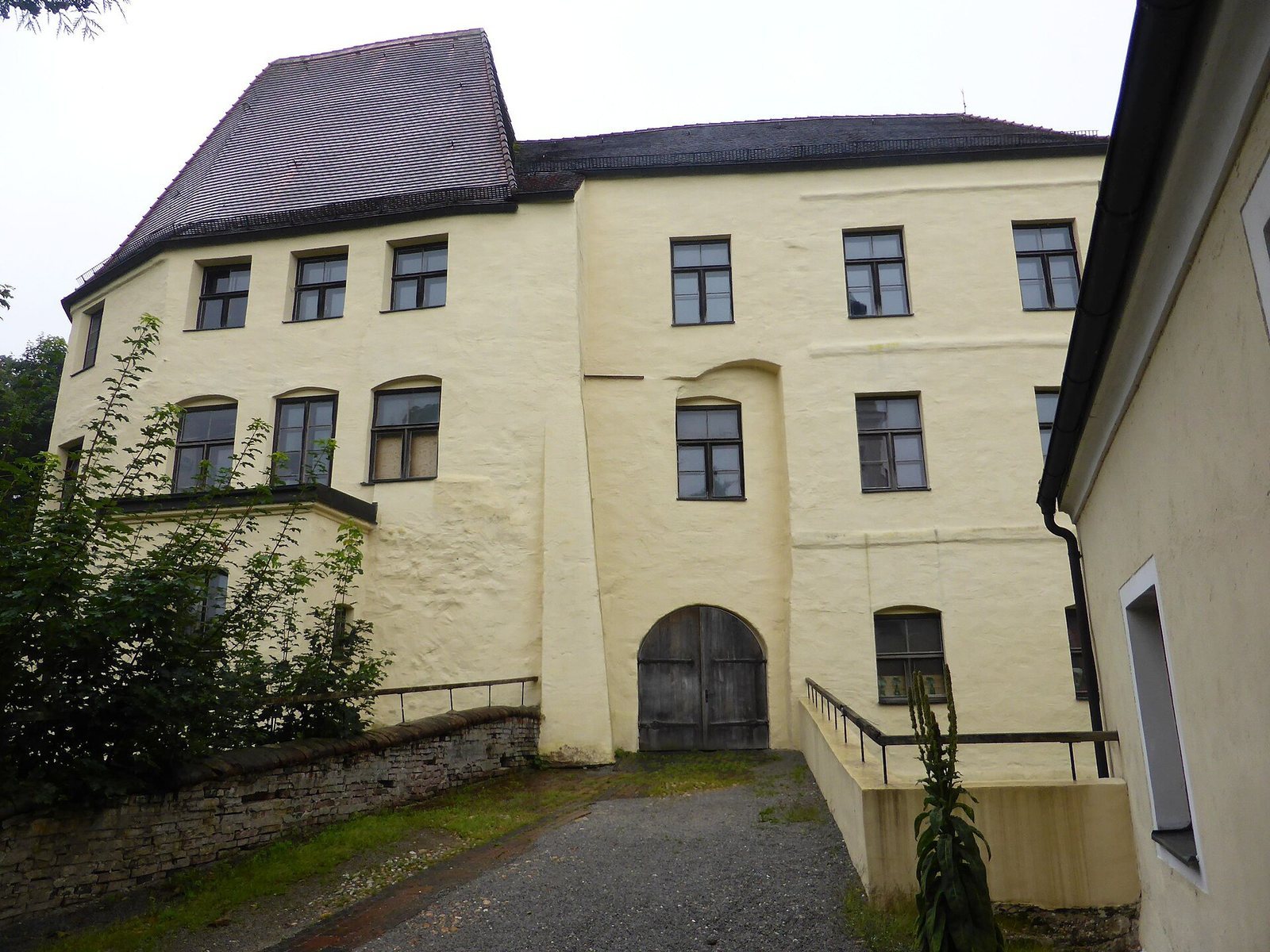
The castle occupies an irregular polygonal plan. Its inner courtyard has arcades and a four-storey tower. A perimeter wall and a bridge crossing the moat date to the sixteenth or seventeenth century. The castle’s physical remains form part of a larger estate that also includes a church, agricultural buildings, and garden grounds.
Historical descriptions and depiction
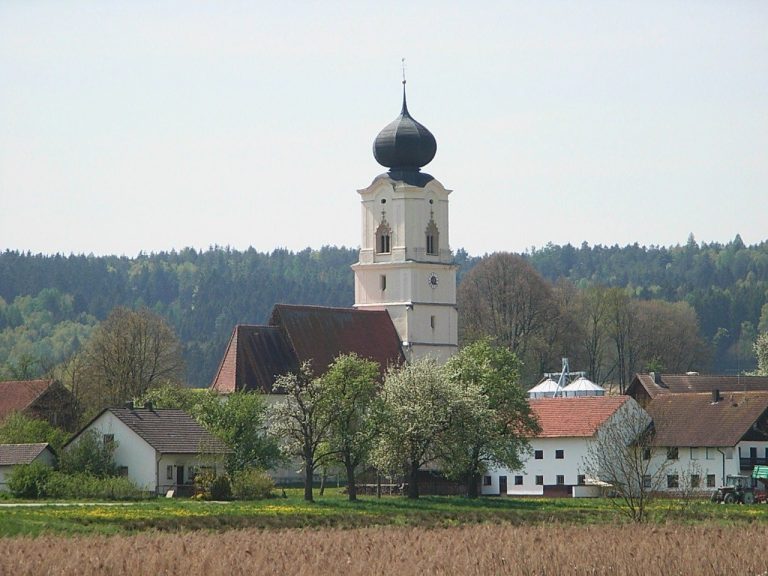
A description from 1597 portrays a masonry castle accompanied by a courtyard building, tavern, bakery, smithy, and bath. In a 1721 engraving, the Bavarian artist Michael Wening showed two groups of buildings on the Baumgarten hill. One comprised a church with an onion-shaped dome and an attached two-storey building, which together had a fortified appearance. The separate castle group consisted of buildings shown as two or three storeys high, enclosed by a wall, with retaining walls on the western side, two towers, and a moat separating it from its surroundings.
Castle church and rectory
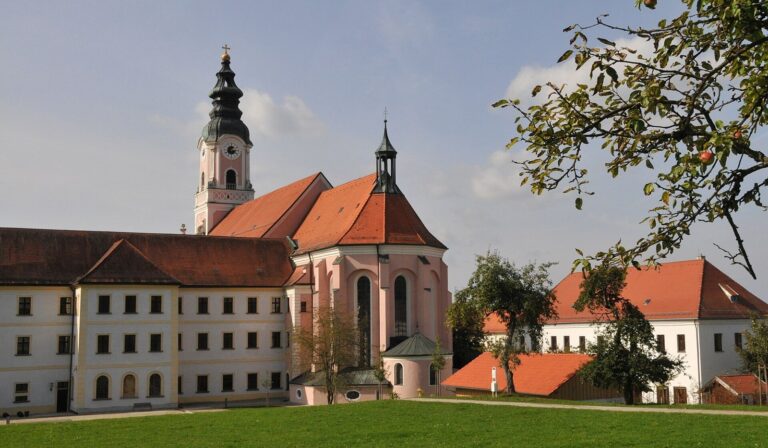
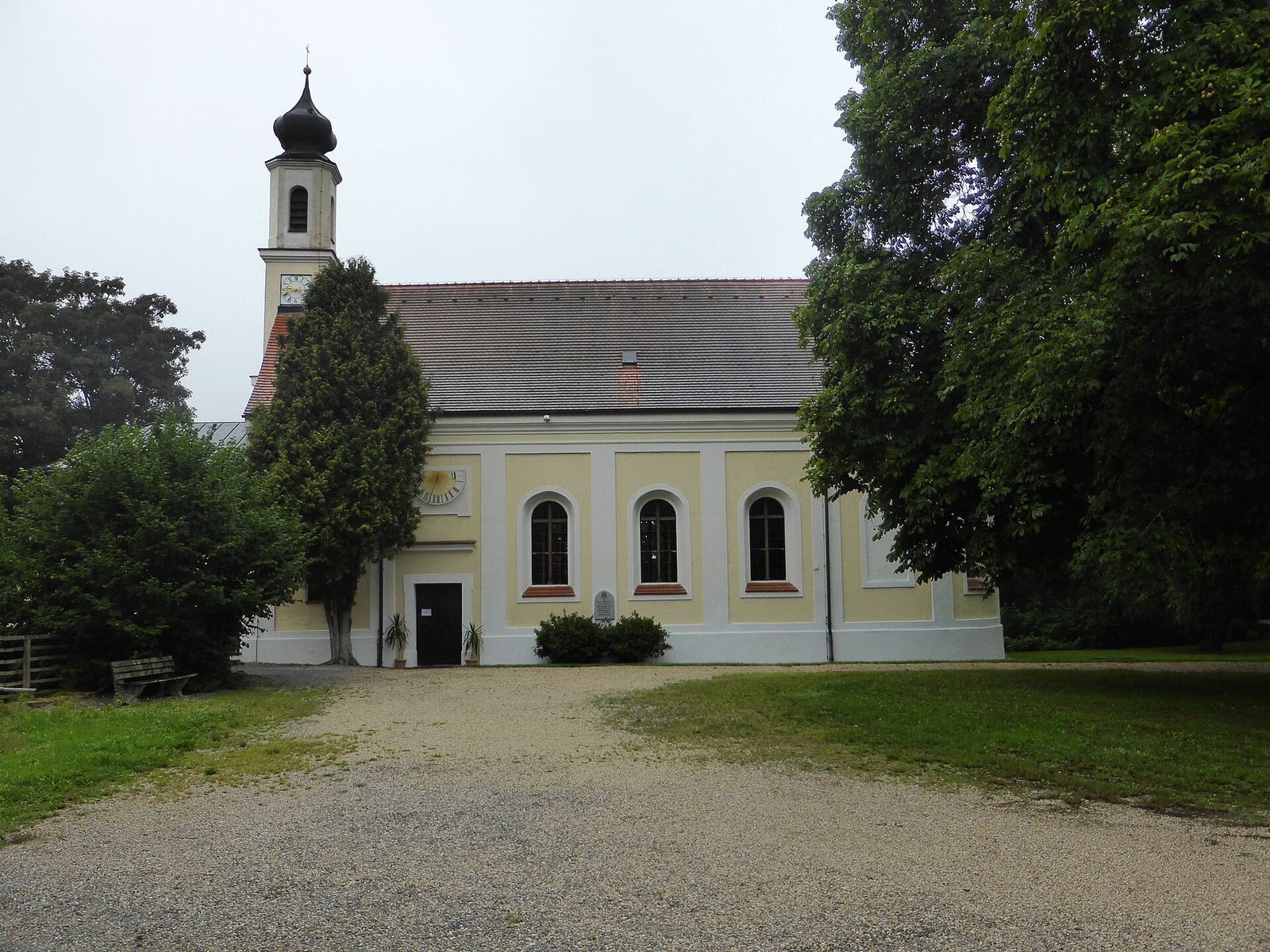
East of the castle entrance stands the Catholic Castle Church of St Bartholomew, built in 1796, with a small residential annex. Buried remains include earlier medieval church buildings. A separate fountain installation in front of the church dates to around 1650. Beside it stands a former rectory with a hipped roof, built in the second half of the eighteenth century.
Farmstead and garden grounds
The estate’s agricultural complex includes two large, hook-shaped brick ranges with hipped roofs, together with outbuildings dating to the nineteenth century. A wall from the eighteenth or nineteenth century encloses the castle park and garden nursery. A bowl fountain in the grounds dates to the eighteenth century. Buried medieval and early-modern remains extend within the castle grounds and across the area of the former garden.