Meienberg: A Habsburg Fortified Town and Administrative Center
Site at a Glance
- Popularity
- Medium
- Country
- Switzerland
- Primary era
- Early Modern
- Eras represented
- Medieval, Early Modern, Modern
- Civilizations
- Habsburg, Holy Roman Empire, Swiss
- Site type
- Settlement
- Remains
- Town
On this page13 sections
History
Meienberg is a former fortified town in Switzerland, established by the Habsburgs after they inherited the area from the Counts of Lenzburg in 1170 or 1172. Its castle was first mentioned in 1247 as a castrum, or fortified site. Meienberg chiefly served as a stronghold and center of lordship, rather than as a self-governing town.
Habsburg foundation and lordship
The castle became the seat of a ministerial, a dependent official who served a lord, and the head of the newly formed Meienberg administrative district. First mentioned in 1273, the district included about ten surrounding villages and continued until 1798. The Habsburgs retained judicial authority, while Meienberg had market and grazing rights but no jurisdiction over the surrounding territory and no legally defined peace district.
Local noble families held the castle as a fief. Around 1300, the lords of Baldegg and Hünenberg possessed it, while the Gessler family held property in Meienberg from 1251 and remained connected to the town into the early sixteenth century. Some family members later adopted Meienberg as their name. In 1359, Duke Rudolf IV of Habsburg pledged the town and district to Ulrich Gessler.
A 1306 record lists annual dues of 14 shillings from plots inside and outside the walls. At an average of half a shilling per plot, this suggests roughly 28 plots. The Habsburg land register of 1308 described the area as a source of little income and noted that the town had burned. That earlier fire probably occurred before 1300 during a feud between Rudolf of Habsburg-Laufenburg, bishop of Constance, and Duke Albert of Austria.
Destruction and decline
As conflict intensified between Lucerne and the Habsburg dukes, Lucerne accepted several Meienberg residents as citizens on 5 January 1386. Swiss Confederates took the town on 24 January. Five days later, a Habsburg force in Aargau defeated the Confederate garrison, and a Confederate relief force razed Meienberg. The settlement did not regain its former importance.
Heinrich Gessler, knighted in 1375, tried to rebuild the town. Its distance from major rivers and trade routes hindered recovery, and the Confederates deliberately obstructed reconstruction. Meienberg consequently dwindled into a small farming community.
Shared rule and administrative change
In 1415, during the conquest of Aargau, Lucerne occupied Meienberg and its district. This followed King Sigismund’s imposition of an imperial ban on Duke Frederick IV, the local lord. Meienberg continued as an administrative and judicial center. After arbitration in 1425, Lucerne shared administration of the district with the other Swiss Confederate cantons. The area became part of the Free Offices, territories governed jointly by members of the Confederacy; Uri acquired a share in 1533. Meienberg kept its market rights, with market days on 25 January, 29 September and 16 November.
During the Helvetic Republic, the centralized Swiss republic established in 1798, Meienberg, Reussegg and Winterhalde were assigned to the Sins administrative unit. Together with the Aettenschwil unit, which included Alikon, it formed the municipality of Meienberg. In 1803, the new Canton of Aargau made the Sins parish a municipality under that name. The municipality was renamed Sins in 1942; Meienberg had long belonged to the parish of Sins.
A cantonal road built in 1853 from Auw through Sins to Dietwil bypassed Meienberg, leaving it farther from the main route. Excavations in 2005 revealed the town’s preserved founding layout and showed that it had been a flourishing center of economic and craft activity before its destruction in 1386.
Meienberg’s local argot
Meienberger Jänisch, a local argot, probably developed around the mid-eighteenth century and was first written down in 1886. It may have declined after 1850 as local crafts and the social life associated with them diminished. Its words covered trades, tavern life and distinctions between local craftspeople and outsiders. Examples include Fisel for a boy, Sprussfetzer for a carpenter, Joli for wine and Ghes for money. The vocabulary had similarities to the speech of South German itinerant traders, who travelled through the Austrian Fricktal, the County of Baden and the Free Offices. The established cantons to the south and east restricted their further movement, making Meienberg their endpoint. A local tradition attributed the argot to a Roma caravan said to have settled in Meienberg, though this origin is uncertain. In 1929, linguist Otto von Greyerz reported that Plazid Villiger, who died aged 81 in 1914, had been described as the last person able to speak it.
Remains
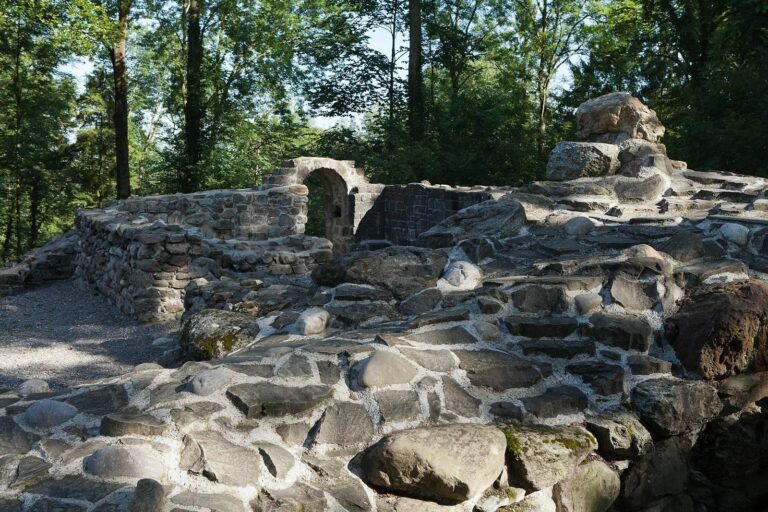
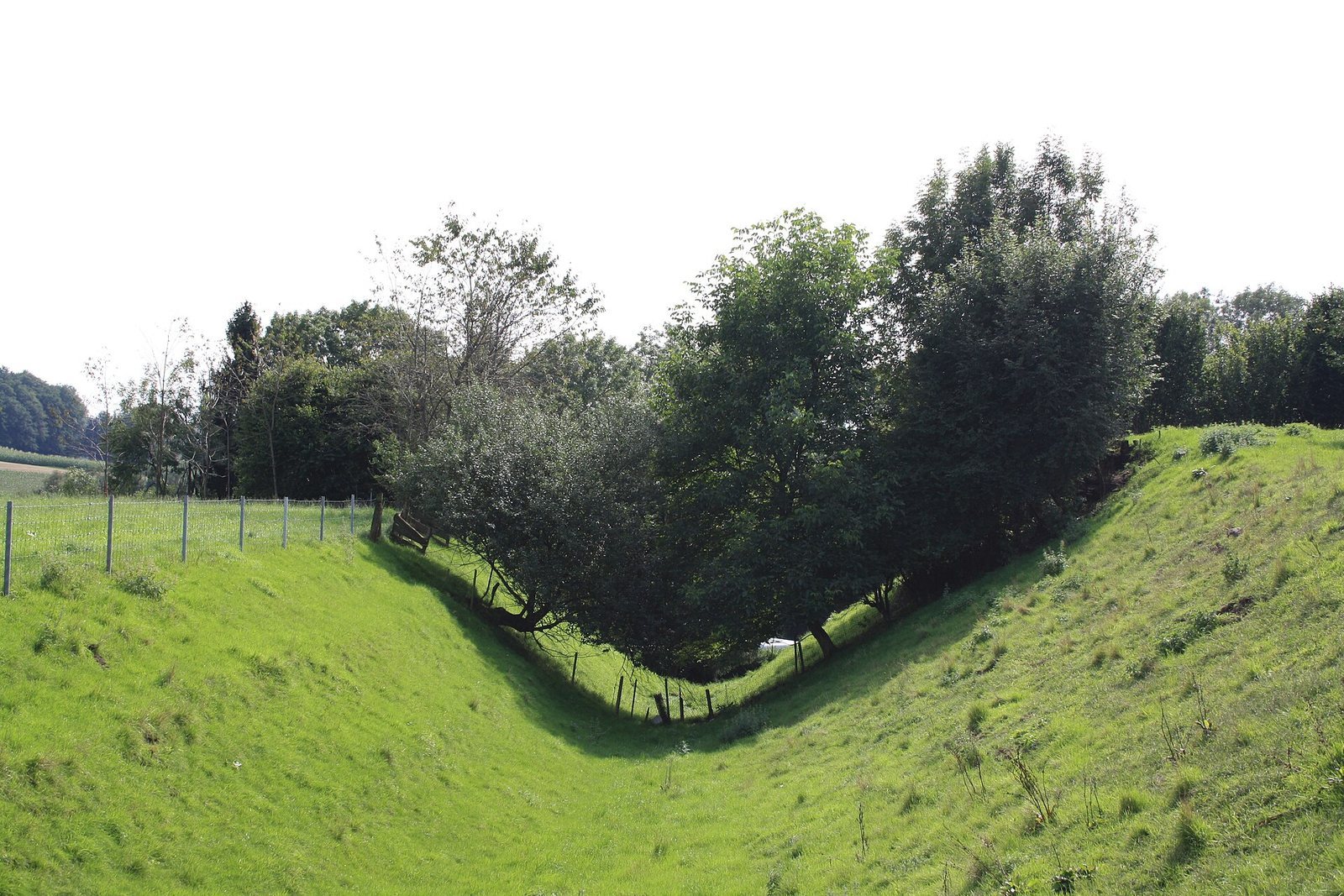
The former town occupied a spur between streams coming from Alikon and Auw. Its roughly quadrangular plan measured about 200 metres. The upper town stood on the hilltop around a square, while other groups of houses occupied the Vorstädtli area of Baumgarten, the old road and the banks of both streams. A ring wall and sturdy tower defended the settlement, and the town ditches can still be seen in the terrain.
Defenses and civic landscape
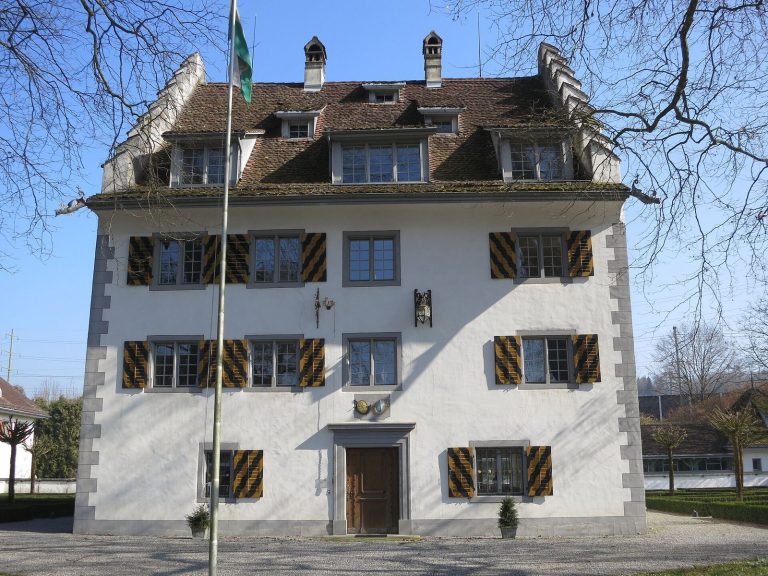
Sections of the town wall are built into the administrative and judicial building in the upper town. A draw well and a linden used for court proceedings also belonged to the settlement’s civic landscape. The arms of both the town and its district showed a green linden on a three-peaked hill.
Historic buildings
The administrative and judicial building
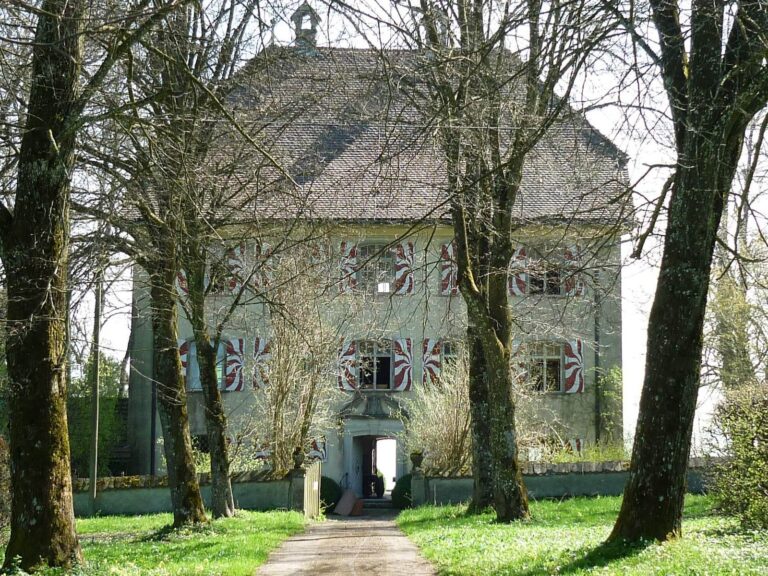
The building known as the Amtshaus, the administrative and judicial center of the district, stands in the upper town. Its fire-damaged ruin was made habitable again in 1575, and it acquired its present appearance in 1765. It is one of the two historic houses surviving on the town square.
Villigerhaus
The Villigerhaus, the other surviving historic house on the square, formerly served as an inn. It was later used as a court, until that function moved to the Kreuz Inn.
Kreuz Inn
On the old road, the Kreuz Inn served as the bailiff’s court from the sixteenth century. A bailiff was an appointed territorial administrator and judicial officer.
Eligius Chapel
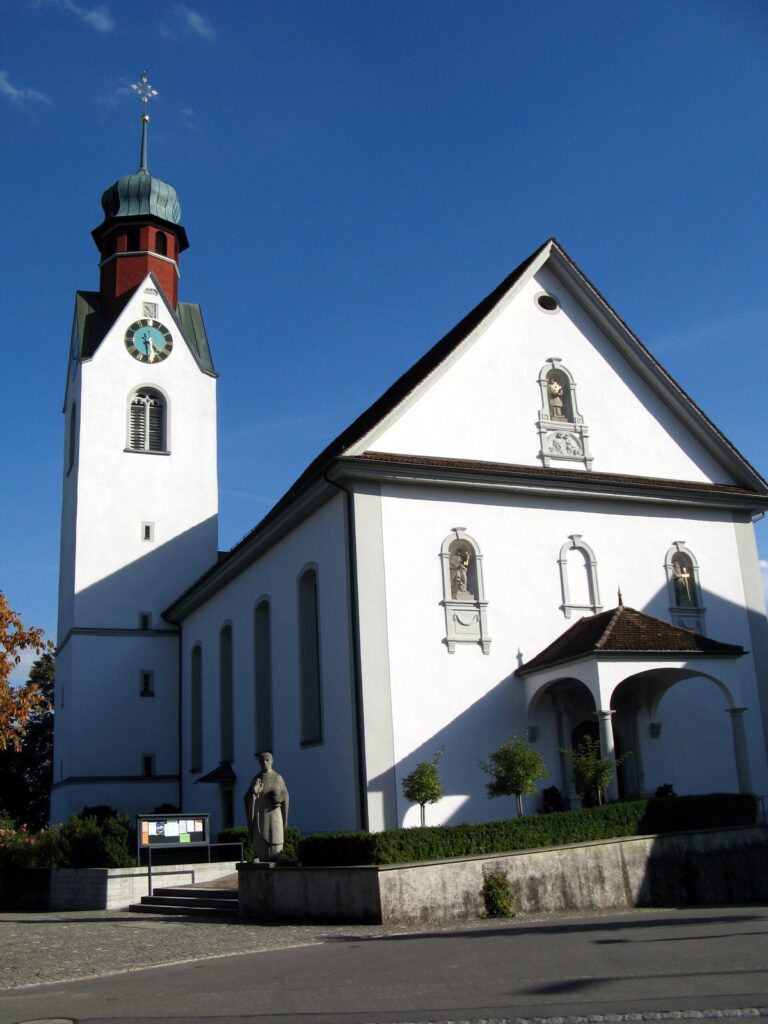
Built in 1553, the Eligius Chapel stands on the road towards Auw.
Later houses
Houses built between 2000 and 2009 in the Vorstädtli area and on the town square were intended to help revive Meienberg’s historic center.