The Piombi: Prison Cells in Venice’s Doge’s Palace
Site at a Glance
- Popularity
- High
- Country
- Italy
- Primary era
- Early Modern
- Eras represented
- Early Modern
- Civilizations
- Venetian
- Site type
- Civic
- Remains
- Prison
On this page8 sections
History
The Piombi were prison cells in the attic of the Doge’s Palace in Venice, Italy, established during the sixteenth century. The palace was the principal seat of government of the Venetian Republic, and the Piombi formed part of the city’s prison system. They were used for people accused of political crimes or awaiting trial, as well as prisoners convicted of minor offenses.
Establishment and use
A decree issued on 15 March 1591 by the Council of Ten, the Venetian governing body responsible for state security and political affairs, called for a new prison for people convicted of minor crimes. It described the existing Pozzi, or “Wells,” as too harsh. The Council’s archive was also housed in the palace attic. The Council ordered that people accused of political offenses or awaiting trial be held in the Piombi.
Prisoners could walk along the connecting corridor during exercise periods. They were allowed beds and dishes, and their cells were regularly cleaned. Inmates could receive medical care, have food brought from outside or order it through the jailer, and were given a small allowance for personal needs. They could also ask the jailer to carry out errands, for which he had to account.
Prisoners and Casanova’s escape
Among those held in the Piombi were the Carmelite friar and scholar Paolo Antonio Foscarini and the writer Giacomo Casanova. Women were also imprisoned there. Casanova’s memoirs, particularly his account of escaping, helped make the prison widely known.
Casanova described escaping with another prisoner on 1 November 1756. His memoir recounting the episode appeared in 1787. The nineteenth-century Venetian historian Francesco Zanotto doubted the story, questioning how the two men could break through the thick roof, cross it without a foothold, and descend about 28 metres. Later critics have judged the escape substantially true as Casanova described it.
Silvio Pellico’s claim that he had been held in the Piombi is mistaken. He was confined in other attic rooms, later demolished; his description placed his cell above the palace chapel. The writer and political activist Nicolò Tommaseo and the statesman Daniele Manin may have been prisoners in the Piombi, which were often used for political detainees.
Closure and prison reorganization
The Piombi stopped serving as a prison in 1797, when Venice reorganized its prison facilities. The New Prison, built across the canal in the sixteenth century by the architect Antonio da Ponte, was linked to the Doge’s Palace prisons by the Bridge of Sighs. Later, a prison complex on Giudecca served as the city prison until Santa Maria Maggiore prison opened in 1926.
Remains
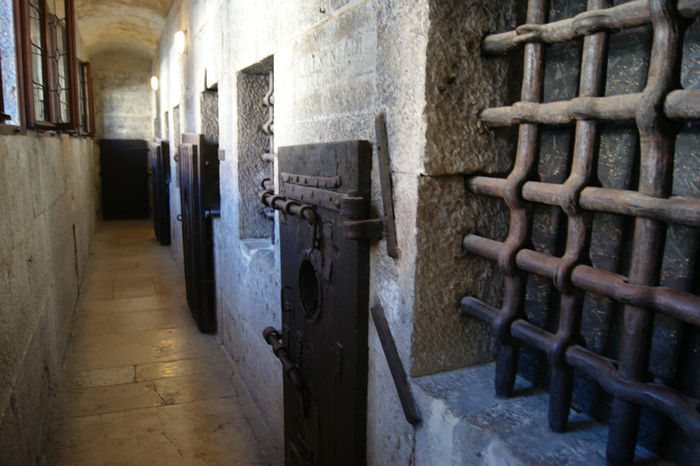
The Piombi comprise six restored rooms beneath the Doge’s Palace’s lead-covered roof. Wooden partitions reinforced with iron plates divided the rooms, which were arranged in pairs and connected by a corridor.
Rooms and circulation
Cell plan
The six rooms varied in shape and size. The first was square, with sides of four metres. The second was triangular, each side measuring 2.7 metres, and had the only direct view of the canal. The third was an irregular polygon, with sides ranging from two to four metres. The fourth was square, with four-metre sides, and may have been Casanova’s cell. The fifth was irregular, with sides between two and four metres, while the sixth was rectangular, with both sides a little longer than four metres.
Access, light, and roof
Two staircases provided access: one from the Hall of the Three Chiefs and another from a corridor near the Hall of the State Inquisitors. A longer staircase linked the Piombi to the Pozzi. Small windows near the roofline faced the canal and illuminated the corridor; light from the corridor reached the cells, and the passage was lit at night. Beneath the lead covering, two layers of larch boards formed the ceiling. The rooms were ventilated and high enough for inmates to stand upright; they grew warm in summer without becoming excessively hot and stayed mild in winter.