Ravenswood Standing Stone: A Prehistoric Monument in Edinburgh
Site at a Glance
- Rating
- 4.2
- Popularity
- Low
- Country
- United Kingdom
- Primary era
- Bronze Age
- Eras represented
- Bronze Age
- Civilizations
- Unclassified
- Site type
- Civic
- Remains
- Megalithic Monument
On this page6 sections
History
The Ravenswood standing stone is a prehistoric monument in Edinburgh, United Kingdom, erected around 2000 BC. Its original purpose is unknown. It may have commemorated an ancient battle or served a ritual purpose.
Origins and relocation
The stone originally stood in what is now Liberton glebe, land historically allocated to support a parish church and its clergy. Its original position was about 60 metres southwest of the present Old Dalkeith Road and approximately 61 metres above sea level. In the early nineteenth century, it was moved to make way for a road scheme, then returned to its original location in 1891. Around 1971, construction of a housing estate prompted another move, about 100 metres north of the original position.
Protection and assessment
The stone is officially designated as the Liberton standing stone. It received protection as a scheduled monument, a site formally protected under Scottish heritage law, in 1938. The schedule was amended in 2002 to cover a circular area 0.7 metres in diameter containing the relocated stone; the surrounding railings lie outside that area. Historic Environment Scotland, Scotland’s public body for the historic environment, considers that relocation has removed the stone’s archaeological potential, but that its cultural significance still warrants protection.
Remains
Setting and form
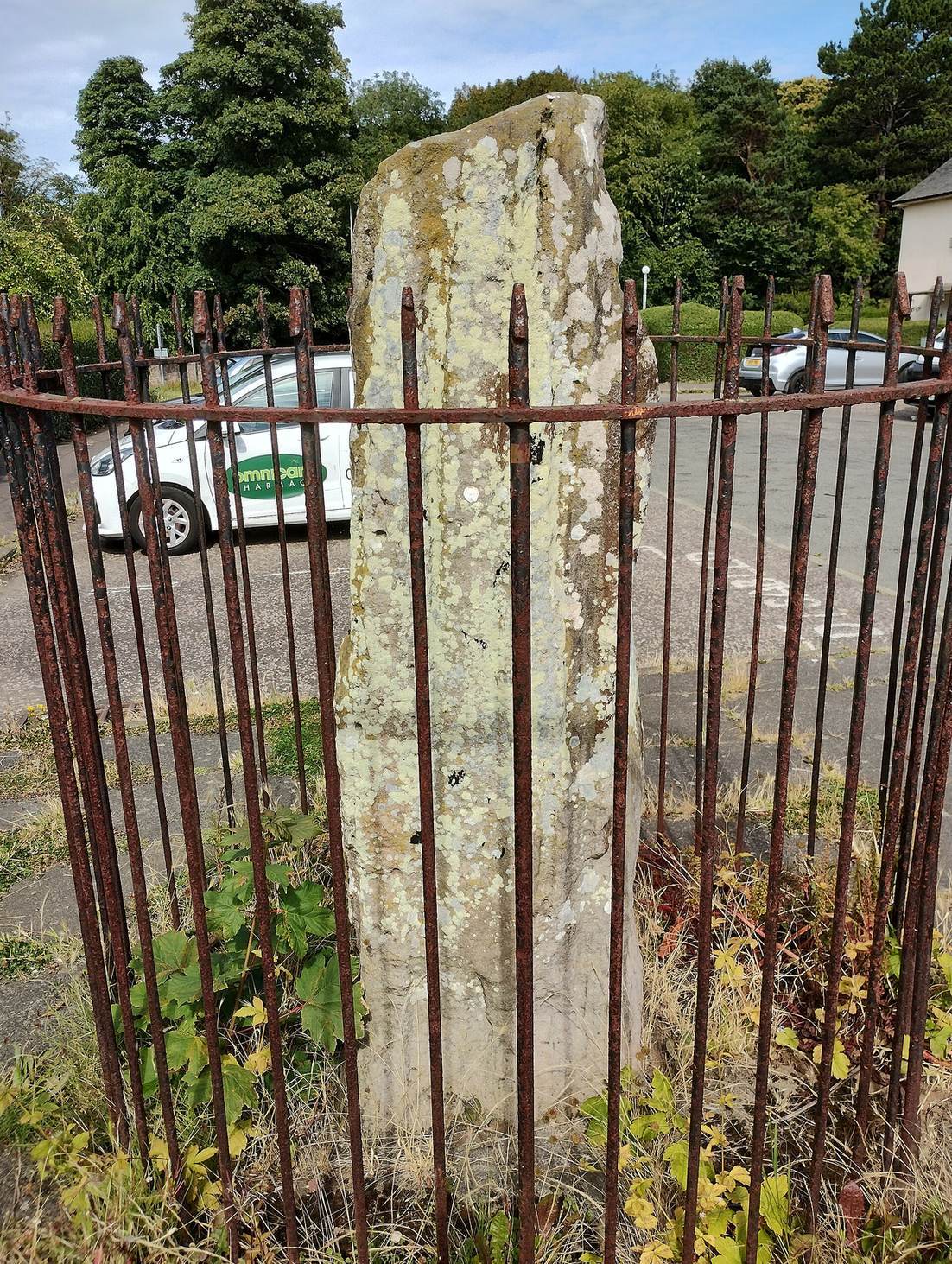
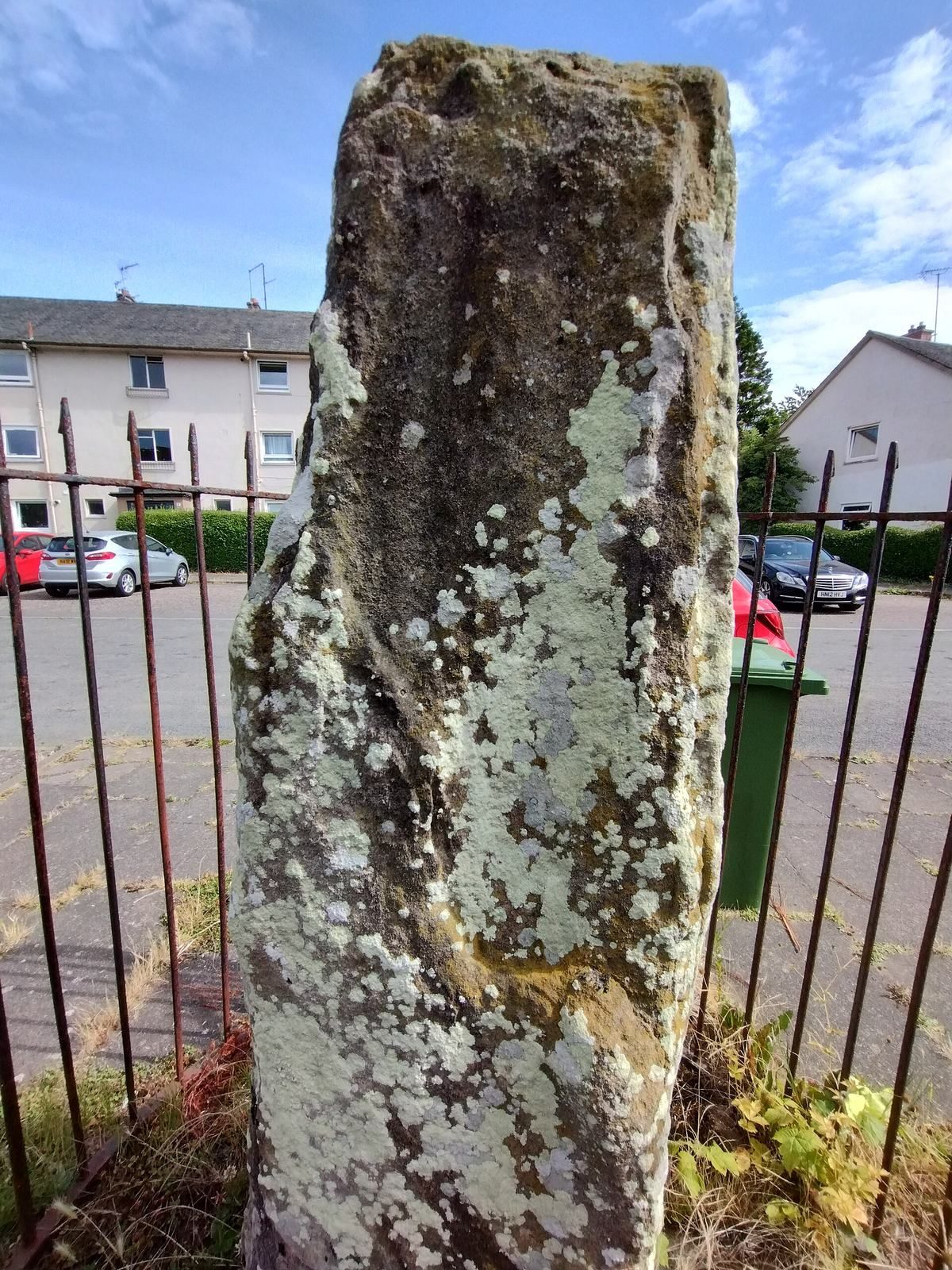
The stone stands in the footway on the northwest side of the cul-de-sac at the eastern end of Ravenswood Avenue, in The Inch, Edinburgh. It is set in concrete and enclosed by metal railings. The grey sandstone monument, which contains some quartz crystals, is 1.85 metres high and 70 centimetres across at its base, narrowing toward the top.
Natural erosion has formed grooves on the east and west faces. A large, naturally formed cavity resembling an ear appears on the east face.
Recorded measurements
A 1903 survey described four faces and an additional corner face. It recorded the principal face as aligned about five degrees east of north. At ground level, the principal face measured 0.64 metres across, the north face 0.51 metres, and the south and west faces 0.56 metres each; the corner face measured about 110 millimetres. The survey gave a total circumference of around 2.4 metres, a circumference of 1.42 metres at the top, and a height of 1.994 metres above ground. In 1929, the circumference was measured at 1.96 metres at a point 0.91 metres above ground.