Chapel of Our Lady of Mercy at Planès: A Romanesque Church in France
Site at a Glance
- Rating
- 4.2
- Popularity
- Low
- Country
- France
- Primary era
- Medieval
- Eras represented
- Medieval
- Civilizations
- Unclassified
- Site type
- Religious
- Remains
- Church
On this page7 sections
History
Origins and medieval records
The Chapel of Our Lady of Mercy at Planès is a small Catholic church in France, generally dated to the eleventh century and built in the Romanesque (a medieval architectural style) tradition. Dedicated to the Virgin Mary as Our Lady of Mercy, it is associated with the Diocese of Perpignan-Elne and the parish of Cerdagne-Capcir. Abbot Oliba, an influential Catalan Benedictine church leader and early eleventh-century patron, is identified as its patron.
A Catalan tradition shared with other churches dedicated to Mary tells that farmers found a statue of the Virgin after a bull repeatedly scraped the earth in one place. They built a church there. Planès is first recorded as part of the parish of Saint-Pierre-dels-Forcats; the church itself appears in written records in 1442.
The church was also known locally as Mesquita, Catalan for “mosque.” The name reflects a popular belief that old monuments in the area had Muslim origins, but it does not establish that this church was built as a mosque.
Nineteenth-century interpretations and devotion
In the nineteenth century, the architect and architectural theorist Eugène Viollet-le-Duc argued that the building’s plan and construction could not be earlier than the thirteenth century. Specialists today generally date it to the eleventh century. Romantic writers also connected the chapel with an eighth-century chronicle attributed to the Anonymous of Córdoba, a conventional name for its unidentified author. The chronicle relates that Cerdanya was under Muslim rule, and that Lampégie, daughter of Odo, Duke of Aquitaine, married Munuza, a Berber (North African) leader. After Munuza was killed in 729, Lampégie was sent to a harem in the East. Romantic writers recast the chapel as her tomb, built by Lampégie.
The church was restored in the nineteenth century and classified as a French historic monument in 1840, on the first list of such monuments. Popular devotion to the Virgin is expressed in gatherings, especially on Corpus Christi, a Christian feast honoring the Eucharist, and on the Feast of Our Lady of Mercy, held on 24 September.
Remains
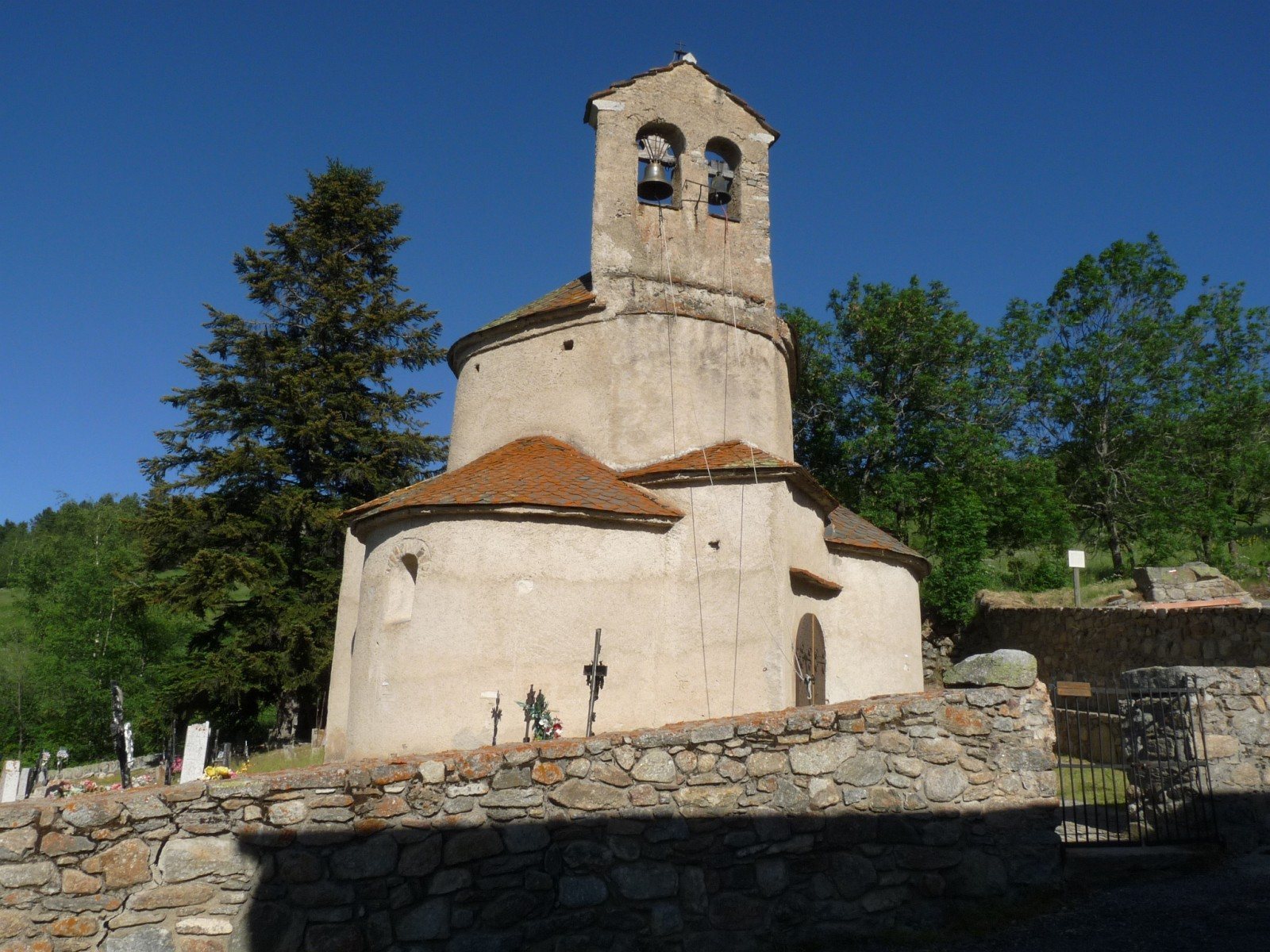
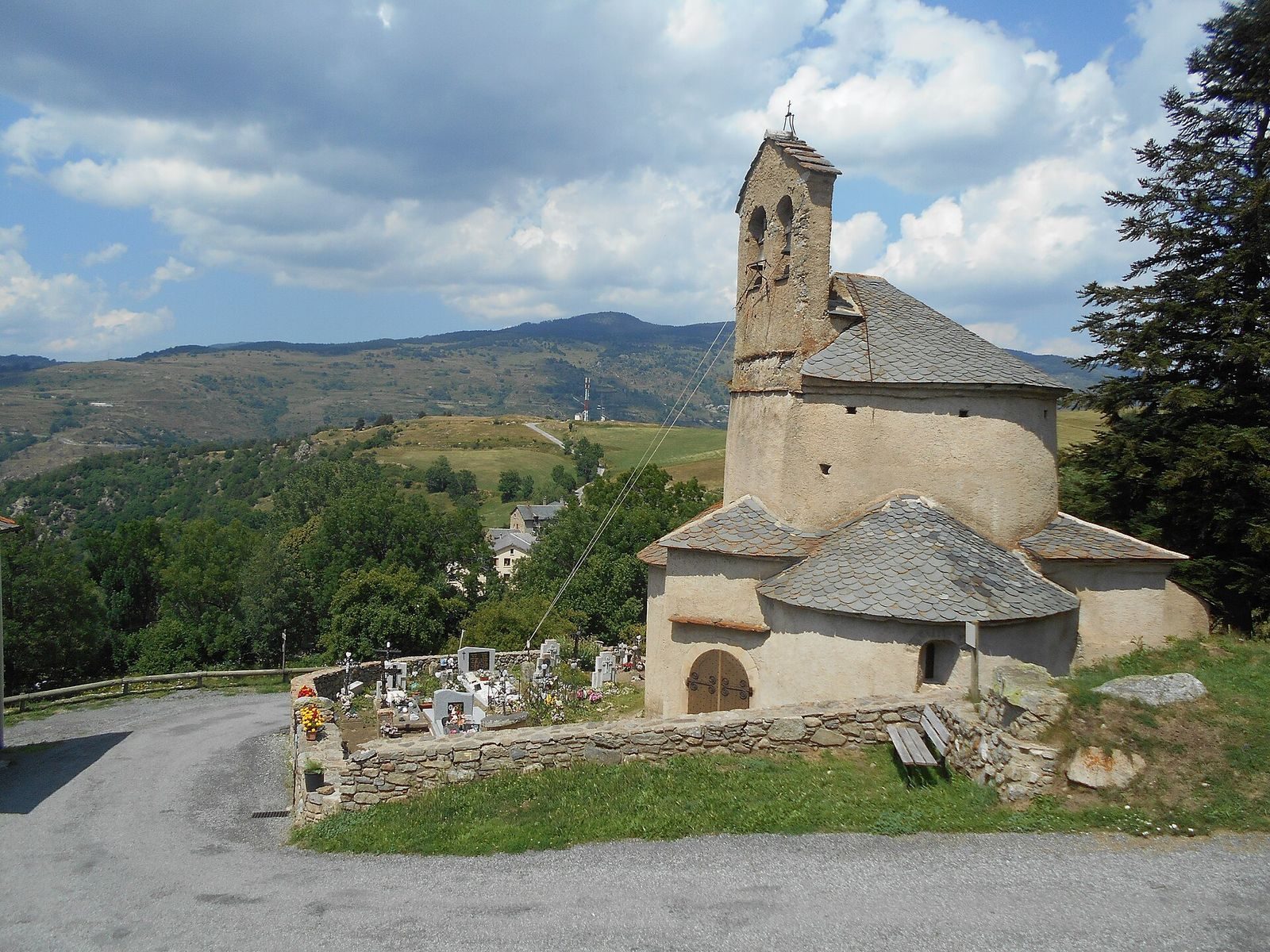
Near Mont-Louis, at about 1,530 metres above sea level, the small church stands in the village cemetery, at the northern end of the hamlet of Església and southeast of Planès de Dellà. Its compact Romanesque form is organized around an unusual triangular and three-lobed plan.
Triangular plan and dome
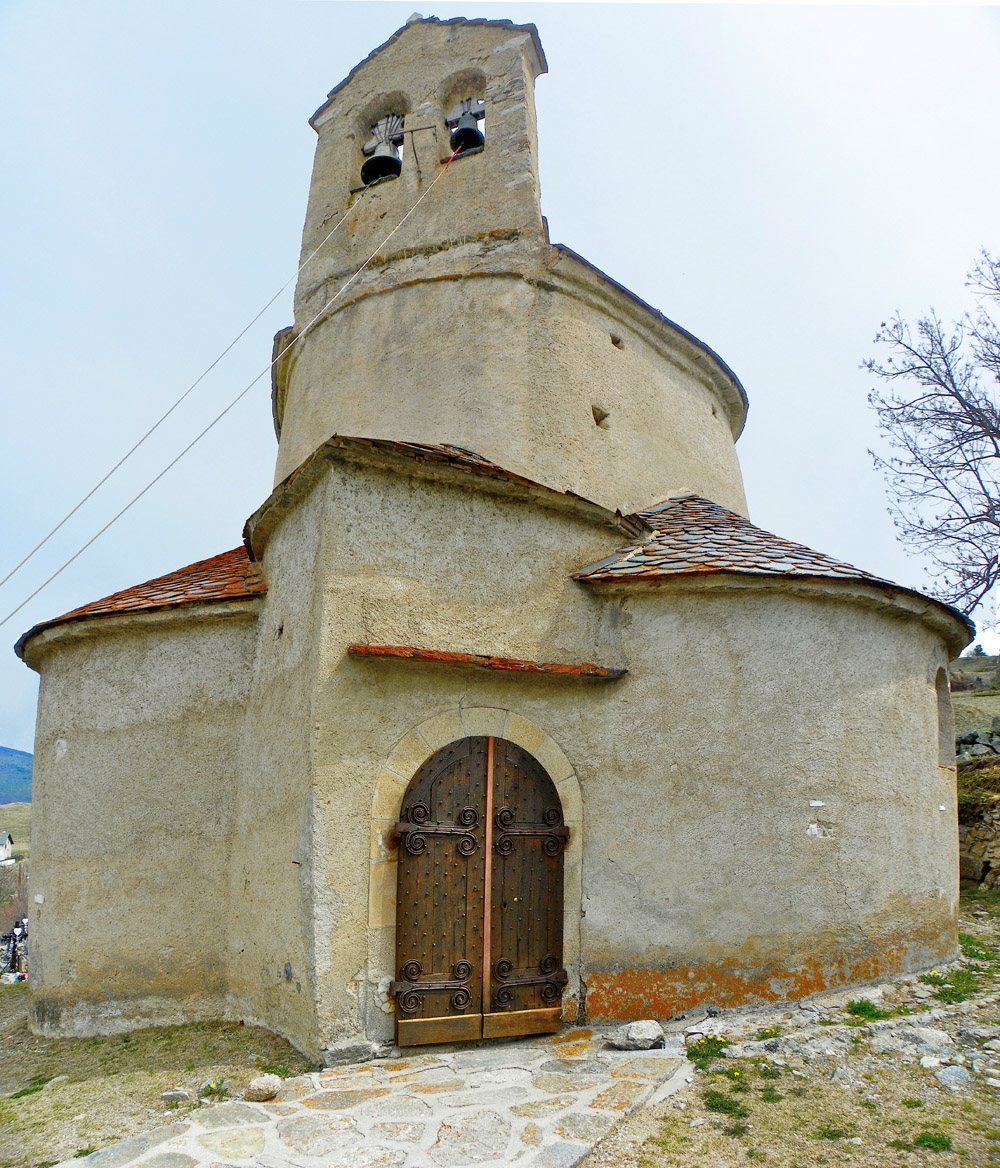
The main walls form a somewhat irregular circle over an equilateral triangle, which rests on a three-lobed arrangement of small chapels. Each side of the triangle has a semicircular apse (a rounded chapel recess) with a half-dome vault, while the triangle’s corners project outward between the apses. Inside, the triangular arrangement rises into an irregular hexagon that supports an ovoid dome. Rounded arches and small squinches (corner supports for a dome) carry the dome, and each of its three supporting piers contains a niche. Construction irregularities mean that Viollet-le-Duc’s idealized plan does not accurately represent the building; the dome nevertheless approaches a circular form, above piers arranged in a triangle. The plan has been interpreted as a possible reference to the Trinity, while the circular form has been linked with the Virgin.
Exterior, entrance, and construction
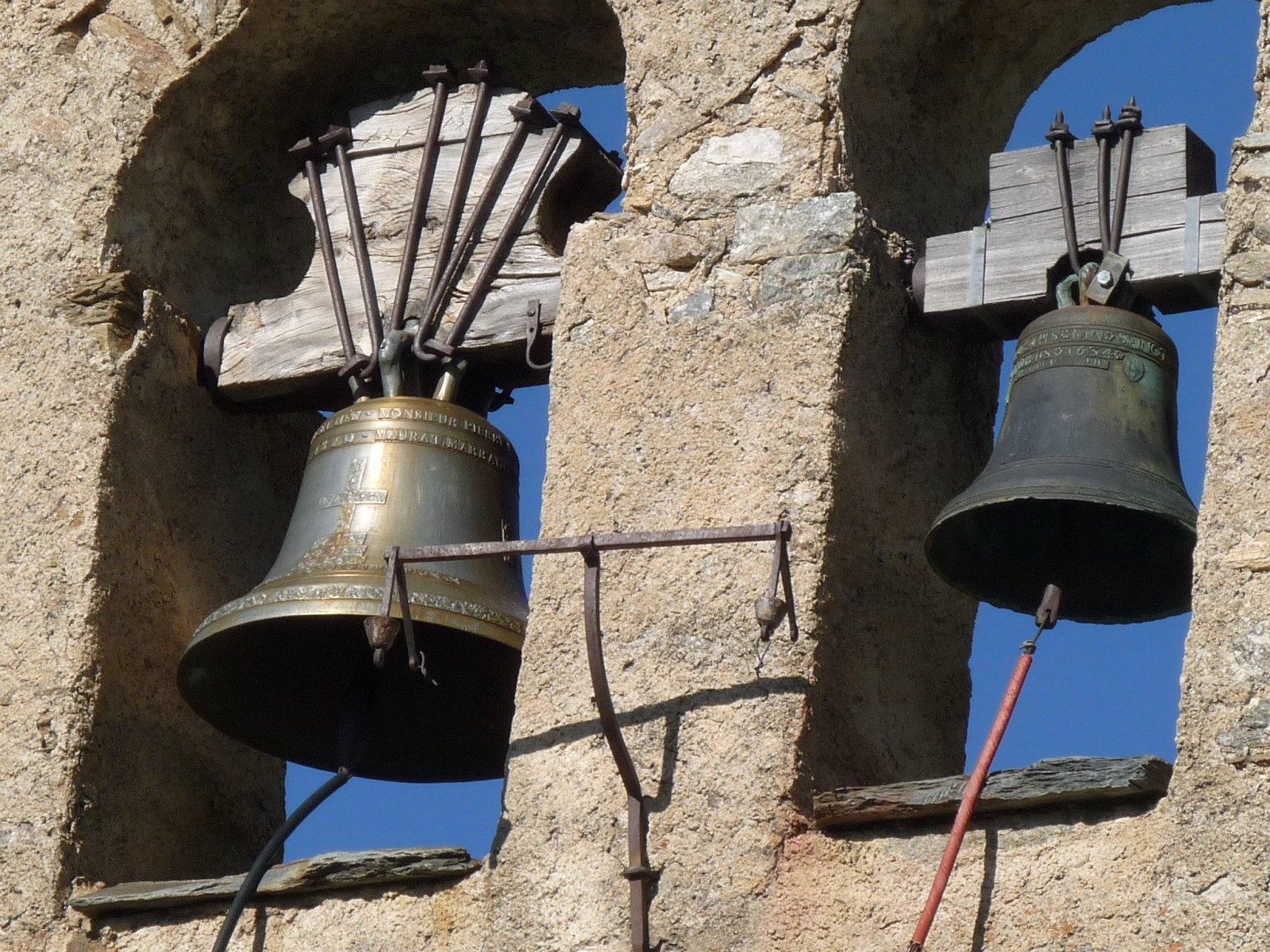
A cylindrical tower with a conical roof conceals the dome from outside, and a bell-gable (a wall-like structure with openings for bells) rises above the building. The entrance is at the western corner; an earlier doorway may have occupied the western apse. Part of the entrance’s original Romanesque ironwork survives. The walls are made of roughly worked rubble and covered with a thick layer of render.
Statue and furnishings
Inside is a multicolored wooden statue of the Virgin dating to the twelfth century. Its workmanship has been compared with statues at Odeillo and Err. The church also contains an altarpiece dedicated to Our Lady of Mercy and a Baroque altar (an altar in an ornate early modern style).