Franciscan Church of the Annunciation: A Baroque Parish Church in Ljubljana
Site at a Glance
- Rating
- 4.6
- Popularity
- High
- Country
- Slovenia
- Primary era
- Early Modern
- Eras represented
- Early Modern, Modern
- Civilizations
- Austrian Empire, Habsburg, Habsburg Austria, Holy Roman Empire
- Site type
- Religious
- Remains
- Church
On this page9 sections
History
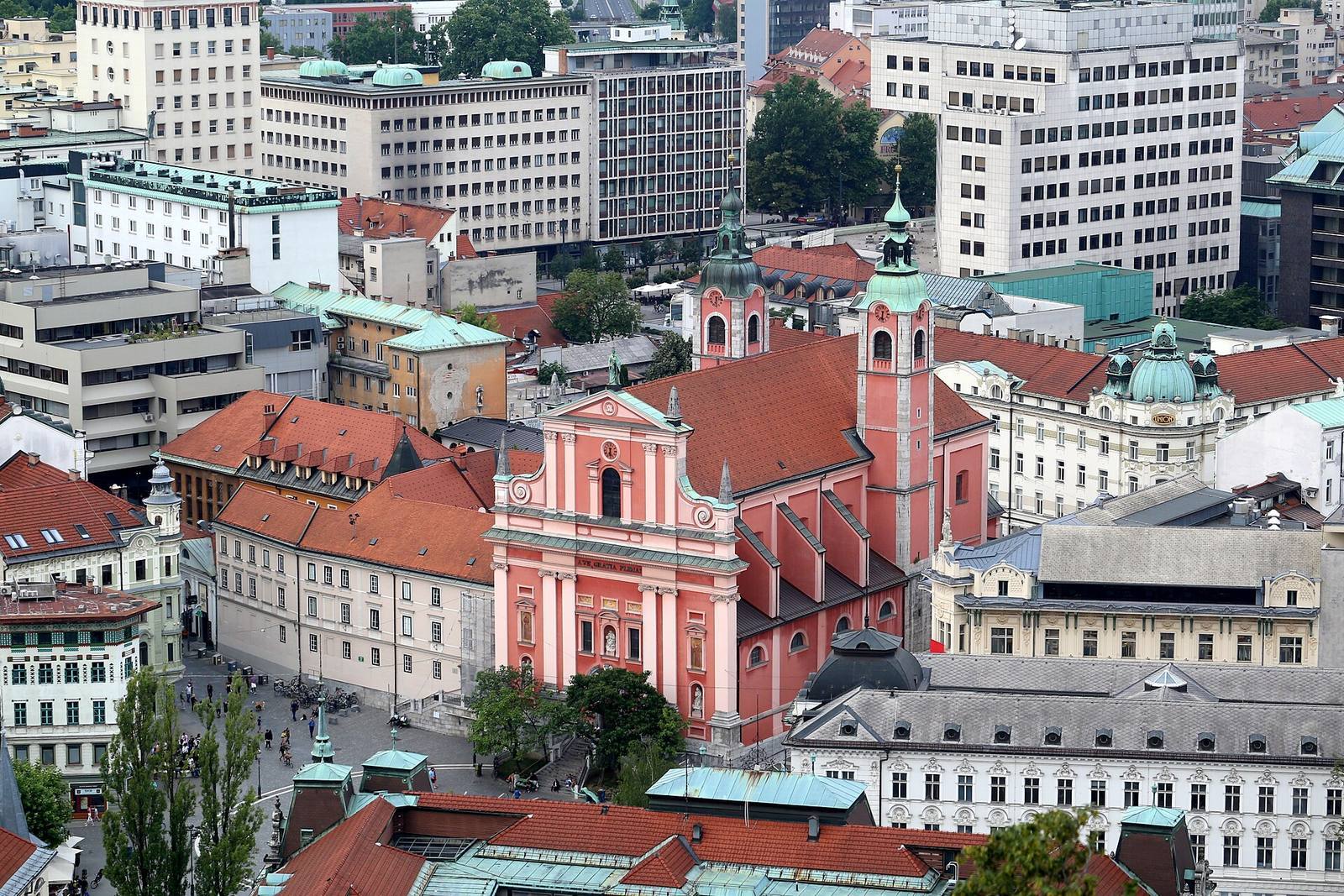
The Franciscan Church of the Annunciation is a Roman Catholic church on Prešeren Square in Ljubljana, Slovenia. It is dedicated to the Annunciation, the Christian account of the angel Gabriel telling Mary she would bear Jesus. Its present building was constructed from 1646 to 1660 in the early Baroque style, an ornate European style that flourished chiefly in the 17th and 18th centuries. The church serves as the parish church of Ljubljana–Annunciation Parish.
Earlier churches and construction
Two, or possibly three, earlier churches occupied the site, including one dedicated to St Martin, a fourth-century bishop of Tours venerated as a Christian saint. In 1628, Bishop Tomaž Hren laid the foundation stone and consecrated the building site. The Augustinians, members of a Catholic religious order, demolished the earlier church in 1645 after it had suffered serious fire damage. Work on the present church began the following year, directed first by Francesco Olivieri from 1646 to 1655 and then by Francesco Rosina from 1655 to 1660.
A chapel beside the church was consecrated in 1669, and Archbishop Sigmund Christoph, Count von Herberstein, consecrated the church in 1700. Its façade was built in the Baroque style in 1703–1706, and the bell towers followed around 1720.
Franciscan tenure and later changes
In the late 18th century, the Josephine reforms, measures introduced under Habsburg emperor Joseph II that included suppressing some religious houses, brought the Augustinian phase to an end. Franciscans, members of a separate Catholic religious order, took over the church and monastery. A Franciscan monastery had existed at Vodnik Square from the early 13th century; it moved to its present site during these reforms. The Annunciation parish was established beside the church in 1785.
The façade was completely redesigned in 1858 to plans by Franz Kurz zum Thurn und Goldenstein. Janez Wolf replaced the image of the four Church Fathers above the entrance with a new fresco in 1882. The 1895 Ljubljana earthquake cracked the church ceiling and damaged many earlier paintings. Repairs followed, but the earthquake did not substantially alter the church’s structure or appearance. It also damaged the monastery library, founded in the mid-18th century by Žiga Škerpin. The library was rebuilt to a design by Raimund Jeblinger, and its interior was completed late in the 19th century.
The façade was renovated in 1961 and again in 1992–1993, the latter project designed by Črtomir Mihelj. Since 2008, the church has been protected as a cultural monument of national significance in Slovenia.
Remains
Church
Plan and façade
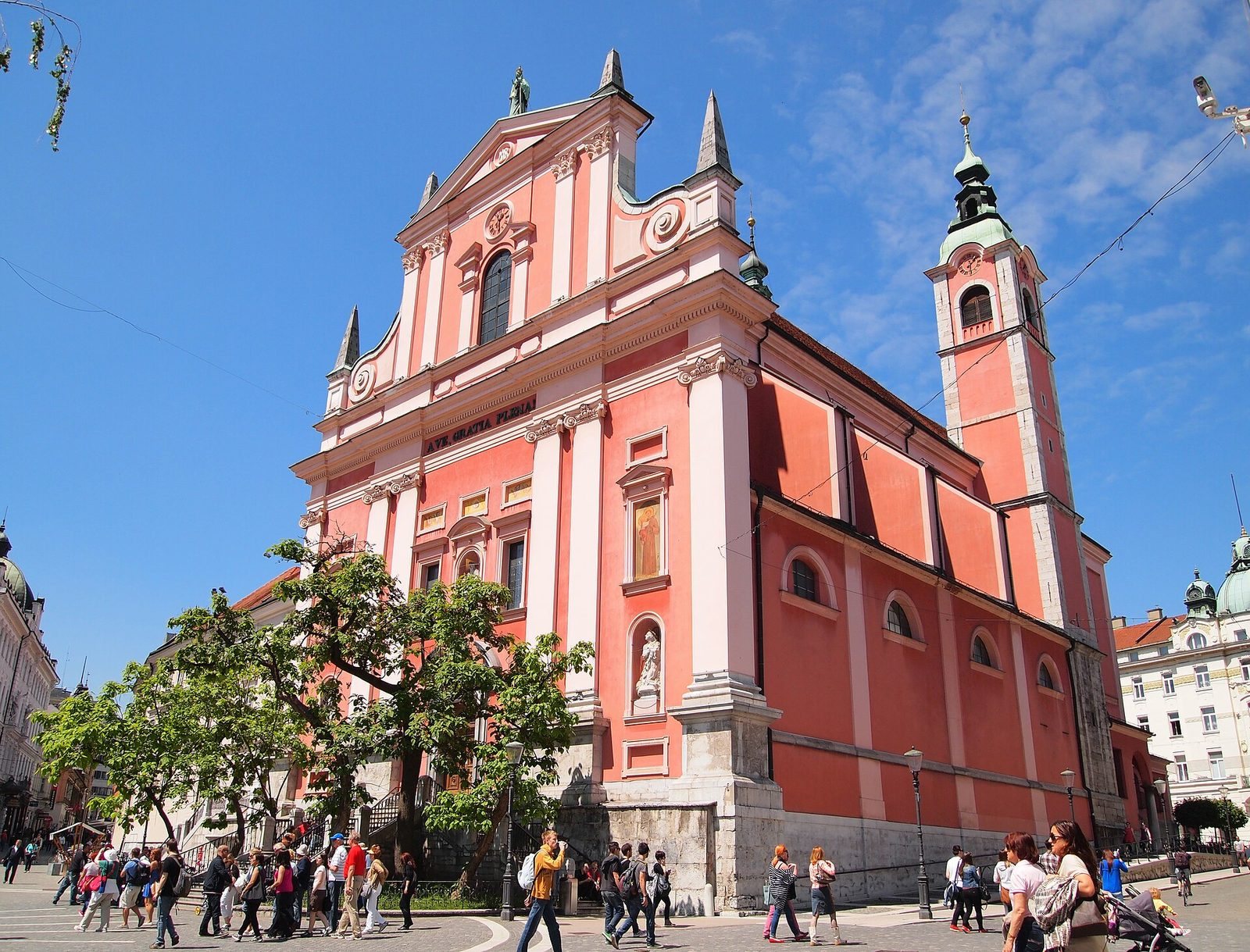
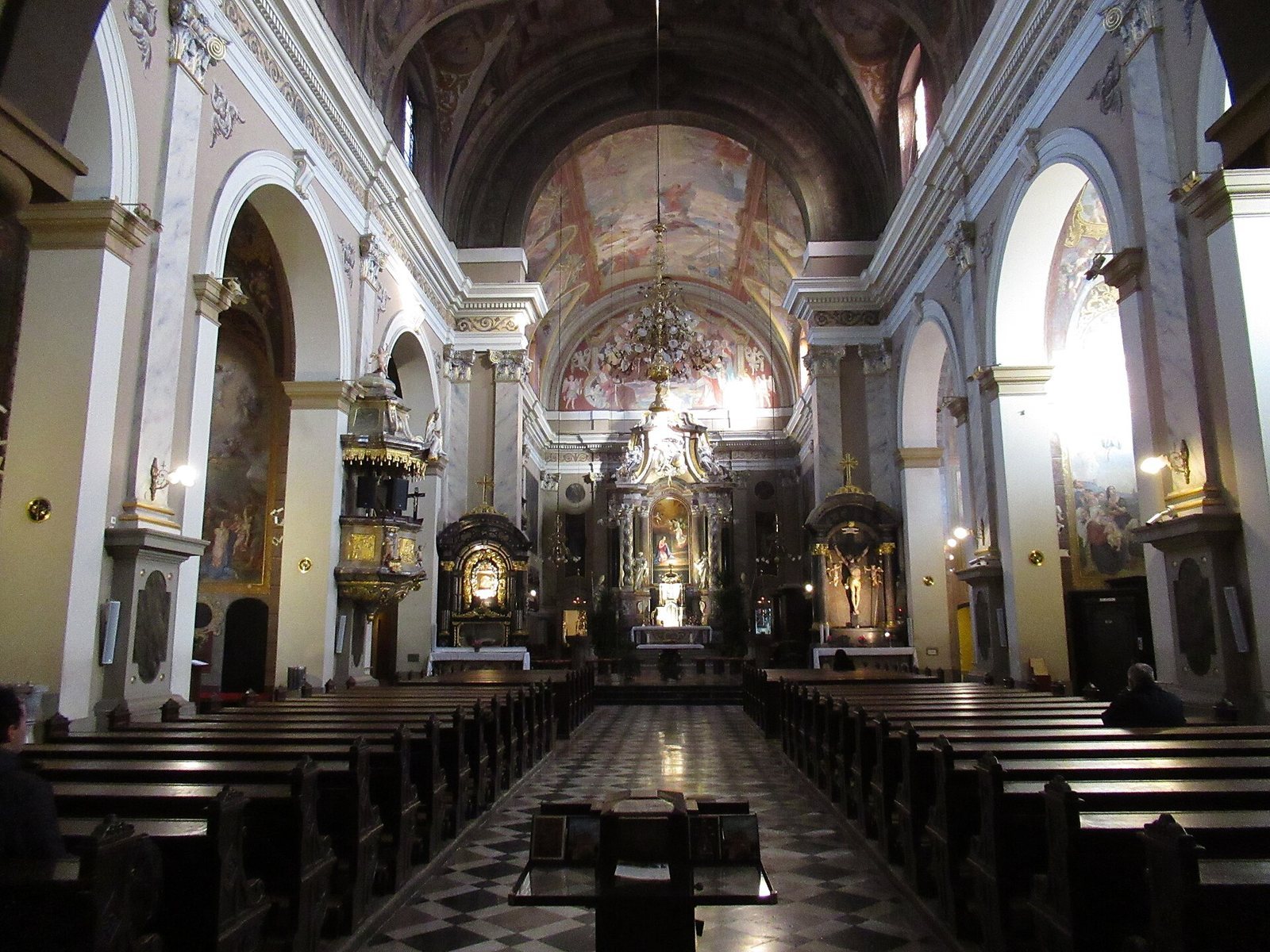
The church’s basilican layout is organized around a single long nave, with two rows of smaller side chapels opening from the main space. Its red façade, a color associated with the Franciscan order, replaced an earlier classical white finish and faces the river. The façade has two levels: pilasters, or flattened columns attached to a wall, carry Ionic-style capitals below and Corinthian-style capitals above. Spiral ornaments decorate the upper sides, while the central section rises above the flanks to a triangular, gable-shaped crown supported by two such ornaments. A recess above the main stone entrance holds a sculpture of God the Father; the two side recesses contain an angel and the Virgin Mary. Baroque sculptor Paolo Callalo made the sculptures, and Franc Ksaver Zajec modeled their faces and hands.
Entrance staircase
A stone staircase leads to the entrance and was built as Prešeren Square developed in the first half of the 19th century. The wooden door at its top bears 19th-century reliefs of women’s heads. Above the façade, a hammered-copper statue of Our Lady of Loreto shows the Madonna and Child. Matej Schreiner made it to a design by Goldenstein; it replaced an older wooden statue of the Black Madonna, and the figures’ heads are crowned with gold.
Altars and paintings
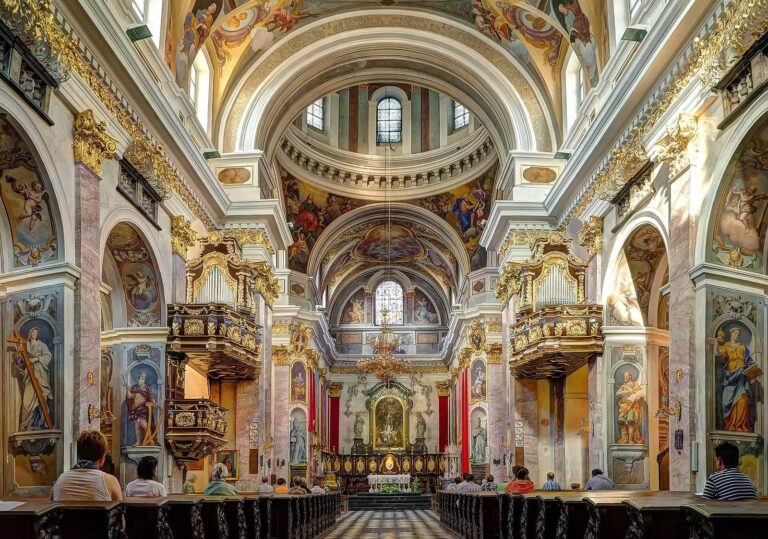
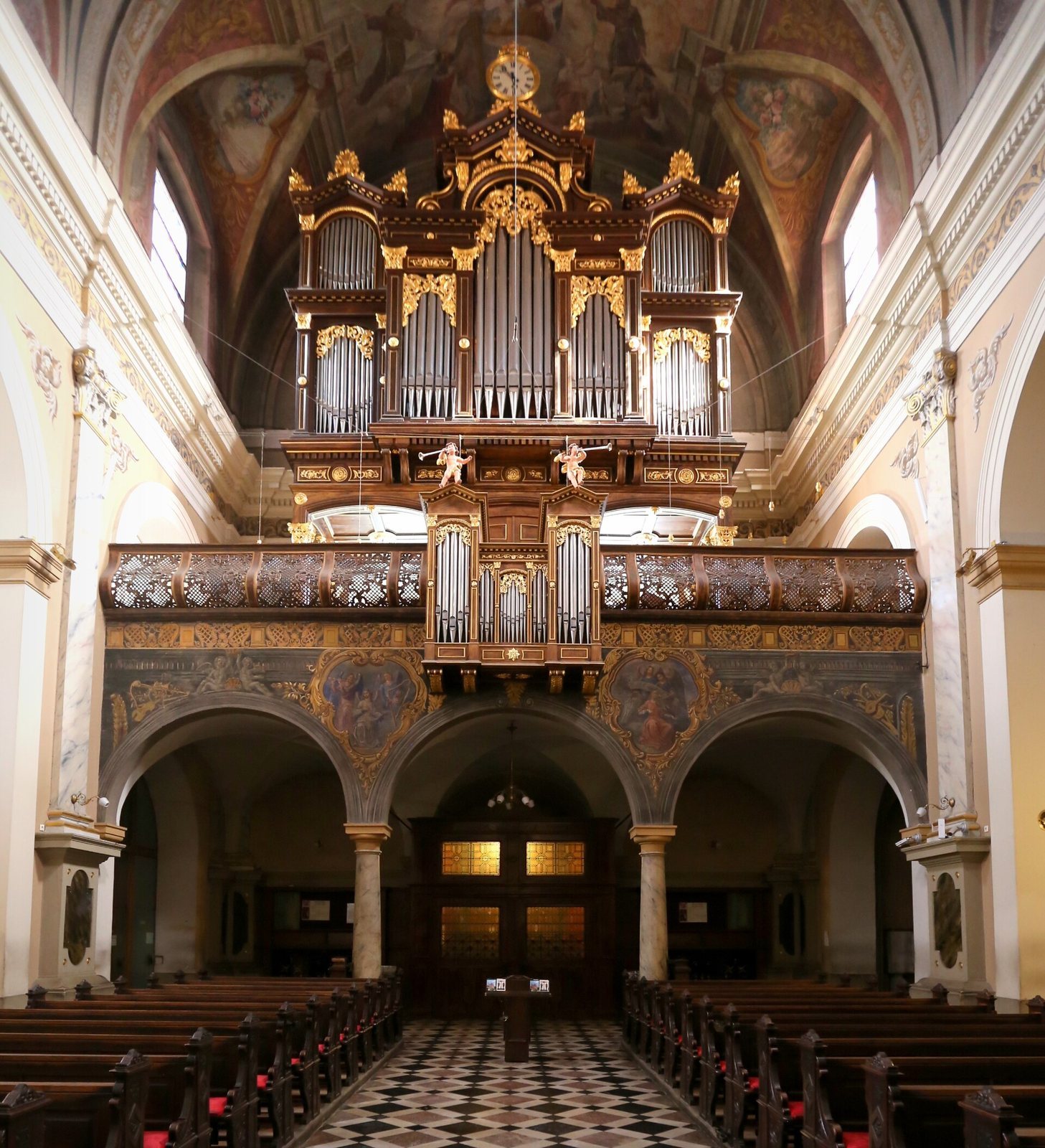
The principal altar is a Baroque work made mostly by Francesco Robba in 1736. Matevž Langus painted most of the interior frescoes in 1845 and from 1848 to 1855, while Janez Wolf added two in 1882. Matej Sternen painted the ceiling frescoes in 1935–1936 using trompe-l’oeil, a technique that makes a flat painting appear three-dimensional.
Monastery and library
The monastery stands beside the church, between Prešeren Square and Čop, Nazor, and Miklošič streets, and includes a garden. Its library holds more than 70,000 books, including medieval manuscripts and incunabula, books printed before 1501. Around 30,000 volumes date from before 1800, and the collection also includes illuminated manuscripts.