Juxtlahuaca: Preclassic Cave Paintings in Mexico
Site at a Glance
- Popularity
- Medium
- Country
- Mexico
- Primary era
- Iron Age
- Eras represented
- Iron Age, Classical
- Civilizations
- Olmec
- Site type
- Civic
- Remains
- Rock Art
On this page11 sections
History
Preclassic art and its wider context
Juxtlahuaca is a cave site in Mexico whose paintings date broadly to about 1200–400 BCE, during the Preclassic, an early period in Mesoamerican history. The images are associated with Olmec iconography. Mesoamerica encompasses parts of present-day Mexico and Central America; the Olmec tradition is associated with early art in the region and a Gulf Coast heartland, but that label does not identify the makers of these paintings.
Along with the paintings at nearby Oxtotitlán, Juxtlahuaca’s images are considered among the earliest known examples of sophisticated painting in Mesoamerica. They are also the only known example of deep-cave art in Mesoamerica outside the Maya area, where the Maya civilization developed across parts of present-day southern Mexico and Central America. The cave lies hundreds of kilometres southwest of the Olmec heartland, and its relationship to a large settlement of the period is unclear. Its location raises questions about Guerrero’s role in the development of Olmec culture and how art influenced by that tradition came to be made so far from its heartland.
Cave imagery also appears in Olmec-style art elsewhere. Altars at La Venta show figures emerging from caves, while cave motifs occur at Chalcatzingo. These examples place Juxtlahuaca’s imagery within a broader Mesoamerican interest in caves.
Exploration
References to the caves date to the 1920s. In 1958, Guerrero’s state government commissioned an exploration of the galleries led by Andrés Ortega Casarrubias. Gillett Griffin of Princeton University and Carlo T. E. Gay carried out the first professional investigations in the 1960s.
Remains
The cave system extends for about 5 km. The paintings lie roughly 1.3 km below the surface, and some passages on the way are partly flooded by seepage. The painted images are among several features within the cave, which also contains human remains, a cut channel and crystalline formations.
Painted images
Painting 1
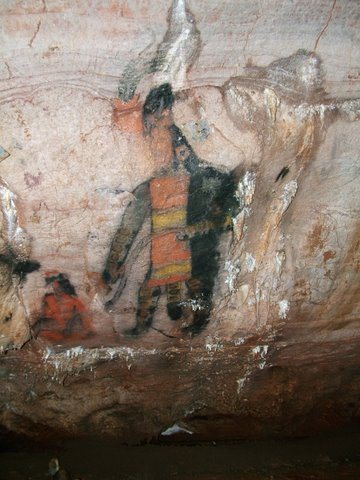
About 2 m high, Painting 1 shows a large bearded man wearing a black cloak, a striped tunic and an elaborate headdress. Jaguar fur covers his arms and legs, and a jaguar tail hangs behind him. He points a trident and a snake-like object toward a smaller, crouching figure. The scene is a rare Olmec-style depiction of one person dominating another. Some researchers interpret it as a human-sacrifice scene.
Serpent and jaguar
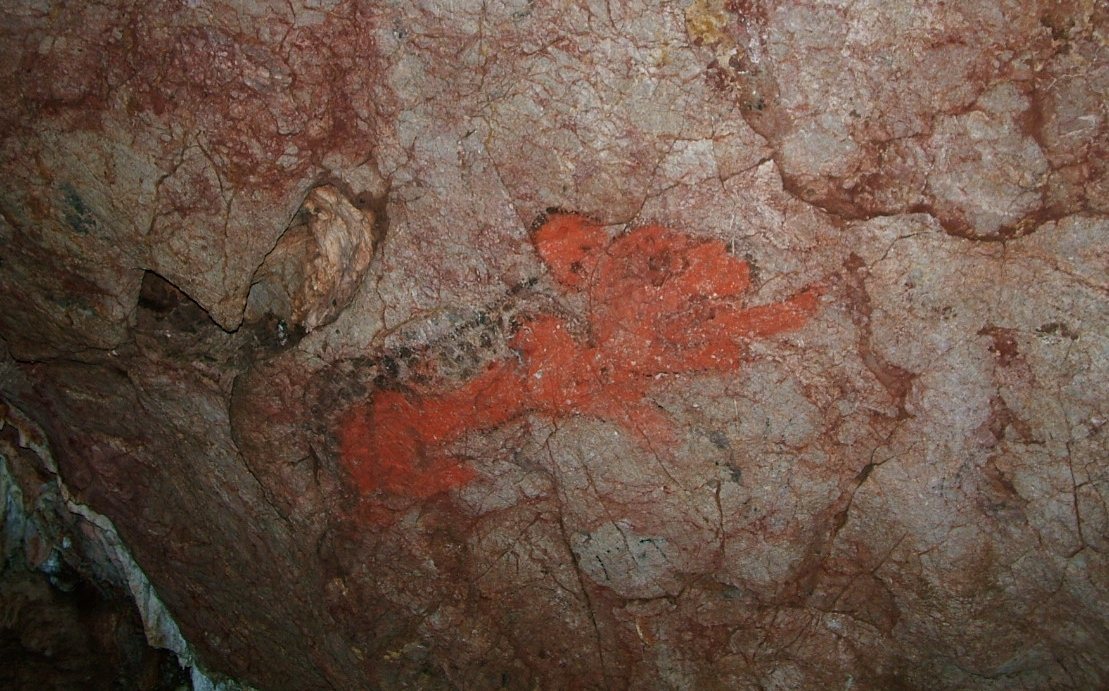
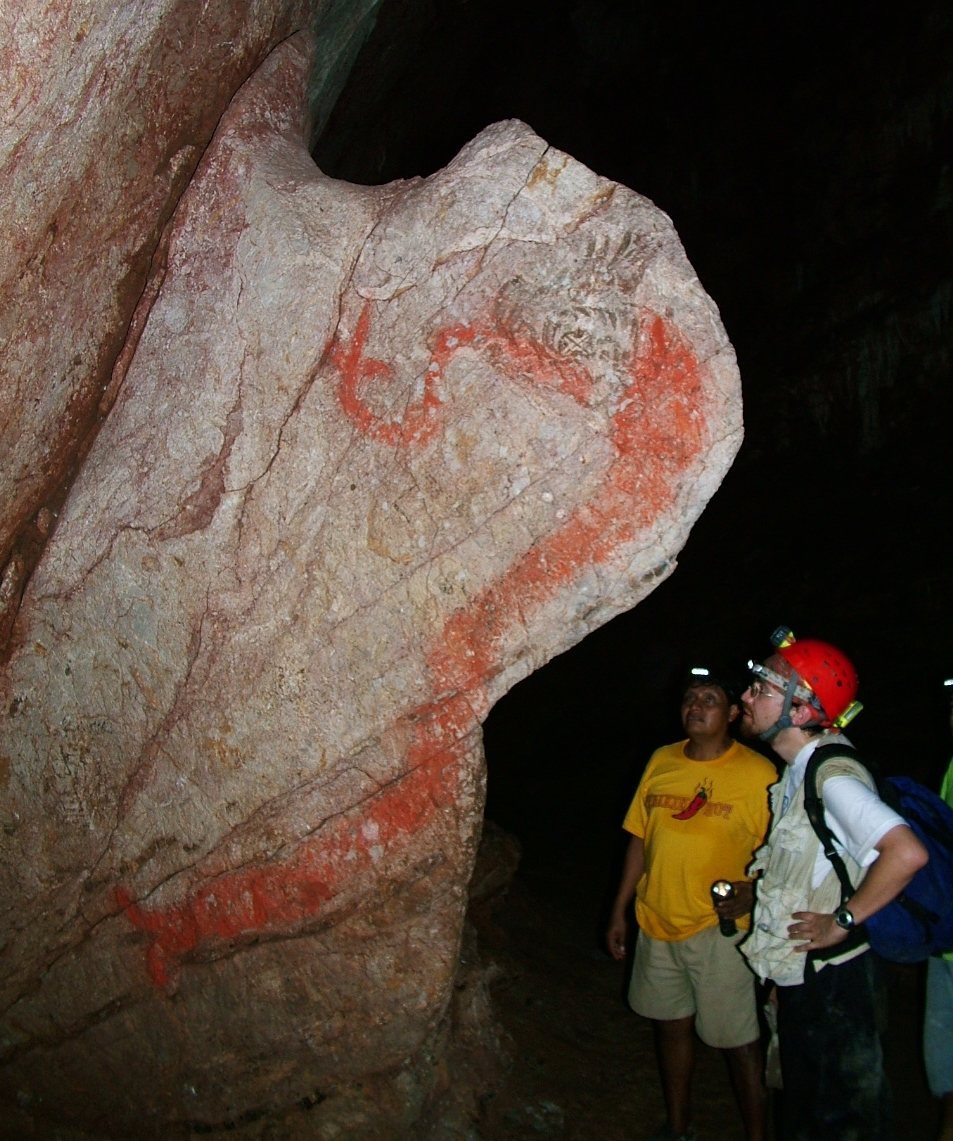
Another image shows a red feathered serpent with green plumes beside a red jaguar. The jaguar’s large ears and eyes give it a youthful appearance. A design on a stalagmite, a mineral formation that grows upward from a cave floor, has been interpreted as a ceremonial setting and, more tentatively, as a temple.
Other cave features
Hall of the Dead
About a dozen skeletons were found in the Hall of the Dead, midway between the cave entrance and the paintings. Some lie extended, while others are in fetal positions. A crust of stalactite material, formed by mineral deposits growing downward from the cave ceiling, covers them. They are thought to represent ancient burials, and a cave-in partly buried some of the remains.
Artificial canal
Just before the paintings, an artificial canal about 80 m long cuts through the cave’s red-clay floor. Its purpose is uncertain.
Crystal garden
The cave’s crystal garden consists of transparent aragonite formations. Aragonite is a crystalline form of calcium carbonate, and the formations resemble animals, flowers and trees.