Ciudad de los Vascos: An Andalusi Frontier City in Spain
Site at a Glance
- Rating
- 4.5
- Popularity
- Medium
- Country
- Spain
- Primary era
- Medieval
- Eras represented
- Medieval
- Civilizations
- Umayyad
- Site type
- Settlement
- Remains
- City
On this page11 sections
History
Ciudad de los Vascos is the site of an Andalusi city near Navalmoralejo in western Toledo province, Spain, occupied from the ninth to the twelfth centuries. Andalusi refers to the parts of the Iberian Peninsula governed by Muslim dynasties. The settlement may have begun on the Christian frontier as a ribat, a fortified post linked to religious and military activity, before becoming a stronghold and home to Berber settlers.
Frontier settlement and urban growth
The city may have developed to control crossings of the Tagus and limit Christian incursions. Other possible purposes include keeping members of the Nafza Berber tribe under control and making use of nearby iron mines in the Montes de Toledo. Metallurgical activity also took place at the site. During the caliphal period, the settlement developed into a medina, or urban settlement, perhaps around 930 to 950.
Vascos belonged to the Middle March, the frontier region of al-Andalus. After the fitna, the civil conflict associated with the fragmentation of the caliphate, it became part of the Taifa of Toledo, one of the smaller successor kingdoms. Toledo’s Dhulnunid rulers were generally at odds with the Taifa of Badajoz. Vascos seems to have grown in population and military garrison during this period.
The name Vascos may have developed from Basaq through Vasak. Basaq was one of three districts associated with Madina al-Talabaira, present-day Talavera de la Reina, though the name may have referred to the district rather than the city. Vascos has also been tentatively identified with the lost Berber settlement of Nafza, but that identification remains uncertain. The name does not appear to refer to the Basques.
Conquest and abandonment
After Alfonso VI, king of León and Castile, conquered Toledo in 1085, Vascos probably passed into Christian control. The city was then depopulated and abandoned. People who resettled the area preferred the Tagus valley.
Archaeological study and protection
Excavations have been directed by medieval historian Ricardo Izquierdo Benito since 1975, with archaeologists and residents of the La Jara region taking part. The owners of the Las Cucañas estate, the Cavestany-Corsini family, have also promoted research in cooperation with the administration.
In June 1931, the site was declared a National Historic-Artistic Monument, a designation that preceded Spain’s later Bien de Interés Cultural status. It is listed as an archaeological zone.
Remains
Setting and urban plan
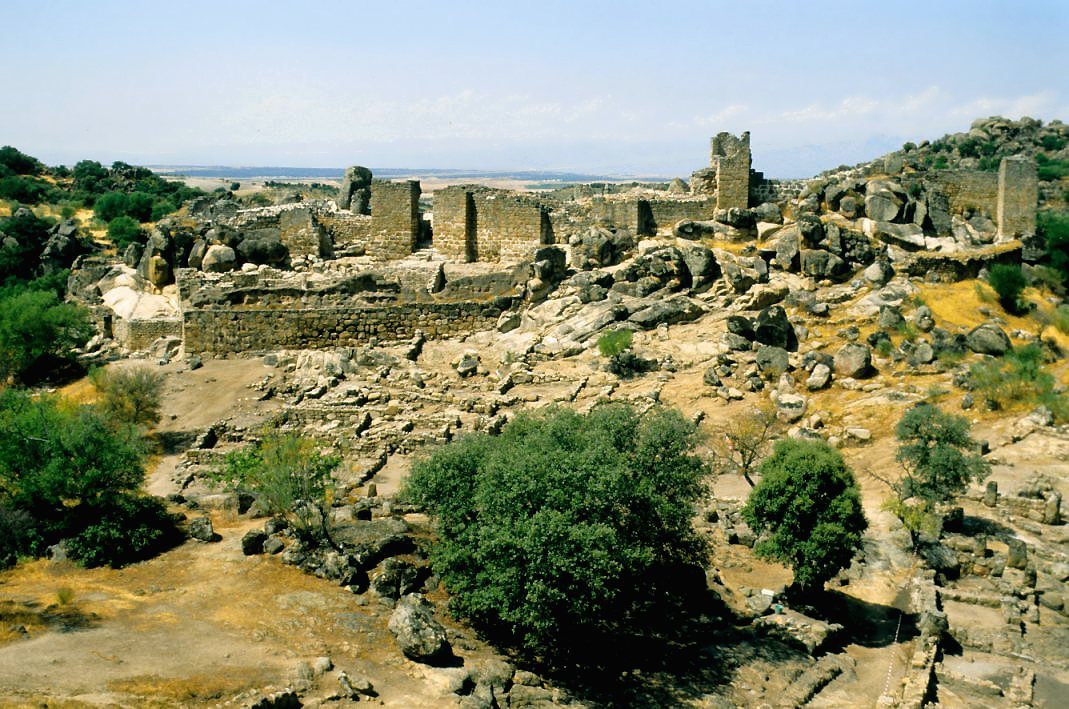
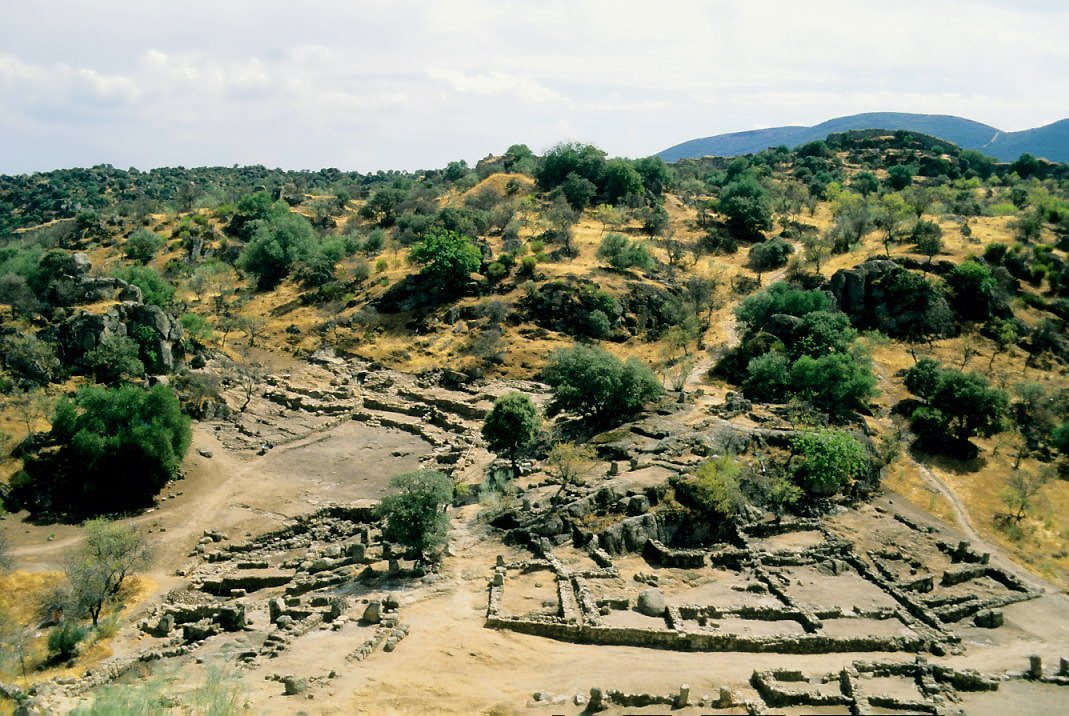
The settlement covers about 30 hectares on a gently sloping hill near the meeting of the Huso and Mora rivers. It lies on the east bank of the Huso, a southern tributary of the Tagus, at the foot of the Sierra Ancha and Sierra Aguda. The central walled area occupies about eight hectares; beyond it are a suburb and two cemeteries. The city’s perimeter follows the contours of the hill, which rises from about 390 metres above sea level in the north to about 430 metres in the south.
Walls, gates, and street
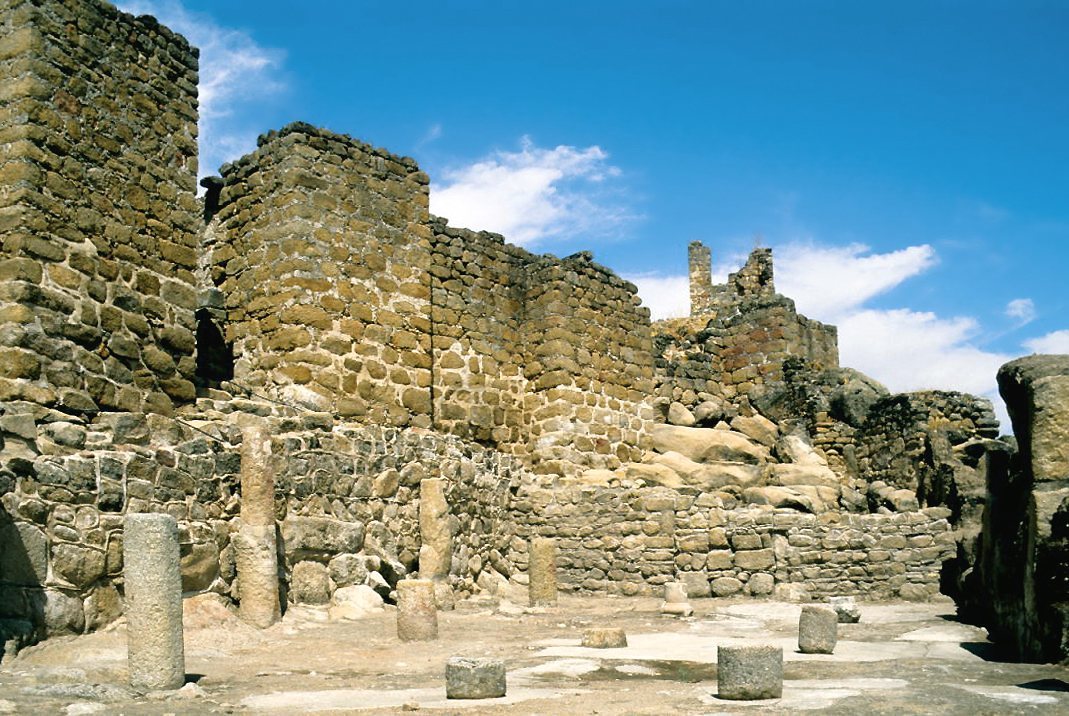
The urban enclosure was built of stone, either laid without mortar or set in masonry. Carefully dressed stone characterizes principal Umayyad enclosures at the site, including the western wall. A main street crosses the city from east to west. The remains also include defensive works and arched gates with carved decoration.
Citadel and buildings
Alcazaba
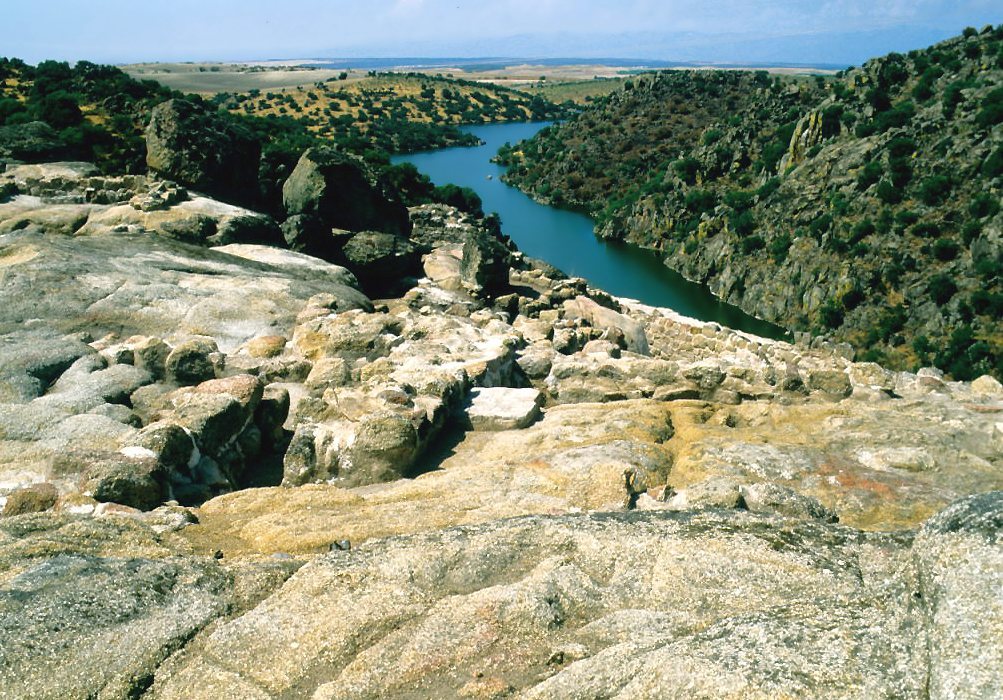
The alcazaba, a fortified citadel, stands at the northern end of the hill, below the settlement’s highest ground. Its position overlooks the Huso–Mora confluence. A high rocky barrier across the Huso restricts the view toward the rivers’ meeting point, while the view toward the city is more open. The steep drop from the citadel to the river has prompted the possibility that its occupants could leave only by passing through the city, though this remains unresolved. An alquerque pattern, used for a traditional board game, is carved on a lintel there.
Mosques
The walled city contained two mosques. A short devotional invocation appears on the eastern wall of one, written in Kufic script, an angular form of Arabic writing.
Bathhouse
A bathhouse survives with a hypocaust, an underfloor heating system.