Saint George Church in Petrovaradin: A Jesuit Baroque Parish Church
Site at a Glance
- Rating
- 4.5
- Popularity
- Medium
- Country
- Serbia
- Primary era
- Early Modern
- Eras represented
- Early Modern, Modern
- Civilizations
- Austria-Hungary, Habsburg, Habsburg Austria
- Site type
- Religious
- Remains
- Church
On this page23 sections
History
Jesuit mission and construction
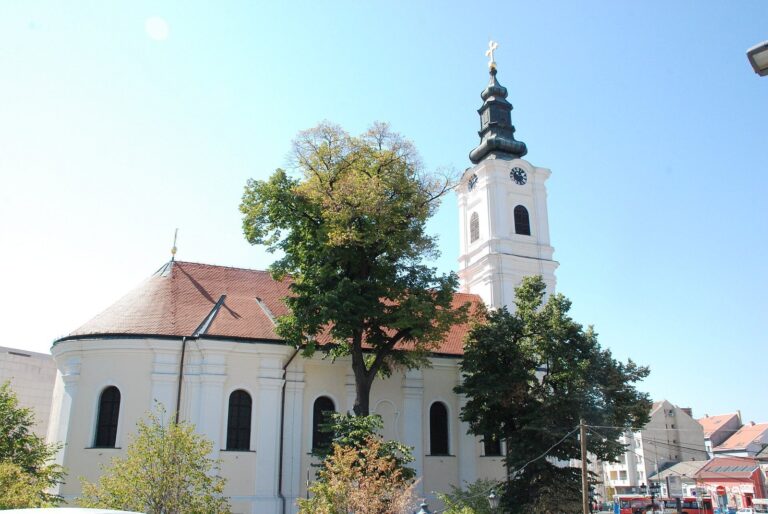
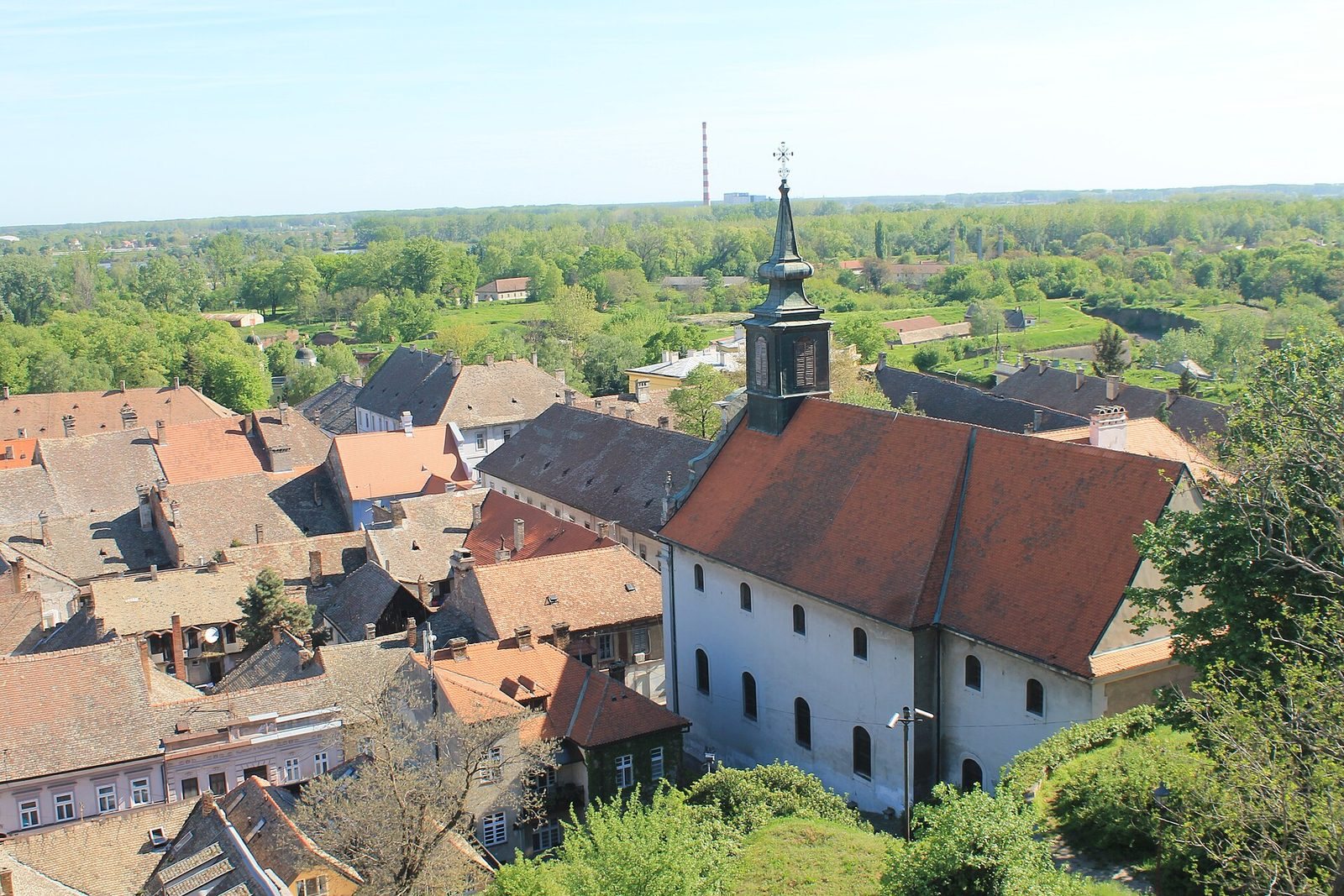
Saint George Church in Petrovaradin is a Catholic parish church in Serbia, begun by Jesuits in 1701 in the lower town beneath Petrovaradin Fortress. Its restrained Baroque design, a form of European art and architecture, drew on Il Gesù, the principal Jesuit church in Rome. The church served a renewed Christian presence in the military garrison after Ottoman forces withdrew in the late seventeenth century.
Cardinal Leopold Karl von Kollonitsch, a senior Catholic church official in the Habsburg lands, brought Jesuits to Petrovaradin. Their mission was one of eleven in the Austrian Jesuit province. A directory from 1695 names Ivan Farkaš as the mission’s superior, or head, and Ignatius Rames as chaplain to the German community. The Jesuits carried out parish work before a parish had formally been created.
The first church available to Catholics in Petrovaradin was a small Saint George chapel in the Upper Fortress, later demolished. The Jesuits also obtained permission to restore an abandoned mosque at Tekije, about four kilometres away, and use it as a chapel dedicated to the Immaculate Conception of Mary, the Catholic teaching that she was preserved from original sin from the moment of conception.
Work on the present church began in 1701. Donations exceeded 500 Rhenish florins, a currency used in parts of central Europe, over the course of a year. Farkaš completed the building in time for a major celebration of Saint Ignatius’s feast on 31 July 1701. Formal consecration followed on 20 May 1714.
Parish life and devotional traditions
Kollonitsch formally established the fortress parish in 1701. Its superior received income from a wine tithe, a levy paid from wine production. In 1703, Kollonitsch removed the parish from the ordinary authority of the Bishop of Srem and placed it directly under the Archbishop of Esztergom. Jesuits served there until their order was suppressed in 1773. The church continues as a Catholic parish in the Diocese of Srem.
In 1713 the Jesuits formed a Brotherhood of the Passion and Death of Jesus, a religious association whose members shared devotional practices. More than 600 people joined during its first year. The brotherhood held annual services for living and deceased members on Passion Sunday and the Friday after All Saints’ Day. Worshippers of Croatian background gathered at the Holy Cross altar on Mondays, while German worshippers met there on Fridays.
The church’s image of Our Lady of the Snows, also called the Tekije Madonna, is a representation of the Virgin Mary. It is associated with Prince Eugene of Savoy, a Habsburg military commander, who visited the Tekije chapel on 5 August 1716 to give thanks for victory over Ottoman forces. Each year the image is carried to the Tekije church on the Sunday after Easter and returned to Saint George Church on the last Sunday in October.
A plague struck Petrovaradin from September to November 1738. In response, the parish established a procession with the Blessed Sacrament, the consecrated Eucharist, for 20 January, the feast of Saints Roch and Sebastian. Bells were rung in the morning and afternoon that year to prompt prayer. The January observance has continued as the parish’s annual devotional day.
A statue of Saint John of Nepomuk was set up beside the Petrovaradin ferry crossing in 1735. It was later moved near the pontoon bridge, then transferred to the churchyard of the Church of the Exaltation of the Holy Cross at Ljudevit Dol when a new bridge was built.
Nineteenth-century associations
Josip Jelačić, later a Croatian military and political leader who held the high governing office of ban, was born in Petrovaradin on 16 October 1801. He was baptized that day in Saint George Church by parish administrator Damian Nützl. The baptismal register lists him as that year’s second entry.
Josip Juraj Strossmayer, a Croatian Catholic bishop and cultural figure, lived at the monastery as a young chaplain from spring 1838 until October 1840. A bishop’s decree then sent him to Vienna to continue his studies.
Twentieth century and present
During the First World War, the church’s bells were spared the removal and recasting for cannonballs that affected bells at other churches in the Austrian Monarchy. From 1941 to 1961, a railway ran along Strossmayer Street, and its soot damaged the church’s formerly milky-white exterior.
The former Jesuit monastery now serves as the residence of the Bishop of Srem. The church and parish house are protected cultural monuments in Serbia.
Remains
Setting and plan
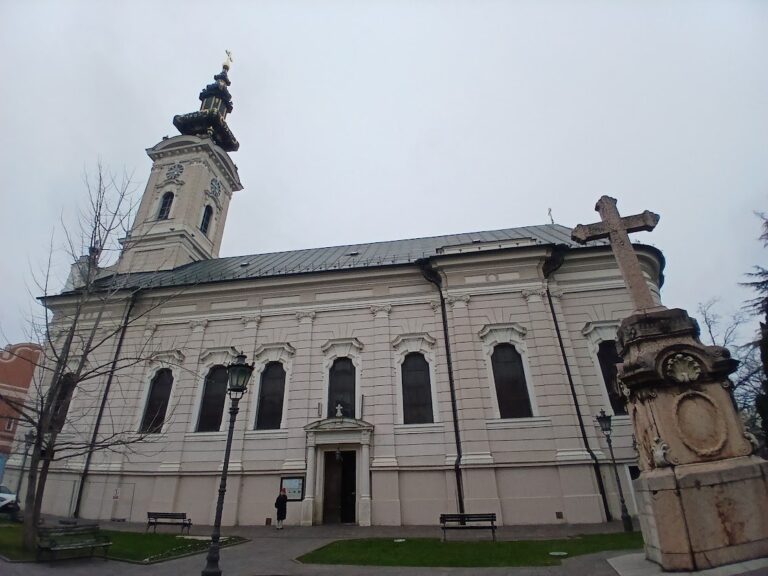
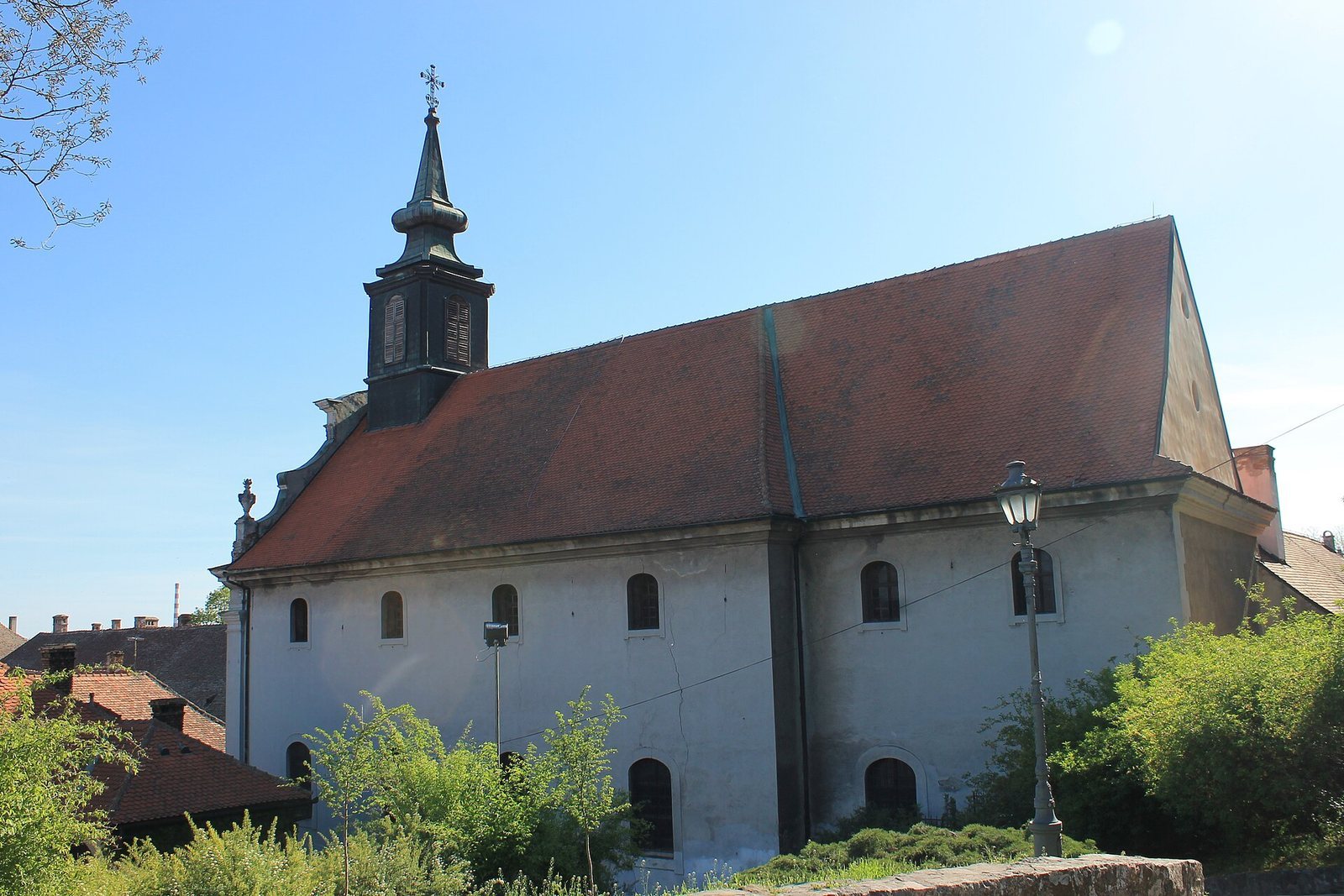
The church stands in the old Baroque lower town, in the Podgrađe district beneath Petrovaradin Fortress. It is a rectangular, single-nave building, meaning it has one main interior space, with a narrower apse, a projecting end space. Its long axis runs approximately north to south, angled about 15 degrees east, with the rear to the west. The main entrance faces north onto Strossmayer Street. The exterior measures about 36.7 metres long and 15 metres wide; the interior span is 12.1 metres, the apse is 8.8 metres wide, and the floor-to-ceiling height is 13.8 metres. The floor area is about 500 square metres.
Exterior
Façade
The north façade is coated in durable plaster made from coarse sand and lime. Its surface has naturally darkened and acquired a patina. Four pilasters, shallow column-like forms attached to a wall, and two moulded horizontal cornices organize the front. The longer central pair supports an arched pediment, a decorative upper feature, with a frieze. Niches contain Baroque angels, while scroll-shaped volutes and ornamental pots complete the decoration. Statues of Saint Francis Xavier and Saint John of Nepomuk were added when the façade was repaired in 1736.
Bell tower
The tower was moved from the rear of the church to the front in 1736. Rising above the façade, it has a bulbous roof. Its support system uses horizontal tie beams, which restrain the roof structure, rather than vertical supports in the choir. The front roof truss, a framework supporting the roof, rests on the façade wall; the truss carrying the tower and roof rests at its ends on the long side walls. The tower’s position interrupts the balance of the façade.
Interior
Vault and choir
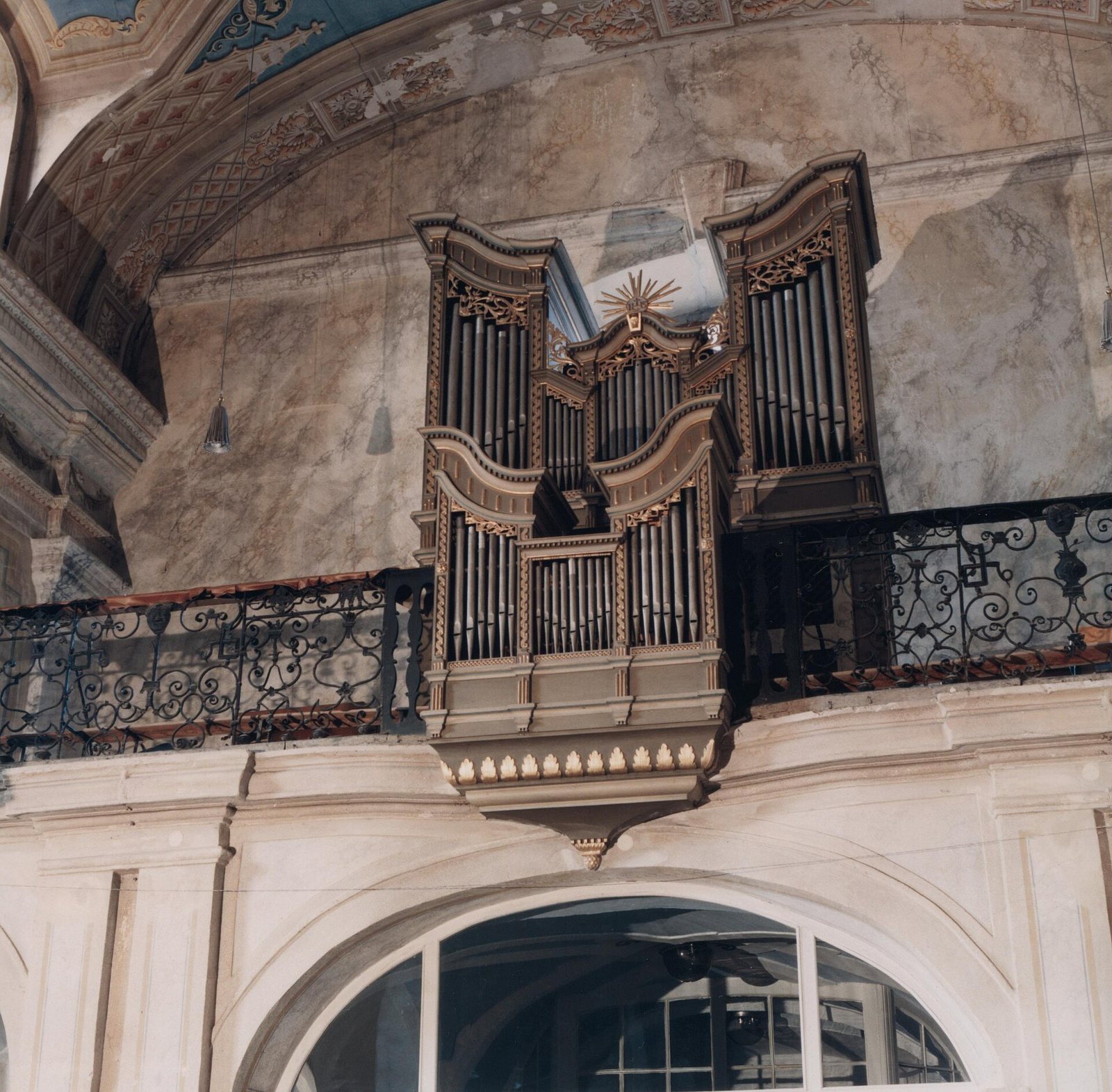
The spacious interior has a vaulted ceiling. Pilasters carry reinforcing arches built from boarding, reeds and plaster, while the vault over the narrower apse is made of brick. The main and side altars combine stone with carved, decorated and gilded wood in the Austrian Rococo style, an ornate European design tradition with curving forms. Above the main entrance, the raised choir has an organ and an iron railing dating from the first half of the eighteenth century.
Main altar
The monumental main altar, completed in 1774, is made of red marble and includes reliquaries, containers for religious relics. Its Saint George altarpiece measures 7 by 4 metres. Viennese painter Felix Ivo Leicher received a commission worth 500 florins for a painting of the saint; that work was removed in 1906 and replaced with another painting. A parish entry records the acquisition in 1903 of a Saint George painting by Czech painter Lang Reichemann, together with paintings of Saints Francis Xavier, Peter and John of Nepomuk, for 1,050 crowns.
Figures on the altar include Saint Ignatius Loyola holding an open book marked with the Jesuit motto, Saint Francis Borgia, Saint Longinus and Saint Demetrius of Sirmium. The statues are about two metres high.
Holy Cross and Marian altars
The Holy Cross altar holds a crucifix of high artistic quality. Opposite it, the Marian altar has statues of Saints Roch and Sebastian, each 1.6 metres high. The image of Our Lady of the Snows is kept there when it is in the church; a smaller copy occupies its place when the original is away. A statue of Saint Rosalia, also associated with protection against plague, is now in a façade niche at the Church of Saint Roch in Novi Majur. The altar dedicated to Saint Francis Xavier has a painting of his missionary work.
Other altars and statues
The Saint John of Nepomuk altar was erected in 1732 at a cost of 90 florins and consecrated on 8 November that year by Sigismund Bereny, Bishop of Pécs. Its painting is now in the corridor before the chapel on the monastery’s upper floor. Installed in 1903 in a corner beneath the apse, the Saint Peter altar replaced an earlier Marian altar. Above its tabernacle, a container for the consecrated Eucharist, is a 4-by-2-metre painting of Jesus handing Peter the keys to the Kingdom of Heaven. Beneath the choir, an altar to Saint Anthony of Padua stands to the right of the entrance; on the left is a 1.6-metre statue of Saint Francis of Assisi. Acquired through donations in 1923, the Francis statue was consecrated on 25 November that year together with the statue of Saint Anthony.
Pulpit and baptismal font
The pulpit, erected by parish priest Ivan Filip Winkler in 1785, remains in the church. A baptismal font is preserved in the sanctuary.
Monastery connection and adjoining spaces
The church and former monastery are linked by three doorways: one between the sacristy and apse, another between the choir and the Strossmayer Room on the monastery’s first floor, and a ground-level passage through the church’s left side wall into the monastery-house corridor and courtyard. The last passage was made in 1984 for church processions. The sacristy, a room for preparing and storing items used in worship, measures 6 by 6 metres. Built in 1719, the parish house and church form a closed quadrangle.
Bells
Small bell
The two bells are the oldest in the area. The smaller one weighs 75 kilograms and was cast in 1701 as a gift from the fortress commander. It hangs on the tower’s east side, facing Majur. Its inscriptions include the maker’s words, “Goss mich Iohann Nyspickher in Wien,” the monograms Mari and IHS, and the Jesuit motto Ad Maiorem Dei Gloriam, meaning “For the greater glory of God.” Another inscription names the fortress captain. A figure on the bell’s north side represents either a saint or the Virgin and Child.
Large bell
The larger bell was cast in Buda in 1714 and weighs 120 kilograms. Benefactor Pavle Simić gave it to the church when the tower was moved in 1736; it hangs on the tower’s west side. Its inscription asks Saints Ignatius and Francis Xavier to pray for the faithful and gives the year 1714. Two figures on the bell carry a cross and a flower, probably a lily, and the Blessed Sacrament with a cross. The inscription supports identifying them as Ignatius Loyola and Francis Xavier.
Crypts
Earlier burial chamber
An older crypt behind the main altar was intended for Jesuit burials but was abandoned because it was damp. Later moisture made its grave inscriptions illegible.
Later burial chamber
A second crypt beneath the church was designed for 109 burials. It received 86 people during its recorded period of use, from 1758 to 1868. Initially intended for Jesuits and church officials, it was later opened to anyone able to pay a fee of 50 florins. Burial ended in 1868 because of health concerns. The crypt contains a Holy Cross altar flanked by carved marble angels, including an especially accomplished weeping figure. These sculptures rank among the finest seventeenth-century Baroque church sculptures in Srem.