St. Salvator Church: The Jesuit Church of the Klementinum in Prague
Site at a Glance
- Rating
- 4.7
- Popularity
- High
- Country
- Czechia
- Primary era
- Early Modern
- Eras represented
- Early Modern
- Civilizations
- Habsburg, Habsburg Austria, Holy Roman Empire, Kingdom of Bohemia
- Site type
- Religious
- Remains
- Church
On this page15 sections
History
St. Salvator Church is an early Baroque church built by the Jesuits, a Catholic religious order, in the Klementinum in Prague, Czechia; foundation work began in 1578. It became the principal Jesuit church in Bohemia and is regarded as one of Prague’s most valuable early Baroque monuments.
Jesuit establishment and church foundations
In 1556, Ferdinand I, a Habsburg king of Bohemia, gave the Jesuits the buildings of a Dominican monastery in Prague. The Dominicans, another Catholic order, received an abandoned Poor Clare convent, a house belonging to a Catholic order of women, in compensation. Jesuit theologian and missionary Peter Canisius had drawn attention to the complex’s position near Charles Bridge and a major road.
The first twelve Jesuits arrived on 18 April 1556 and adapted the west wing of a rebuilt building, known as Canisium, for their first monastery. The college was formally established on 20 June, and teaching began on 7 July under a provisional arrangement. The Jesuits developed the Klementinum as a base for schools, libraries, theatres, a printing press, a pharmacy, and churches. Their teaching supported the Counter-Reformation, the Catholic Church’s response to the spread of Protestant movements. A book burning in the courtyard destroyed 30,000 books classified as heretical.
St. Salvator was built over the foundations of the Gothic Church of St. Clement, which was associated with the Dominicans. Jesuits led by rector Giovanni Paolo Campana laid the new church’s foundations between 1578 and 1581, with the chancel and transept following; the cornerstone was formally laid in 1581. The work proceeded through several building phases, first under builders whose names are not known, and later involving Carlo Lurago and Francesco Caratti.
Also in 1581, Mordechai Maisel, leader of the neighboring Jewish Town, donated 100 thalers, silver coins used in Central Europe, toward construction. The gift is associated with religious coexistence in Rudolfinian Prague, the city during Emperor Rudolf II’s reign, when his court was based there.
Baroque development
In the early 17th century, the Jesuits added the nave and a western marble entrance portal with a portico, along with built-in galleries and stucco decoration. Lurago directed this phase. Between 1654 and 1659, a new representative façade was constructed to his design, with Caratti also taking charge of work at the church.
In the late 1640s, rector Martin Středa arranged for a dome to be raised above the crossing, the point where the nave and transept meet. The provincial governor, Count Václav Michna of Vacínov, provided financial support. The dome’s stucco decoration was later removed because of its weight and replaced with a lighter scheme. In 1714, architect František Maximilián Kaňka altered and raised the church’s towers.
Religious, academic, and heritage history
The church continued to serve religious and academic life in Prague. Jesuit preacher Antonín Koniáš occasionally preached there during the 1730s to 1750s. Composer and organist Jakub Jan Ryba played its organ during the 1780s, and priest, mathematician, and philosopher Bernard Bolzano served as university preacher from 1805 to 1819. In 1950, priest Oto Mádr undertook pastoral work with university students at the church.
Pastoral care for students resumed in February 1990. In October 2004, the church became the Czech Republic’s first academic parish, serving students, teachers, and employees of Prague universities and their families. Tomáš Halík, a Czech priest and theologian, has served as church rector since 1990 and parish priest since 2004. St. Salvator forms part of the Klementinum heritage complex and of the Prague Historic Centre, inscribed on the UNESCO World Heritage List in 1992. It is also part of Czech national heritage.
Remains
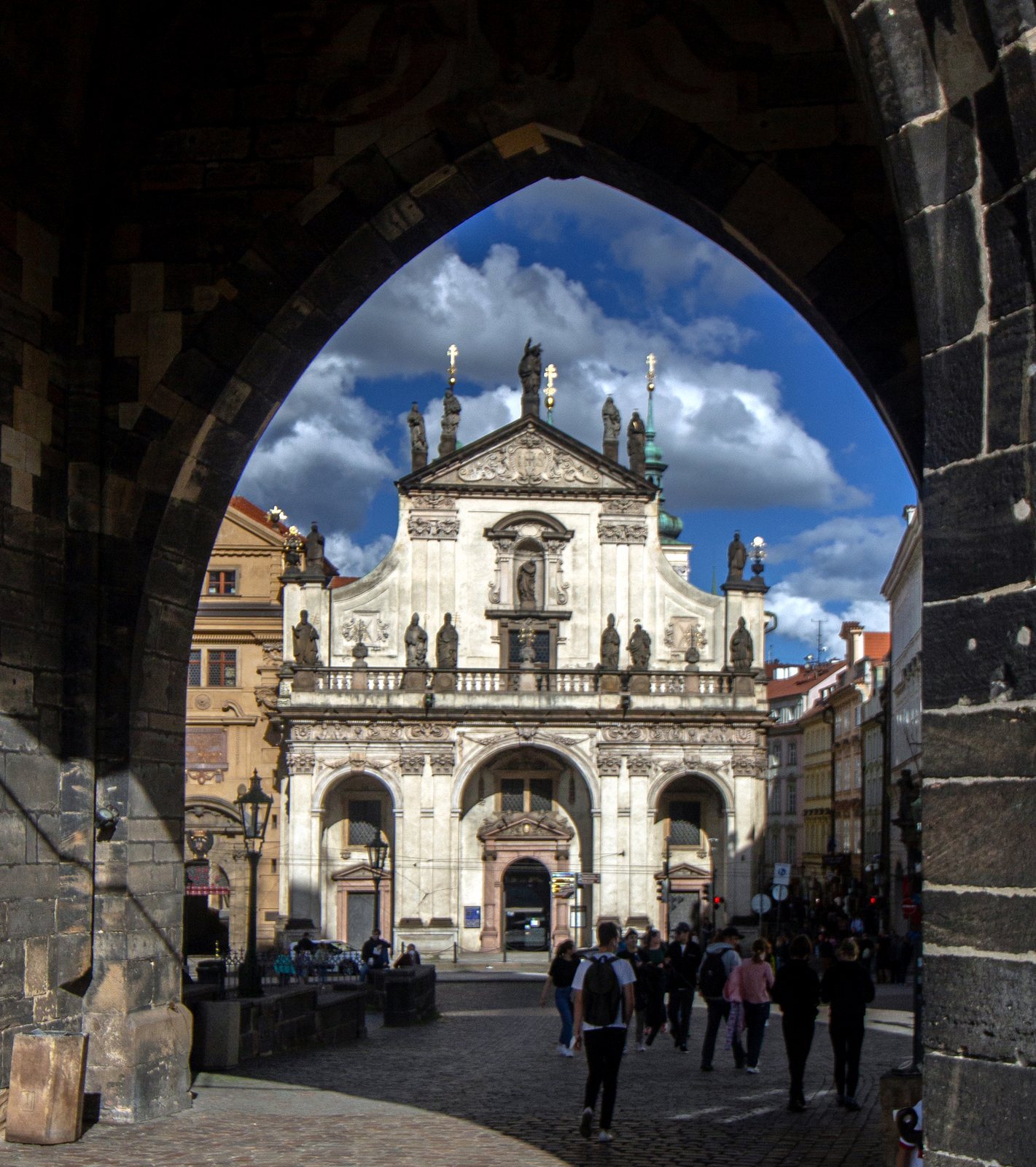
Built of stone and masonry, the church has a nave, its main body, divided into three lengthwise aisles, a chancel around the main altar, and a transept forming the crosswise section. Its western front faces Křižovnické Square and Charles Bridge, while an entrance on the north side leads from the Klementinum courtyard to the sacristy, a room used for preparation and church furnishings. At the rear, on Karlova Street, the church adjoins the Chapel of the Assumption of the Virgin Mary and the Cathedral of St. Clement.
West façade and sculpture
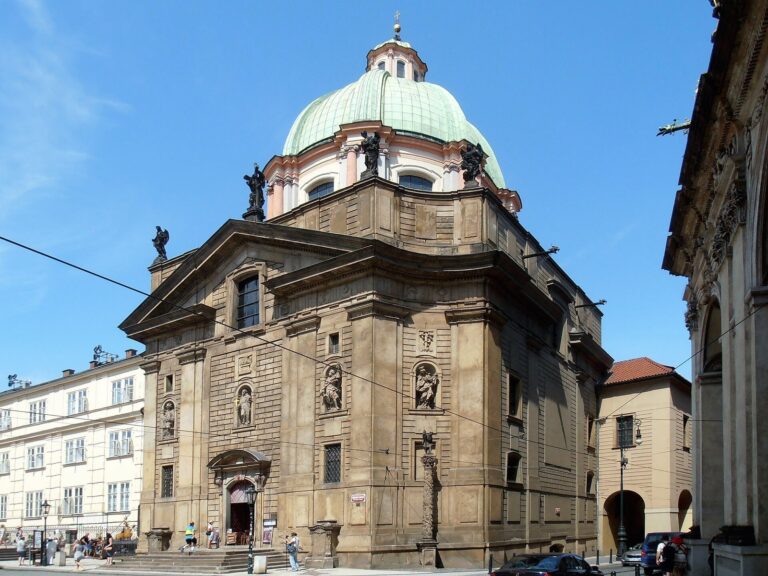
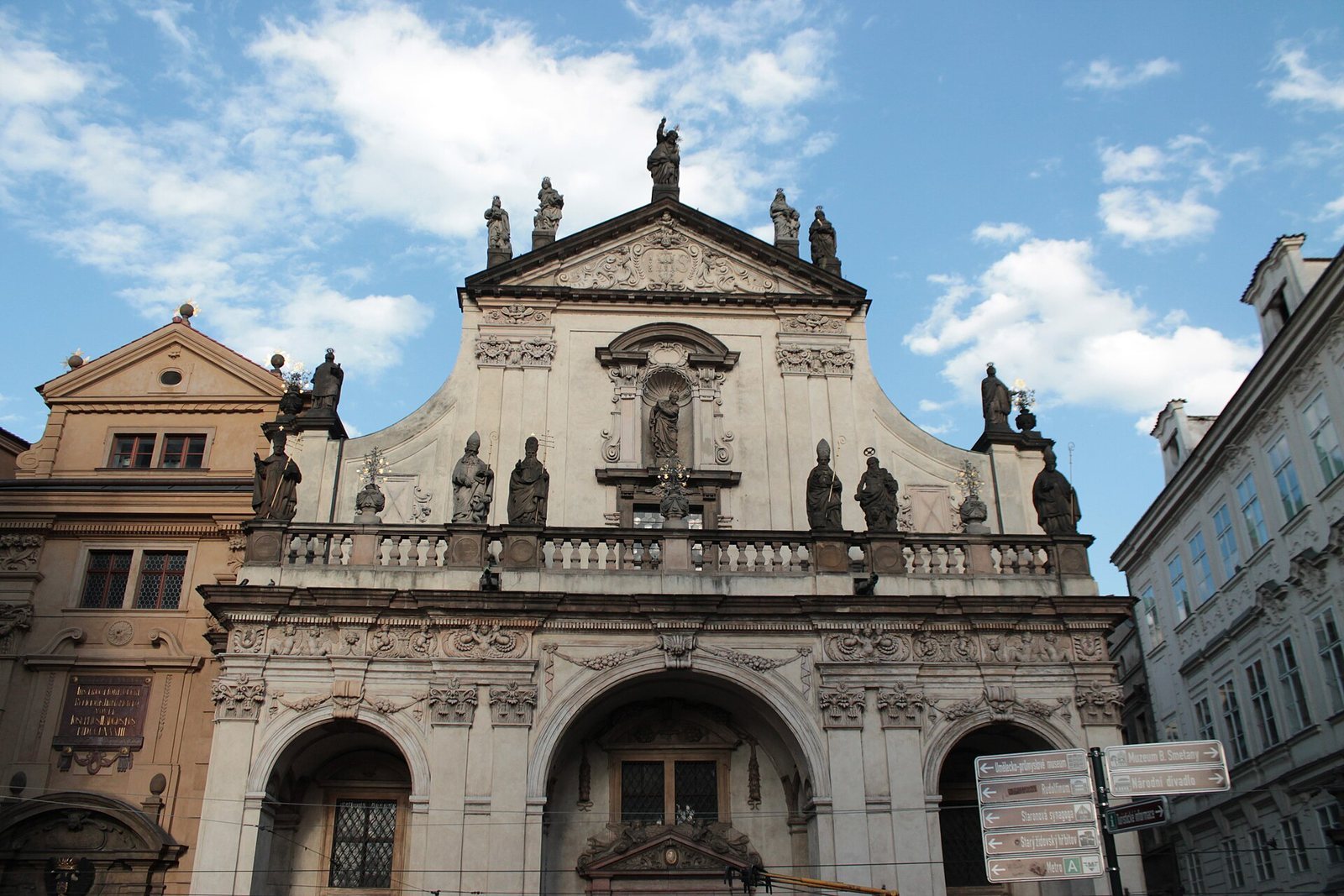
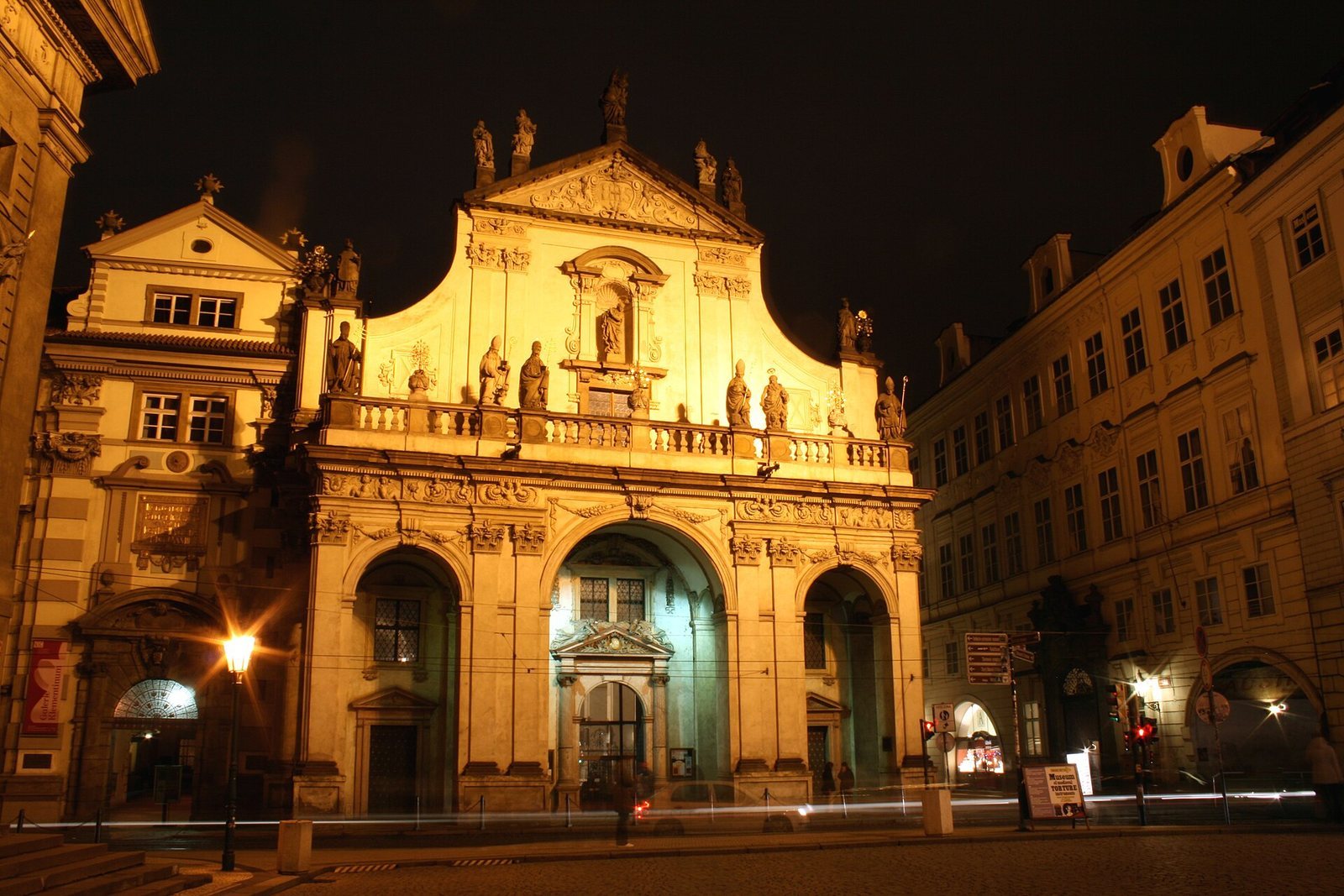
The west entrance includes a marble portal and portico, a roofed porch supported by columns or piers. The representative façade has a portico of three arched openings, designed to recall Roman triumphal arches, and an upper terrace edged by a balustrade, or railing with supporting posts. Fourteen larger-than-life sandstone statues made by Jan Jiří Bendl’s workshop between 1655 and 1660 decorate the façade and terrace.
Christ and the four Evangelists, the figures traditionally associated with the authors of the Gospels, stand above the tympanum, the central field of a pediment. Ignatius of Loyola and Francis Xavier occupy the sides of the gable, while a figure of the Immaculate Virgin Mary, expressing the Catholic belief that Mary was conceived without original sin, stands in the central niche. Six Church Fathers, influential early Christian teachers and writers, line the terrace balustrade: Clement, Basil the Great, Augustine, Gregory, Ambrose, and Jerome. The composition of Mary’s statue adapts the design of the figure on the Marian Column in Old Town Square.
In 1999, copies made by Petr Váňa replaced the statues of Luke, John, and Augustine. Their originals are preserved in the National Museum’s Lapidarium, a collection for stone sculptures and architectural fragments, at the Prague Exhibition Grounds. The church’s towers have onion-shaped cupolas.
Interior and furnishings
Floor, benches, and confessionals
Marble donated by Kristina Kortesiová in 1660 covers most of the floor, alongside surviving areas of ceramic tile and brick paving. Benches from around the same period have carved decoration on their fronts and sides. Six confessionals have gables decorated with white-finished figures of the Evangelists from Bendl’s workshop.
Main altar
The main altar holds a 1632 painting of the Transfiguration by Jan Jiří Häring, based on a composition by the Renaissance painter Raphael. Four white-finished statues, including figures of St. Clement and St. Bartholomew, flank it. Above them, figures of God the Father, the Son, and the Holy Spirit appear among angels. Karel Kovář painted an allegory of the Four Continents on the ceiling above the altar.
Chancel altars
At the north end of the chancel, an altar holds a painting of St. Ignatius of Loyola commissioned by papal envoy Filippo Spinelli in the first decade of the 17th century. The altar at the south end features a painting of the Death of St. Francis Xavier, acquired in 1646 by František of Sternberg. Two allegorical statues representing Asia and Africa stand beside it.
Other altars and paintings
Other altars are dedicated to St. Aloysius Gonzaga, beneath the dome; the Sorrowful Virgin Mary; St. Stanislaus Kostka; and St. John of Nepomuk. The altar of the Sorrowful Virgin includes a painting by Josef Vojtěch Hellich showing Mary beneath the Cross between two angels, donated by seminary director František Srdínko. Hellich also painted the image of St. John of Nepomuk, obtained by Karel František Průcha. Two large paintings facing one another depict Ignatius of Loyola and Francis Xavier undertaking missionary work; their altar tables are made of polished ebony.
Pulpit and organ
The pulpit is decorated with gilded high-Baroque carving. A statue of Moses holding the tablets of the Old Testament stands on its canopy, while figures of the four Evangelists and reliefs of biblical scenes decorate its front. The organ loft connects with galleries on both sides. A door on its north side opens onto a second-floor corridor in the Klementinum college. The organ, by an unidentified maker and dating from the 1780s, has two manuals, or keyboards, and 23 stops, controls for sets of pipes. It was restored between 2009 and 2011.
Burials
Floor tombs
About twenty floor tomb slabs, mostly marble and decorated with coats of arms, lie within the church. They are worn, and benches partly cover some of them. Those commemorated include Edmund Campion, whose burial lies beneath an unmarked slab; Jindřich Písnic (1608); Bedřich of Donín (1610); Jakub Horčický of Tepenec (1622); Marie of Rozdražov, born Countess Berková of Dubá; Kateřina Chanovská of Dlouhá Ves; Count Filip Kinský (1749); Ludmila Kateřina of Újezd, born of Talmberk; Polyxena Ludmila Malovcová of Malovice (1697); and Kryštof Knaut of Schwanenzwung. František of Sternberg is commemorated by a bronze slab.
Jesuit crypt
Beneath the dome, a worn floorstone dated 1674, bearing a Czech-language inscription on a metal plate, covers the Jesuit crypt. Several dozen coffins lie in sealed burial niches. Those buried there include Václav Hájek of Libočany, the Jesuits Jan Tanner and Antonín Koniáš, and possibly Jiří Plachý-Ferus.