Church of Saint Francis of Assisi in Staré Město: Principal Church of the Knights of the Cross
Site at a Glance
- Popularity
- High
- Country
- Czechia
- Primary era
- Early Modern
- Eras represented
- Medieval, Early Modern, Modern
- Civilizations
- Austrian Empire, Habsburg, Habsburg Austria, Holy Roman Empire, Kingdom of Bohemia
- Site type
- Religious
- Remains
- Church
On this page16 sections
History
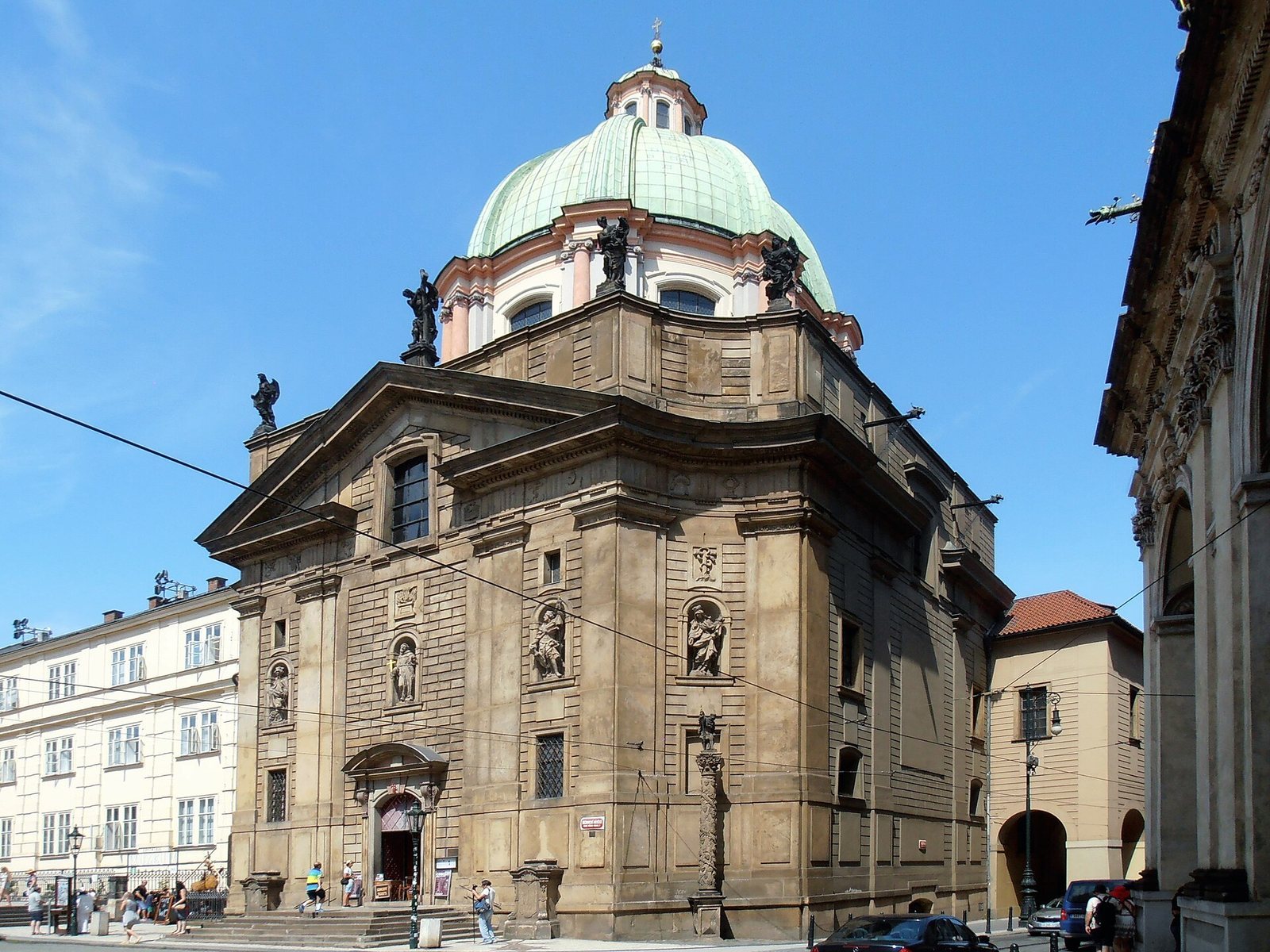
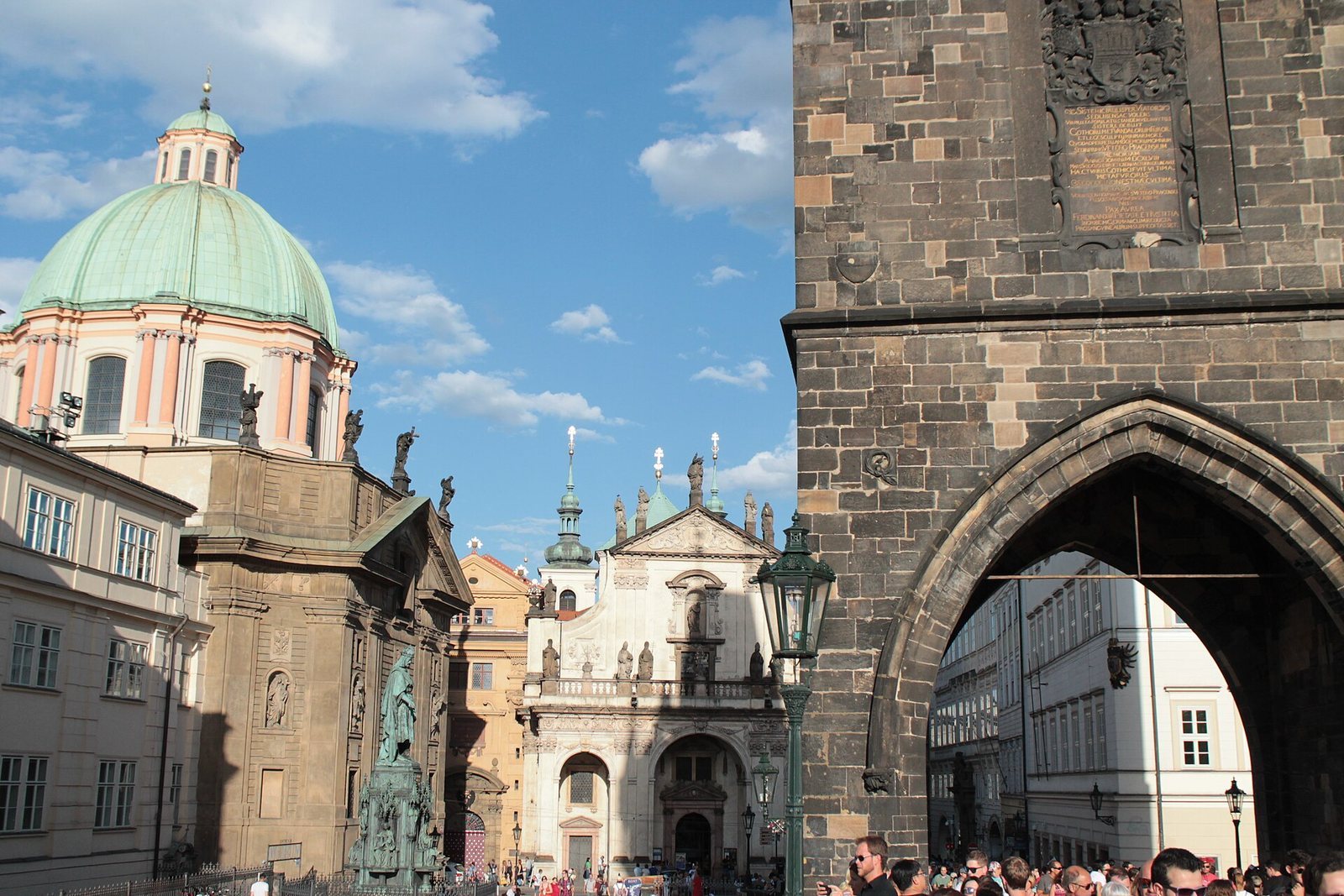
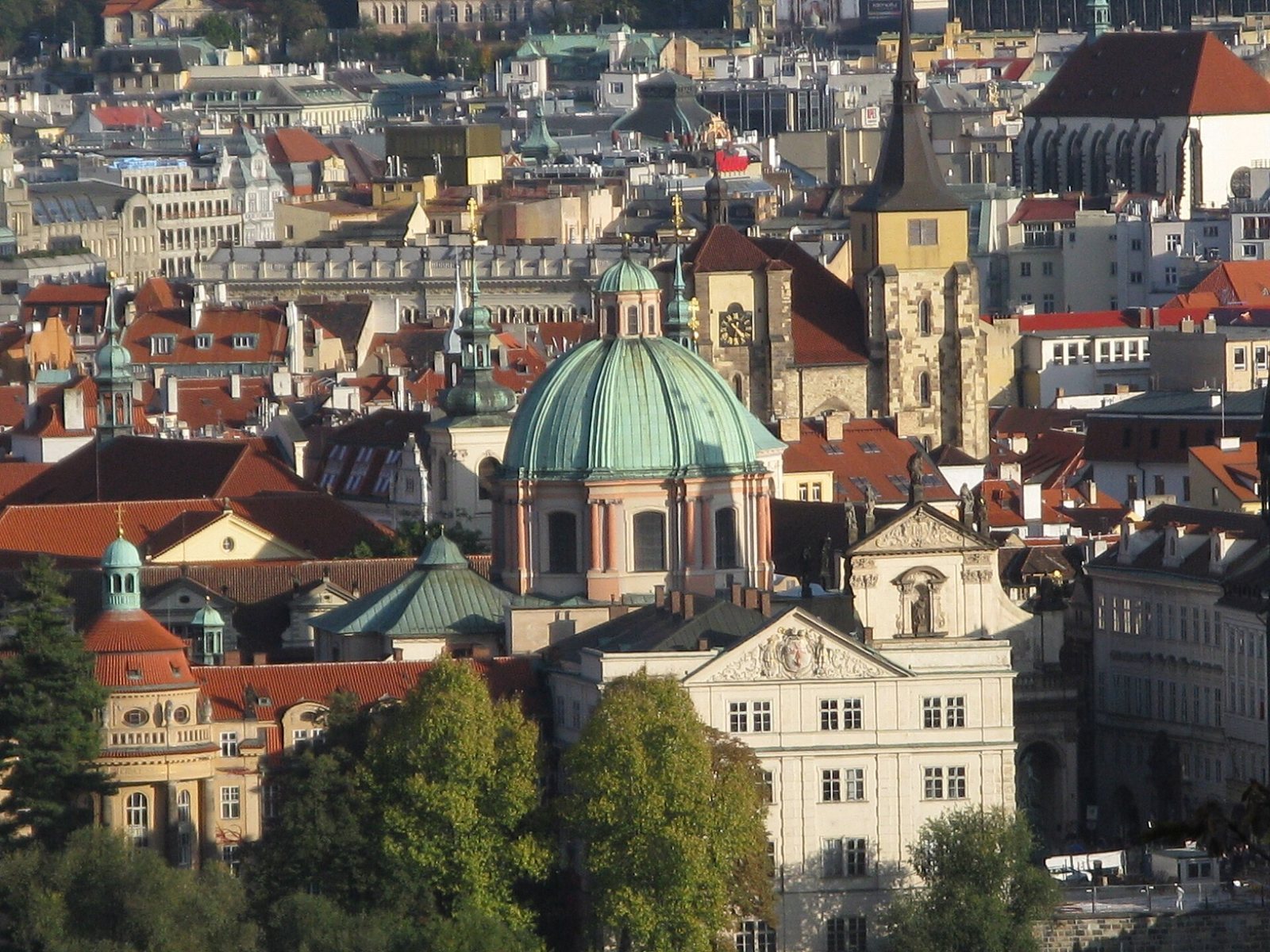
The Church of Saint Francis of Assisi in Staré Město is a Roman Catholic church on Crusaders’ Square in Prague, Czechia. The Knights of the Cross with the Red Star built the present Baroque church in 1679–1685. Founded in Bohemia as a Catholic religious order, the Knights continue to use it as their principal church, as well as an order, monastic, and parish church.
Medieval foundation and the bridge
In 1252, Agnes of Bohemia, a Bohemian princess and religious figure, founded the Knights of the Cross with the Red Star. Beside the Old Town end of Judith Bridge, she established a hospital and a church dedicated to the Holy Spirit, whose foundation stone was laid that year.
In 1253, Agnes’s brother, King Wenceslaus I of Bohemia, gave the order the right to collect tolls on the bridge and roads. In return, the Knights were responsible for guarding and maintaining Judith Bridge. These duties and rights ended in the 14th century when Charles Bridge was completed. Sandstone for the new bridge came from a quarry near Hloubětín owned by the order.
A fire in the convent damaged the Holy Spirit church in 1378. The church was repaired and remained in use until the construction of its Baroque successor in the 17th century. The order reached the height of its power in the 16th and 17th centuries.
Baroque rebuilding and later history
The new church was built partly over the foundations of its Gothic predecessor. French architect Jean-Baptiste Mathey designed it, and Italian builders Gaudenzio Casanova and Domenico Canevalle carried out the work. Jan Bedřich of Valdštejn, Archbishop of Prague and head of the order, consecrated the church in 1688 and dedicated it to Saint Francis of Assisi.
After the largely peaceful Velvet Revolution ended communist rule in Czechoslovakia in 1989, the church and adjoining monastery buildings, which had been nationalized, were returned to the order in 1990. Mozart and Franz Liszt are among the musicians who played the church’s organ.
The Charles IV monument
The order’s leader Jakob Bär commissioned a monument to Charles IV, the medieval King of Bohemia and Holy Roman Emperor. Dresden sculptor Ernst Julius Hähnel made it in 1844. Its planned unveiling in 1848, intended to mark 500 years since the founding of Charles University, was postponed amid student unrest during the Pan-Slav Congress, a gathering of Slavic representatives in Prague. The monument was unveiled on 31 January 1851.
Remains
The church stands east of Charles Bridge on the right bank of the Vltava. The restricted building site determined its north–south orientation. Its central Greek-cross plan, with four arms of roughly equal length, surrounds an oval central space beneath a large dome. The main altar is at the northern end. The building combines stone, masonry, wood, and marble.
Plan and exterior
The main entrance is on the south side, where a stone-clad façade is articulated by Roman Doric pilasters, shallow column-like projections in a classical style, and concave corners. Sculpted angels stand along the upper section. Five niches hold statues of Agnes of Bohemia, Saint Vitus, Saint Francis of Assisi, Saint Ludmila, and Saint Wenceslaus. Dated 1723–1824, the figures are attributed to the workshop of Matthias Wenzel Jäckel.
Interior decoration
Dome, paintings, and stucco
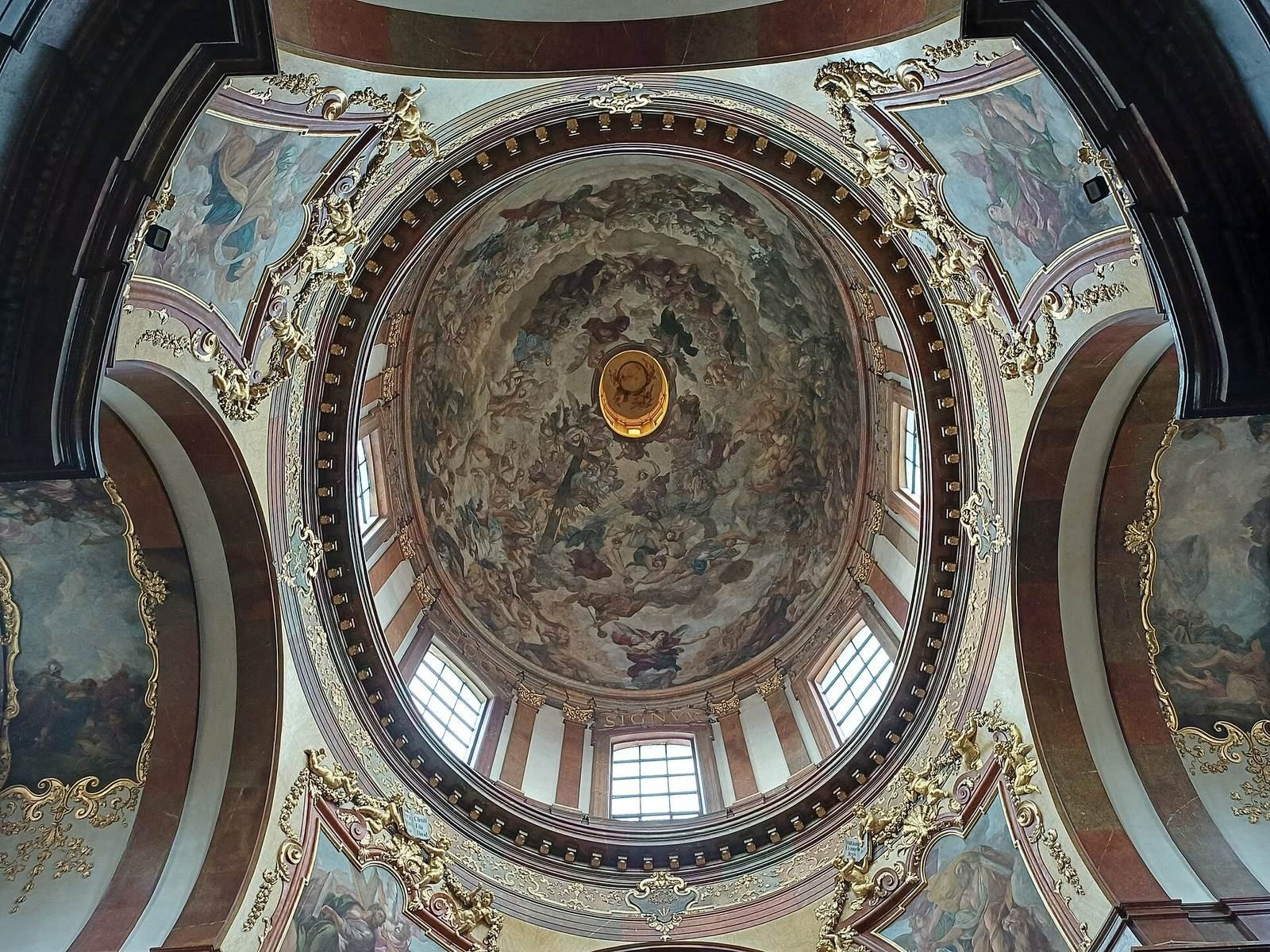
Václav Vavřinec Reiner painted the dome’s Last Judgment fresco in 1722–1723. A fresco is a painting made on wet plaster. Among the dome’s stucco ribs, Italian painter Tommaso Soldati depicted the Four Evangelists. Other frescoes show episodes from Saint Francis’s life. Reiner also painted the Church Fathers on metal panels. Above the altar arch are his works The Assumption of Mary, The Battle of Constantine, and The Adornment of the Ark on the Temple Mount.
Decorative stucco, a plaster material used for ornament, came from the workshops of Giovanni Pietro Palliari and Giovanni Bartolomeus Cometa. Jan Kryštof Liška’s allegorical figures and angels appear on the presbytery ceiling, in the chapels of Saint John the Baptist and the Holy Trinity, and in paintings above the entrance. Liška also represented the four cardinal virtues: prudence, justice, temperance, and courage.
Altars and sculpture
The central image on the main altar, credited to Liška, shows Saint Francis receiving the stigmata. Liška and Jäckel are credited with works for the main and two side altars; the main altar itself is attributed to A. J. Dobner. It also contains a fragment of the True Cross, traditionally identified as the cross on which Jesus was crucified. The side chapels have altarpieces depicting the Exaltation of the Holy Cross and the Assumption of the Virgin Mary. One chapel contains Michael Willmann’s painting of the Expulsion of the Merchants from the Temple.
Ten niches in the church contain sandstone statues. Jäckel made figures of Mary Magdalene, Joseph, John of Nepomuk, and John the Baptist. Konrád Max Süssner sculpted Barbara, Catherine, and George; Jeremiáš Süssner made Joachim, Martin, and Anne.
Organ and sacristy painting
The church’s organ dates to the early 18th century. Its gallery is unusually positioned to the right of the main altar. A small copy of a painting by El Greco hangs above the sacristy entrance; the original is in the Prado Museum in Madrid.
Medieval church and adjoining buildings
Lower church
The lower church preserves the layout and orientation of the medieval church. That earlier building measured about 10 metres long and 12.5 metres wide, including its side aisles. It had an east-facing presbytery and a pentagonal apse, a projecting end of the church. Its southern side entrance survives as a fragment.
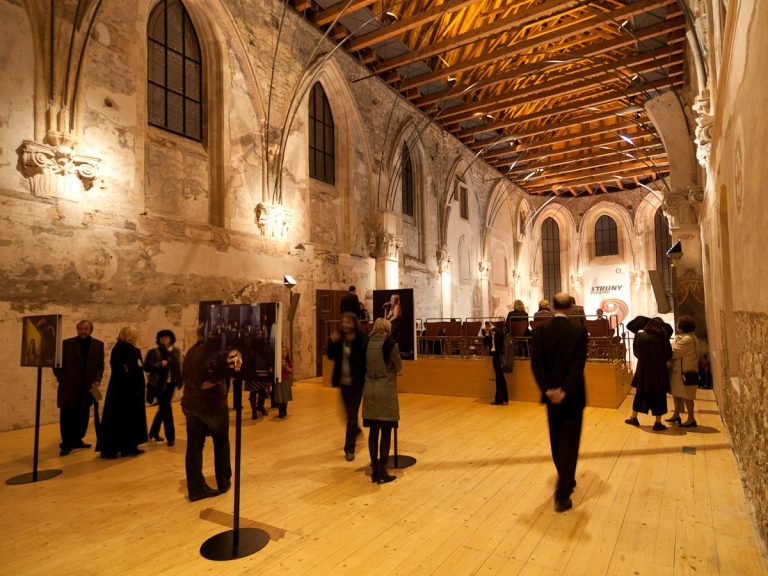
Behind a modern doorway is an early Gothic columned portal. Fragments of door frames, architectural mouldings, and wall paintings from the former three-aisled church were uncovered after 1990. The lower church also contains tombs of people associated with the order and a Baroque grotto, an artificial cave-like feature, on its southern side. Three small barred openings in the floor connect it to the upper church; access is also possible from a monastery corridor.
Residence and monastery
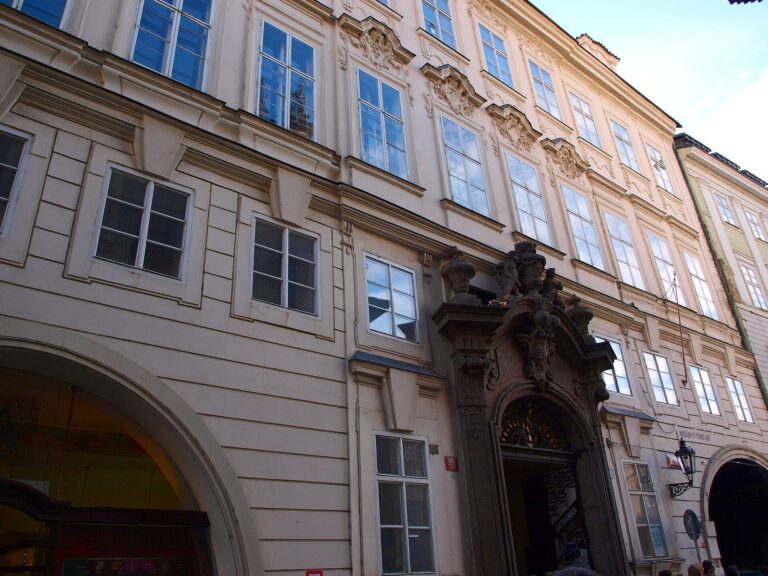
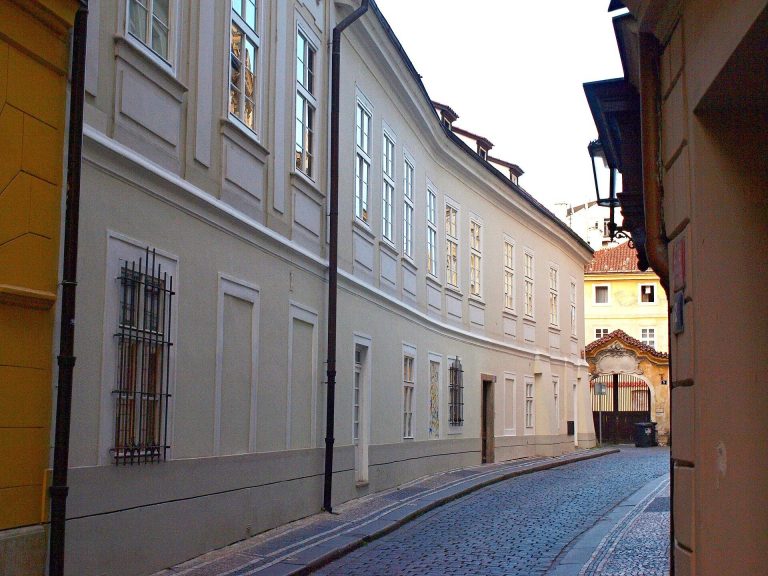
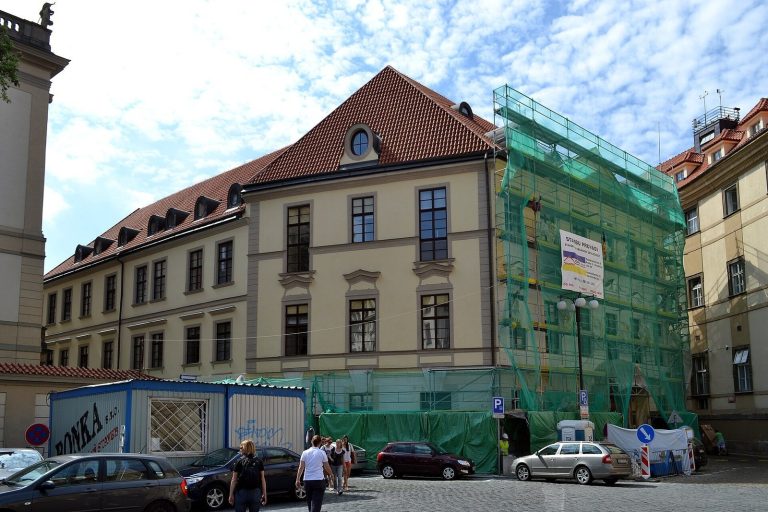
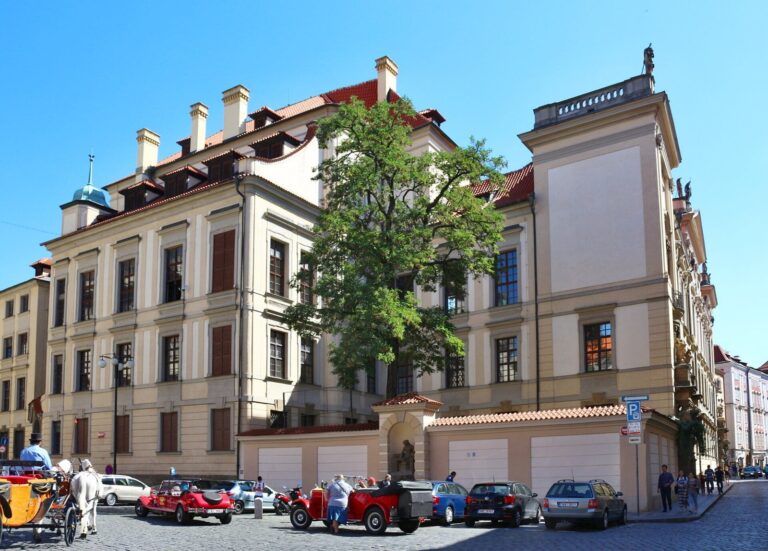
The former residence of the order’s head adjoins the church on the west. Built in the early Baroque style in 1661–1662, it gained an additional storey in 1846. The order’s largest monastery lies to the north. Part of the brick masonry of Judith Bridge’s tower is incorporated into its wall.
Monuments beside the church
Charles IV monument
In front of the church, the Charles IV monument stands on an ornate pedestal in the Gothic-revival style.
Vintners’ Column
To the right of the church, a statue of Saint Wenceslaus by Johann Georg Bendl, dated 1676, stands atop the Vintners’ Column.