Franciscan Church in Vienna: A Renaissance-Era Franciscan Parish Church
Site at a Glance
- Popularity
- High
- Country
- Austria
- Primary era
- Early Modern
- Eras represented
- Early Modern
- Civilizations
- Habsburg, Habsburg Austria, Holy Roman Empire
- Site type
- Religious
- Remains
- Church
On this page10 sections
History
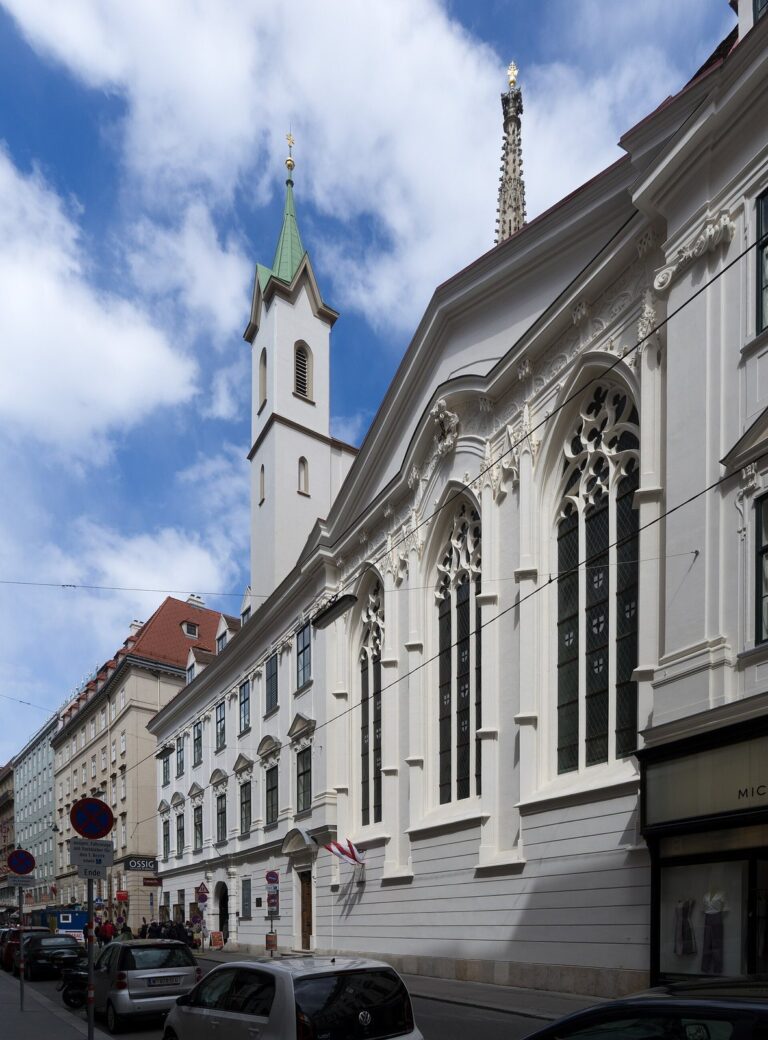
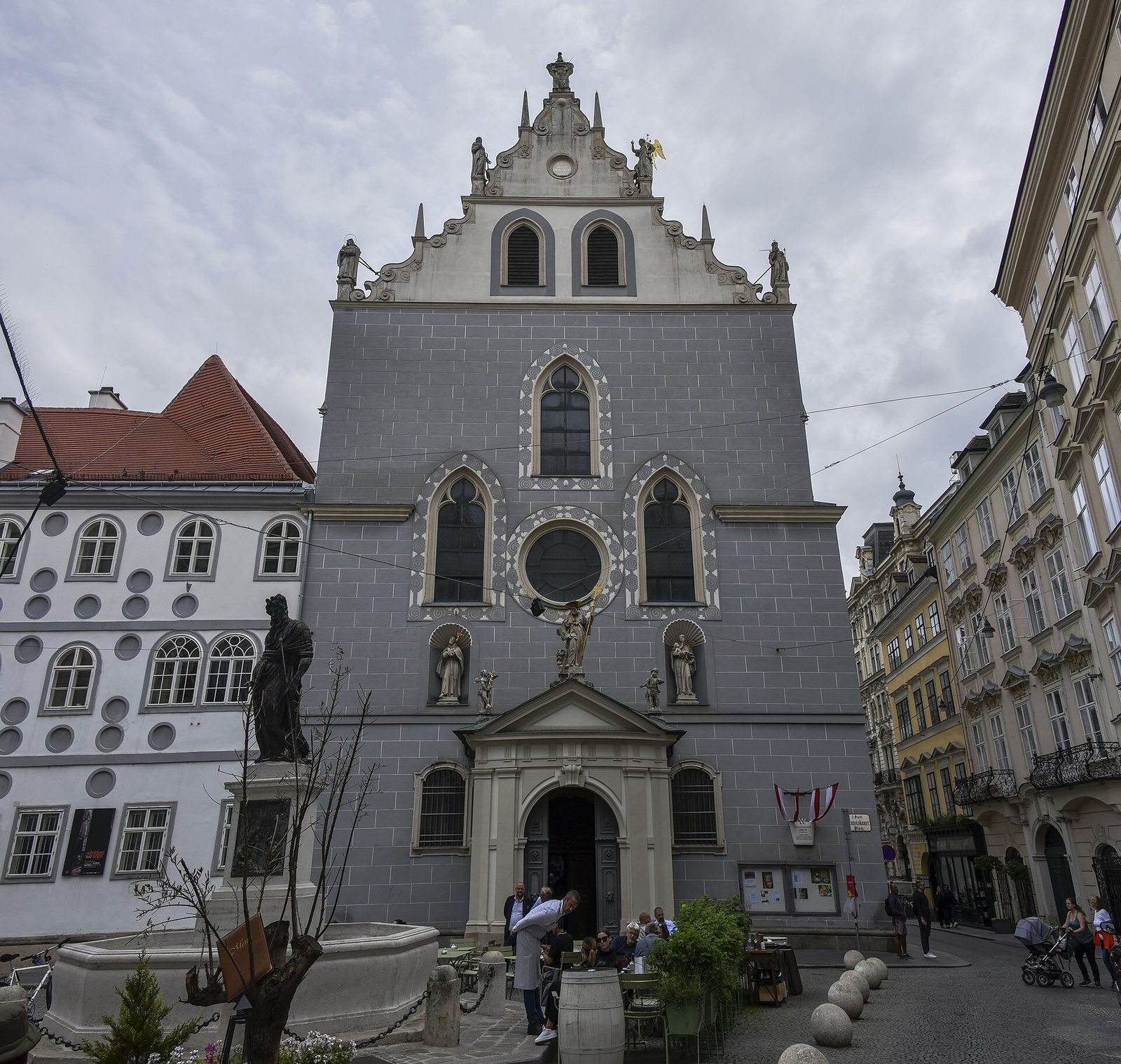
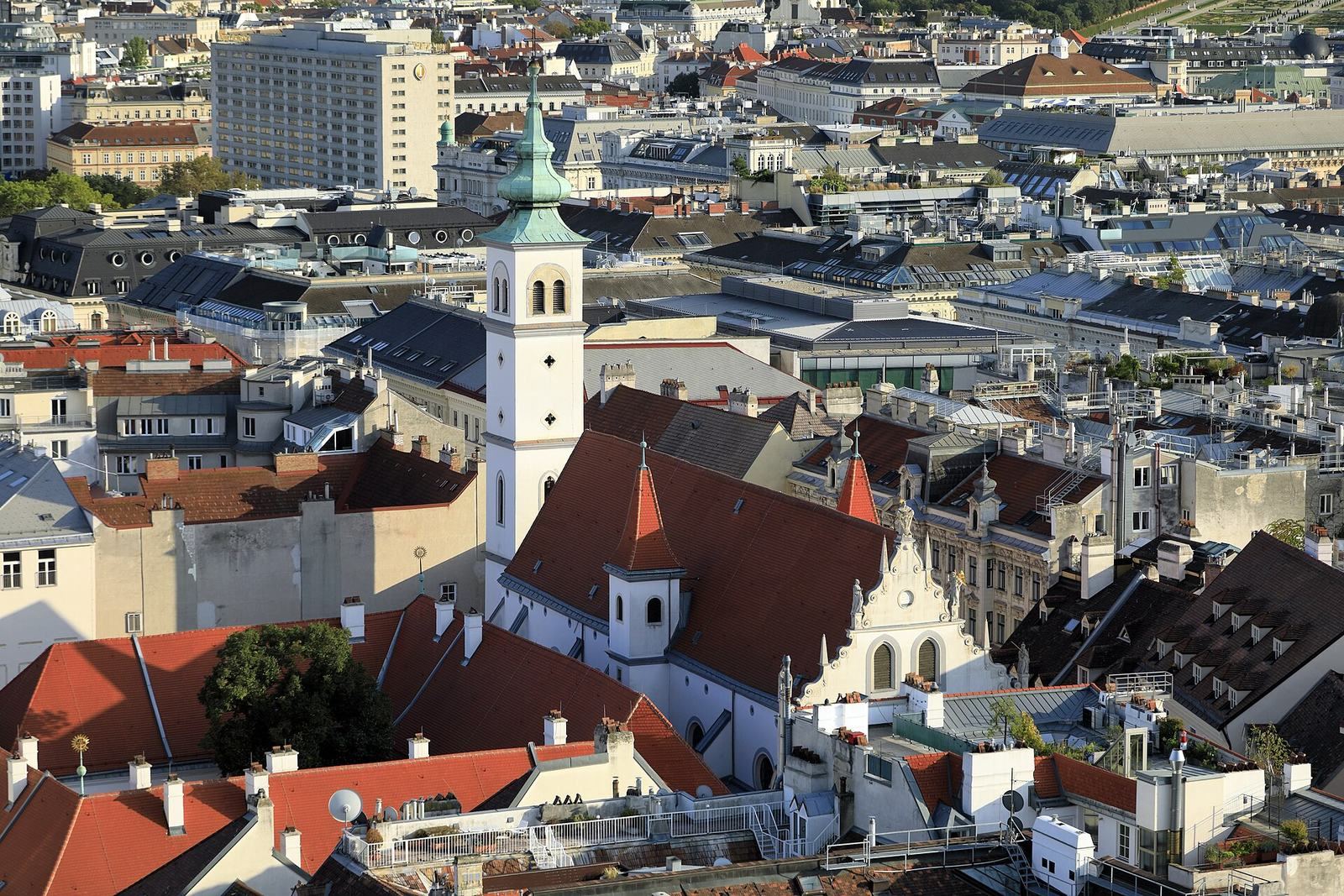
The Franciscan Church in Vienna is a Roman Catholic parish church in Austria, on Franziskanerplatz. Construction began in 1603. Its Renaissance design, a revival of classical forms, incorporates Gothic elements.
The first Franciscan monastery
On 22 July 1451, the Franciscan Order established its first monastery in Vienna under the direction of John of Capistrano, a fifteenth-century Franciscan preacher and reformer. The community took over the former St Theobald convent in Laimgrube, founded in 1349. During the Ottoman siege of Vienna in 1529, Ottoman forces destroyed the monastery and about 100 friars were killed. The Franciscans then lived at various churches around the city.
Relocation and rebuilding
Other Franciscan houses proved too small. One at St Rupert was used until 1545, while another was associated with St Nikolaus at Nikolai and Grünangergasse. After prolonged negotiations, Vienna’s municipal authorities transferred a burned and ruined convent to the Franciscans in 1589. Built beside a cemetery between 1383 and 1387, the convent had served as a refuge for women who had repented of prostitution. It was known as the convent of the Penitents or St Jerome. About four decades before the transfer, Petrus Canisius, a Jesuit theologian and leading figure in the Counter-Reformation, the Catholic response to Protestant reforms, had regularly preached in its church. The Franciscans rebuilt the church using older building components.
Construction and continuing use
The cornerstone of the new church was laid on 14 August 1603. The church was completed in 1607, and the friars moved into the still-unfinished complex on 8 December that year. Planned for 200 brothers, the monastery was completed in 1630. The church was consecrated in 1611, while work on its interior decoration continued until about 1720.
Since 1633, the monastery has housed the General Commissariat of the Holy Land, an administrative office that supports Franciscan missions there. It also operates a meal service for poor people. Dedicated to Saint Jerome, a fourth-century Christian scholar and translator of the Bible, the church serves as a Franciscan parish within the Archdiocese of Vienna and the parish of St Stephen’s Cathedral. The monastery belongs to the Order of Friars Minor, the formal name of the Franciscan order, and its Austrian province, also known as the Province of St Leopold in Austria and South Tyrol. A Franciscan province is a regional administrative division within the order.
Remains
The church is a basilica, a church organized around a central nave, or main lengthwise space. It measures 65 metres long and 20 metres wide, with a nave 12 metres wide. F. Bonaventura Daum is identified as its architect. The gray façade faces northwest. Inside, Baroque decoration, marked by dramatic scale, movement, and ornament, is combined with Rococo, a lighter decorative style that developed in eighteenth-century Europe.
Façade and square
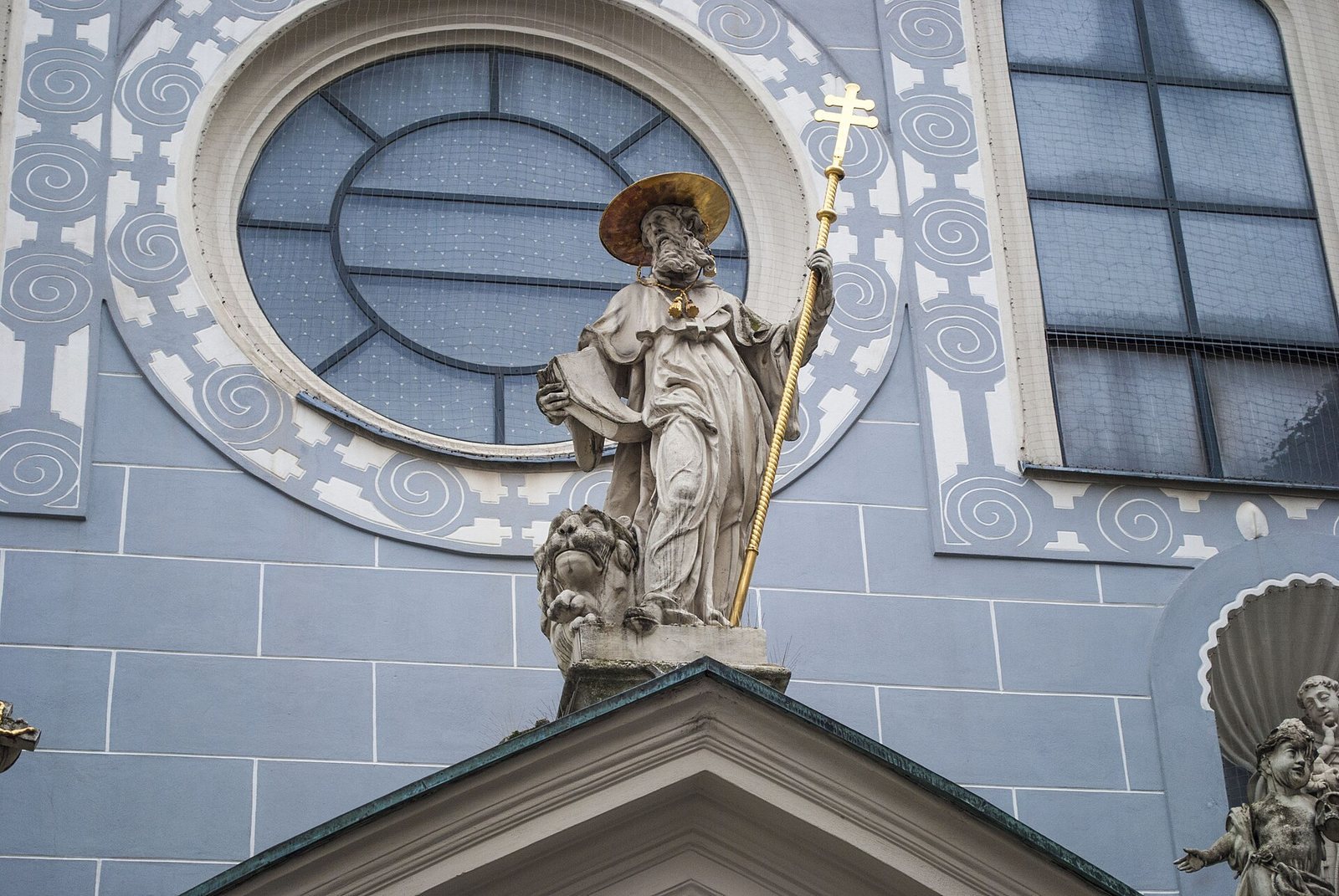
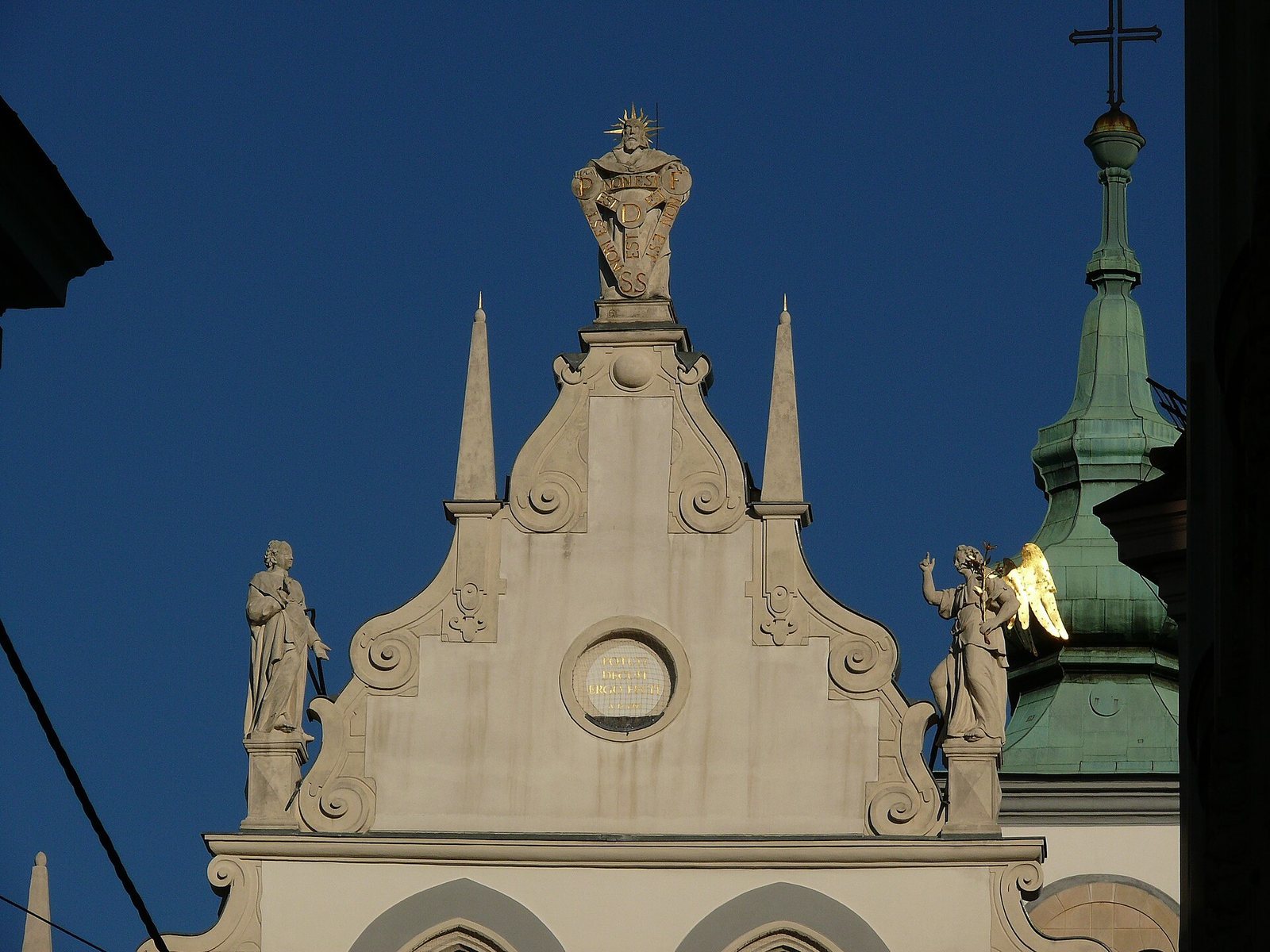
The gable bears an unusual three-faced depiction of the Holy Trinity, the Christian doctrine of one God in three persons. At its base are sculptures of Louis IX of France, a thirteenth-century king and member of the Franciscan Third Order, and Clare of Assisi, founder of the Poor Clares, a Franciscan order for women. A separate sculpture depicts Saint Jerome beside a lion. On Franziskanerplatz in front of the church stands the Moses Fountain, made by Johann Martin Fischer in 1798.
Interior furnishings
High altar
Andrea del Pozzo, an Italian Jesuit painter and architect, designed the Baroque high altar in 1707. It depicts the Virgin Mary. A wooden statue of the Virgin, made in Grünberg in Bohemia in the fifteenth century, stands on the altar. Known as the Madonna with the Axe, it is regarded as miraculous.
Organ
The carved Baroque organ is described as the oldest in Vienna. Johann Wöckherl designed it in 1642, and it was installed in 1643 in the choir behind the high altar.
Side altars and chapels
The Baroque side altars are adorned with paintings and sculptures by Johann Martin Schmidt, Carlo Carlone, and Franz Xaver Wagenschön. Wagenschön’s painting of the martyrdom of St John of Capistrano is in the Capistran Chapel. The Francis Chapel contains an image of the church’s patron saint by Johann Georg Schmidt, while the Crucifixion Chapel has a painting of the Crucifixion by Carlo Carlone.