Almallutx: A Talayotic Ceremonial Complex in Mallorca
Site at a Glance
- Rating
- 5
- Popularity
- Very Low
- Country
- Spain
- Primary era
- Iron Age
- Eras represented
- Iron Age, Classical
- Civilizations
- Unclassified
- Site type
- Religious
- Remains
- Sanctuary
On this page12 sections
History
Almallutx is a prehistoric complex in Mallorca, Spain, built by communities of the Talayotic culture. This Iron Age culture developed on Mallorca and Menorca from the seventh century BC, and Almallutx was occupied from that century until Roman occupation began in 123 BC. The complex is generally interpreted as a sacred ceremonial site.
Talayotic occupation
Interpretations of Almallutx’s purpose include animal sacrifice and burial. Some compare its sanctuaries with Menorcan taulas, monuments formed by a large upright stone supporting a horizontal one. Another proposal identifies Almallutx as a possible central sanctuary for the island, based on the sacred importance attributed to high places in prehistoric belief. Its elevated position has also been interpreted as bringing the dead closer to the gods.
Recognition and later changes
A photograph taken in 1934 by Francisco Franco, then a Spanish military officer, drew attention to prehistoric structures on Puig Major. Archaeologist Jaume Deyà later proposed that these remains might form a separate Talayotic sanctuary, perhaps connected with Almallutx. Although the two sites are far apart, they are visible from one another, a relationship used to support the idea that Almallutx held symbolic importance.
Spain declared Almallutx an Asset of Cultural Interest in 1966. Archaeologists Manuel Fernández-Miranda, Bartomeu Ensenyat, and Catalina Ensenyat excavated the complex in 1969 and 1970, and later restoration improved the condition of two sanctuaries. Construction of the Gorg Blau reservoir in the 1970s submerged part of the archaeological site. A separate Islamic camp, excavated from 2011, partly overlaps the Talayotic settlement.
Remains
Layout and construction
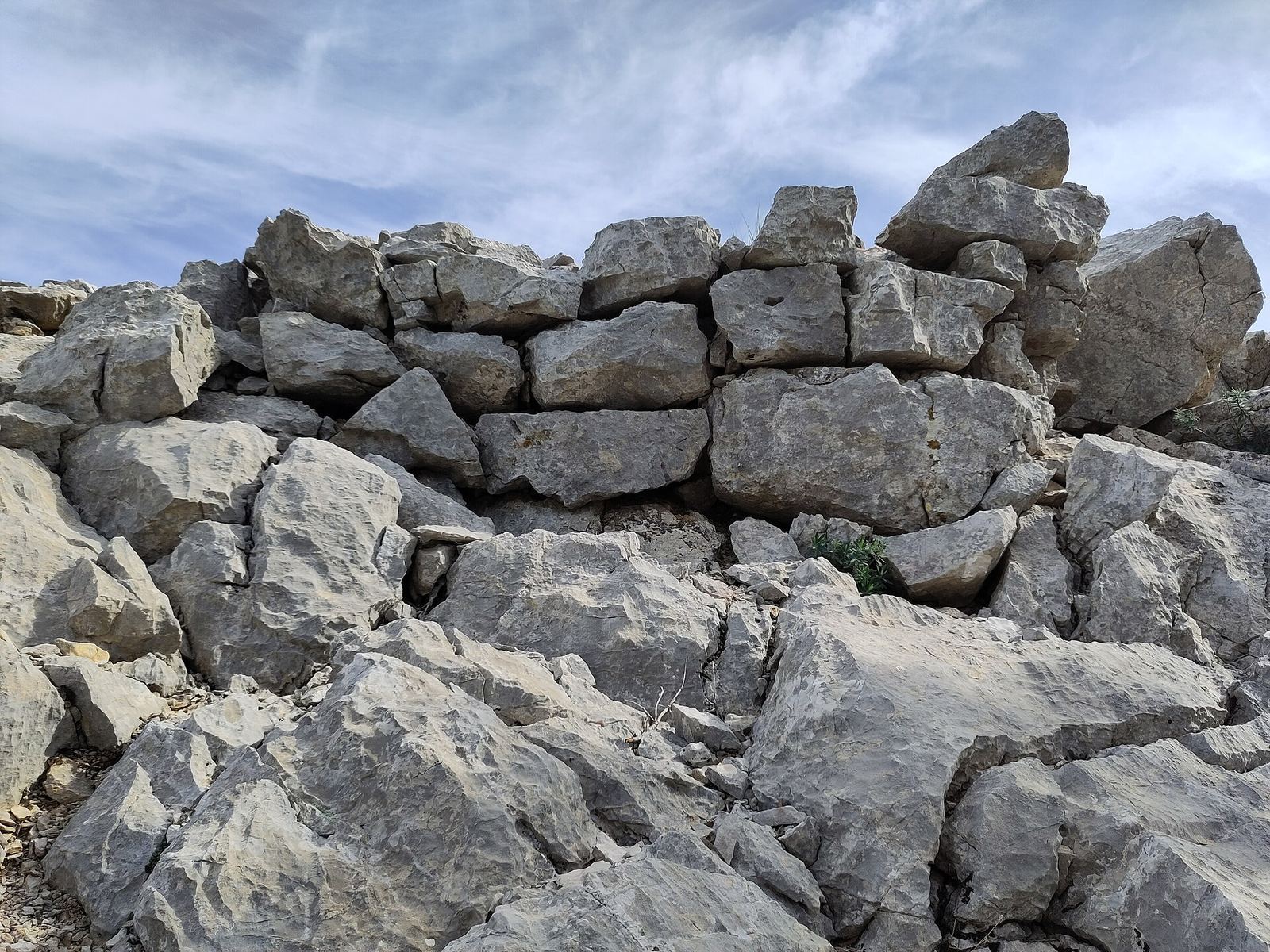
The complex lies about 610 metres above sea level in the valley between Morro d’Almallutx and Puig de ses Vinyes, on the slope of Es Castellot and east of the Gorg Blau reservoir. It extends across the valley over an area of about 2,000 square metres. A 35-metre wall protects its lower side. The site includes two sanctuaries and two other structures known as Talayots 3 and 4, whose functions remain undetermined. Its buildings have quadrangular bases and use very large stone blocks.
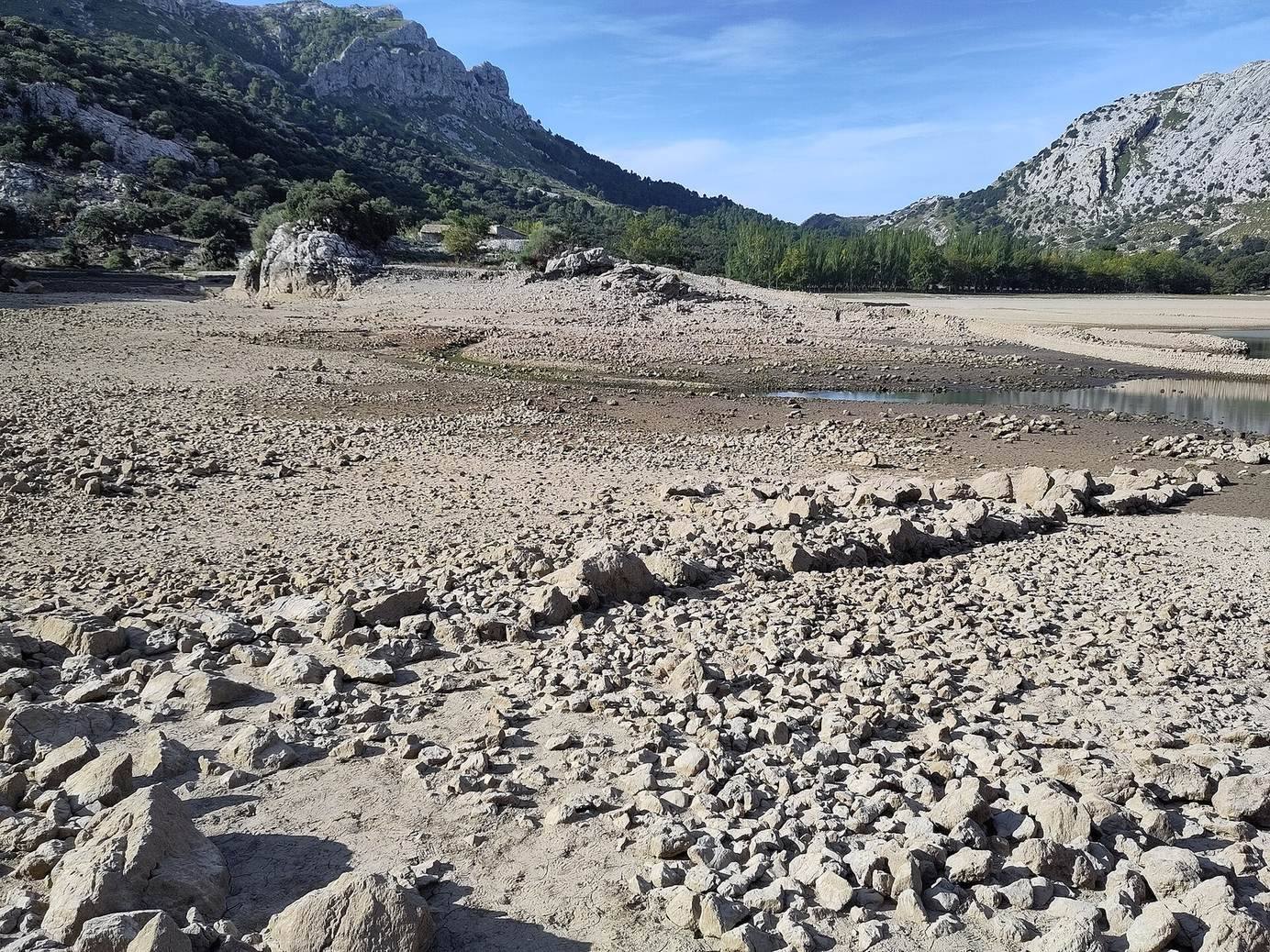
The adjacent Talayotic settlement lay between the sanctuaries and the estate houses. It is now submerged beneath the reservoir, with the extent of inundation changing according to seasonal water levels.
Sanctuaries
Sanctuary 1
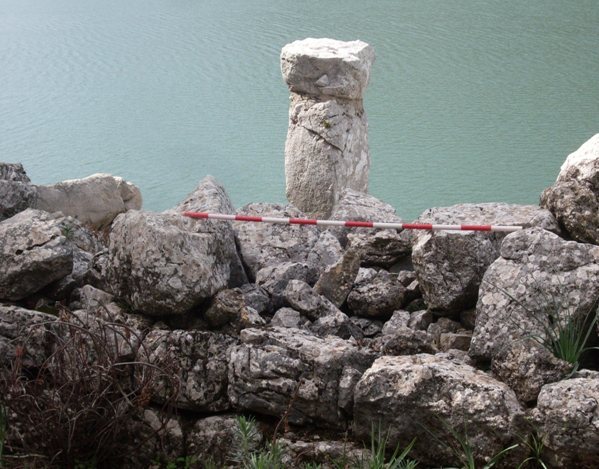
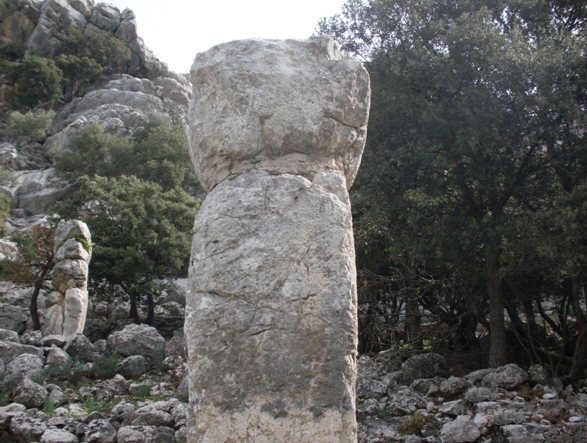
In the north-western part of the site, nearer Es Castellot, Sanctuary 1 has a rectangular plan with rounded corners, measuring about 9.4 by 9.6 metres. Its walls are built in courses of large stones. A central support made from three stones stood about 4 metres high; it had fallen by the time of excavation. In 1969, one of the sanctuary’s columns was moved beside the road near a viewpoint overlooking the reservoir.
Sanctuary 2
Sanctuary 2 stands closer to the reservoir. It is rectangular, measuring about 9.65 by 8.65 metres, with a central three-stone structure about 3.5 metres high.
Other prehistoric structures
Talayot 3
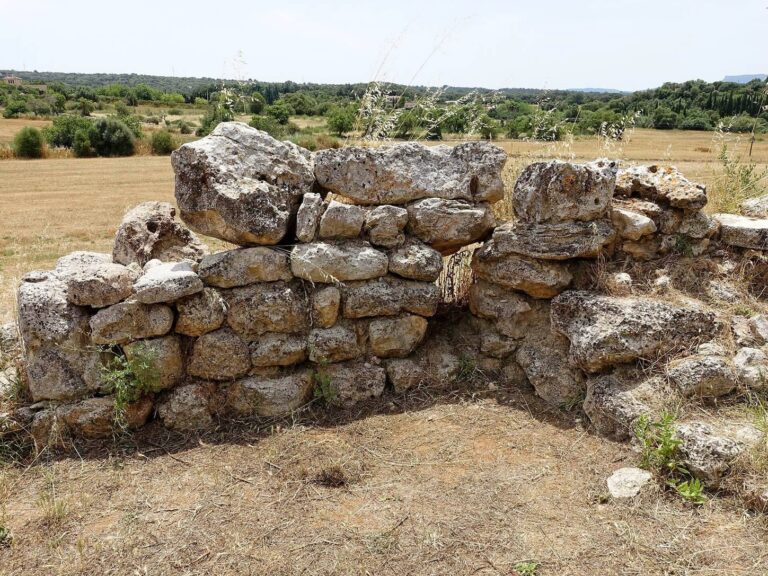
A talayot is a large prehistoric stone structure associated with Talayotic culture. The remains identified as Talayot 3 have a roughly square base, about 6.5 by 6.35 metres. Only two wall corners survive, reaching about 0.6 metres at the level of the first stone course, and no doorway remains are visible. A column base is also preserved; the column would have stood nearly 4 metres high if complete.
Talayot 4
Talayot 4 is almost entirely destroyed. Irregular traces survive to a height of about 0.5 metres or less.
Finds and burials
Truncated-conical vessels contained chopped animal remains. In Sanctuary 1, the identified fragments comprised 67.5 percent sheep, 14.2 percent goat, 17.1 percent pig, and 2.5 percent cattle. Two human burials were found: one young person had been laid out and covered with stone slabs, while the other body was crouched. A spherical projectile lay near each burial, including one beside a skull, and a child’s mandible was also recovered. A crucible found inside Sanctuary 1 has been interpreted as evidence of the importance of metalworking in Talayotic beliefs.