Wickliffe Mounds: A Mississippian Ceremonial and Administrative Center
Site at a Glance
- Rating
- 4.5
- Popularity
- Medium
- Country
- United States
- Primary era
- Medieval
- Eras represented
- Medieval
- Civilizations
- Mississippian
- Site type
- Settlement
- Remains
- Town
On this page10 sections
History
Wickliffe Mounds is a Mississippian community on a bluff near the confluence of the Ohio and Mississippi rivers in the United States. It belonged to the Mississippian culture, a pre-Columbian Indigenous North American tradition associated with settled farming communities and mound building. Occupation is dated broadly to about 1000–1350, and the community served as a ceremonial and administrative center for an important chiefdom, a ranked political community led by a chief.
Settlement and mound-building phases
The settlement began as a small village around 1100. Its development is divided into an early phase, about 1100–1175; a middle phase, about 1175–1250; and a late phase, about 1250–1350. Mound construction started around 1175, with Mound B built first. During the middle phase, residents built Mounds A and C, enlarged B, and may have begun work on D. After 1250, they built no new mounds, but completed A, B, and D. The community continued to expand across the bluff.
At its height, Wickliffe probably had a population in the hundreds and was governed by a hereditary chief. Maize was the staple crop; growing and storing it supported a larger population and greater social stratification. The community traded with societies as far away as present-day North Carolina, Wisconsin, and the Gulf of Mexico.
Archaeologists associate Wickliffe with Kincaid, Tolu, and Angel Mounds in the lower Ohio Valley because of similarities in pottery and settlement plans. Comparisons with Kincaid and Angel have led some researchers to suggest that the communities shared a society. In the late phase, fishhooks stopped appearing in excavated material, a change interpreted as a possible sign that fish had left the residents’ diet.
Abandonment and archaeological history
Residents began moving to the Twin Mounds Site, several miles northeast near the Ohio-Mississippi confluence, around 1300. Wickliffe appears to have been abandoned by about 1350.
Robert Loughridge mapped the mounds for the Kentucky Geological Survey in 1888, the first written mention of them. Amateur and semiprofessional excavations began around 1913, and highway construction exposed pottery and other finds in 1932. That year, lumberman and artifact collector Fain W. King paid for excavations in central parts of Mounds A, B, and C, including the cemetery in C. Alabama state geologist Walter B. Jones directed the work, with David L. DeJarnette as crew chief. Private excavations in the 1930s also destroyed at least four other mounds shown on Loughridge’s map.
King and his wife, Blanche Busey King, opened the site as the “Ancient Buried City.” Their venture drew criticism for sensational advertising, alterations made for display, and interpretations challenged by professional archaeologists. Blanche King published a book about the excavations in 1939. In 1946 the Kings deeded the site to Western Baptist Hospital in Paducah, which continued operating it as a tourist attraction. After Blanche King’s death in 1983, the hospital donated the site to Murray State University. The university established a research center and carried out further excavations from 1984 to 2004.
Kentucky acquired the site in 2004, making it the state’s 11th State Historic Site. Wickliffe Mounds is also a Kentucky Archaeological Landmark and has been on the National Register of Historic Places since 1984. Because excavation has removed mound material, the preservation policy is to avoid further digging unless it is expected to yield substantially new knowledge.
Remains
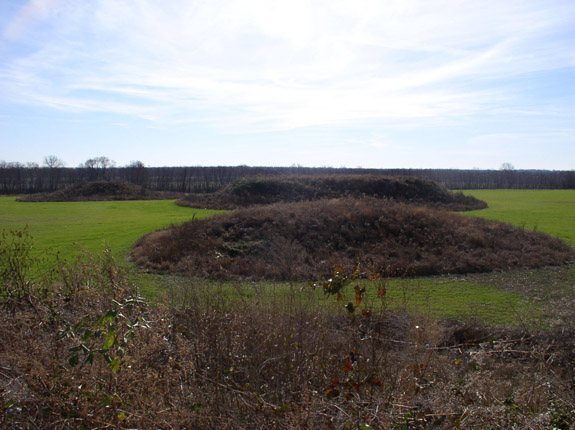
The archaeological site occupies a bluff, and the state historic park covers 10 hectares. The settlement was arranged around a central plaza, now beneath the parking lot. Its earthworks include two large platform mounds, raised flat-topped earthworks that could support buildings or other activities, and at least eight smaller mounds around the plaza. Four excavated mounds are identified as A through D, in the order they were excavated.
Mounds
Mound A
The largest mound is a platform that supported ceremonial buildings and served as the community’s political and religious center. Excavations identified six phases in its development.
Mound B
Mound B was used for housing and was built up over about 200 years. It contained two buildings erected on the mound. Layers of charred cooking material and holes left by support poles indicate residential use; the poles held woven plant walls coated with earth or clay. One house may have belonged to the chief and his family or to a head priest. A corner of a house has been reconstructed. The Architecture Building, which once covered the mound, has been removed, and the excavation was later filled in.
Mound C
Mound C served as the community cemetery. Its burials date to the thirteenth century, around 1200, and include many infants as well as people with identifiable conditions or injuries, including arthritis and tuberculosis. The original human remains were reinterred. Artificial skeletons illustrate the burials, while curtains with traditional designs cover remains left in place. The excavation has been filled in.
Mound D
Also called the Lifeway Mound, Mound D occupied an early residential area. Excavations revealed the arrangement of earlier houses and numerous infant burials. The houses were later replaced by an elongated mound, most of which was removed during excavation.
Pottery and museum displays
Pottery fragments from Wickliffe include painted examples and pieces decorated with cut lines. These rare types make up about 3–4 percent of the pottery assemblage, compared with less than 1 percent near Kincaid. Styles found across the associated lower Ohio Valley communities include Angel Negative Painted, Kincaid Negative Painted, and Matthews Incised. The pottery was made with crushed shell mixed into the clay. It ranges from Mississippi Ware, with smoother surfaces and a coarser shell mixture, to the finer, more polished Bell Ware.
The site museum displays pottery and other objects excavated at Wickliffe, alongside exhibits on pottery, stonework, and shell and bone finds. A mural depicts how the Mississippian village on the bluff may have looked from above.