Rawak Stupa: Buddhist Monument of the Khotan Silk Road
Site at a Glance
- Rating
- 5
- Popularity
- Very Low
- Country
- China
- Primary era
- Classical
- Eras represented
- Classical
- Civilizations
- Unclassified
- Site type
- Religious
- Remains
- Stupa
On this page7 sections
History
Rawak Stupa, a Buddhist monument often associated with relics or commemorative worship, was the central structure of a complex in the historic Khotan region of China. Khotan was an oasis kingdom and Buddhist center on the Silk Road, a network of routes connecting regions across Asia and beyond. The complex’s architecture is associated with Gandharan style, linked to an ancient cultural region whose art combined influences from several traditions. Its chronology remains uncertain. One estimate places the complex’s period of existence from about the mid-fourth to the mid-seventh century. Aurel Stein favored a late-third- to early-fourth-century date, while other assessments place it around AD 400 to 500; another proposal dates its foundation to sometime between the Jin and Tang dynasties, separated by several centuries and intervening regimes.
Dating and abandonment
Stein based his proposed date on the stupa’s form, sculptures, and paintings. Assessments placing Rawak around AD 400 to 500 have cited coins, sculptures in a passage around the stupa, and a chamber high in its dome. The differing chronologies have not resolved when the complex was founded or abandoned.
The reasons for abandonment are also disputed. One explanation links it to a change in the river’s course. Another proposes that religious conflict reduced the labor force available to maintain the site.
Archaeological investigations and protection
In April 1901, archaeologist Aurel Stein excavated at Rawak for eight days. He described the stupa as the most imposing structure he had encountered among the Khotan ruins. After recording sculptures, he covered them again with sand, helping to protect and support them. When he returned in September 1906, treasure seekers had removed most of the large sculptures. Stein checked his earlier plans and excavated ruins between the stupa and the nearby Tati of Hanguya complex.
In 1928, Emil Trinkler led a German-Swiss expedition at Rawak. Chinese archaeologist Huang Wenbi made a brief visit in June 1929 as part of the Sino-Swedish expedition led by Sven Hedin. Local authorities excavated at the site in 1942, and an international expedition focused on research in the Western Regions returned in 1992.
Rawak became a Major Historical and Cultural Site Protected at the National Level in China in 2001, a designation for culturally important sites under national protection. Emergency reinforcement work began in 2007, and the national cultural heritage authority approved the conservation plan in principle in 2012.
Remains
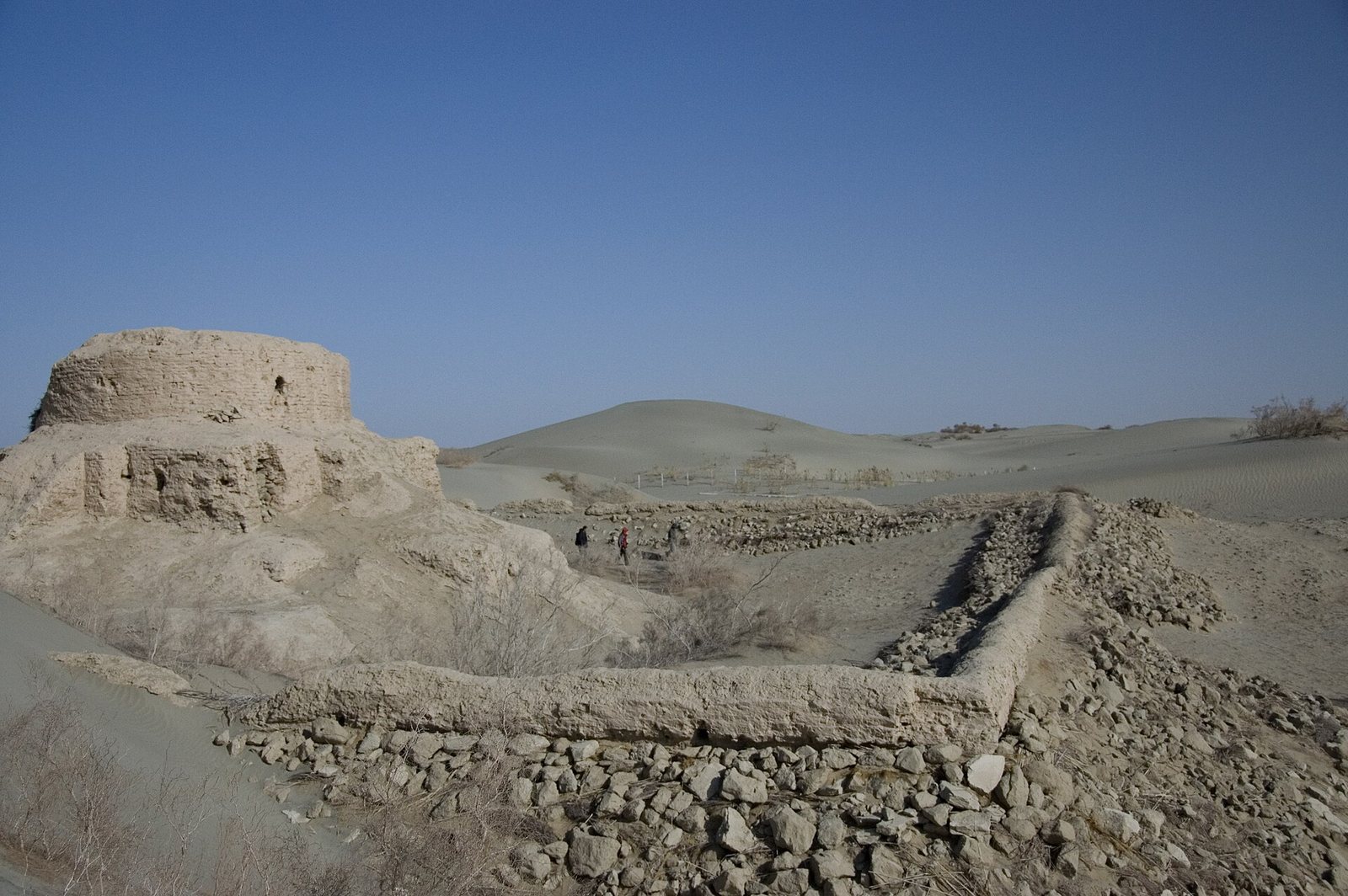
The complex is arranged around a Buddhist stupa inside a rectangular walled courtyard, with smaller buildings around the central monument. Its plan adapts a square-based stupa form: stairways project from all four sides to create a cross-shaped base. The stupa and surrounding buildings have been interpreted as a three-dimensional mandala, a symbolic arrangement representing sacred or cosmic order. The site lies on the southern edge of the Taklamakan Desert, east of the Yulong Kashgar River and north of Jiya Township, at about 1,290 m above sea level. It is roughly 40 km north of Hotan and about 50 km northeast of Luopu County.
The stupa
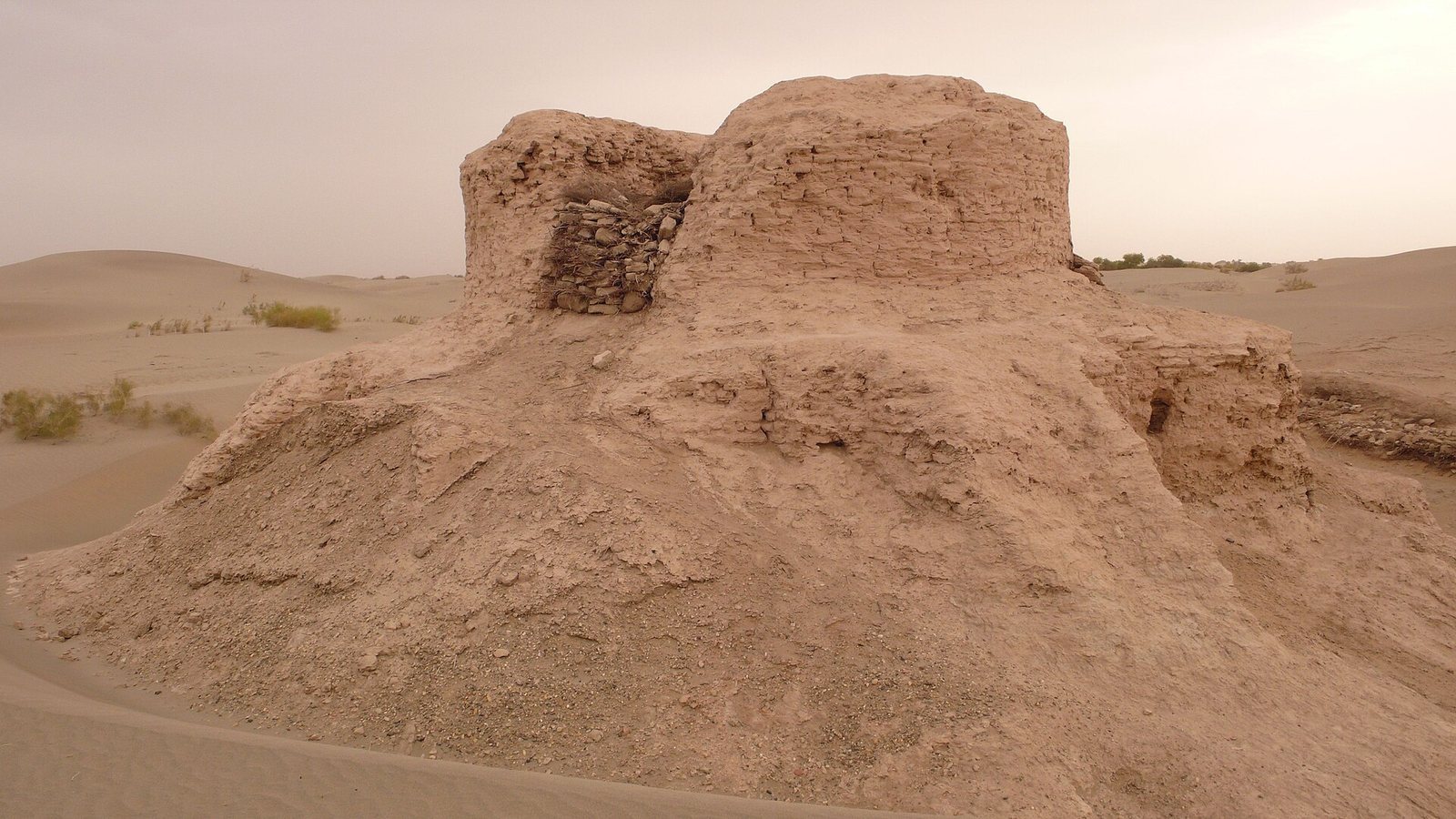
The stupa stands on a cross-shaped platform about 5 m high. Its surviving inverted-bowl-shaped base is approximately 10 m high and 23 m wide. A pit about 2 m across marks the top, while gaps on the southeast and northwest sides have been attributed to slope failure.
The stupa’s form has been compared with the Bamiyan Buddhas, the Kanishka stupa at Balkh, and Top-i-Rustam. Kanishka was a ruler of the Kushan Empire, a major Central and South Asian power. The design has also been compared with a stupa described in the Divyavadana, a collection of Buddhist narratives, with four stairways, three platforms, and an egg-shaped dome. Rawak has been described as a prototype for many forms of Chinese pagoda.
Courtyard walls and decoration
The courtyard measures about 50 by 43 m. Its east wall is approximately 49 m long and its west wall about 46 m; both stand nearly 3 m high, with tops less than 1 m wide. Sand covers the west wall, while the south wall is severely weathered. The inner wall faces carry mainly ochre-colored paintings and red-clay decoration, including raised images in stucco, a plaster-like material. Much of this work has been damaged or destroyed by natural weathering. Rawak is described as the only Buddhist site in the Hotan area with Gandharan architecture, and its stupa as the area’s only relatively well-preserved stupa of that style. Wind and water erosion continue to affect the complex, with cracks developing and looters’ pits enlarging.
Sculptures and excavated objects
Excavations in 1901 uncovered 91 large sculptures of Buddhas and bodhisattvas, figures who seek enlightenment and help others attain it, as well as smaller figures of attendant deities. The sculptures were made of stucco, a plaster-like material, and colored fragments were also found among the ruins. Numerous small raised images in fired clay came from excavations in 1906 between the stupa and Tati of Hanguya; Stein considered them to date to the fifth or sixth century. Finds from the 1942 excavation included three gilded sculptures, 20 intact clay figures, coins, and beads. Some Rawak finds are held by the British Museum. The Metropolitan Museum of Art acquired part of the Trinkler collection in 1930, including a statue head; other material from the collection is held by the Overseas Museum in Bremen.