Maumbury Rings: A Neolithic Earthwork and Roman Amphitheatre
Site at a Glance
- Rating
- 4.5
- Popularity
- Medium
- Country
- United Kingdom
- Primary era
- Stone Age
- Eras represented
- Stone Age, Classical, Early Modern
- Civilizations
- English, Roman
- Site type
- Entertainment
- Remains
- Amphitheatre
On this page13 sections
History
Maumbury Rings is a prehistoric earthwork in Dorchester, United Kingdom. It originated in the later Neolithic and was later adapted as a Roman amphitheatre for nearby Durnovaria, the Roman name for Dorchester.
Neolithic origins and Roman use
Seventeenth-century antiquaries, people who studied the past through material remains, considered the earthwork a possible sun temple. In the Roman period, it was remodelled as an amphitheatre between AD 70 and 150, probably toward the end of the first century. It served the inhabitants of Durnovaria and may also have been used as a barracks and training ground by the Second Legion, a large unit of the Roman army.
The amphitheatre may have ceased regular use by the middle of the second century, though finds point to activity at the site in the third and fourth centuries. Three people were buried there after the amphitheatre fell out of use. One burial was headless, but its possible connection to the later execution ground remains uncertain.
Civil War fortification
During the English Civil War, the conflict between supporters of Parliament and Royalists who backed the king, Parliament’s supporters converted the Rings into an artillery fort to defend Dorchester’s southern approach. The fort was ordered on 19 July 1642 despite opposition from Dorset’s Royalist High Sheriff, a senior Crown-appointed county official. It was completed in 1643 and taken without resistance that August by the Royalist commander Lord Caernarvon. A report from 1649 still referred to the fort.
Executions and later history
The site was used again for public executions in the late seventeenth and early eighteenth centuries. In 1685, following the Monmouth Rebellion, a failed rising against James II, Judge George Jeffreys ordered 80 rebels executed there. In 1705, 19-year-old Mary Channing was strangled and burned after being convicted of poisoning her husband. The execution drew 10,000 spectators. Thomas Hardy later treated the case in his poem The Mock Wife, referred to it in his 1886 novel The Mayor of Casterbridge, and wrote about his research into the event.
By the later eighteenth century, the enclosure had become farmland. In 1846, the proposed route of the Southampton and Dorchester Railway was changed to protect the Rings.
Excavation and protection
Harold St George Gray excavated the site from 1908 to 1913. He recorded finds in three dimensions, but not the layers in which they were found or their relationships to other layers. Preliminary reports appeared between 1908 and 1914, and Richard Bradley published the excavation results in 1976. In 1962, the henge, Roman amphitheatre and Civil War earthworks received protection together as a Scheduled Monument, a legally protected archaeological or historic site in England.
Remains
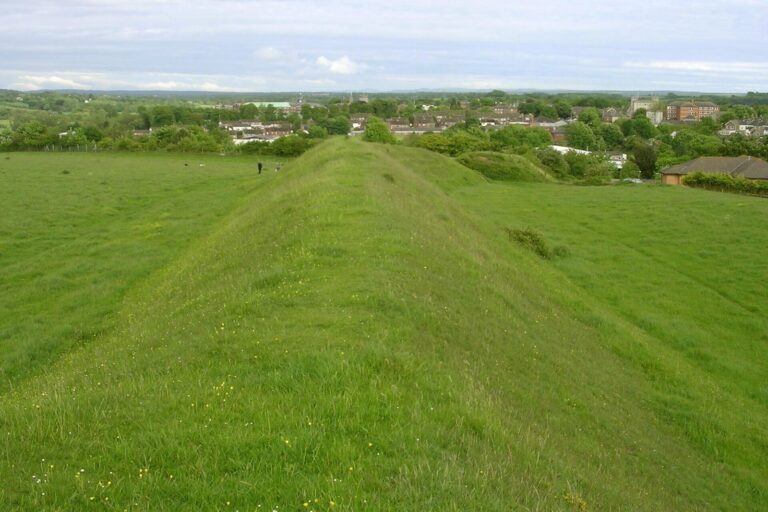
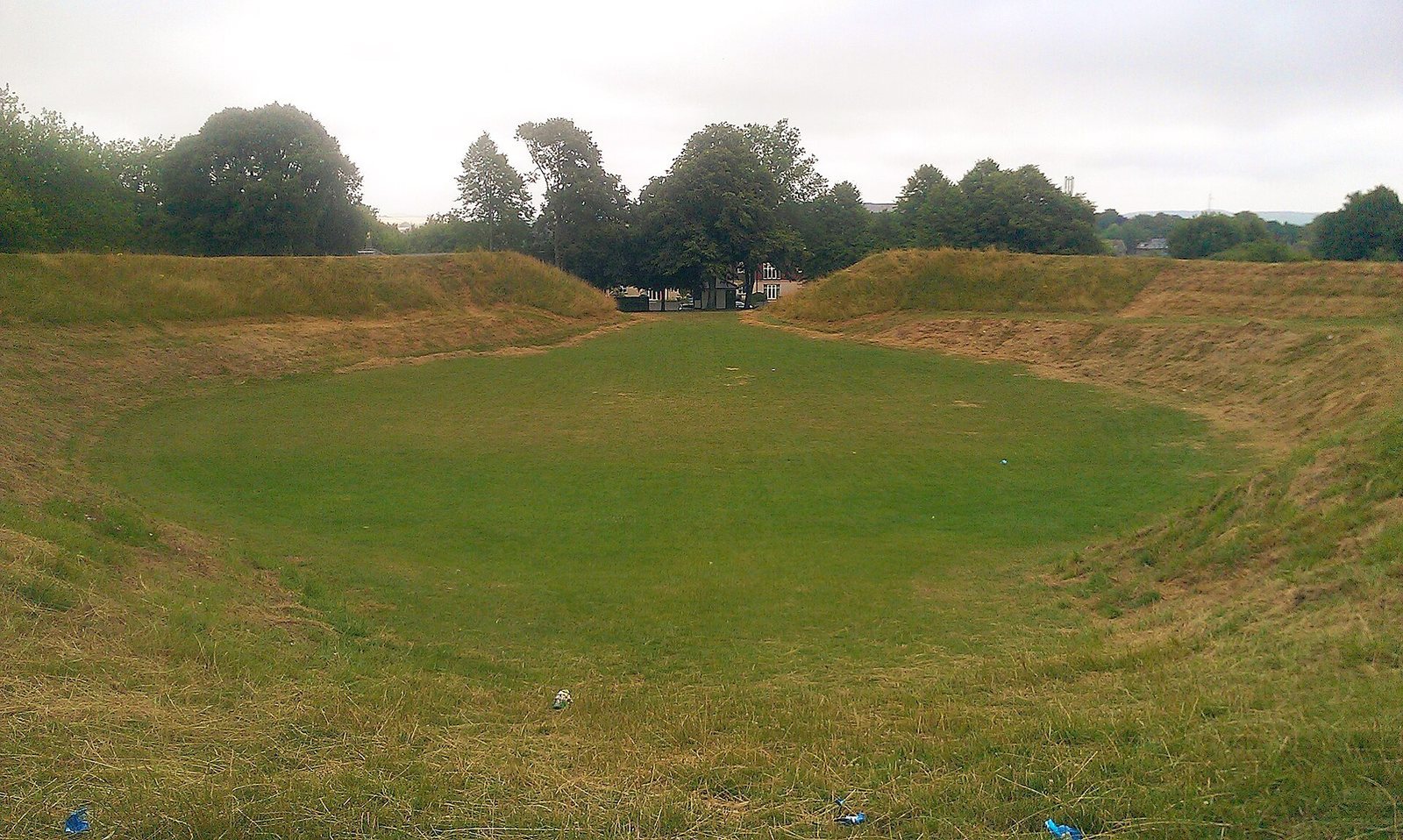
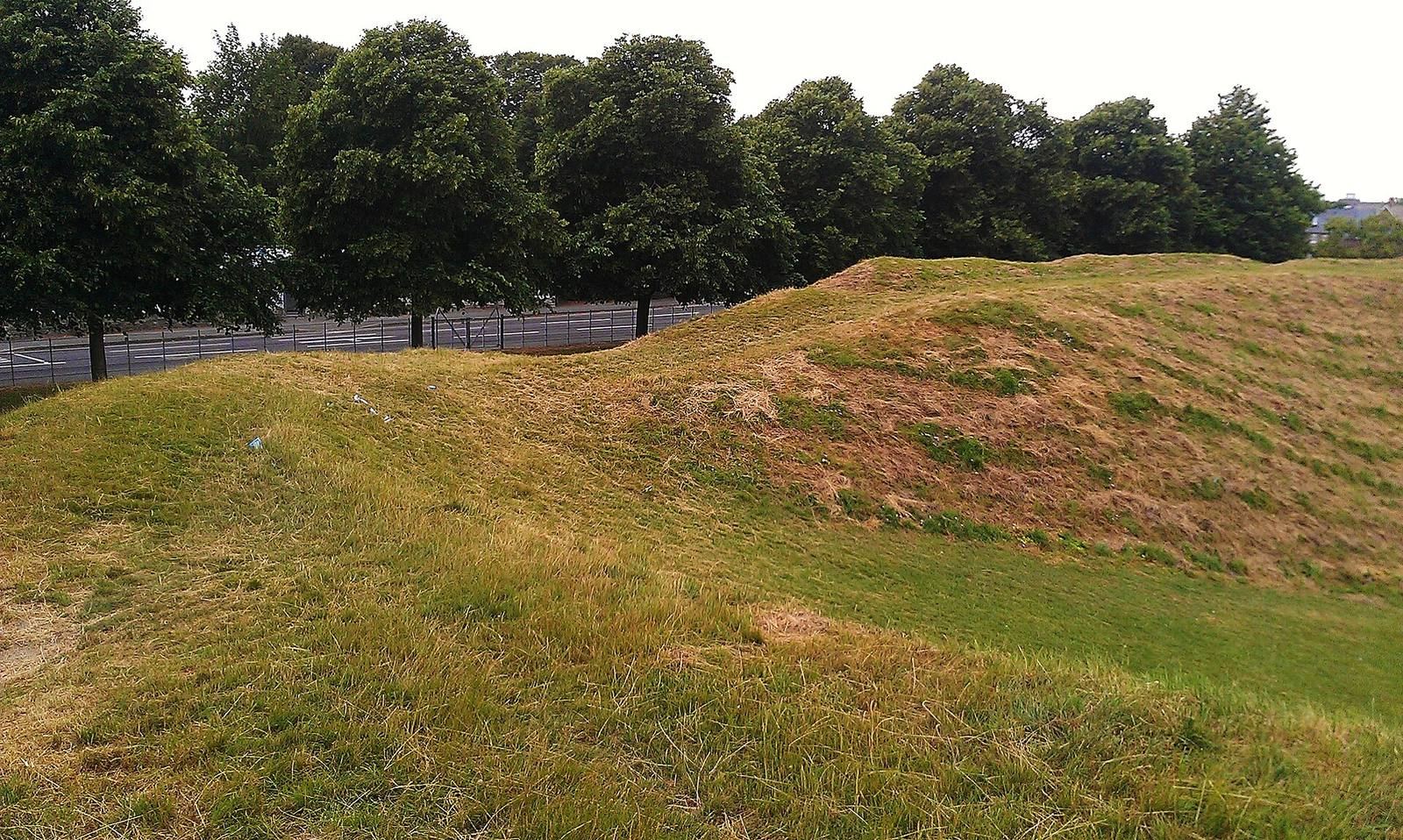
The surviving site brings together a circular prehistoric enclosure, a level oval arena formed during Roman remodelling, and earthworks from the Civil War fort. Its banked outline measures about 85 metres across, while the Roman arena occupies the interior.
Prehistoric enclosure
Bank and entrance
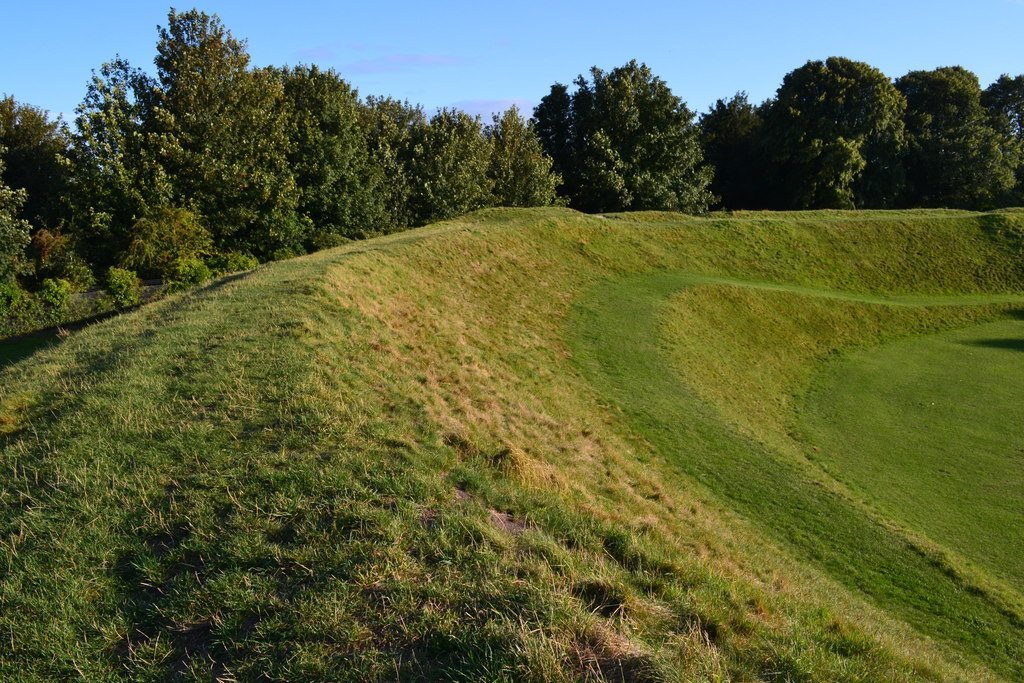
The enclosure has a single bank and a north-eastern entrance. Its internal diameter is about 50 metres. The bank averages 4 metres in width and stands about 5.6 metres high on the inner side and 4 metres on the outer side.
Internal ditch and deposits
Excavation revealed that the enclosure’s ditch consisted of closely spaced, funnel-shaped shafts cut into the chalk, joining to form a continuous trench. Up to 45 shafts, as deep as 11 metres, have been identified, and eight were fully excavated. Their deposits included antler, animal and human bone, flint, and carved chalk objects shaped as human phalluses. These objects may relate to fertility practices among the builders. Pottery included a Grooved Ware sherd from one pit and a later Beaker sherd from another.
Roman amphitheatre
Arena and seating
Roman work lowered the banks by about 3 metres and piled the removed soil onto them. The interior was levelled into an oval arena, with seating cut into the inner slope and bank. Chalk or timber faced these seating areas. The amphitheatre could hold about 10,000 people.
Chambers and finds
Chambers were cut into the south-west bank and on either side of the arena’s centre. Excavation finds included an uninscribed British coin, Roman pottery, leg bones and coins. Later activity is represented by New Forest ware and coins of Carausius and Constantine I. Coins of Tetricus I, Tetricus II and Constantine II came from the upper fills of Roman postholes. Finds from the excavations are held at Dorset Museum.
Civil War earthworks
The fort’s earthworks include a gun platform and ramp on the south-west side, internal terraces to the east and west, and a ditch beyond the northern bank. A bulge in the south-west earthwork marks the gun emplacement; the ramp and sloping bank altered the enclosure opposite its entrance. An unfinished well lay near the north-west edge of the arena, and 160 lead pistol bullets were found on the east bank.