Haus Angerort: A Medieval Castle and Fortress in Duisburg
Site at a Glance
- Popularity
- Medium
- Country
- Germany
- Primary era
- Early Modern
- Eras represented
- Medieval, Early Modern
- Civilizations
- Duchy of Berg, Holy Roman Empire
- Site type
- Domestic
- Remains
- Manor House
On this page9 sections
History
Haus Angerort is a medieval moated castle and fortress in Duisburg, Germany, in the Hüttenheim district near Wanheim-Angerhausen. Its origins are uncertain, though a fortified house with the Medefurt estate and mill may have stood here by the eleventh century. A local legend credits Charlemagne with ordering a tower built in 796, where fires would warn of approaching dangers such as Norman raiders. Charlemagne, a Frankish king crowned emperor in 800, belongs to the story of the site, not to a securely established construction date.
Early records and a frontier castle
A charter dated 1051 appears to refer to Angerort, but the identification is probably mistaken. The earliest verifiable written mention comes from a Duisburg municipal account for 1409–10. It notes a visit to the site by the city’s mayors and reeve, a local administrative or judicial officer, who met canons from Kaiserswerth.
In 1425, Duke Adolf of Berg ordered Angerort developed into a castle and frontier fortress. It stood near the duchy’s northern boundary, facing the neighbouring Duchy of Cleves, including its enclave at Wanheim-Angerhausen. The defenses were intended to protect the recently united territories of Jülich and Berg. The eight administrative districts of Berg were each required to contribute 60 imperial guilders a year toward the work.
In 1429, the dukes of Jülich-Berg and Cleves met at Duisburg and Angerort, alongside the Count of Moers, to address their competing claims. Angerort belonged to the administrative district of Angermund. Its castle administrators held the title Amtmann, meaning district administrator, but Angerort did not become a separate district.
Residence, administration, and early military use
Alf Quade, also known as Adolf Quadt, became castellan in 1433. His successor, Ludger Staël von Holstein, enlarged Angerort into a residential castle. In 1441, Duke Adolf of Cleves-Mark protested that Berg had carried out a death sentence at the castle. Marshal Johann vom Haus was appointed district administrator in 1451; in 1478, Ruprecht von Steinen held the office of reeve there. A man named Steynhaus was serving as Amtmann around 1520.
Imperial troops, serving the Holy Roman Emperor, were stationed at Angerort during the late-fifteenth-century War of the Burgundian Succession, a conflict over Burgundian inheritance. In 1493, the castle’s doors and bridge required repair, and its supplies of gunpowder and lead were replenished. On 9 March 1514, leading figures from Jülich-Berg and Cleves met at Angerort to discuss a proposed marriage between Charles of Guelders and Anne of Cleves.
In 1522, Duke Johann of Jülich-Cleves-Berg granted Angerort and the Medefurt estate for life to Gerhard von Troistorp and Margarete von Hammerstein. They had paid an old ducal debt to other creditors. In 1541, Duke Wilhelm transferred the properties to his chancellor, Johann Ghogreff. He compensated Margarete, then a widow, and her son Sibert: Sibert became district administrator of Angermund, while Margarete received the right to live at Angermund Castle for life. Angerort later passed first to the von Binsfeld family and then to the von Fürstenberg family.
In 1524, the fortress held the leader of a citizens’ revolt in Emmerich as a prisoner. Its earliest known drawing, made by cartographer Arnold Mercator, dates to 1571.
War and destruction in the seventeenth century
During the Thirty Years’ War, the major European conflict of 1618–48, forces of the Dutch Republic plundered Angerort in 1629 and removed its furnishings. Imperial forces strengthened it in the 1630s as a bastioned fortress, using projecting defensive works to cover its walls. Bishops also took part in negotiations at Angerort intended to resolve religious disputes in the region.
In 1635 and 1636, Gerhard von Neuland requested timber for river groynes, structures built out from a bank to influence the current. Duke Wolfgang Wilhelm ordered 1,500 stakes and 2,000 bundles of brushwood delivered. In October 1643, correspondence between the imperial commander Johann, or Hans, von Fargel and Imperial Field Marshal Count Melchior von Hatzfeldt discussed a proposed sluice, a channel or gate for controlling water. By March 1644, some of Angerort’s fortifications had collapsed.
In 1642, Wolfgang Wilhelm stationed Peter Melander von Holzappel at Angerort. Melander had served as a general for Hesse-Kassel and was then an imperial field marshal. His arrival may have prompted an attack by Hesse-Kassel forces that spring; the fortress was plundered and devastated. Berg troops took control, but in June their commander, Lieutenant Friedrich Weingens, was captured, beaten, and threatened by imperial soldiers while returning from Düsseldorf. Fearing for his life, he ordered the troops remaining at Angerort to surrender.
Fargel held the fortress from 1642 to 1644 and repeatedly plundered the surrounding countryside. After Angerort lost its military importance in 1644, he negotiated his departure and left for Koblenz with about 200 men in August or September. The identity of those who destroyed the fortress after the imperial withdrawal remains uncertain. A Duisburg guesthouse ledger attributes the demolition on 1 October 1644 to Wolfgang Wilhelm, who may have wanted to prevent another occupation. Imperial troops, who had strengthened the site, are considered the more likely destroyers; shortly beforehand, Wolfgang Wilhelm had requested that the fortress be handed over so he could station his own men there.
On 19 August 1651, Wolfgang Wilhelm and Frederick William, Elector of Brandenburg, met at Angerort in an unsuccessful effort to mediate the Jülich-Cleves succession dispute, a contest over inheritance claims to these western German territories. A settlement was signed in October. After 1657, Gerhard von Neuland, who held the property under a pledge, rebuilt Angerort as a modest house without towers.
Rebuilding, estate use, and industrial change
The Neuland family retained Angerort until 1731, when Arnold Franz von Neuland transferred the lordship to Johann Peter von Reiner, a vice-chancellor of Jülich-Berg. A 1719 decree also indicates that Baron de Rouveroy had held the property during the intervening period. Von Reiner appears to have enlarged the house; in 1733 he requested timber for building work. Flooding and ice on the Rhine and Angerbach caused severe damage in 1740. Two years later, he renovated Angerort and added two Baroque side wings, in the European architectural style prominent in the seventeenth and eighteenth centuries.
By the late eighteenth century, the house had become a leased farm. Its first tenant, Peter Lausberg, attempted to establish a distillery, but the equipment and stock were auctioned in May 1785. In 1787, the estate, including Medefurt farm, went to Elberfeld manufacturer Braselmann, who produced Turkey red, a dye used in textile making. The business soon ceased amid wartime disruption. In 1795, French troops crossed the Rhine about 1.5 kilometres north of Angerort and defeated Austrian forces on the eastern bank. War burdens and severe flooding and ice on the Rhine and Angerbach in January 1799 further damaged the house.
Merchant J. H. Wiesmann of Hattingen bought the estate in 1838, together with 267 Morgen of land in Huckingen, Ehingen, and Wanheim. A Morgen was a historical land measure whose area varied by region. Friedrich Krüger of Ruhrort acquired Angerort in 1861, including its main and ancillary buildings and adjoining gardens. The property later passed to Duisburg wholesaler Johann Hendrich Kirberg and then to the Count of Spee, who redeemed rents charged against it. Only the ground floor of the castle was occupied at that time. In 1891, the heirs of Count Wilderich Spee zu Maubach transferred it to Count Franz Spee.
The firm Schulz-Knaudt bought Angerort and about 50 hectares of surrounding land in 1907. After company mergers, ownership passed to Mannesmannröhren-Werke in 1914 and remained there until 1988, when it passed to Hüttenwerke Krupp Mannesmann. From around 1910, the house briefly served as a steelworks director’s residence. It became a laboratory and heat-treatment department in 1930, then a laboratory for Mannesmann Research Institute after the Second World War, including for non-destructive testing. The building has been unused in recent years. Duisburg designated Haus Angerort an archaeological monument in 1991 and a built monument in 2005.
Remains
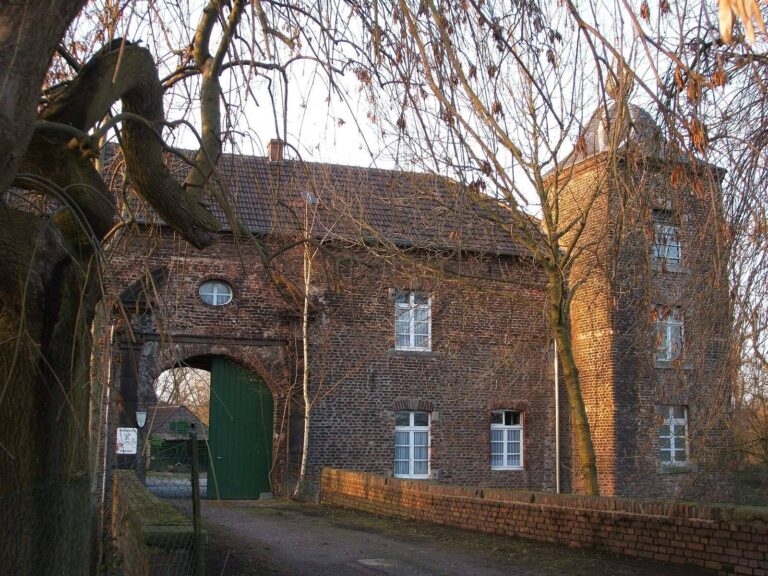
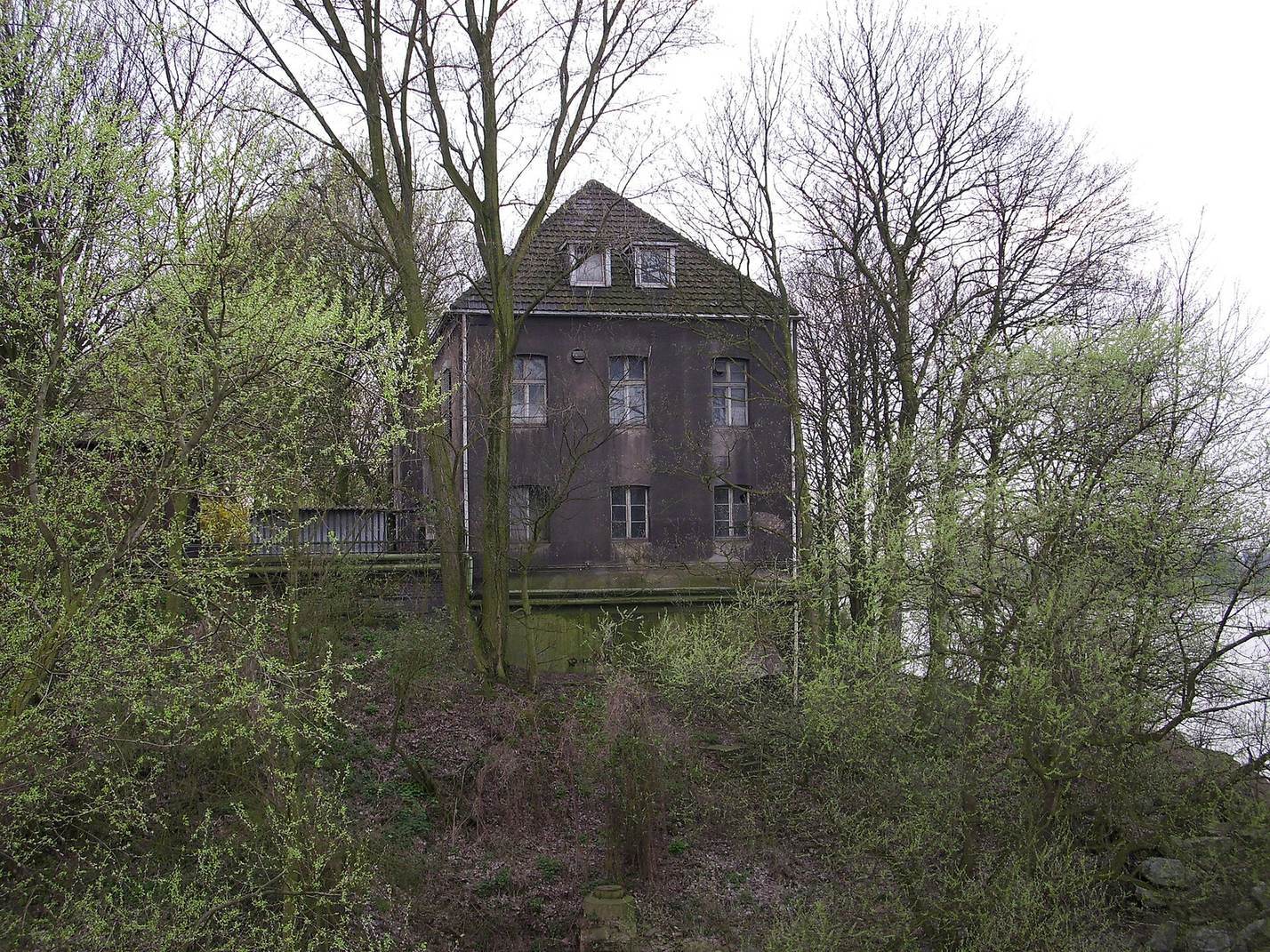
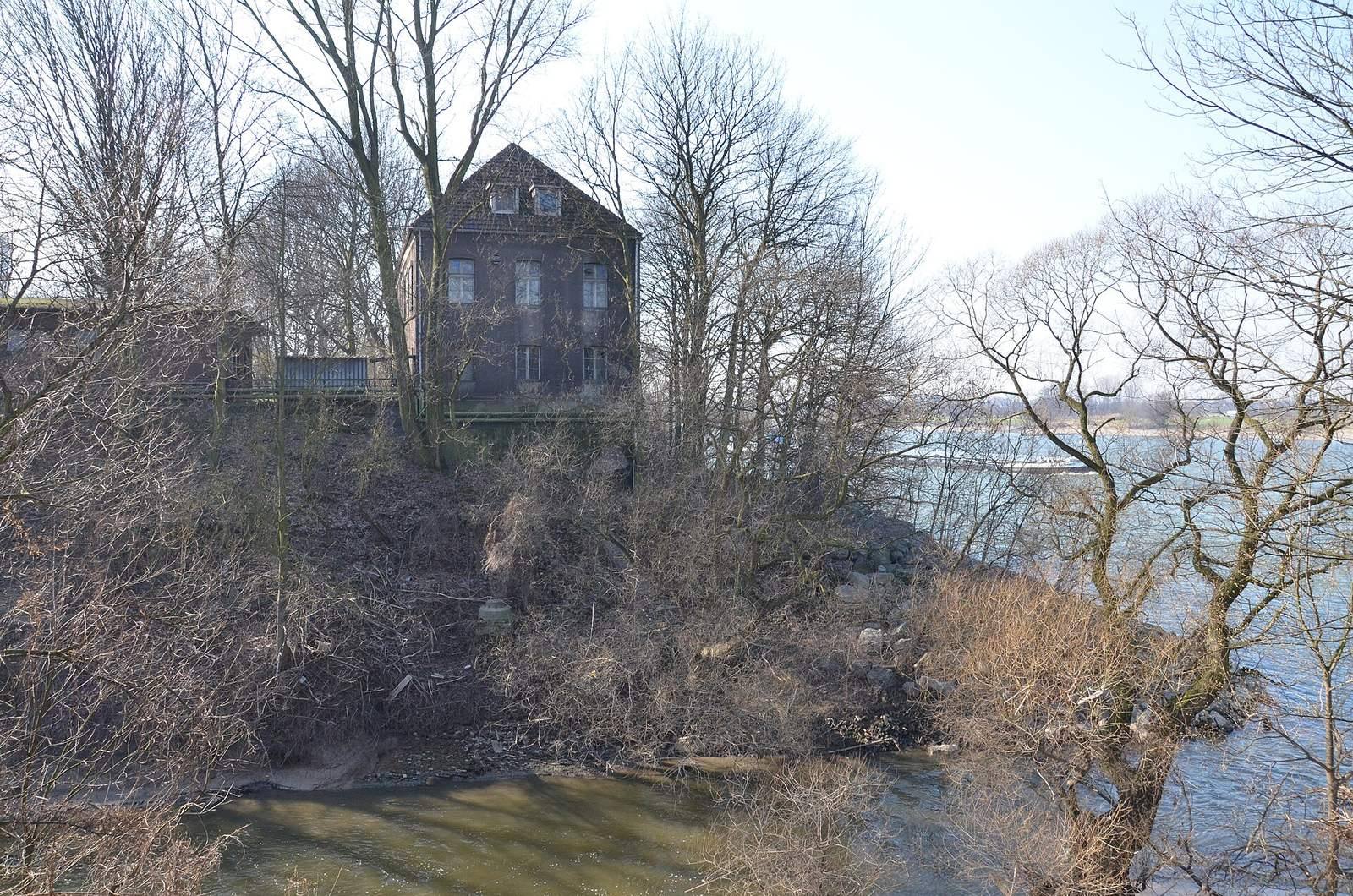
Haus Angerort stands just south of the mouth of the Angerbach, where the stream enters the Rhine. Its name combines “Anger,” referring to the Angerbach, and “Ort,” meaning an end or point. The surviving house is a two-storey plastered masonry building with a hipped roof. Although two upper storeys are visible, the original lowest storey is now a basement because the moat and lower level were buried beneath fill around 1920. The fill used sand from the expansion of a works harbour.
Earlier castle and fortress works
The castle in Mercator’s drawing
Arnold Mercator’s 1571 drawing shows an irregular complex of walls and buildings. It includes two large round towers and a smaller tower, probably positioned to flank the entrance. The drawing provides a view of the earlier castle arrangement before the seventeenth-century strengthening of the defenses.
Bastioned defenses and later rebuilding
The fortress was strengthened in the 1630s with projecting defensive works designed to cover its walls. A proposed water-control sluice appears in correspondence from 1643, and records from the following year describe collapsed sections of the fortifications. After the fortress was destroyed, the rebuilding begun after 1657 produced a towerless house. The two Baroque side wings added in 1742 were demolished in phases around 1908 and around 1960.