Fulneck Moravian Church: A Chapel within a Yorkshire Moravian Settlement
Site at a Glance
- Rating
- 4.3
- Popularity
- Low
- Country
- United Kingdom
- Primary era
- Early Modern
- Eras represented
- Early Modern
- Civilizations
- British
- Site type
- Settlement
On this page10 sections
History
Fulneck Moravian Church is an eighteenth-century Moravian place of worship in Fulneck, near Pudsey in Leeds, West Yorkshire, United Kingdom. Its chapel was built within the Congregation House, begun in 1746 and consecrated on 2 June 1748. The settlement, established in 1744, became a centre of communal religious life in Yorkshire.
Moravian origins and the Yorkshire mission
The Moravian Church traced its origins to the Bohemian Brethren’s Church, founded in 1457, and was renewed in Saxony in 1722 under Count Nicolaus Ludwig von Zinzendorf, a Moravian bishop and Lutheran priest. Moravian representatives travelled to England in 1728 and 1734 to build ties with the Church of England and support missionary work in the American colonies. A Moravian Society was established at Fetter Lane in London in 1738.
In Yorkshire, the Anglican clergyman Benjamin Ingham had gathered groups of evangelical Christians and sought Moravian assistance. Moravian brother John Toeltschig visited him in November 1739. On 26 May 1742, Bishop August Gottlieb Spangenberg, with the support of the Fetter Lane Society, agreed to establish a Yorkshire congregation. Its headquarters opened at Smith House, a farmhouse near Halifax, in July that year. The Gussenbauer family was sent to work in Pudsey and lived at Bankhouse, at the western end of the Falneck ridge.
Zinzendorf visited the Gussenbauers in February 1743 because one of their children was seriously ill. Impressed by the view from Falneck, he selected the place for a settlement modelled on Herrnhaag, a Moravian community in west-central Germany. In January 1744, the Moravians acquired land on the Fulneck estate after Ingham, who had bought it, donated part of the property. They decided to build there in May 1745.
Settlement and communal life
The community was first called Lamb’s Hill, a name used from 1744 to 1760 that referred to the Lamb of God and the biblical image of a city on a hill. The church building was known as Grace Hall from 1750 to 1763. After 1760, the settlement adopted the name Fulneck, echoing the estate’s earlier English forms, Falneck or Falnake, understood as a contraction of Fallen Oak. The name also honoured Bishop John Amos Comenius, who had ministered to the Bohemian Brethren at Fulnek in Moravia. In 1661, Comenius appealed to Charles II and the Church of England to care for the Unitas Fratrum, or Unity of the Brethren.
Fulneck’s members belonged to Choirs, communal groups organised around people’s circumstances rather than simply musical ensembles. These included the Married Choir, Single Sisters’ Choir, Great Girls’ Choir and Little Girls’ Choir, each with its own religious and communal life. Businesses operated for the community’s shared benefit rather than private profit. In 1751, James Charlesworth, warden of the Single Brethren’s Choir, developed a church cloth-weaving business that traded with Portugal and Russia. His fundraising helped avert bankruptcy across the Moravian Church amid rising missionary costs. In 1754, he also reconciled Zinzendorf and Ingham.
The burial ground became an important focus of religious practice. In 1751, Fulneck’s elders noted that its beauty led some people to seek admission to the church when close to death. A funeral that year included musicians, ministers and pastoral workers in procession, while eight labourers from the Single Brethren’s Choir carried the coffin. At dawn on Easter Sunday, the congregation processed among the graves with music to celebrate the Resurrection and remember the dead. About 10,000 people attended the procession in 1753, making it difficult to manage; the elders cancelled it the following year.
Schools, ministry and later history
Fulneck’s boarding school for boys opened in 1753, followed by a school for girls in 1755. The community later trained candidates for ministry as well. A theological seminary, an institution for preparing people for religious ministry, opened in the Brethren’s House on 12 October 1808 under principal Henry Steinhauer, with five students. Before then, candidates had trained in Germany. John Hartley had proposed collegiate study at a provincial conference in 1795, but Bishop Samuel Liebisch considered the plan impracticable. The seminary closed in 1828, after which candidates again trained at Niesky or Gnadenfeld.
In 1858, the British Provincial Synod decided that a theological college was needed. A new college opened at Fulneck in October 1860 under principal John England, training teachers for Moravian schools as well as ministers. It occupied the Single Brothers’ House. Following a decision at the 1874 Provincial Synod, the college moved in 1875 to Fairfield Moravian Settlement in Lancashire, where it could connect with Owen’s College, later part of the Victoria University of Manchester. The boys’ and girls’ schools merged in 1994.
Eighteenth-century Fulneck had bands of musicians, including trombone players whose Easter-dawn music evoked the trumpet sound associated with the Christian belief in the final Resurrection. The tradition continued in Moravian congregations in several other countries, but not in England. Fulneck hosted the first Yorkshire Moravian Choir Festival on 30 March 1912. Around that time, organist C. S. Nelson retired after 47 years of service; his father and brother had also played the organ, bringing the family’s service to 92 years. Fulneck remains an active congregation, and its church is a Grade I listed building, the highest category of listing for historic buildings in England.
Remains
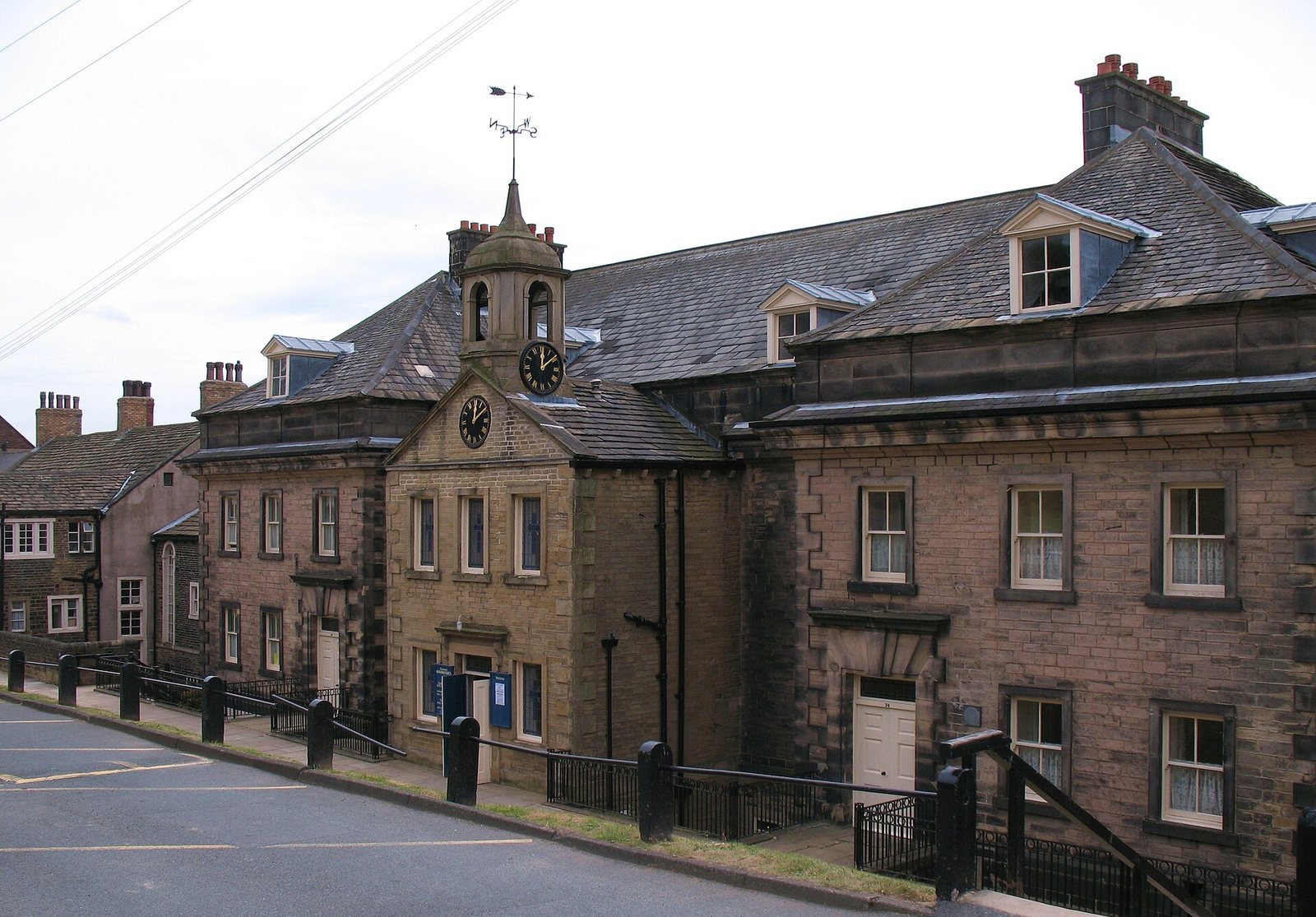
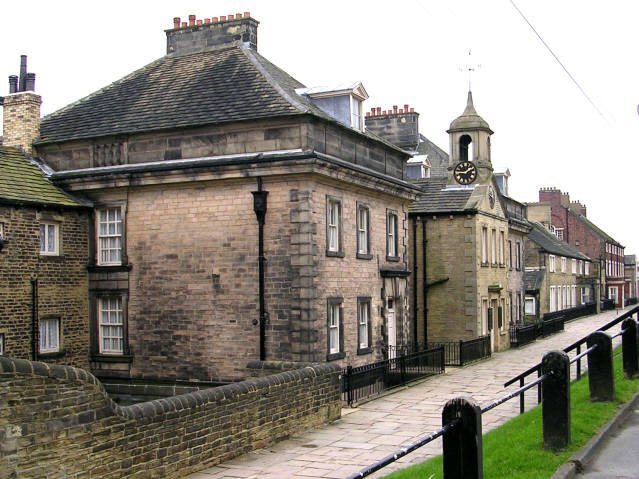
The residential terrace extends for a quarter of a mile, with the Single Brethren’s House at its western end and the Single Sisters’ House at its eastern end. Their gardens descend the slope in front of the terrace. God’s Acre, a term for a burial ground, lies at the terrace’s eastern end, while the chapel is housed within the Congregation House.
Congregation House and chapel
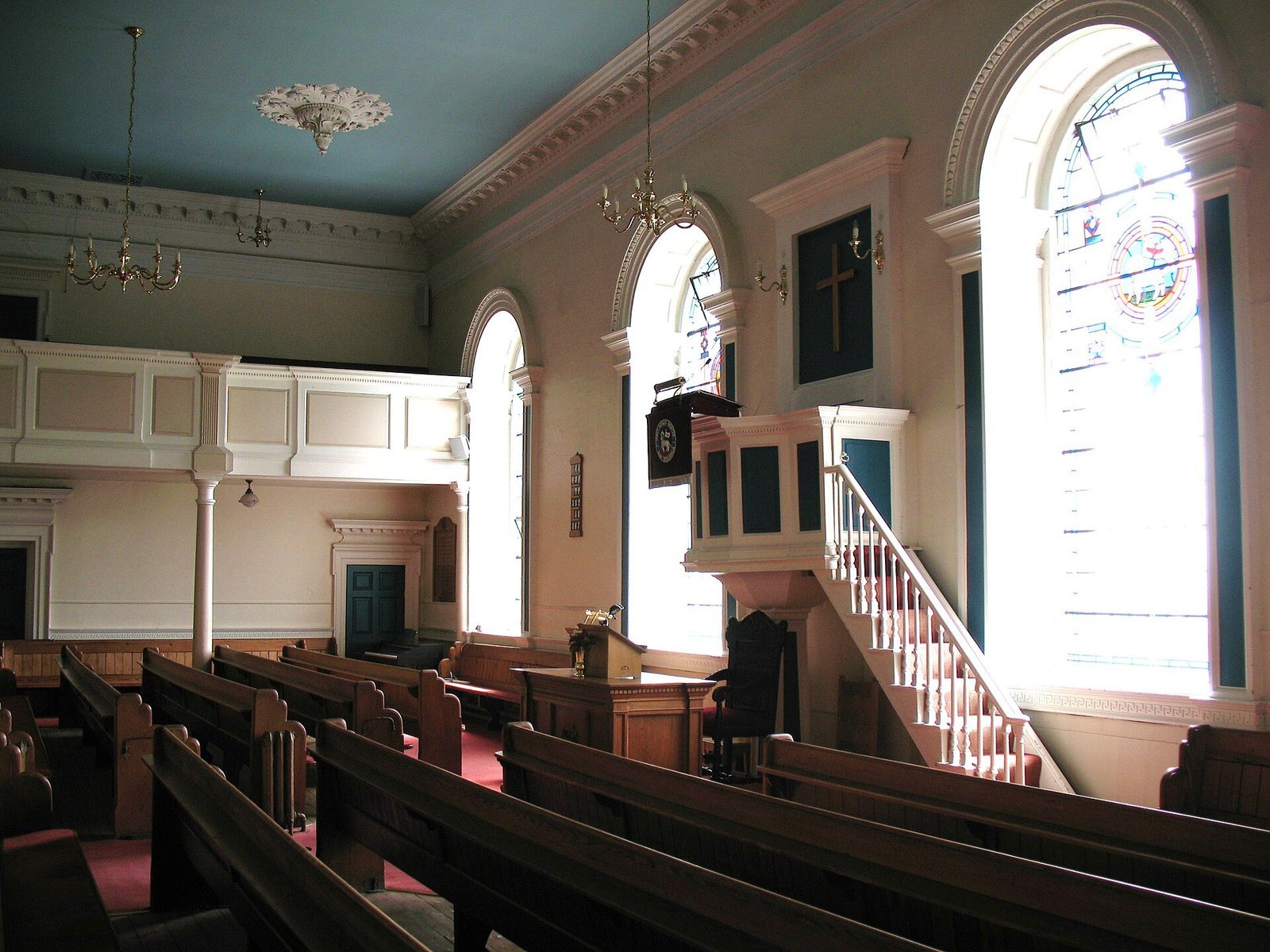
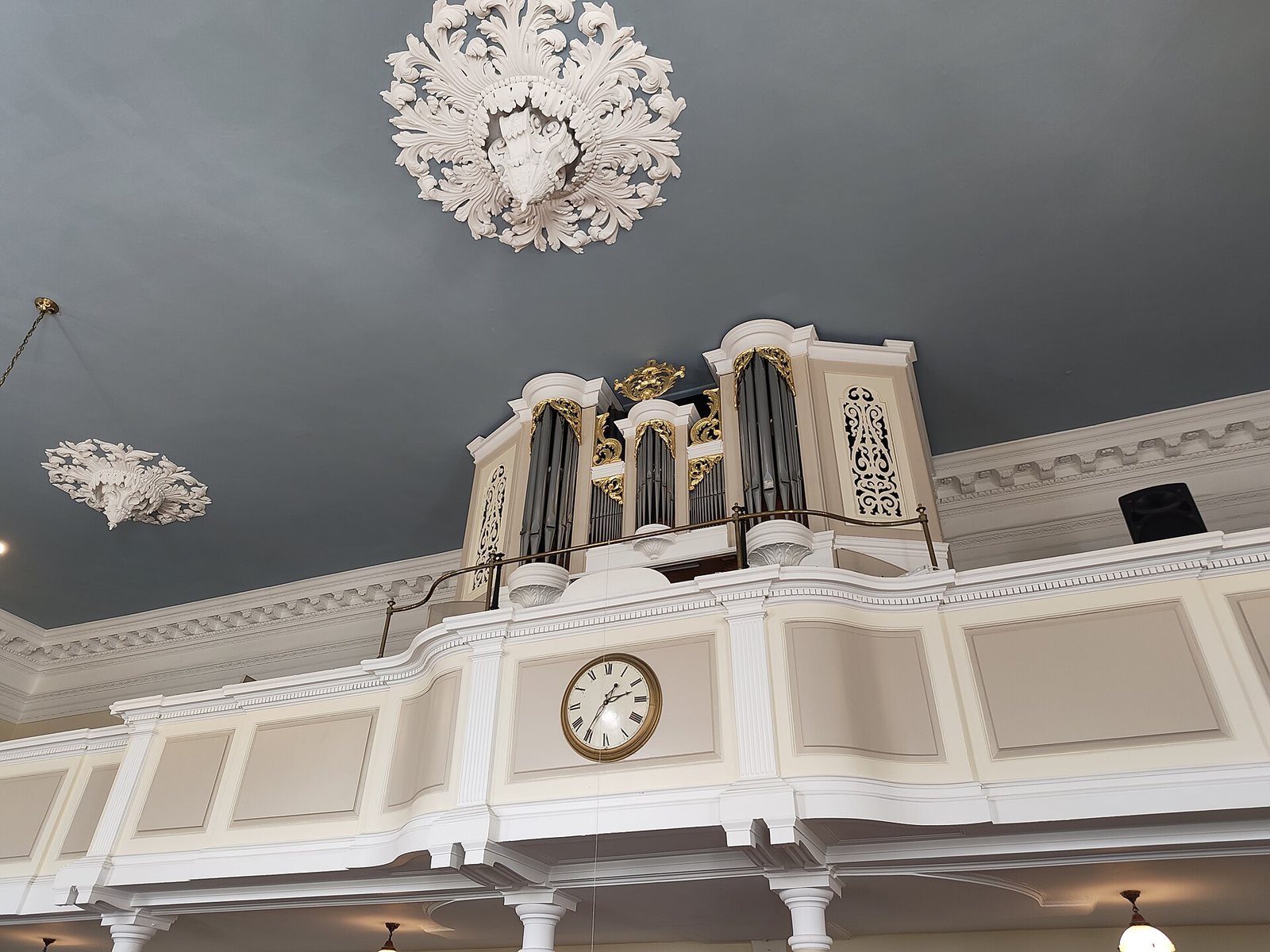
The Congregation House combined the chapel with accommodation for congregation workers. The worship hall occupied the central parts of the first and second floors and was distinguished by a single row of tall windows. Natural light, furnishings and decoration gave the interior a light, restful character. The worship leader sat behind a table with other pastoral workers, while members sat in separate Choir groupings near the entrances from their respective choir houses. The pipe organ was made by John Snetzler in 1748, with later work by J. J. Binns in 1930; its elaborate fretwork case added detail to the hall.
Residential and communal buildings
Single Brethren’s and Single Sisters’ Houses
Both houses had a dining room just inside the front entrance and a central staircase. Each included a Choir hall on the first floor, work and living rooms on the first and second floors, and an open-plan dormitory on the third floor. Their recreational gardens ran down the slope in front of the terrace.
Other buildings and the school
The settlement also included a Widows’ House, a shop and an inn. A small roof cupola was added to the church. A new building for the boys’ school was erected in 1784.
God’s Acre
A white triumphal arch marks the entrance to the burial ground, which is divided into four squares. Graves are arranged by Choir rather than by family, with one body in each grave. Small, uniform gravestones lie flat on the ground and give the names and dates of those buried there.