Collegiate Church of Santa María la Mayor: A Romanesque-Gothic Church in Spain
Site at a Glance
- Rating
- 4.6
- Popularity
- High
- Country
- Spain
- Primary era
- Medieval
- Eras represented
- Medieval, Early Modern
- Civilizations
- Crown of Castile, Kingdom of León, Spanish
- Site type
- Religious
- Remains
- Church
On this page17 sections
History
Foundation and construction
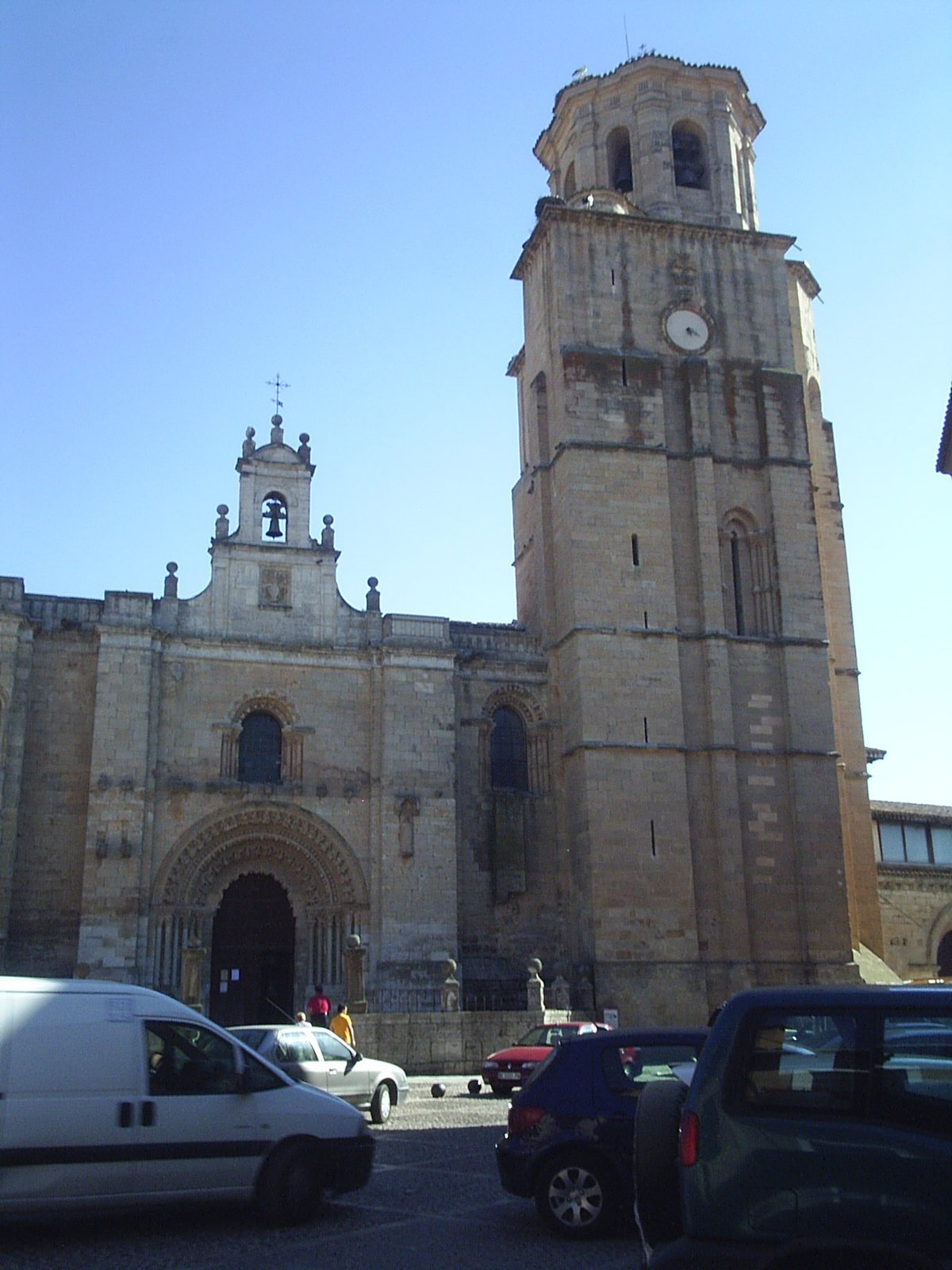
The Collegiate Church of Santa María la Mayor is a Catholic church on the southern edge of Toro, Spain, founded in 1170 under the auspices of the kings of León. Construction began around that year during the reign of Ferdinand II, king of León from 1157 to 1188, and continued into the mid-13th century. Dedicated to Saint Mary the Great, the church belongs to the Diocese of Zamora, a church jurisdiction under a bishop. As a collegiate church, it is served by a chapter of secular clergy, priests who do not belong to a religious order.
The building is a notable Spanish example of the transition from Romanesque, with its rounded arches and substantial masonry, to Gothic architecture, associated with pointed arches and more elaborate structural systems. Its design drew inspiration from Zamora Cathedral. Construction proceeded in two main phases: the first established the plan, walls, and side portals, while the second added the roof and crossing dome with its turrets. Work on the western part continued until about 1240 and used Gothic forms. The crossing tower belongs to a group of related structures associated with the cathedrals of Zamora, Plasencia, and Salamanca.
Later care and protection
The church, particularly its crossing tower, has undergone repeated stabilization and restoration. A 1949 decree and Spain’s 1985 Historical Heritage law protect the building, which is also designated an Asset of Cultural Interest, the country’s formal category for protected cultural heritage.
Remains
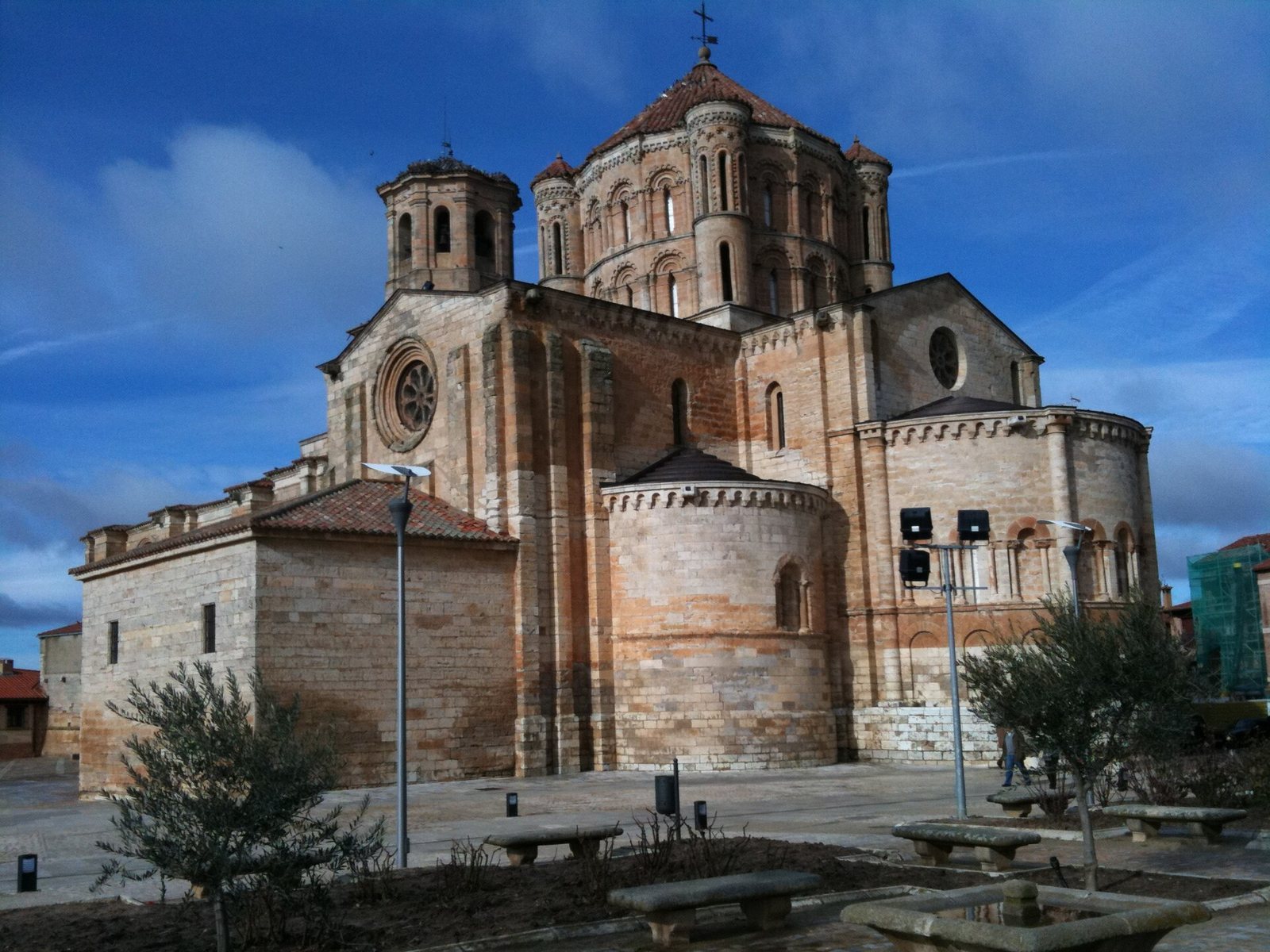
The church stands on a rise above the Duero River, at an elevation of about 720 metres. Its Latin-cross plan, a long nave crossed by a shorter transept, has three aisles divided into three bays, a transept, and three semicircular apses at the eastern end.
Structural features
Vaults and materials
Large blocks of ashlar, carefully cut stone laid in regular courses, form the foundations. The church’s vaults vary by area: quarter-dome conch vaults cover the apses, barrel vaults span the transept, and ribbed vaulting covers the central area. The first building master used limestone in the older sections. A second master worked in reddish sandstone and incorporated features described as stylistically older.
Apses and transept windows
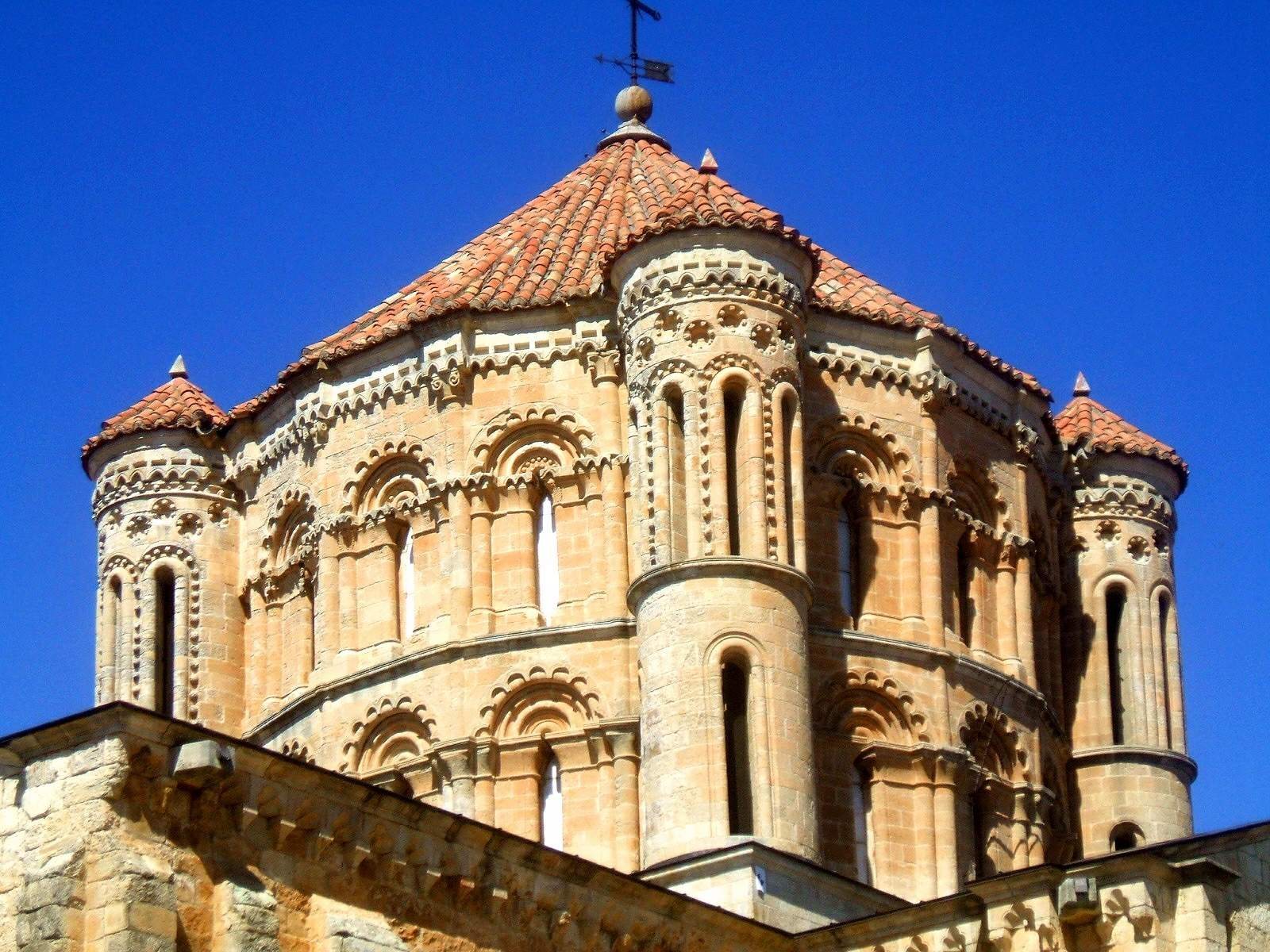
The central apse has a more elaborate design than the two side apses. Engaged columns and two tiers of blind windows, recessed shapes that resemble windows but have no opening, articulate its exterior. Each side apse has a framed window and a horizontal cornice. All three apses end below the eaves in a corbel frieze, a projecting decorative band supported by stone blocks. Late Romanesque rose windows, circular windows with radiating divisions, appear on both sides of the transept and above the central apse.
Crossing tower
The crossing tower has a sixteen-sided plan and two levels both inside and out. Four round turrets at the corners emphasize four sides of the structure and serve decorative and structural purposes. Each level has similarly arranged windows framed by small columns and finished with multifoil arches, whose curves are formed from a series of lobes. Inside, a two-tier dome with sixteen ribs rests on pendentives, curved supports that carry a dome over a square space. Twenty-four windows admit light, while eight additional windows are screened by the outer turrets.
Bell tower
A separate tower rises from a square lower plan toward an octagonal bell stage and is buttressed on all sides. Its two lower stages survive.
Portals
North portal
The north portal has no tympanum, the enclosed space above a doorway. Its inner arch has multiple lobes, and the archivolts, molded bands that follow an arch, carry vegetal and religious imagery. Angels face a central figure identified as God or Christ, alongside the twenty-four elders of the biblical Book of Revelation. The outer imagery shows a bearded God the Father with Mary and John acting as intercessors.
South portal
The south portal has a slightly pointed arch decorated with geometric and plant forms. Its design includes features associated with the transition from Romanesque architecture and with buildings of the Cistercians, a monastic order known for relatively restrained architecture.
Majesty Portal
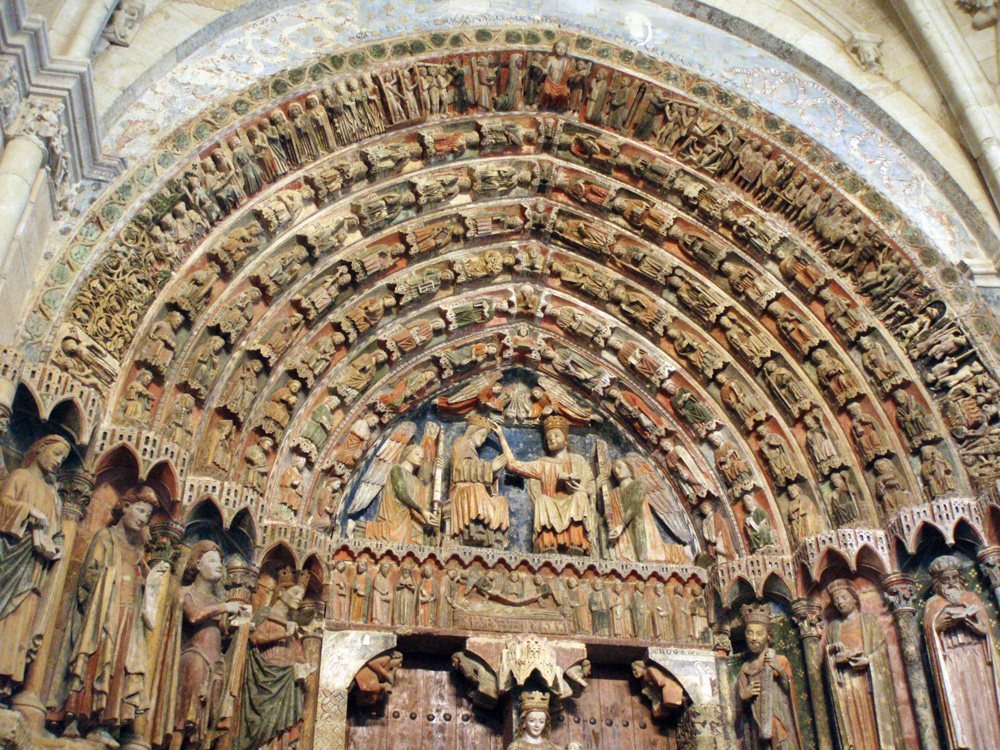
The Gothic Majesty Portal is dated to the reign of Sancho IV of Castile and León, from 1284 to 1295. Its colored finish dates to the 18th century and may follow medieval models or traces. The polychrome sculpture depicts episodes from the lives of Mary and Christ as well as the Last Judgment. Mary, shown as Queen of Heaven with the Christ Child, stands on the central support between the doors, called a trumeau. The doorway sides, or jambs, show Old Testament kings, including David and Solomon, and prophets. Above them, the lintel depicts Mary’s death and Assumption, the Christian belief that she was taken into heaven; the tympanum shows her coronation by God among angels.
Across the portal’s six archivolts are 78 individual figures, including eight kneeling angels, ten crowned figures understood as Old Testament kings, twelve apostles, fourteen bishops, sixteen women, and the elders of Revelation. The outermost imagery presents the Last Judgment. Christ is accompanied by angels carrying the instruments of the Passion, objects associated with his suffering and death. Intercessors and angels blowing trumpets appear alongside the damned being led toward Hell and the saved being guided toward Heaven.
Interior and collections
Sculpture and furnishings
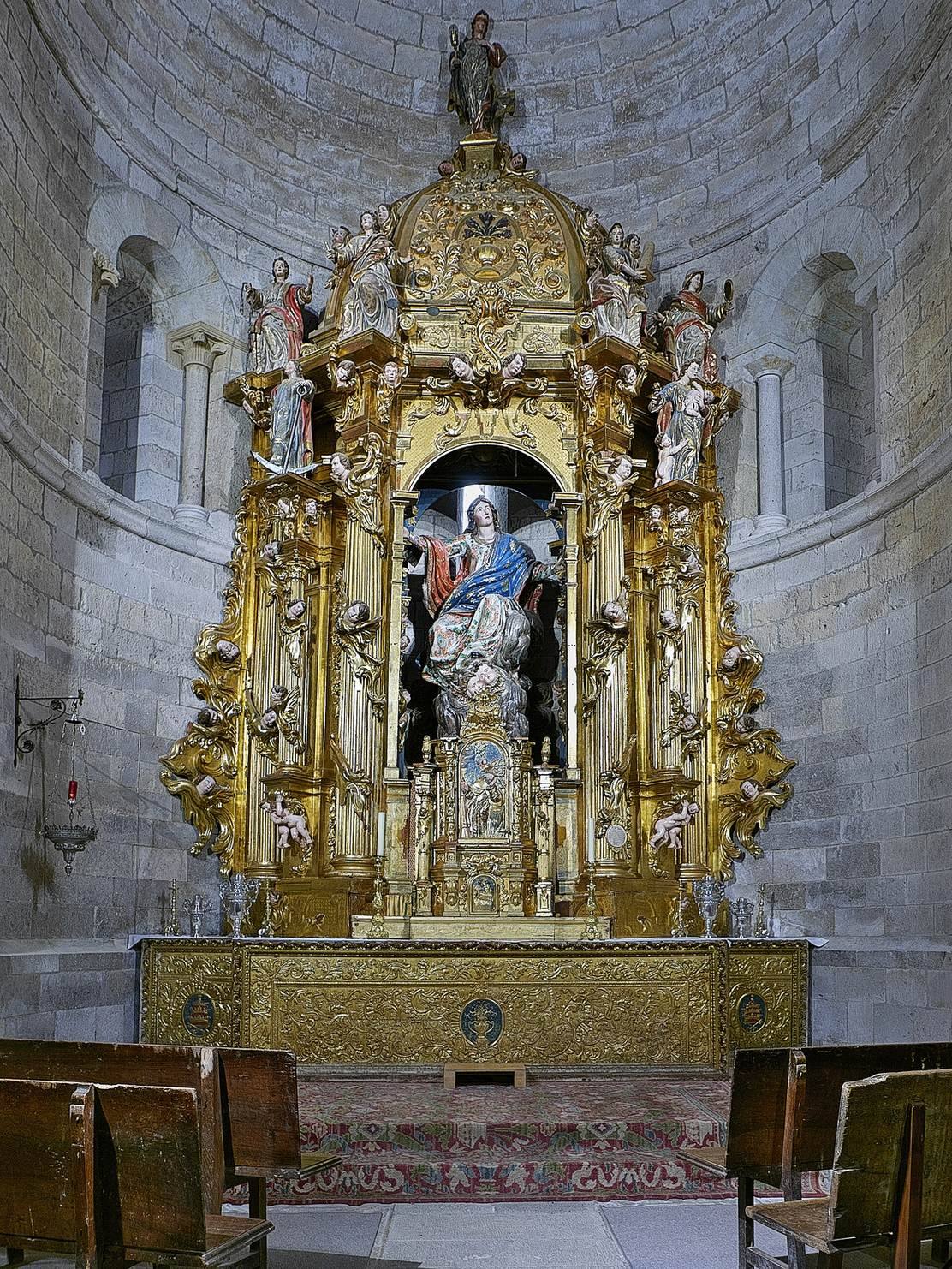
An image of the pregnant Virgin stands on the first pillar of the nave, facing the Archangel Gabriel on the opposite pillar. Together, the figures form an Annunciation group. The Virgin is also known as the Virgin of Hope, or Virgin of O, and the sculpture’s date is uncertain. The next two pillars carry statues of James the Greater and John the Evangelist. A wooden altarpiece stands in the main apse, while a second altarpiece in the north transept is dedicated to Juan de Ávila, a Spanish priest later canonized in 1970. The south transept contains a choir. Other features include the Chapel of St Thomas, a decorated blind Gothic window, and a Baroque organ, in a European style that developed from the late 16th century.
Sacristy museum
The sacristy museum contains the 16th-century Flemish panel painting known as the Virgin of the Fly. Its scene has been interpreted either as the Holy Family or as a unified devotional image of Mary and the Child with saints. Mary Magdalene appears as an attendant in the background, while Catherine of Alexandria sits apart. Catherine may be a concealed posthumous portrait of Isabella I of Castile, who died in 1504. The painting was once dated to about 1520, and its painter was debated; many scholars now attribute it to Fernando Gallego, a Spanish painter active in the late 15th and early 16th centuries, and favor an earlier date.
Mary holds an apple in her right hand, and her gesture toward the Child is open to interpretation. The fruit may refer to temptation and sin, or to Christ as the New Adam, overcoming the sin associated with Adam through his death. The fly on Mary’s red garment, near her left knee, was added later. The halo around her head is also a later addition that replaced an earlier veil. Other retouching includes the rich embroidery on Catherine’s dress.
Other sacristy objects
The sacristy also holds a 17th-century ivory Crucifixion group inlaid with tortoiseshell and a silver monstrance, a vessel for displaying the consecrated Eucharistic host, made in 1538 by Juan Gago Díez. The monstrance remained in London until 2005. The collection further includes religious metalwork and a skull associated with Saint Valentine, a Christian saint traditionally identified as an early martyr whose historical identity remains uncertain.