Royal Necropolis of Byblos: Tombs of Phoenician Rulers
Site at a Glance
- Popularity
- High
- Country
- Lebanon
- Primary era
- Bronze Age
- Eras represented
- Bronze Age, Classical
- Civilizations
- Phoenician, Roman
- Site type
- Burial
- Remains
- Necropolis
On this page24 sections
History
The Royal Necropolis of Byblos is a group of underground royal tombs within the ancient city of Byblos in present-day Lebanon. Created for Phoenician rulers of Gebal, its earliest burials date to the nineteenth century BC, during the Middle Bronze Age, and use continued into the Late Bronze Age. The necropolis reflects Byblos’s close political and cultural connections with Egypt.
Byblos and Egypt
Byblos, the later Greek name for the city known as Gebal and also called Gubla and Kebny in ancient records, had been inhabited since about 7000–8000 BC. During the Bronze Age, trade linked it with Mesopotamia, Anatolia, Crete, and Egypt. Sustained contact with Egypt shaped local culture and burial practices, including the use of vertical-shaft tombs.
Egypt’s Old Kingdom held Byblos within its sphere of influence. After that kingdom’s collapse, the Amorites destroyed the city around 2150 BC. During the rise of Egypt’s Middle Kingdom, Byblos’s walls and temples were rebuilt and its alliance with Egypt renewed. Around 1725 BC, the Hyksos, rulers who controlled parts of Egypt and the Phoenician coast before their expulsion, took power in the Nile Delta and coastal cities. Egypt later drove them out, restored its influence in Phoenicia, and defended the region against incursions by the Mitanni and Hittites. Byblian trade flourished in this period, and a phonetic alphabet of 22 consonant signs developed at Byblos.
Relations with Egypt weakened again in the mid-fourteenth century BC. Letters from Rib-Hadda, king of Gebal, describe Egypt’s inability to protect the city and its lands from Hittite attacks. Egyptian control returned under Ramesses II, but the Sea Peoples, groups associated with upheavals in the eastern Mediterranean, destroyed Byblos around 1195 BC. With Egypt weakened, Phoenicia entered a period of greater independence and prosperity. The contemporary Story of Wenamun reflects the continuing but strained relationship between Gebal’s ruler and Egypt.
The royal tombs
Tombs I–IV, in the northern group, were built earlier and with greater care than Tombs V–IX to the south. Tombs I–III date to the nineteenth century BC, when Egypt’s Twelfth Dynasty ruled during the Middle Kingdom. Royal gifts link two burials to rulers of that dynasty. Tomb I is attributed to Abishemu and contained gifts associated with Amenemhat III. Tomb II is attributed to his son Ip-Shemu-Abi and included an object bearing the name of Amenemhat IV. These objects suggest that the two kings of Gebal lived during the later part of the Twelfth Dynasty.
A scarab, an Egyptian beetle-shaped amulet or seal, bearing the name Medjed-Tebit-Atef led Pierre Montet to propose that Tomb IV belonged to a ruler of Egyptian origin appointed as a vassal king. This interpretation would imply a break in Gebal’s royal line, but it remains a theory. The southern tombs are harder to date because they were looted in antiquity. Evidence points to Late Bronze Age use for some of them. Pottery from Tomb V has been compared with material from Egypt’s New Kingdom, about 1550–1077 BC, while Tomb IX may be closer in date to the northern group.
Tomb V is associated with King Ahiram through its funerary inscription, which also names his son and successor Pilsibaal. Objects bearing the name Abishemu came from Tomb IX. The tomb has been tentatively attributed to another ruler of that name, possibly a grandson of the earlier Abishemu.
Rediscovery and excavation
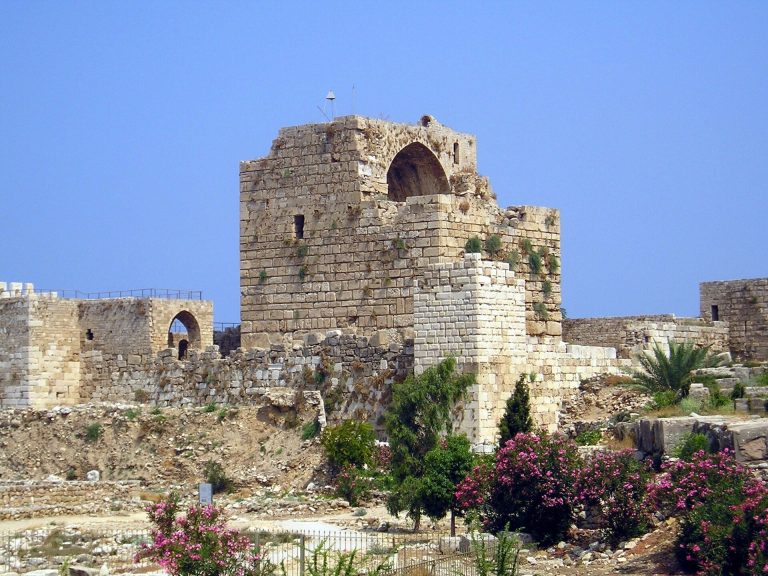
Ernest Renan identified the ancient city in 1860 while investigating the location of Byblos. Guided partly by the ancient geographer Strabo and a Roman coin depicting the city, he focused on the hill occupied by the Crusader citadel and ordered two long trenches to be dug. Their finds connected the site with ancient Gebal, or Byblos. Later exploratory work under the French Mandate uncovered reliefs inscribed with Egyptian writing and prompted more systematic investigation.
Henri Gouraud, the French High Commissioner, established Lebanon’s Service of Antiquities. Joseph Chamonard led it first, followed by Charles Virolleaud on 1 October 1920. After Pierre Montet reported Egyptian-inscribed reliefs found at Jbeil in 1919, Charles Simon Clermont-Ganneau supported a systematic survey. He believed the site included an Egyptian temple, and Montet began excavations on 20 October 1921.
Heavy rain triggered a landslide on 16 February 1922, exposing the first tomb and a large, unopened sarcophagus, or stone coffin. Sheikh Wadih Hobeiche, the local administrator, secured the area against treasure hunters. Virolleaud examined the tomb and opened the coffin on 26 February. Montet found Tomb II in October 1923. A systematic survey followed, and by 1924 he had identified seven more tombs, bringing the total to nine. Maurice Dunand took over in 1925 and continued archaeological work at Byblos for about four decades.
Remains
Setting and arrangement
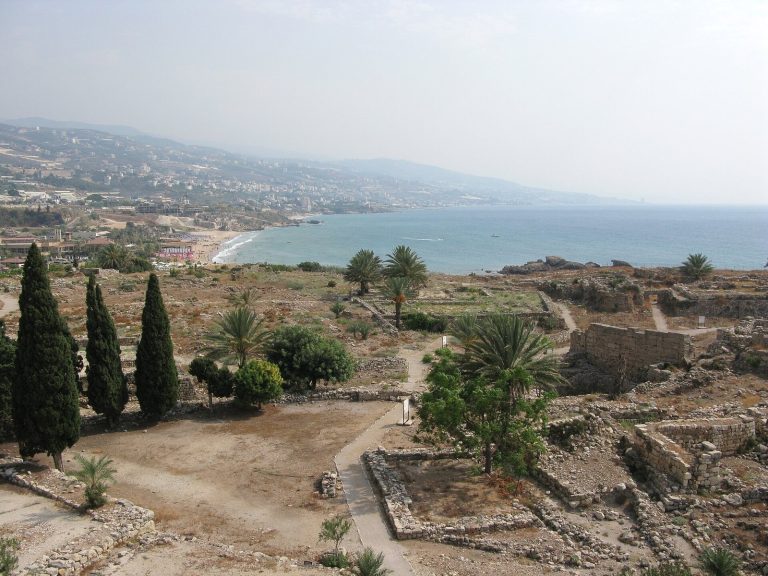
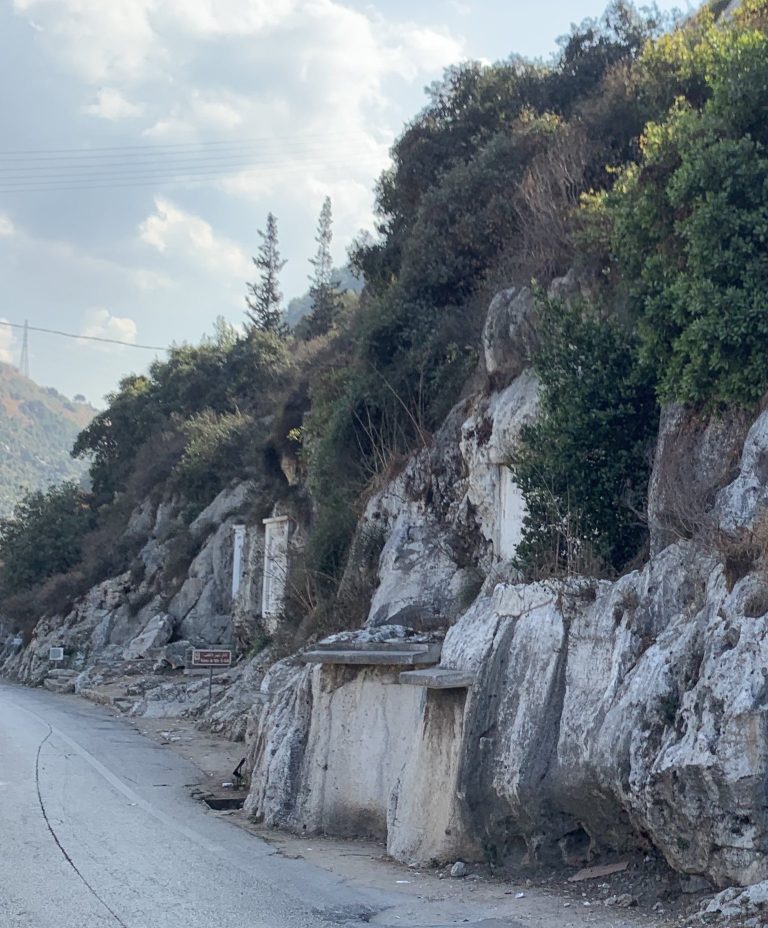
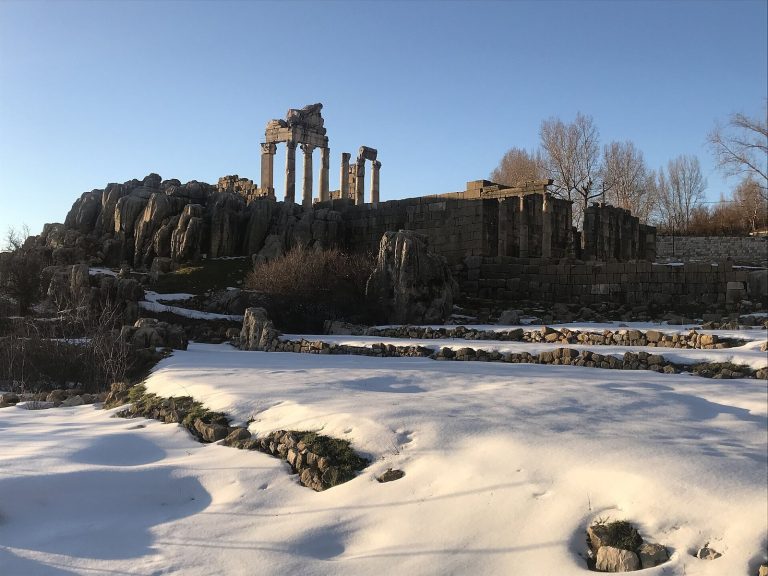
The nine tombs lie within the walls of ancient Byblos, arranged in a northern group of Tombs I–IV and a southern group of Tombs V–IX. Each has a vertical shaft leading to an underground burial chamber. The necropolis occupies a spur on the summit of a semicircular coastal promontory, overlooking the city’s two harbors and lying at the foot of a Roman colonnade. Ancient Byblos stood about 33 km north of Beirut, on a seaside plateau formed by two hills separated by a narrow valley. A 22 m-deep well supplied fresh water, and the two harbors flanked the defensible mound. Montet compared the tombs with Egyptian mastabas, low, flat-topped tombs. He proposed that a ground-level altar or chapel above a shaft served funeral rites, with the deceased’s spirit passing upward from the burial chamber.
Northern tombs
Tomb I
Tomb I has a square shaft 4 m wide and 12 m deep. Its chamber is partly cut into bedrock and partly into clay. The west wall, which faced the coastal cliff, collapsed in the 1922 landslide, while the grave goods remained undamaged. A rough wall divided the chamber from the shaft, which had been filled with stones and mortar. The same materials formed a platform around the shaft and foundations for a low, flat-topped superstructure inspired by Egyptian tombs. Little of it survives, and a Roman bath took its place. A north–south sarcophagus stood in the chamber. An opening in the north wall led to a corridor 1.8 m high and 1.2–1.5 m wide, joining Tomb II’s shaft with another passage from the northwest corner of Tomb I’s shaft. The S-shaped passage reached a small opening and a roughly cut circular cavity containing an earlier tomb. Montet suggested that the connection between the two royal burials might have allowed Ip-Shemu-Abi to remain in contact with his father.
Tomb II
Tomb II’s shaft is shallower than Tomb I’s and is separated from its chamber by one course of masonry. Earth filled the shaft, whose opening was covered by a thick slab made of five or six courses of blocks. The slab supported a structure represented today by a few surviving masonry blocks. At the chamber’s center, the ceiling reaches 3.5 m and slopes to 1 m at the north wall. Four stones in the middle supported a wooden coffin, now decayed. Pottery jars and other objects lay in thick clay; falling pieces of ceiling damaged some of the jars.
Tomb III
The opening of Tomb III’s shaft measures 2.5 by 3.3 m. Masonry sealed with ash was covered by a heavy layer of cement. Two square channels, each about 30 cm wide, passed through the shaft fill. One lay near the southwest corner; the other, near the northwest corner, descended only 2 m. A niche was cut into the north wall near the bottom of the shaft. The chamber extends southward and was closed by a single course of masonry without cement. Its floor is paved, and its walls rise straight to the ceiling. Funerary objects rested in a clay layer about 70 cm deep.
Tomb IV
East of Tomb III, Tomb IV is the shallowest, at 5.75 m deep, with a shaft measuring 3.05 by 3.95 m. A masonry wall 1 m thick strengthened its southern side. A vertical channel, like those in Tombs III and V, pierced the shaft fill; such channels appear to have been distinctive in Byblian burial practice. The limestone coffin stood in the center of the chamber, facing the entrance, with two stones beneath it to steady and level it on the sloping floor.
Southern tombs
Tombs VI–IX lie in a thick deposit of hill sediment, about 50 m east of the necropolis cliff and 30 m south of Tomb IV’s shaft. Their chambers were cut into muddy clay, which enabled ancient looters to tunnel between tombs. The shaft coverings survive unevenly: Tomb VIII retains its paving, while only parts remain over Tombs VI and VII. Tombs V–VIII are generally less carefully built than the northern group; Tomb IX shows more careful construction.
Tomb V
Also known as Ahiram’s Tomb, Tomb V has a semicircular chamber and lies between the northern and southern groups. Mud partly filled the chamber. A two-course wall and column bases along the west side of the shaft belonged to its superstructure, and a short channel lay near the northeast corner. Two sets of four square slots, cut into the east and west walls at depths of 2.2 m and 4.35 m, held wooden beams and floors across the shaft. A Phoenician warning inscription was cut into its southern wall, 3 m below the top. René Dussaud translated it as a warning that destruction lay below.
Part of the chamber wall had collapsed, and a large block from the vault lay on Ahiram’s coffin. The three coffins had been looted and contained human bones. Fragments of alabaster vessels were found near the entrance, including one inscribed with the name of Ramesses II.
Tomb VI
Tomb VI has the deepest shaft in the necropolis. Masonry supports it to a depth of 6 m; below that, the shaft continues through muddy soil without a retaining wall. A few objects remained in and near the chamber entrance.
Tomb VII
Tomb VII’s square shaft measures 5 m on each side. Its chamber cuts through hard rock into clay and was found two-thirds full of clay and pebbles. Surviving stone courses supported the chamber walls, and a paved floor lay beneath a roughly cut rectangular stone coffin. Its concave lid has two large lifting lugs at each end. Precious objects and jewelry remained in the tomb.
Tomb VIII
The opening of Tomb VIII’s shaft is diamond-shaped and becomes square lower down. The shaft passes through hard upper rock into clay. Its thin partition from Tomb VI is pierced at the center, possibly by accidental quarrying. Clay and gravel filled the chamber; most retaining walls had fallen, and small pebbles covered the floor. Finds included a plain stone coffin, fragments of alabaster vessels and other pottery, and gold foil in the muddy soil.
Tomb IX
Tomb IX’s shaft cuts through 8 m of rock. Looters tunneled through clay to reach chambers in Tombs V, VIII, and IX rather than breaking through its closing wall. The chamber roof had collapsed, leaving mud and ceiling fragments inside, but its paved floor and sturdy walls remained in good condition. Finds included fragments of alabaster, malachite, and pottery, as well as terracotta objects bearing the names Abi and Abishemu.
Sarcophagi and carved stonework
Seven stone coffins came from the necropolis: one each from Tombs I, IV, VII, and VIII, and three from Tomb V. Other chambers appear to have held wooden coffins that decayed; remains of the Tomb II coffin lay among its grave goods. The sarcophagi from Tombs IV, V, and VII were removed during the fifth excavation campaign, between 8 March and 26 June 1926.
Tombs I and IV
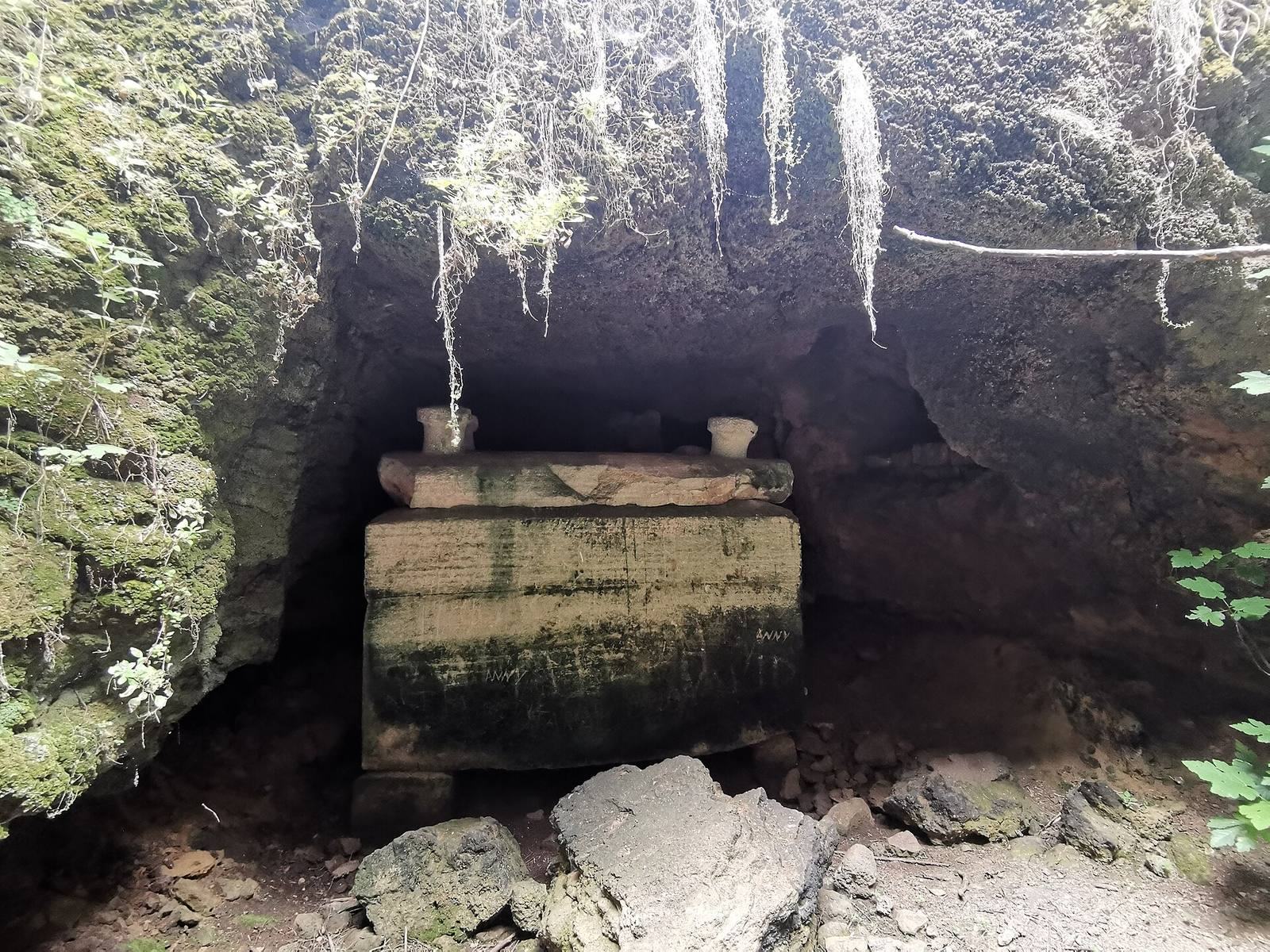
The coffins from Tombs I and IV were made from fine white limestone quarried in nearby Lebanese mountains. Their thick, polished surfaces are plain. Tomb I’s coffin measures 1.48 by 2.82 m and stands 1.68 m high. Its walls are 35 cm thick and its base 44 cm thick. The lid has beveled edges and a lower projection that fits into the body. Its rounded back bears uneven lengthwise grooves: one broad groove at the center and five narrower ones on each side. Three lifting lugs project near the lid’s corners; the northwest lug and part of that corner are broken.
Tomb IV’s coffin measures 1.41 by 3 m and is 1.49 m high. Its long sides are beveled at top and bottom, while the short sides have bench-like projections at the base. Black traces on the rim indicate that a curved wooden lid covered it. The forms of the coffins from Tombs I, IV, V, and VII resemble common Egyptian stone coffins, while the Byblian lids retain lifting lugs. Their shared design, alongside similarities among alabaster vessels from the tombs, suggests a relatively limited period of production.
Ahiram’s sarcophagus
Ahiram’s sandstone sarcophagus measures 3 m long and 1.14 m wide, and stands 1.47 m high with its lid. Its 38-word inscription is in Old Phoenician, an early form of the Phoenician language, and is considered the earliest known example of the fully developed Phoenician alphabet. It is one of five known royal inscriptions from Byblos. Some scholars use it to set a lower chronological limit for the alphabet’s transmission to Europe. The inscription appears in two places: a shorter part on the body above the floral decoration, and a longer part along the front edge of the lid. It warns against disturbing the tomb.
An upper band of inverted lotus flowers alternates buds with open blooms. A thick-rope pattern frames the main relief, and pillars mark the corners. Four lions support the coffin body, their heads and forelegs projecting outward. On the front, a seated king holds a wilted lotus before a table of offerings, with seven men in a procession. Each short side shows four mourning women; two are bare-chested, and two raise their hands to their heads. The back depicts men and women carrying offerings.
The slightly curved lid has a lion’s head at each end, with the animals’ bodies carved across its surface. Two bearded figures, each 171 cm high, stand beside the lions. One holds a wilted lotus and the other a fresh flower. Montet understood both figures as the dead king; Maurice Chehab, who identified traces of red paint, interpreted them as the king and his son. The inscription’s lettering and the carved scenes make the coffin a richly decorated royal monument.
Objects from the tombs
The necropolis yielded more than 260 objects, including jewelry, weapons, vessels, and Egyptian-inscribed gifts. Their materials and workmanship reflect Byblos’s connections with Egypt and other parts of the eastern Mediterranean.
Finds from Tomb I
Tomb I contained pottery jars, two alabaster vessels, and a 12 cm obsidian vase with a gold-inlaid lid. The vase bears the hieroglyphic throne name of Amenemhat III. A rare fragment of a silver vessel with spiral decoration also came from the tomb. Edmond Pottier compared its design with a gold wine jug from a tomb at Mycenae, suggesting either Aegean artistic influence at Byblos or trade with Mycenae.
Finds from Tomb II
Two objects in Tomb II were associated with Amenemhat IV. One was a rectangular obsidian box, 45 cm long, with four legs and a gold-inlaid lid. An oval frame around the king’s hieroglyphic name and titles remains well preserved. Boxes of similar shape appear in Egyptian tomb scenes as containers for incense. A stone vase bore an inscription describing Amenemhat as the good god, son of Ra, living forever.
Royal jewelry, weapons, and vessels
Tombs I, II, and III each held a carved gold chest ornament in an Egyptian-influenced style. Tomb II also contained a locally made gold ornament set with gems and a shell-shaped pendant decorated with metal divisions and bearing Ip-Shemu-Abi’s name. Large silver hand mirrors came from Tombs I and II. Across the three tombs were gold and amethyst bracelets and rings, silver sandals, and finely decorated bronze and gold khopesh weapons, curved blades used in the ancient Near East. One weapon from Tomb II bears the names of Ip-Shemu-Abi and his father, Abishemu. Other finds included a silver knife decorated with dark inlay and gold, bronze tridents, teapot-shaped silver vases, and vessels of gold, silver, bronze, alabaster, and terracotta.