Bush Barrow: An Early Bronze Age Burial Mound on Normanton Down
Site at a Glance
- Popularity
- High
- Country
- United Kingdom
- Primary era
- Bronze Age
- Eras represented
- Bronze Age
- Civilizations
- Unclassified
- Site type
- Burial
- Remains
- Burial Mound
On this page13 sections
History
The Early Bronze Age burial
Bush Barrow is an Early Bronze Age burial mound on Normanton Down in the United Kingdom. It belongs to the Wessex culture, an archaeological culture of Bronze Age southern Britain, and dates broadly to the early second millennium BC. The Early Bronze Age was the earlier part of the period when bronze was used alongside other materials.
The grave’s unusually rich goods have no established explanation. The burial is sometimes associated with an elite status, but other barrows in the cemetery also held richly furnished primary burials of similar date. Bush Barrow’s wealth therefore does not, by itself, establish the buried man’s rank or the mound’s place in the group.
Excavation and the collection
In 1808, antiquary and excavator William Cunnington investigated the mound with John and Stephen Parker. Richard Colt Hoare, an antiquary and patron of archaeological work, financed the excavation. Cunnington named the barrow for the bushes growing on it. Hoare’s account of the discovery, published in 1812, drew substantially on Cunnington’s excavation report.
Hoare kept finds from Cunnington’s excavations at Moss House on Cunnington’s estate at Heytesbury, arranged according to where they had been found. After Cunnington died in 1810, Hoare acquired the collection in 1818. Following Hoare’s death it remained neglected for about four decades. The Wiltshire Museum borrowed it in 1878, and the Wiltshire Archaeological and Natural History Society purchased it in 1883. The Bush Barrow finds, including its gold objects, are now held at Wiltshire Museum in Devizes.
Modern study and interpretation
The gold lozenge was lent to the British Museum for restoration in 1922, but the outcome of the work remains contested. Bush Barrow became a scheduled monument, a site protected under UK law, in 1925. It also forms part of the Stonehenge, Avebury and Associated Sites UNESCO World Heritage property, inscribed in 1986.
The grave goods have prompted proposals of contact between Britain and Mycenaean Greece, the Bronze Age civilization centered on mainland Greece. Comparisons have been made between Bush Barrow fittings and Greek weapon decoration; British amber has also been found in elite Mycenaean shaft graves, deep, vertical-sided burial pits. Suggested exchange routes pass through western or central Europe and the Mediterranean. One proposal is that gold-stud decoration travelled from Britain and Armorica, the region of northwestern France that includes Brittany, to Greece, while amber may have reached Britain from Scandinavia in exchange for metal. These ideas have been considered alongside earlier links between western Europe and the Aegean during the Bell Beaker period, a prehistoric European horizon associated with distinctive bell-shaped pottery.
Remains
The mound and cemetery
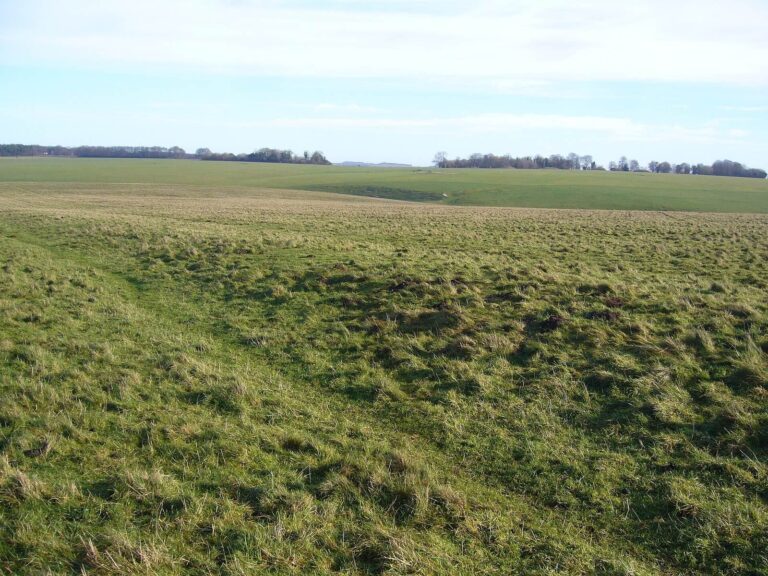
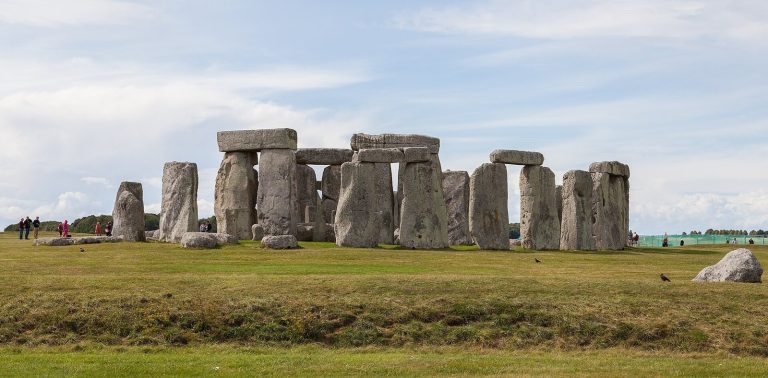
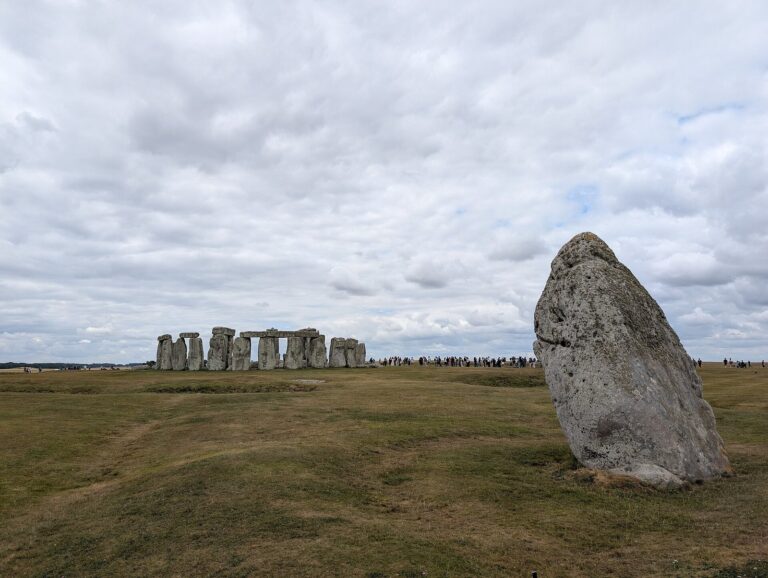
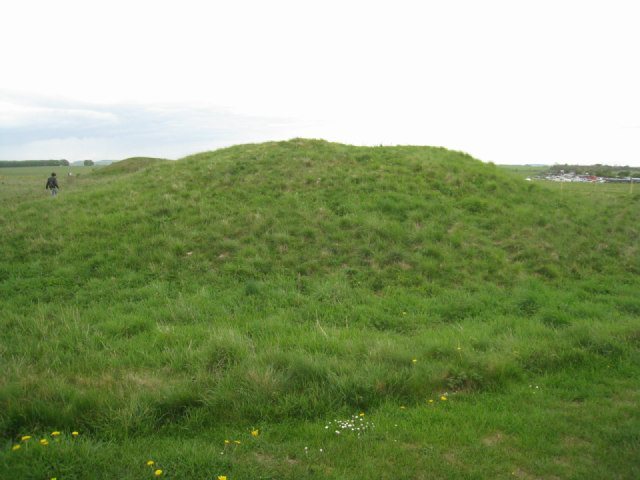
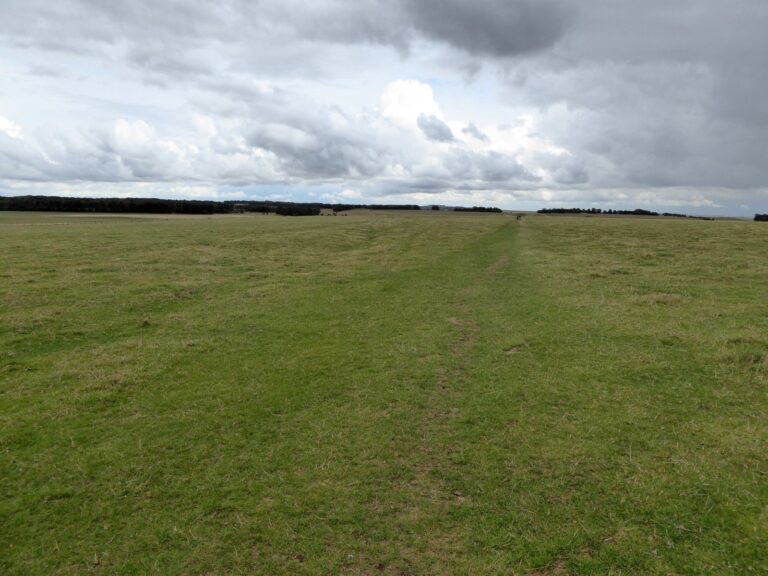
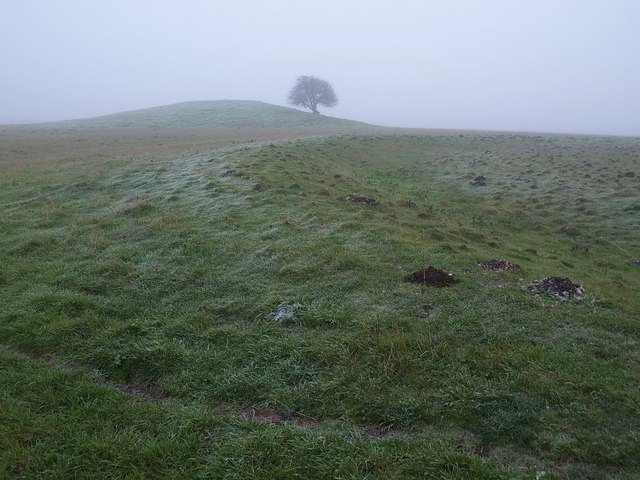
The surviving earthwork measures about 49 metres across and stands about 3 metres high. Its flattened summit is around 10.5 metres across, and breaks in the slope have been interpreted as signs of three phases of development. Bush Barrow stands at the western end of the Normanton Down cemetery, where about 40 barrows extend along an east-west ridge. The mound lies at the ridge’s highest point, about 1 kilometre southwest of Stonehenge, although it is neither the tallest barrow nor clearly identified as the cemetery’s principal mound.
Burial and grave goods
The burial
Excavation revealed the remains of a large man laid at full length on the old ground surface, with his body oriented north-south. He is often called the Bush Barrow chieftain, but the nickname does not establish his rank.
Daggers
The grave contained three bronze daggers, two with blades unusually large for their period. Their blades are triangular, either flat or formed with a raised central rib, and six rivets attached each to a handle. Comparable daggers are known from Brittany and the Únětice culture, an Early Bronze Age culture of central Europe. One dagger was recovered in fragments.
One dagger had a wooden hilt about 30 centimetres long, decorated with as many as 140,000 tiny gold studs arranged in a herringbone pattern. Each stud is about 0.2 millimetres wide and 1 millimetre long, with more than a thousand in each square centimetre. Sent to Professor Atkinson at Cardiff University in the 1960s, the hilt was overlooked for more than 40 years before one of his successors rediscovered it in 2005.
Gold ornaments
Two gold sheets were shaped as lozenges, or diamond-like forms, and worked with precise geometric patterns. The larger measures about 185 by 156 millimetres. Its sheet is about 1 millimetre thick and rises to a profile of around 5 millimetres. Its position on the man’s body has led to the interpretation that it was a chest ornament; it may have been attached to a wooden object, with four holes serving as fixing points. The smaller sheet has interlocking lozenges that can look square when viewed from some angles.
The larger ornament’s design places repeated hexagons within three concentric circles, with smaller decorated panels inside them. Its precise, angular pattern has been taken to suggest the use of accurate tools and a measuring system. The smaller sheet also uses hexagonal forms. A roughly contemporary gold lozenge from Clandon Barrow has a different, ten-sided geometric design.
One interpretation links the larger lozenge’s angles, measured at about 81 degrees, to the difference between the summer and winter solstice sun positions at Stonehenge’s latitude. On this reading, its long axis also points toward the sunrise at the equinox. The pattern has consequently been read as a representation of the annual solar cycle, though this remains an unproven interpretation. Other proposals connect it with earlier traditions involving large stones and ritual, or read the lozenge shape as an image of a female deity, fertility, or maternity. Another suggestion is that its lines and shapes encode a calendar of Venus.
Scientific analysis indicates that the gold came from Cornwall. The finds also include a decorated gold belt plate and a separate thin gold belt hook, found beside the man’s right arm and thought probably never to have been used.
Mace
A stone macehead lay to the right of the man. It was made from a rare fossilized marine sponge, probably obtained in Devon or Cornwall. Its wooden handle had zigzag-shaped bone mounts, along with a bronze fitting and numerous small rings. The bone mounts survive.
Axe and other objects
A metal axe with raised side ridges lay near the man’s head. It is classified as a Ballyvalley type, also known as Needham type V, a form found chiefly in Ireland. The grave assemblage also includes a stone mace, a bone sceptre, an arrow, and a shield.
Earlier knife
Bronze fragments and rivets are identified as remains of a knife dating to about 2400 BC, earlier than the burial. This has prompted the suggestion that the buried man belonged to a long-established elite lineage. The further proposal that he was a priest who controlled rituals at Stonehenge remains speculative.