Ed-Dur: An Ancient Port and Settlement in the United Arab Emirates
Site at a Glance
- Rating
- 4.5
- Popularity
- Very Low
- Country
- United Arab Emirates
- Primary era
- Classical
- Eras represented
- Iron Age, Classical
- Civilizations
- Unclassified
- Site type
- Settlement
- Remains
- Town
On this page14 sections
History
Ed-Dur is an ancient Arabian settlement and port in Umm Al Quwain, in the United Arab Emirates. It was most prosperous in the first century CE, when it served as a major port on the southern Gulf coast. Its archaeological record reaches back through the Ubaid period, a prehistoric culture of ancient southwestern Asia, and the Stone Age, the era of stone-tool use. Occupation continued through the Neolithic, the later phase of the Stone Age, and the Bronze and Iron Ages, named for characteristic metal technologies. After occupation through the Iron Age, the settlement experienced a period of desertion and was later abandoned around AD 1000.
Port and regional trade
Between the third and first centuries BCE, trade associated with Ed-Dur shifted from merchants based in northeastern Arabia to traders from the southeast. The settlement developed into a major port and, at its height, was the largest coastal port in the southern Gulf. It may also have been the only significant port in that coastal region.
Ed-Dur is thought to be the ancient port of Omana. The Greco-Roman writers Pliny and Strabo described Omana as an important town in the Lower Gulf. The Periplus of the Erythraean Sea, an ancient guide to maritime trade routes and ports, calls Omana the Gulf’s most important port in the first century CE. It also links Omana with Apologos, a port at the head of the Gulf that has been associated with Basra. Greek texts list pearls, purple dye, clothing, wine, gold, enslaved people, and large quantities of dates among the region’s exports.
Coastal commerce and camel routes leading inland toward Syria may help explain the large quantity of Roman material found at Ed-Dur. The site was closely associated with Mleiha, an inland trading center. Their archaeological similarities include burial customs, vessels, decorations, and small bronze snake figures.
Archaeological investigations
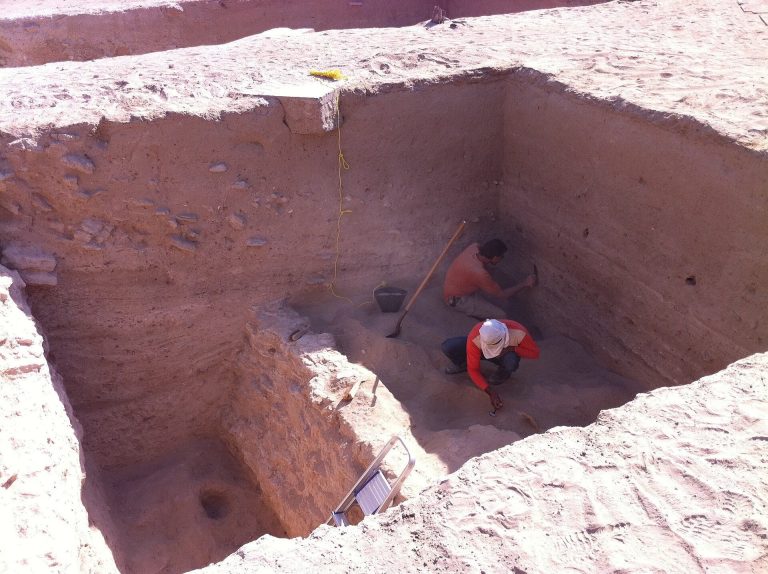
An Iraqi archaeological team surveyed Ed-Dur and excavated briefly in 1973–74. English, French, Danish, Belgian, and Australian teams began work in 1981, and formal archaeological exploration started in 1989. Researchers identified 50 principal excavation areas. Work between 1989 and 1995 recorded more than 1,400 finds and at least 13,000 pottery fragments useful for identifying vessels and archaeological contexts.
A Belgian expedition excavated the Sun Temple in 1987. A restoration effort begun in early 2016 aimed to return the building to its condition in the 1980s. By 2019, the temple was still exposed to the elements and deteriorating. Excavations in late March of that year uncovered 15 tombs, bronze statues, settlement remains, jewelry, and pottery dating to the first century CE.
Remains
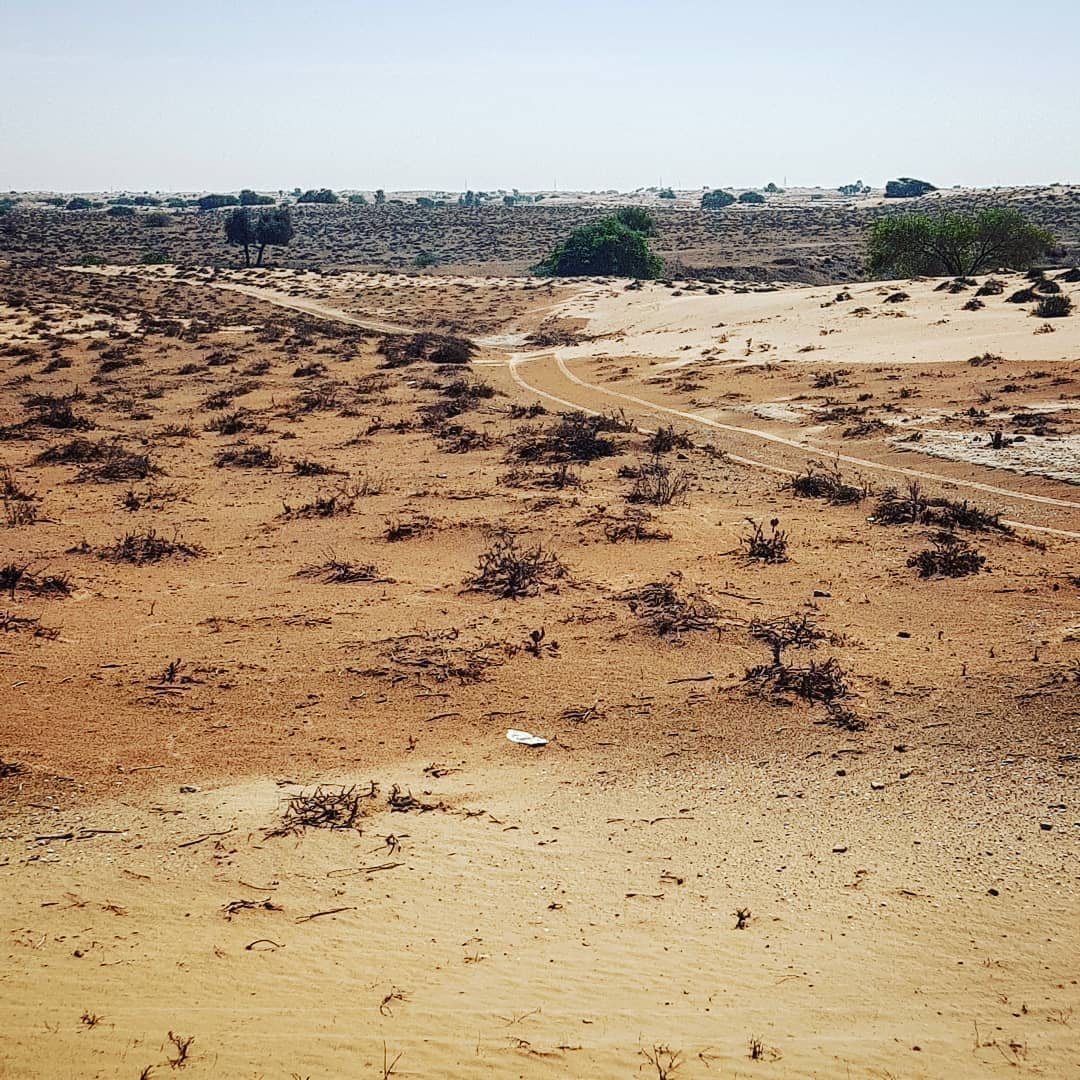
Ed-Dur covers about 5 km² and overlooks Al Beidha Lake. A shallow creek beside the site once provided a harbor, although the remains now lie about 3 km from the coast. Shells and fish bones found west of the site, along the coast and east of the modern road, may mark the ancient shoreline. The excavated remains include buildings, a fort, a temple, a well, and extensive burial grounds.
Settlement layout and buildings
Mounds and fort
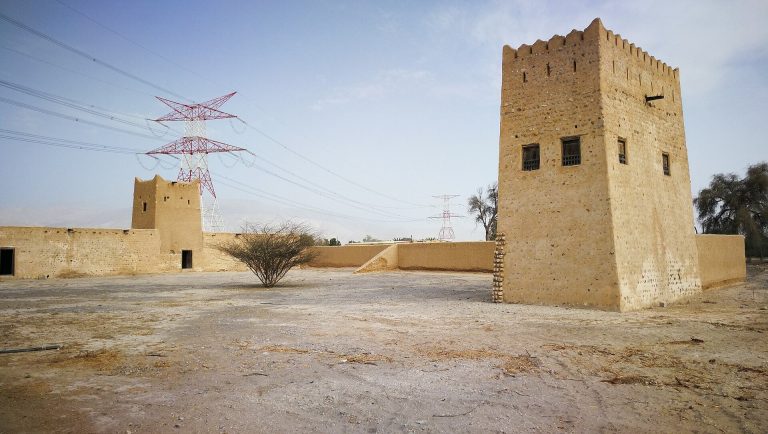
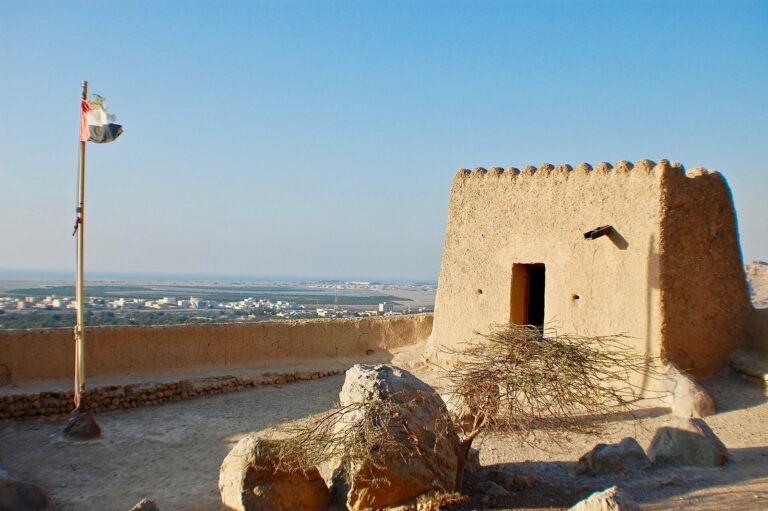
Excavation of a mound in the site’s southeast revealed a square building with dry-stone walls. A larger mound about 1.6 km to its south contained a square fort, with four walls of roughly 20 m each joined to round towers about 4 m in diameter. Beach rock provided most of the building material. Within the fort stood a separate, roughly square, three-room building, while another enclosure abutted the eastern wall. The fort served as the focus of political power; the Sun Temple lies to its south.
Public and residential buildings
Excavations also revealed public and private buildings of varying sizes. The pre-Islamic settlement contained dozens of structures, many built using areesh, a form of construction made from palm fronds. Houses may have used palm fronds, palm trunks, or timber, materials that could decay over time.
Temple and water supply
Sun Temple
The rectangular Sun Temple was dedicated to Shamash, a Mesopotamian sun deity. Built from locally available beach stone, it measures about 30.8 by 8 m, and its walls survive to roughly 2 m. The entrance faces east and was preceded by columns with Corinthian capitals, elaborately ornamented column tops. Two internal gates lead respectively to the main building and its courtyard. Four altars were made of beach stone. The exterior has a simple geometric plaster design, with alternating squares and rectangles formed by projecting panels. This pattern is associated with the eastern Mediterranean in the late Iron Age and also appears at a first-century temple in Hermopolis, an ancient Egyptian city, and at Pompeii, an ancient Roman city.
A rectangular basin on a broad base occupies the temple’s northeastern corner. Its eight-line inscription is in Aramaic, a widely used language of the ancient Near East, and only the word Shamash can be deciphered. A fire pit measuring about 2.7 m across and 1 m deep has prompted suggestions that fire formed part of religious ritual. A simple stone altar found inside was probably used for offerings or sacrifice. Two stone eagles found in an Emirati excavation in 2015 are thought to have decorated the entrance. The temple has been compared with the Great Temple at Hatra, an ancient city in northern Mesopotamia, though its architecture is simpler.
Well
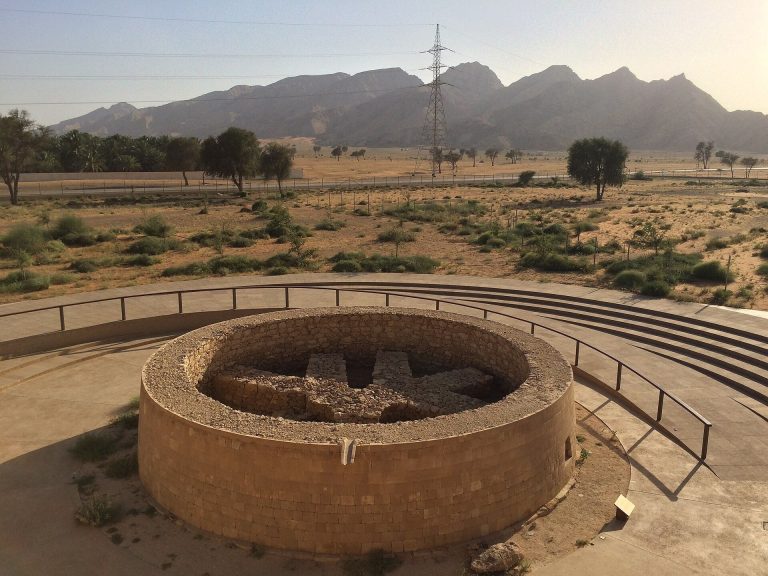
A circular well lined with stone stands near the temple. It is 6 m deep, and its water level was about 4.5 m below the surface.
Burials and excavated finds
Tombs and burial goods
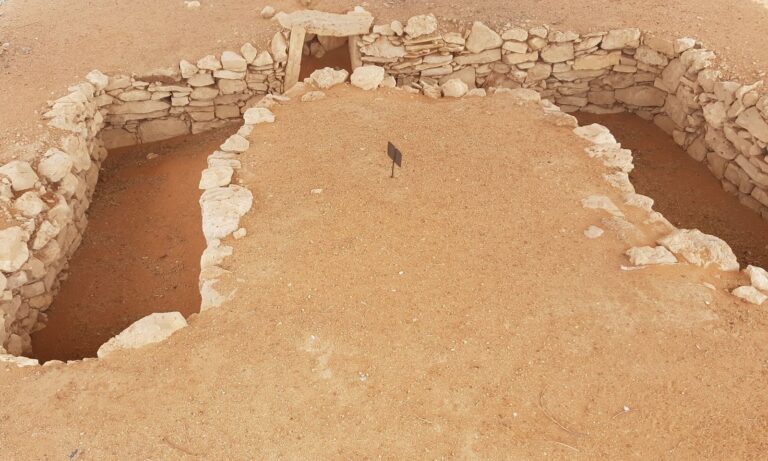
An estimated 20,000 tombs lie across the site, and roughly 500 have been excavated. Burial goods include drinking sets, Roman glass, weapons, pottery, jewelry, and ivory objects. One camel skeleton lay beside an iron sword. In area AV, two further camel skeletons were found with their necks drawn backward. More elaborate burials resemble Parthian burials at Assur in Upper Mesopotamia.
Pottery and other objects
Pottery includes imported and local wares, storage jars with black rims, yellow jars, and thin-walled vessels in varied colors. Glazed pottery makes up a large share of the ceramic material and was likely imported from southern Mesopotamia or southwestern Iran under Parthian rule, an Iranian-led empire that controlled much of the region east of the Roman world. Black-on-orange Namord pottery points to connections across the Strait of Hormuz with Persia and Baluchistan, while Indian red-polished ware indicates contacts farther east.
Finds dated from the second century BCE to the late first or early second century CE include metal arrowheads and iron nails, glass vessels, bronze rings, bracelets and bells, bone and ivory plaques, incense burners, figurines, beads of semiprecious stone and colored glass, a lead weight with an iron ring, and animal bones. The finds also include two limestone bird figurines, possibly falcons or eagles. Alabaster windowpanes from Ed-Dur represent the earliest recorded use of this feature in the Arabian Peninsula.
Coins
Eight coins recovered from the surface during the early Iraqi work comprised two Characene issues, four locally struck Arabian coins, and two that were difficult to read. Other finds include Macedonian-style coins associated with Alexander the Great, the fourth-century BCE Macedonian king and conqueror. Hundreds of additional coins show Heracles, a Greek hero, on one side and a seated Zeus, the chief Greek god, on the other, alongside the name Abi’el in Aramaic. Abi’el’s precise identity is uncertain. The designs match coin molds found at Mleiha and are distinctive to the two sites. Abi’el coins make up about 70 percent of Ed-Dur’s coin hoard. Dating these issues to around AD 100 is complicated by similar coins in a Bahrain hoard dated to 200 BCE. Abi’el’s name may have continued to appear on coins after his lifetime, as Alexander’s did.
Other coins reflect a broad range of regional connections. They include issues associated with Attambelos III–VI, rulers of Characene, a kingdom in southern Mesopotamia, and a small number linked to Aretas IV, king of the Nabataeans, an Arab kingdom centered around Petra. Further examples come from Roman, eastern Mediterranean, southern Mesopotamian, South Arabian, Persian, and Indian sources, including coins associated with Augustus and Tiberius, Gaza, Hadramawt, Parthia, and Persis.