Trinity College: An Oxford College Founded in 1555
Site at a Glance
- Rating
- 4.5
- Popularity
- Medium
- Country
- United Kingdom
- Primary era
- Early Modern
- Eras represented
- Medieval, Early Modern, Modern
- Civilizations
- British, English
- Site type
- Civic
- Remains
- University
On this page20 sections
History
Trinity College is a college of the University of Oxford in Oxford, United Kingdom. Founded in 1555 by the English benefactor Thomas Pope, it developed from a medieval religious foundation into an academic community shaped by changing religious policies, civil conflict, educational reform and successive building programmes.
Durham College and the Tudor foundation
The college’s predecessor, Durham College, was established for Benedictine monks from Durham Cathedral. Benedictines are members of a Christian monastic order whose life follows the Rule of Saint Benedict. The monks had been sent to Oxford several years before land was purchased for the college in 1291. Durham College was dedicated to the Virgin Mary, Saint Cuthbert and the Holy Trinity, the Christian belief in one God as Father, Son and Holy Spirit.
Durham College surrendered its land to the Crown in 1545. Edward VI granted most of its buildings and grounds to private owners in 1553, and Pope acquired them on 20 February 1555. He received a royal charter on 8 March to establish the College of the Holy and Undivided Trinity in the University of Oxford, of the foundation of Sir Thomas Pope (Knight). A wealthy Catholic with no surviving children, Pope hoped that students would remember him in their prayers. The new college’s name is thought to reflect Durham College’s dedication to the Trinity. Its foundation also coincided with Mary I’s interest in restoring Oxford as a centre of Catholic study.
The statutes set out a foundation of a president, 12 fellows, 12 scholars and up to 20 undergraduates. A president heads a college; fellows are elected academic members, while scholars receive college support for their studies. Fellows were required to study theology and remain unmarried. Thomas Slythurst, previously a fellow at Magdalen College, became Trinity’s first president. Pope transferred estates to the college on 28 March 1555, the only recorded occasion on which he visited it. The statutes came into force on 1 May 1556, and the college admitted its first students 29 days later. Their studies included classical literature, philosophy, mathematics, geometry and astronomy.
Pope supported the foundation with loans that became part of its endowment. By 1557, the college held five manors, or landed estates: Wroxton-with-Balscote, Sewell, Dunthorp, Holcombe and Great Waltham. Their rents, together with income from smaller properties, supported the college. In 1558, Pope exchanged additional land at Great Waltham and returned land at Sewell and Dunthorp without reducing the college’s overall finances. He also provided furnishings, many inherited from Durham College, 63 library books and equipment for the kitchen and dining hall.
After Pope’s death in 1559, his widow Elizabeth carried out provisions in his will. These included paying for a boundary fence beside St John’s College and accommodation intended as a refuge from plague in the city; the provisions were put into effect in 1564.
Religious change and college life
Elizabeth I’s accession in 1558 brought new pressure on the college’s Catholic character. The English Reformation was the break with Roman Catholic authority and the development of Protestant religious institutions. Slythurst was removed from office soon after Elizabeth became queen. His successor, former fellow Arthur Yeldard, led the college for almost four decades and was regarded as practical rather than strongly Protestant. Under pressure to conform, Trinity melted down church plate and acquired English hymnbooks. In 1583, Balliol College accused Trinity of insufficient commitment to Protestant teaching.
Student life and the college’s social divisions also changed during the sixteenth century. Servitors received financial support in return for service, battelers paid fees, and wealthier gentleman commoners paid higher fees. Trinity also appointed its first professional gardener. Disagreement with Balliol became a lasting feature of college life. The first recorded antagonism dates to 1583. Later college folklore associated president Ralph Bathurst with stones thrown at Balliol’s windows, while the rivalry took its modern form in the late 1890s around the song known as Gordouli.
Kettell’s improvements and the Civil War
President Ralph Kettell, who served from 1599 to 1643, strengthened the college’s finances and oversaw extensive repairs. After the great hall collapsed in 1618, the buildings around it were rebuilt. The college continued to dine in Durham College’s former refectory and created a cellar that later became the college bar. The library was repeatedly enlarged and refurbished with help from alumni legacies. A fellow was appointed librarian and given a small salary, and improvements also included toilet facilities.
Kettell raised money from former students and added funds of his own. Alumni gave tableware, and a dedicated collection for silver and other tableware gathered items valued at as much as £173. He also built accommodation on nearby land leased from Oriel College. By 1630, Trinity had more than 100 students, although many left without taking degrees.
The English Civil War, fought between supporters of Charles I and Parliament, disrupted Trinity’s finances and daily life. The college lent Charles £200 in 1642, a debt that was never repaid. Oxford became a Royalist defensive stronghold, and on 19 January 1643 almost all Trinity’s plate, valued at £537, was seized for the Crown and not returned. The surviving church vessels included a chalice for Eucharistic wine, a paten for communion bread and two flagons. Students left, some fellows followed, and the college was required to provide rooms for members of the royal court.
Parliament took Oxford in June 1646 and expelled Royalists. Hannibal Potter, president from 1643, resisted demands that he resign, but was forcibly removed and excluded for 12 years. A parliamentary inspection found three fellows, nine scholars and 26 undergraduates at Trinity. Two fellows, one scholar, one undergraduate and two bursars were expelled for refusing the parliamentary oath.
Recovery and eighteenth-century change
Robert Harris became president after the war and served for ten years as the college gradually recovered and its finances improved. Following his death in 1658, the fellows elected William Hawes, who resigned after about nine months, apparently so that they could choose another president before Parliament intervened. They elected Seth Ward, but the Restoration, the return of the monarchy under Charles II in 1660, brought prewar figures back to Oxford. Potter returned and died in 1664, after which Ralph Bathurst became president.
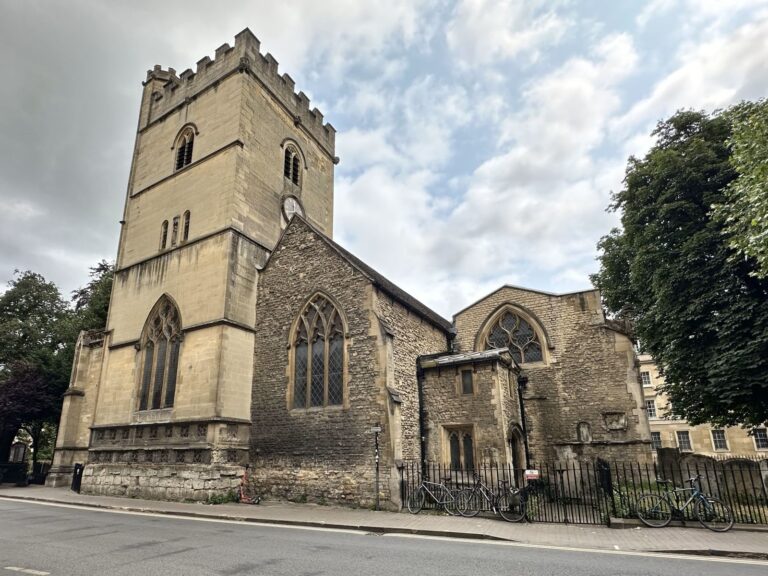
Bathurst led a long programme of rebuilding and expanded college accommodation. By the 1680s, Trinity again had more than 100 students. Teaching widened beyond classical subjects to include experimental philosophy, and Trinity was among the first Oxford colleges to open its library to undergraduates. Prayer remained compulsory, but attendance penalties and the curfew were gradually eased. The chapel consecrated in 1694 was the only college building completed during a visit to Oxford by Peter I, the Russian tsar and emperor; whether he entered it is uncertain.
Trinity’s finances remained stable in the eighteenth century. William Dobson’s presidency was contentious: he expelled one student against the tutor’s wishes and later expelled two commoners who criticized him. He was also challenged for supporting Whig politics, a political grouping associated with parliamentary government, and for questioning customary arrangements for appointing fellows. After Dobson died in 1731, George Huddesford became president. His tenure of 44 years and 292 days remains the longest in the college’s history.
Educational and social practices continued to change. The library began lending books in 1765, and the last servitor entered in 1763. Oral examinations were introduced, and by 1789 all students were examined twice a year. Religious requirements were gradually relaxed, although college rules continued to regulate conduct, including drinking and keeping hunting dogs. A rule on firearms followed in 1800.
Academic reform and broader access
Oxford imposed more rigorous degree examinations in the early nineteenth century, and Trinity formalized its oral examinations, known as collections, in 1809. Student John Henry Newman welcomed the increased academic strictness. During John Wilson’s presidency, beginning in 1850, the college strengthened teaching and tutorial provision, expanded scholarships and improved undergraduates’ access to the library. Earlier changes had allowed former scholars to become fellows from 1825, initially subject to religious restrictions, and students from other colleges to become fellows from 1843.
Religious rules governing college members continued to ease. In 1870, eight scholarships were freed from religious obligations. In 1882, taking Holy Orders, or ordination in the Christian Church, became optional for fellows other than the chapel clergy, and fellows were permitted to marry. Trinity’s boundaries with Balliol and St John’s were revised in 1864. Earlier purchases between 1780 and 1787 had added small plots where cottages and temporary lavatories were built.
War, memorials and coeducation
Herbert Blakiston became president in 1907 and resigned in 1931, but remained an influential elder statesman until his death in 1942. He resisted admitting non-white students and opposed pressure from the India Office to accept undergraduates from British India, although one non-white student entered during his presidency. The contrast between Trinity’s conservatism and social exclusivity and Balliol’s more radical politics sharpened the rivalry between the colleges.
The First World War sharply reduced Trinity’s population. Around 150 people lived at the college in May 1914; by the end of that year there were about 30, and fewer than ten remained by the war’s close. Rooms were requisitioned for the armed forces, students and fellows left for military service, and staff salaries were cut. In total, 820 Trinity students and alumni served, and 153 died. In 1919, Blakiston initiated a memorial project that led to a new library. Trinity recovered quickly after the war. During the Second World War it maintained student numbers, hosted officer-training courses and rented buildings while Balliol’s residential accommodation was requisitioned. A further 133 Trinity graduates serving as officers were killed, many in the Royal Air Force.
After the Second World War, Trinity expanded its accommodation. It developed Rawlinson Road in 1970 and Staverton Road in 1986, and added its eighteenth staircase in 1992. The college introduced a middle common room in 1964 and student kitchen facilities in 1976; catering shifted to self-service, and professional staff replaced domestic servants. A royal visit in 1960 prompted renewed plasterwork in the dining hall.
Changes to student life accompanied the expansion. Trinity appointed its first female lecturer in 1968, allowed overnight visitors from 1972 and weekend visitors from 1974, and abolished the curfew in 1977. Women entered as undergraduates from 1979, and the first woman fellow was elected in 1984. Trinity became coeducational and co-residential.
The rivalry with Balliol has involved sport, songs across the college boundary and practical jokes. The song Gordouli was reportedly sung by Trinity and Balliol men in the Mesopotamian trenches during the First World War. In 1962 or 1963, Balliol students covered Trinity’s junior common room with grass and daffodils. In 1985, Trinity students sent Balliol newcomers a false request for urine samples as a medical check; about 57 were returned, and a banner was displayed over Balliol. In 2010, vandalism of Trinity’s senior common room pond killed all but one of its fish. Trinity also educated three British prime ministers: William Pitt the Elder, Frederick North, known as Lord North, and Spencer Compton, Earl of Wilmington.
Remains
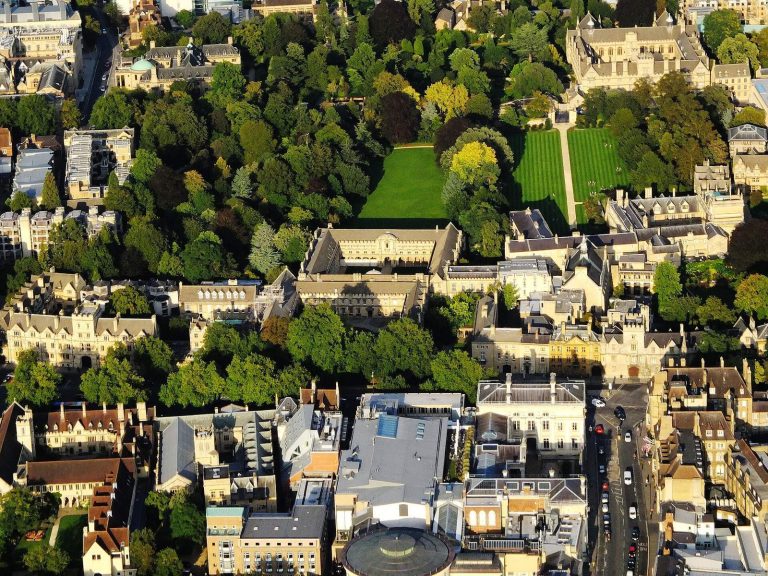
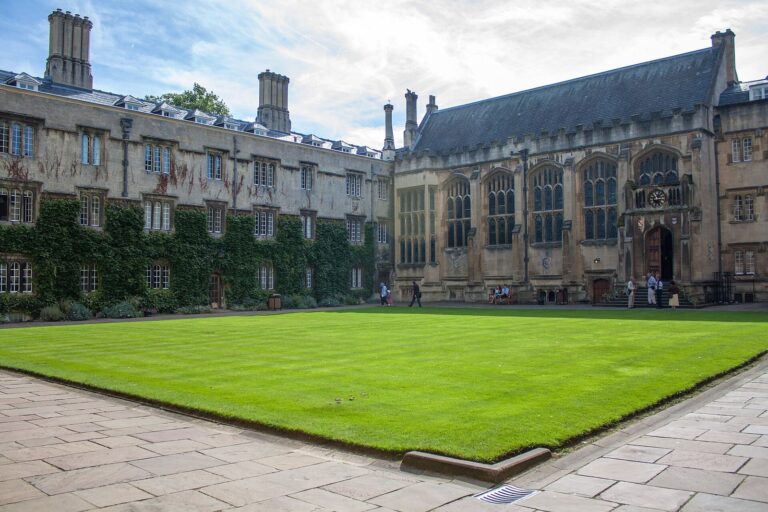
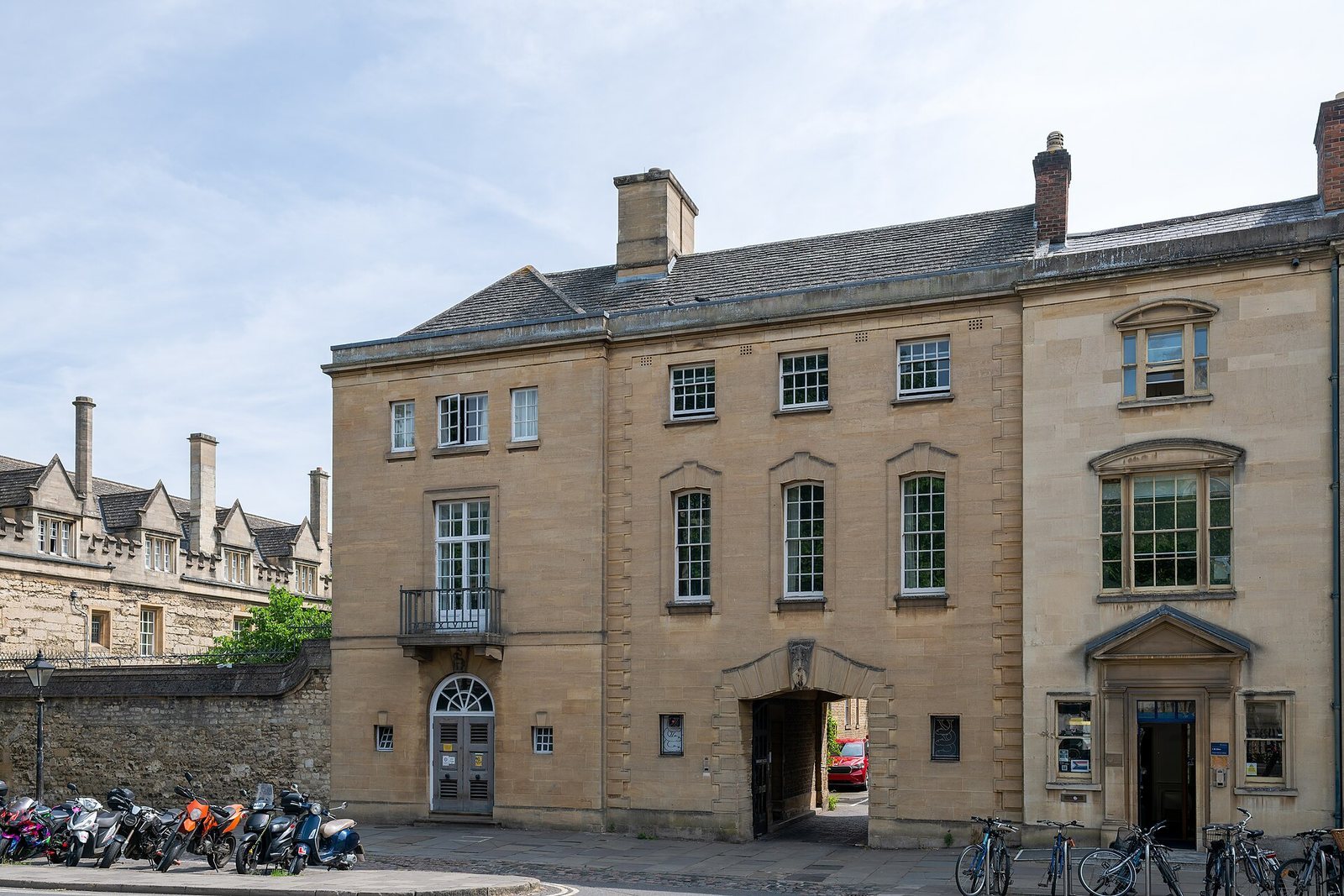
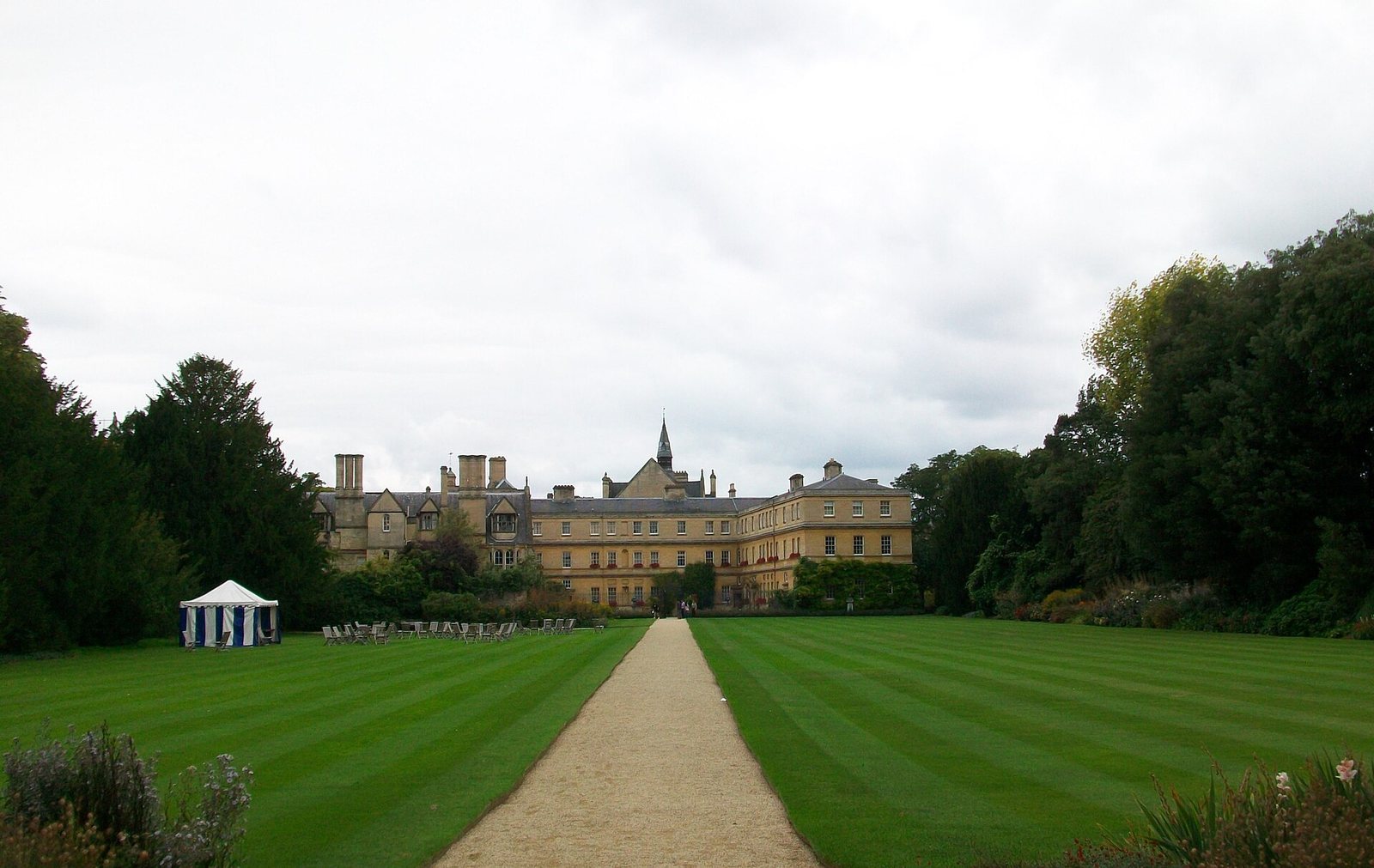
Trinity’s four principal quadrangles are courtyards enclosed or partly enclosed by buildings, set among a lawn, gardens and a small wooded area. The college’s main entrance faces Broad Street, between Balliol College and Blackwell’s bookshop and opposite Turl Street. Blue gates mark the entrance, and an iron fence of upright rails encloses the site. The rear boundary meets St John’s College, with other entrances on St Giles’ and Parks Road.
The quadrangles
Durham Quadrangle
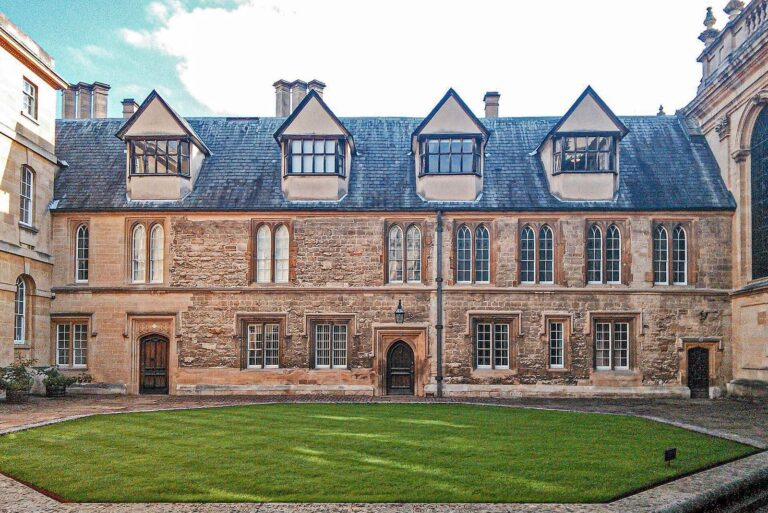
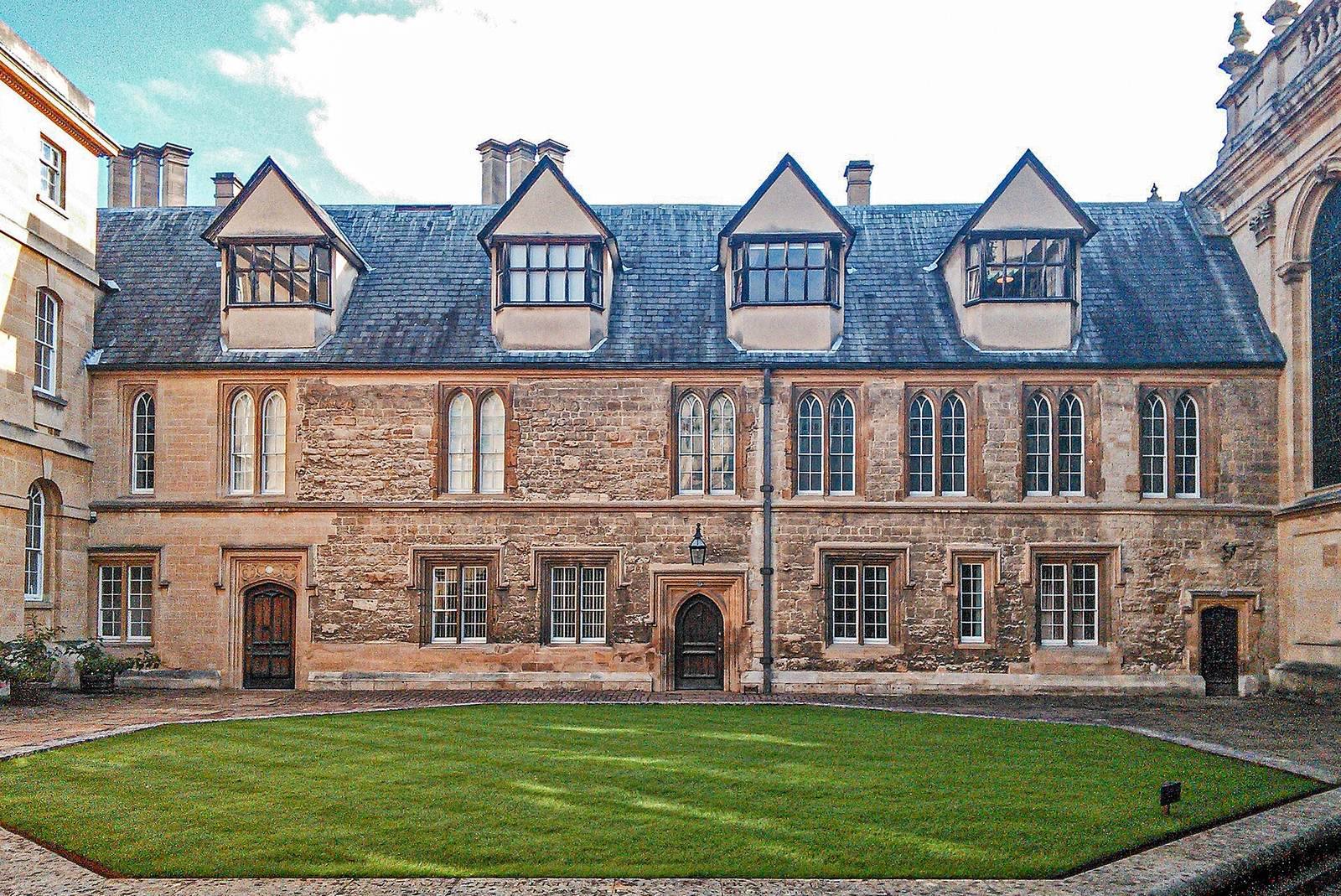
The Durham Quadrangle retains the arrangement of Durham College’s medieval courtyard. Its east range survives, with the Old Library on the first floor. That library building dates to 1417–1421, and parts of the medieval west range also remain.
Front Quadrangle
Between the Durham Quadrangle and Broad Street, the Front Quadrangle brings together Kettell Hall and four older cottages. Kettell Hall is a stone house built around 1620 by Ralph Kettell on land leased from Oriel College.
Thomas Graham Jackson designed new buildings for the Front Quadrangle, constructed in 1883–1885, and the president’s lodgings, built in 1885–1887.
Garden Quadrangle
The Garden Quadrangle began as a separate accommodation block planned to keep the Fellows’ Garden visible. In 1665, Christopher Wren advised Bathurst against enclosing the space as a quadrangle, comparing the proposed form to a three-legged table. While Wren was in Paris, the stonemason family the Townsends oversaw an initial two-storey building with a mansard roof, which has two slopes on each side and a steeper lower slope. Built between 1665 and 1668, the roof was the first of its kind in Oxford.
The west side followed the same plan in 1682. As student numbers grew, the mansard roof was removed and a third storey added. A central block later completed the courtyard, probably drawing on William Byrd’s Garden Quadrangle at New College. By 1728, three sides had three-storey buildings with ornate French-style exteriors.
Library Quadrangle
The Library Quadrangle lies between Jackson’s buildings and the library, built from 1925 to 1928 as a memorial to Trinity members who died in the First World War. J. Osborne Smith designed the library, whose ornate barrel-shaped roof was created by Leonard Shuffrey.
The Cumberbatch buildings, designed by Maguire and Murray, were added to the north and south sides of the quadrangle in 1964–1966. The northern building was later replaced by the Levine Building, north of the quadrangle and the university’s Weston Library. Designed by ADAM Architecture, Levine opened in 2022.
Chapel and worship
Chapel design
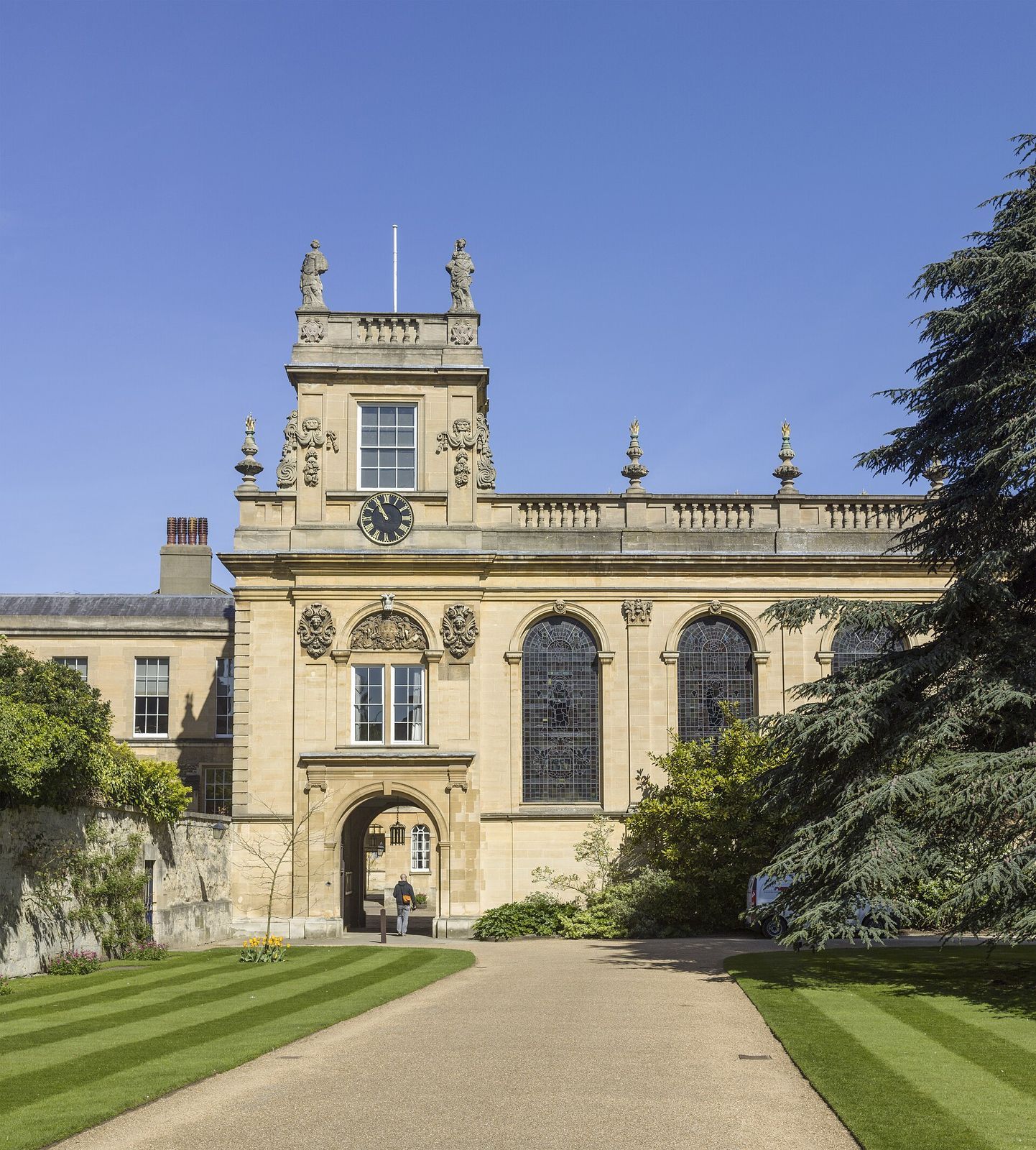
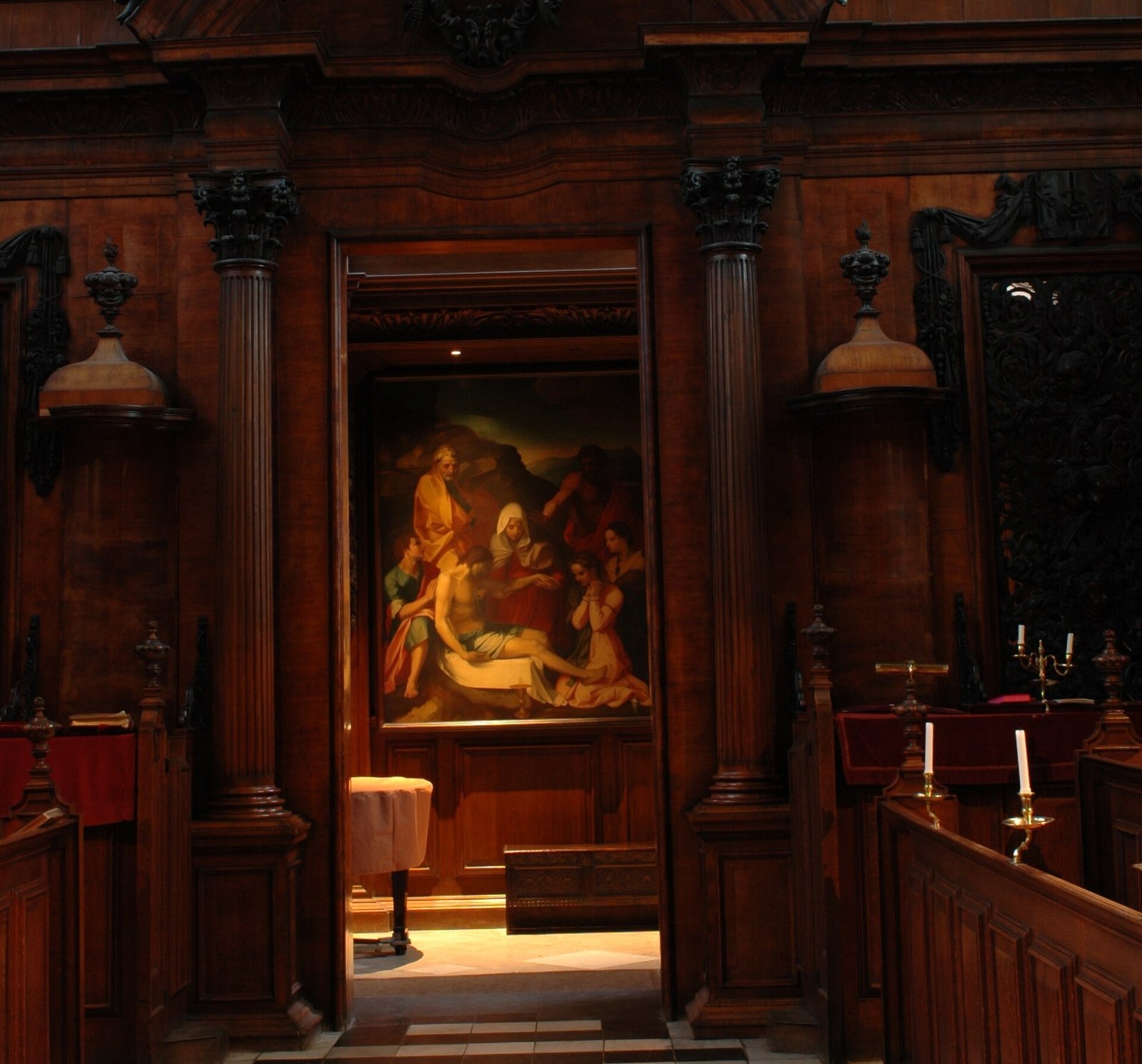
Trinity’s chapel is designed entirely in the Baroque style, an ornate form prominent in seventeenth- and early eighteenth-century Europe. It is thought to have been designed by Henry Aldrich with advice from Christopher Wren, and was consecrated in 1694. The built design followed a revised second print by Wren. An earlier print, preserved in Christ Church’s library, depicts a different plan for the west tower and interior.
Tower figures and memorial
Four female statues atop the west tower represent astronomy, geometry, medicine and theology. Thomas Pope’s remains lie in an enclosure beside the chapel altar, having been transferred there from St Stephen’s Church against his wishes.
Chapel choir
The Chapel Choir includes up to eight choral scholars and more than 30 volunteer singers from Oxford. Most are members of Trinity, and the choir does not hold auditions. It sings Sunday Evensong, an Anglican evening prayer service traditionally accompanied by choral music, each week and sometimes performs at weekday college services. Organ scholars oversee the choir under the chaplain’s supervision; the college has no director of music.
Underground room and college arms
Norrington Room
The Norrington Room, named for former president Arthur Norrington, occupies 10,000 square feet (930 square metres) beneath the college and houses Blackwell’s bookshop.
Arms and motto
Trinity’s arms have a vertically divided gold-and-blue field, a chevron between three griffin heads with jagged edges, and four stylized lilies on the chevron. The heraldic charges take the field’s colours in reverse. The college motto means, “What you wish to keep secret, tell to no one.”