Durham College, Oxford: A Benedictine College for Durham Priory
Site at a Glance
- Popularity
- High
- Country
- United Kingdom
- Primary era
- Medieval
- Eras represented
- Medieval, Early Modern
- Civilizations
- British, English
- Site type
- Civic
- Remains
- University
On this page15 sections
History
Durham College was a Benedictine college of the University of Oxford in the United Kingdom, established as a dependent house of Durham Priory to educate its monks. Benedictines followed a shared monastic life shaped by the Rule of St Benedict, and a dependent house, or cell, was linked to a larger monastery. Durham College’s foundation is attributed either to Hugh of Darlington or to his successor Richard de Hoton. Hugh acquired land around 1286, and building work began under Richard. The institution was known as Durham Hall until 1381.
Foundation and study
Durham monks had been sent to study at Oxford by 1278, before the college was established. In 1291, southern abbeys agreed to bring their Oxford arrangements together at Gloucester College, but Durham had already begun establishing a separate house. The residents remained monks of Durham Priory and lived in Oxford at the prior’s discretion. A prior, the officer leading the monastic community, was appointed by Durham to head the college.
The hall was intended for six to ten monks, though a lawsuit in 1367 indicates that only two to five lived there during that decade. On one occasion, the prior sent a companion so that a monk would not have to live alone. Students generally came to Oxford after studying grammar and arts at Durham Priory or, at times, Stamford. They could then proceed directly to higher degrees in theology, including Bachelor and Doctor of Divinity.
The college’s leadership and administration were sometimes disputed. In 1319, the university chancellor claimed the right to assign vacant rooms because Durham Priory’s head was not resident in Oxford. The college’s prior later gained authority to administer the house, collect rents, and hear confessions. By the 1340s, he also sat on the oversight board of Balliol College.
Endowment and college life
In 1338, Richard de Bury, Bishop of Durham, sought to secure the college’s future by persuading Edward III to grant it the income of the rectory at Simonburn. A rectory was a church benefice supported by parish revenues. De Bury planned new statutes dedicating the college to God and St Margaret, as well as a library of more than 1,500 books with a lending system. He described the plan in The Philobiblon in 1345. De Bury died heavily in debt later that year; the plan was apparently not carried out, the Simonburn income went instead to the canons of St George’s Chapel at Windsor Castle, and his books were sold to pay his debts.
De Bury’s successor, Thomas Hatfield, drew up an endowment agreement in 1380 worth £3,000. It was meant to provide £200 a year for eight monk fellows and eight secular scholars, meaning students who were not monks. The arrangements were delayed after Hatfield’s death in 1381, but the funds were eventually delivered. Robert de Berington of Walworth, Prior of Durham, put the monk John de Berington, probably his brother, in charge. John used the money to buy rectories at Frampton, Fishlake, Bossall, and Ruddington, along with estates intended to provide continuing income.
The statutes required fellows to study philosophy and theology and oversee the selection of scholars. Four scholars were to come from North Yorkshire and four from the Diocese of Durham. They studied philosophy and grammar, helped the monks with daily tasks, and were expected to stay for seven or eight years. One fellow served as warden, the officer responsible for college administration, while the Bishop of Durham had oversight as the college’s visitor.
Durham College also housed monks from other northern Benedictine communities, including York and Whitby. Rooms were sometimes rented to people from outside the foundation. Gilbert Kymer, for example, dated official acts from the college during his second term as university chancellor, from 1446 to 1453. Six of its wardens later became priors of Durham, while other former members held senior roles at Coldingham and Finchale.
The college’s relationship with Gloucester College was contested. Gloucester’s prior of students claimed authority over all Benedictine monks in Oxford, including those at Durham and Canterbury Colleges. In 1422, John Wessington, Prior of Durham and a former bursar of Durham College, argued in a treatise that Durham’s students should be exempt because their college predated the appointment of Gloucester’s prior.
Reformation and later claims
During the English Reformation, Durham College was surrendered to the Crown in 1540. Its annual income was then put at about £115, and a surveyor of the Court of Augmentations inspected the buildings. They were returned to the Dean of Durham, which retained a rector, six fellows, and four “inferior fellows.” George Clyff, the senior fellow, became rector but apparently did not perform the role effectively, and the college did not survive.
In 1541, Henry VIII proposed using the college’s funds to establish a university at Durham, but the proposal was reduced to a grammar school whose headmaster and assistant master would be paid from cathedral funds. The buildings were surrendered to the Crown again in March 1544/5 and were not returned; the estates went back to the Dean and Chapter of Durham. Walter Wright, Archdeacon of Oxford and later university vice-chancellor, briefly occupied the buildings as a private hall, after which they fell into disrepair.
In 1546, half of the college grove, which had for a time been leased to St Bernard’s College, was granted with that college to Christ Church. The garden later formed part of the original site of St John’s College, founded in 1555. In 1553, Edward VI granted Durham College’s buildings and remaining grounds to George Owen of Godstow and William Martyn of Oxford. They sold them to Thomas Pope on 20 February 1554/5; sixteen days later, Pope used the property to found Trinity College, Oxford. Durham College had been dedicated to the Virgin Mary, St Cuthbert, and the Trinity, and Trinity College is thought to have taken its name from the final part of that dedication.
Durham’s estates remained with the Dean and Chapter after the Reformation. In the nineteenth century, the founders of the University of Durham argued that these lands, together with earlier efforts by Henry VIII and Oliver Cromwell to support higher education at Durham, gave the university a claim to use them. Founded by the Dean and Chapter in 1832, the University of Durham asserted that it succeeded Durham College; its coat of arms includes Bishop Hatfield’s arms.
Remains
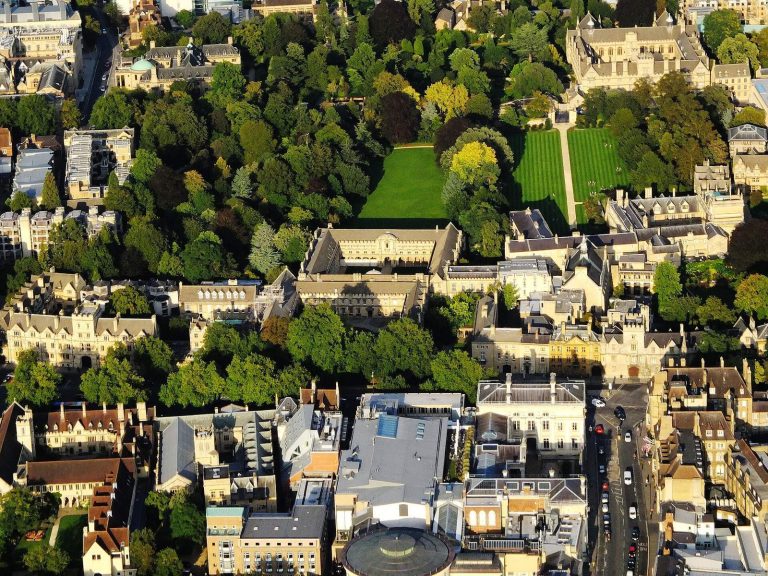
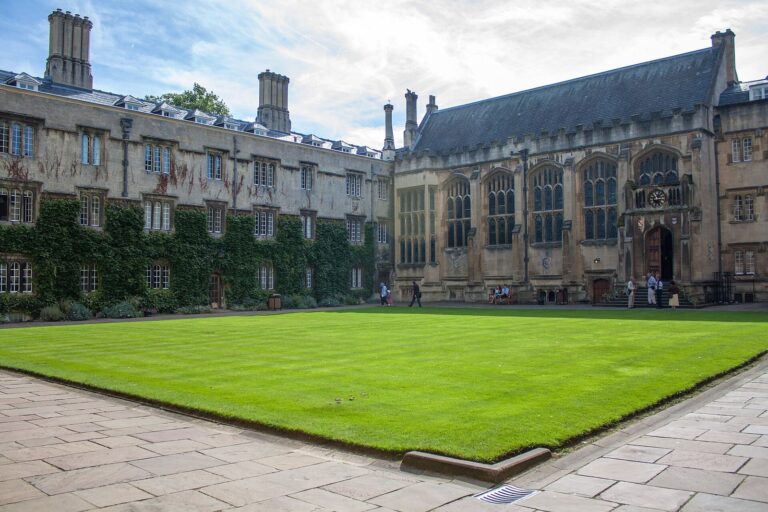
The college occupied a substantial site north of Oxford’s city walls, with access from Horsemonger Street, now Broad Street, and Beaumont, now Parks Road. The land was acquired in stages, beginning with ten acres at Beaumont obtained from Godstow Abbey around 1286. The layout developed from early residential and prayer spaces into a courtyard enclosed by buildings, reached by a walled road. The east range largely survives within Trinity College’s Durham Quadrangle.
Early buildings and quadrangle
Residence and prayer spaces
By 1302, the college had a two-storey residence containing a dormitory and cellar. An inventory from 1315 lists mass vestments and ornaments, indicating that a consecrated worship space had been arranged by then. An oratory, a small room or building for prayer, was built in 1323, and groundwork for a chapel followed soon after.
Gate and quadrangle
A new gate onto Horsemonger Street was built in 1397. It opened onto a walled road leading to a quadrangle, a courtyard enclosed by buildings. The buildings around it included living quarters, a refectory or dining room, a chapel constructed in 1408–1409 with help from a bequest by Bishop Walter Skirlaw, and a library built in 1417–1418. In 1412, the chapel received a license for burials through a bull issued by John XXIII, the Pisan claimant to the papacy during the Western Schism, a period of rival claims to papal authority. The quadrangle appears to have been completed in 1420–1421.
Gardens
An inspection around 1540 described three well-proportioned gardens within the grounds.
Surviving ranges
East range
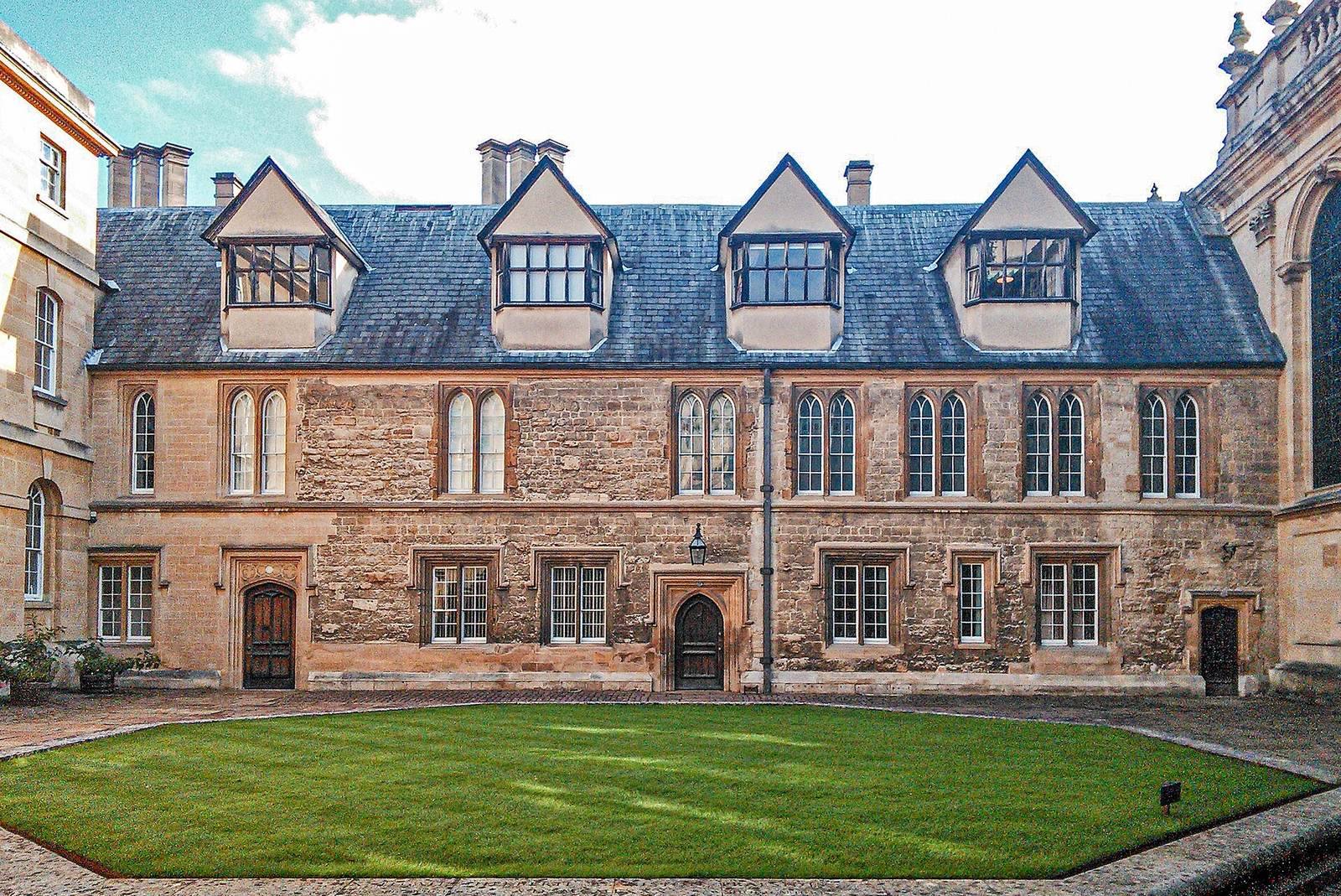
Much of the former quadrangle’s east range survives as part of Trinity College’s Durham Quadrangle. The former monastic library occupies its first floor. Stained-glass panels show the arms of Thomas Hatfield and John Wessington and are believed to belong to the original building. Fifteenth-century stained-glass figures of saints may have come from the Durham College chapel when it was demolished. In 1602, Ralph Kettell added attic rooms with dormer windows, known as “cock-lofts.”
West range
The west range’s dining hall remained until 1618, when it collapsed during excavations directed by Trinity president Ralph Kettell and was rebuilt. Fourteenth-century fabric survives at both ends of Kettell’s hall. This includes the outer buttery, a service room for provisions and drink, which retains some fifteenth- and sixteenth-century stained glass. The hall’s south wall has a double arch and may be the oldest surviving fragment of Durham College.
Replaced quadrangle features
Chapel
In 1692, the college chapel was described as homely, infirm, and ruinous. It was demolished and replaced.
North range and entrance gate
William Townesend replaced the quadrangle’s north range in 1728. The college gate had a large archway and a smaller secondary entrance, or postern, with an ornamented niche above it. In 1733, the gate was replaced by a metal fence and gates because the entrance was considered too narrow for public use.