Lublin Crown Tribunal: The Polish Crown’s Highest Appellate Court for the Nobility
Site at a Glance
- Rating
- 4.6
- Popularity
- Medium
- Country
- Poland
- Primary era
- Early Modern
- Eras represented
- Medieval, Early Modern
- Civilizations
- Kingdom of Poland, Polish–Lithuanian Commonwealth
- Site type
- Civic
- Remains
- Town Hall
On this page11 sections
History
Establishment and court life
The Lublin Crown Tribunal in Poland is the former town hall that became the highest appellate court for the Polish Crown’s nobility in 1578. The Crown was the Polish part of the Polish-Lithuanian Commonwealth. At the Sejm, the Commonwealth’s parliament, King Stephen Báthory gave up his former authority as supreme judge in favor of a court of the noble estate. Under the 1578 constitution, the Tribunal’s jurisdiction covered the Crown alone and dealt with land law. Lublin served Małopolska, or Lesser Poland, while Piotrków served Greater Poland and Mazovia.
The court’s sessions began on the Monday after the first Sunday following Easter. They continued until the year’s cases had been heard, usually through St Bartholomew’s Day on 24 August. In 1611, the Sejm extended the time allowed for sessions. Judges, known as deputies, were elected annually from the nobility and clergy. The marshal, the lay presiding officer, was chosen from among the lay deputies. The president was always a deputy from the Gniezno cathedral chapter, the college of canons serving the cathedral.
The Tribunal helped establish Lublin as a legal center. As university-based legal training declined, its courtroom gave many aspiring legal practitioners their first experience. The Zamoyski Academy in Zamość, where law was taught, also drew students to the city. They came from across the Commonwealth and abroad. Lublin grew rapidly after the court’s establishment, with magnate palaces and noble residences appearing, and civic life becoming busier during Tribunal sessions.
A Lublin legend places a widow’s trial at the Tribunal in either 1637 or 1638. In the story, a magnate bribed the judges, and the widow appealed to a courtroom crucifix, declaring that even devils would judge more fairly. That night, demonic judges supposedly ruled in her favor and burned a handprint into the courtroom table. The legend says that Christ turned his head on the crucifix rather than witness the devils delivering a fairer judgment than human beings.
Reforms, closure, and later use
In 1764, the Crown Tribunal was divided into separate tribunals for Greater Poland and Małopolska, which met simultaneously. A constitution adopted by the Sejm in 1767 to 1768 brought them together again as one tribunal for both provinces. During the reign of Stanisław August Poniatowski, the last king of Poland and grand duke of Lithuania, the court painter Marcello Bacciarelli had an artistic studio in the building. Plans were also made to establish Poland’s first academy of fine arts there.
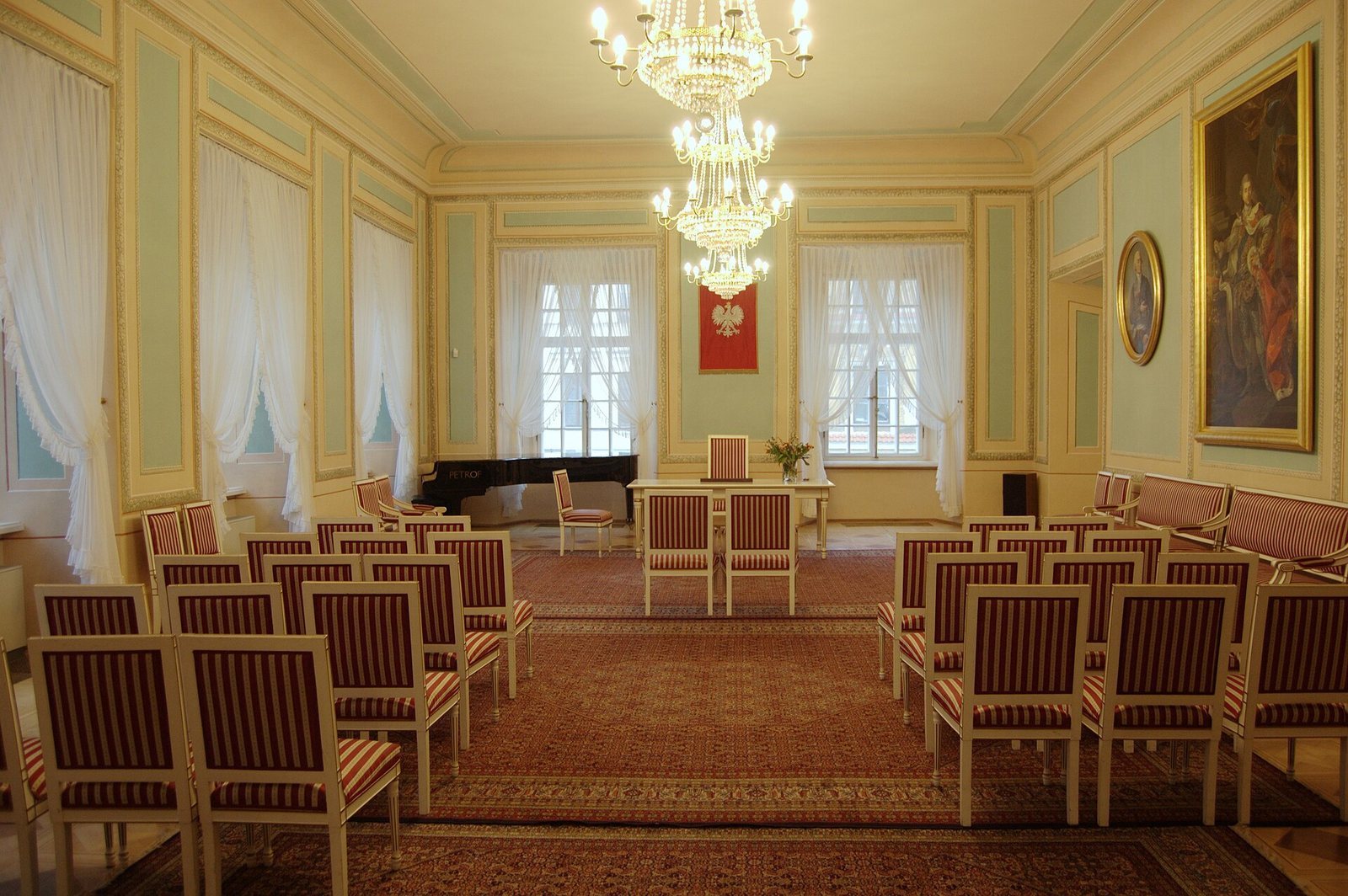
After the Partitions of Poland, the Tribunal closed along with the other noble courts of the former Polish state. Its records were kept in the dining hall of a Dominican monastery, moved to a Bernardine monastery in 1811, and transferred in 1827 to Lublin’s newly established archive of old documents. Between 1836 and 1840, they were moved to the Warsaw archive, where they were destroyed during the Warsaw Uprising in 1944. The building now houses a wedding palace, and some rooms are used by the Museum of the History of the Town Hall and Crown Tribunal.
Remains
Successive town hall forms
The town hall on the site was rebuilt in Gothic, Renaissance, Baroque, and Classical styles. The earliest structure was a wooden Gothic town hall from the 14th century, with two towers and an external staircase. It burned in Lublin’s fire of 1389. A larger masonry town hall was then built on the same site; its Gothic phase dates to around the turn of the 14th and 15th centuries.
Rebuilding in the first half of the 16th century gave the town hall a Renaissance appearance, with an ornamental low wall along the roofline and an external staircase to the first floor. After another fire in 1575, the building was reconstructed in Renaissance style, apparently drawing on the town halls of Sandomierz and Tarnów. In the 1680s, it was remodeled in the Baroque style: a second floor was added and the tower altered. A 1719 painting of the Fire of Lublin, now in a Dominican church, depicts the building in this phase.
Classical rebuilding and facade
Classical enlargement
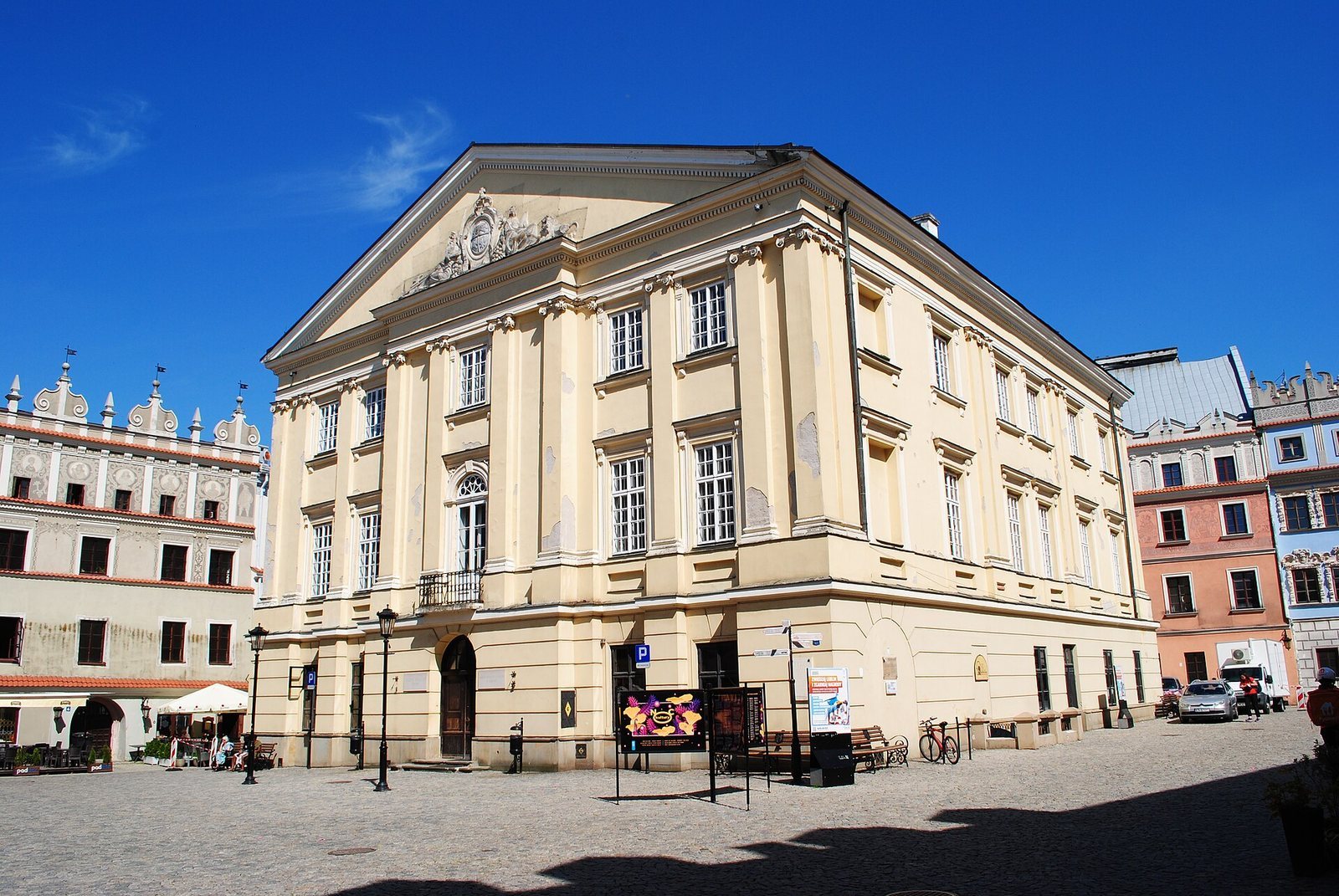
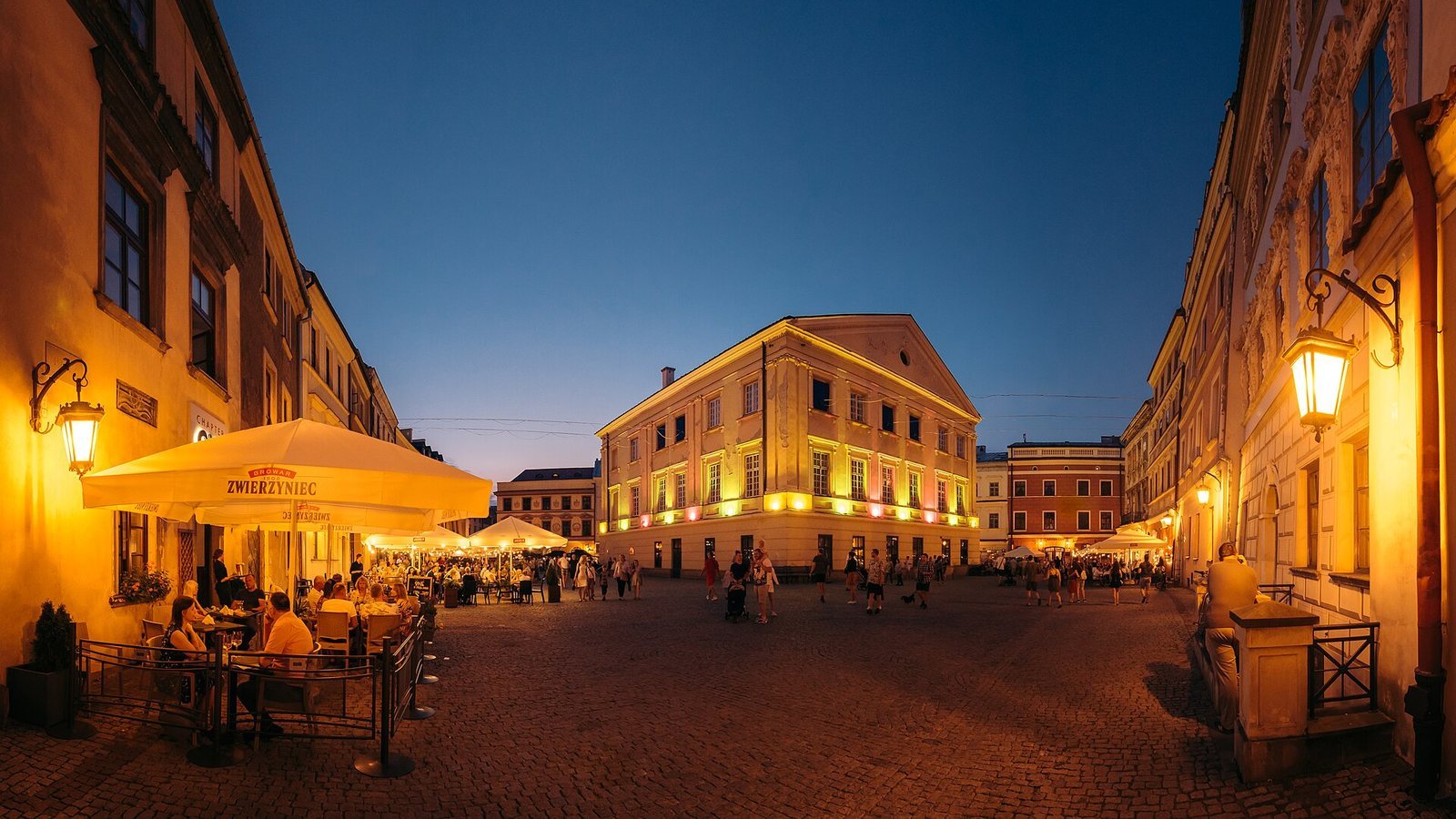
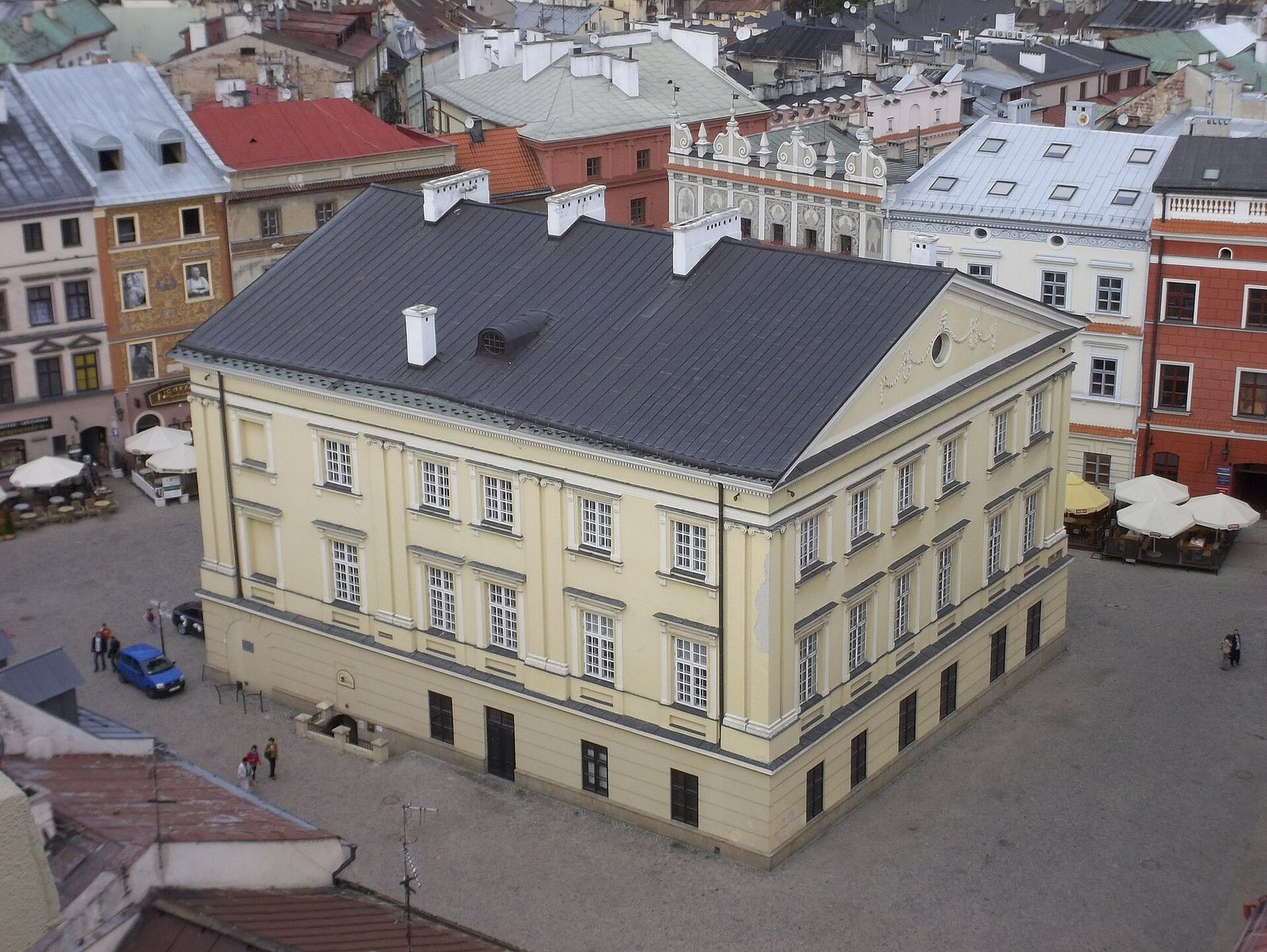
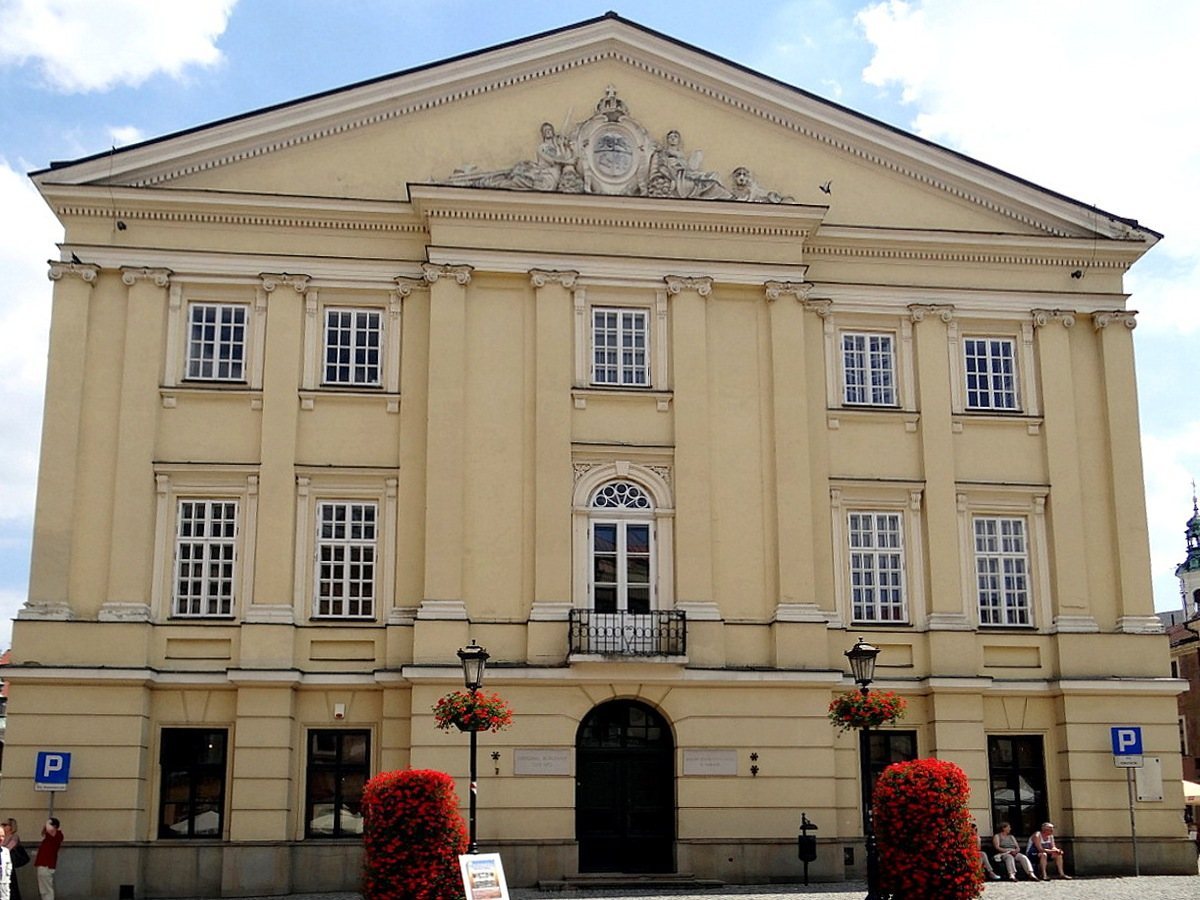
From 1781 to 1787, architect Dominik Merlini remodeled and enlarged the building in the Classical style, bringing it to nearly twice its former size. The second floor was completed for the land courts, while the other interiors were left unchanged. The exterior walls have pilasters, shallow column-like projections.
Facade relief
The central field of the exterior pediment carries a relief symbolizing justice. The upper facade also includes a shield bearing the Polish Eagle and the Pahonia, Lithuania’s traditional emblem of an armed mounted knight, as well as a Polish royal crown topped by a cross. Two seated women appear in the relief, one holding a sword and the other scales, with a lion at one woman’s feet. The relief was reconstructed in 1977.
Interior and associated objects
Paintings and cellar space
Paintings held in the building include portraits of King Stephen Báthory and Stanisław Małachowski, marshal of the Four-Year Sejm. The underground route occupies former cellar space used as a wine cellar and prison.
Objects associated with the widow’s legend
The courtroom crucifix associated with the legend is now in a chapel of Lublin Cathedral. The table, which predates 1578 and bears the reputed burned handprint, is held in the museum at Lublin Castle.