St Giles in the Fields: A Historic Parish Church in London
Site at a Glance
- Rating
- 4.5
- Popularity
- Medium
- Country
- United Kingdom
- Primary era
- Early Modern
- Eras represented
- Early Modern, Modern
- Civilizations
- British, English
- Site type
- Religious
- Remains
- Church
On this page15 sections
History
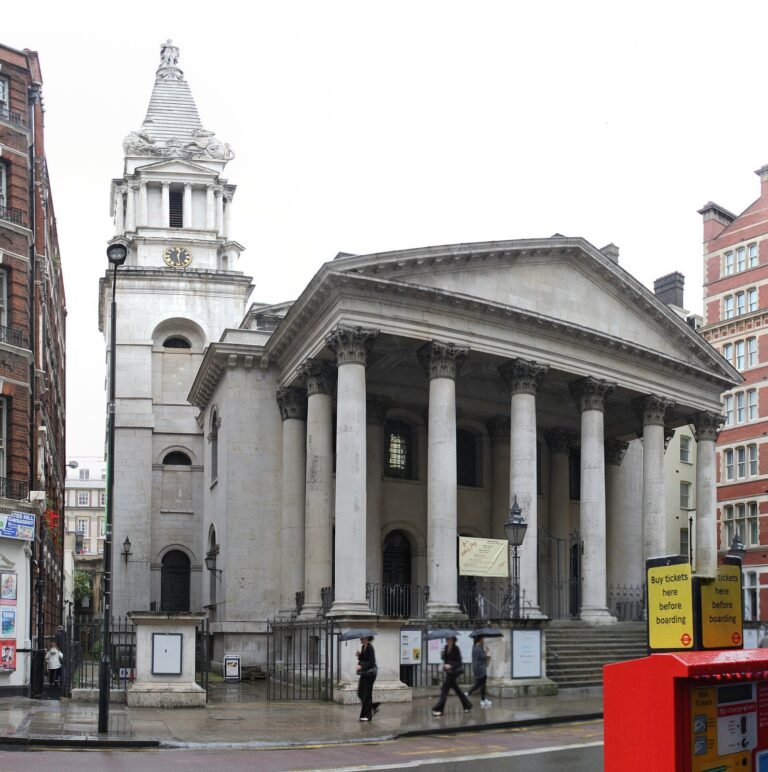
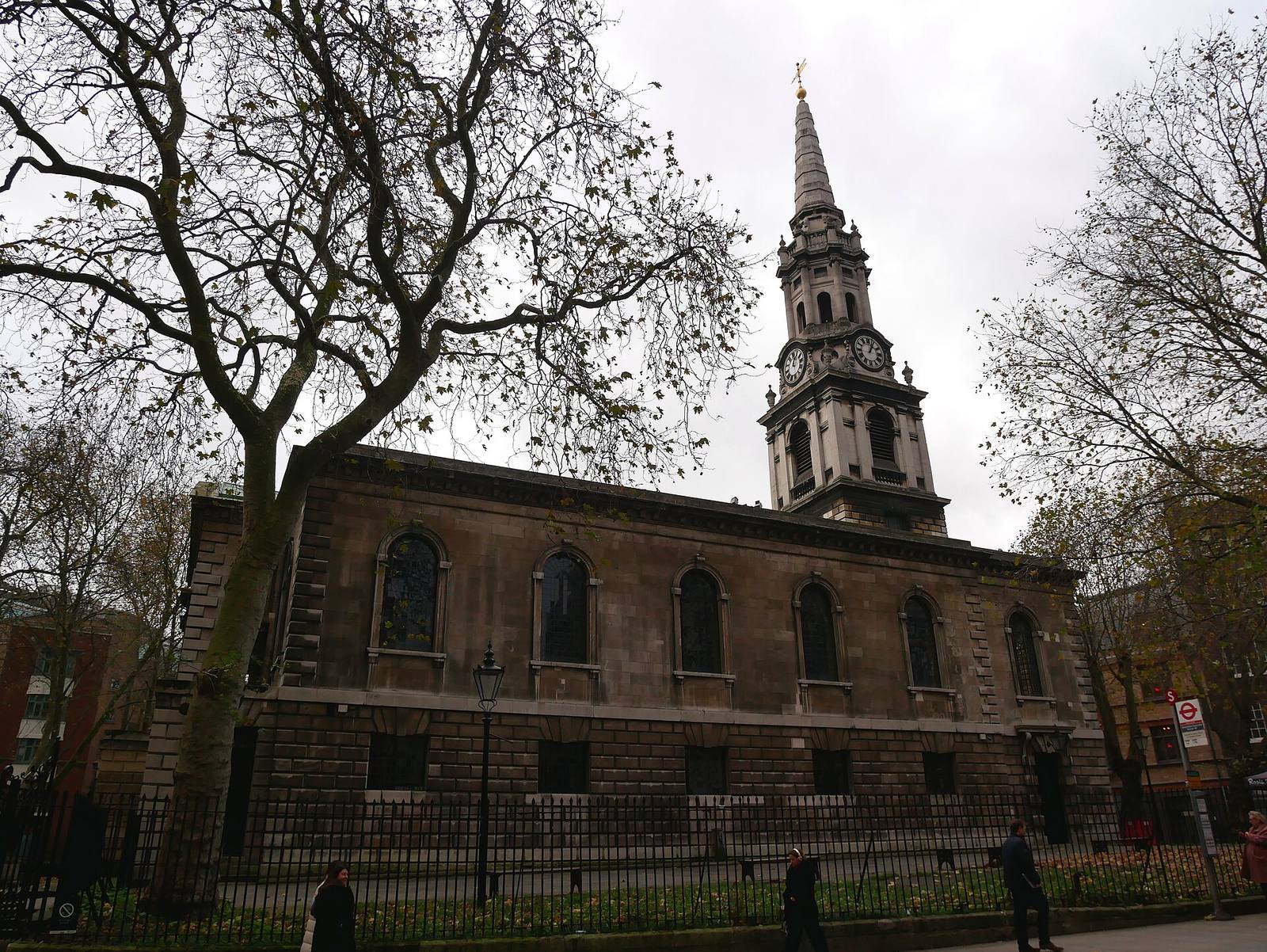
St Giles in the Fields is a Church of England parish church in London, United Kingdom. Its present building was constructed in 1730–1734 in the Palladian style, on the site of a chapel founded as part of a hospital by Matilda of Scotland, queen of Henry I, between 1101 and 1109. The hospital stood outside the City of London, on the road toward Tyburn and Oxford, between London and Westminster.
Hospital and parish in the Middle Ages
Henry II granted the hospital land, gifts, and privileges between 1169 and 1189, strengthening its position. He was later known as its “second founder.” The chapel probably served a hamlet that grew near the hospital, and a parish of St Giles existed by 1222. In the thirteenth century, a papal decree confirmed the hospital’s privileges and placed it under the special protection of the pope. For its first two centuries, the Crown supported the hospital and the City of London administered it as a Royal Peculiar, a religious institution under royal rather than ordinary diocesan authority.
In 1299, Edward I assigned the hospital to Burton Lazars, a house of the Order of St Lazarus, a religious order associated with caring for people with leprosy. St Giles then became a subordinate house, or cell, of that institution. Complaints in the fourteenth century accused the order’s brothers of mismanagement and of prioritizing the order over the care of lepers. In 1348, London citizens alleged that sick people had been displaced and replaced by members of the order who were not ill. A warden governed the hospital under the master of Burton Lazars, while the king intervened in its affairs on several occasions.
Richard II sold the hospital, chapel, and lands to the Cistercian abbey of St Mary de Graces in 1391. The Lazar brothers, led by their master Walter Lynton, seized the property and resisted an archbishop’s inspection. Important records were lost or destroyed during the dispute. The king later acknowledged that he had been misled about the ownership, and the sale was formally revoked in 1402, restoring the property to the Lazar brothers.
Rebellion, conspiracy, and the hospital’s end
In 1414, St Giles Fields became the gathering place for an unsuccessful uprising led by Sir John Oldcastle against Henry V and the Catholic Church. Lollards, religious reformers who challenged aspects of the established Church, assembled there on 9 January. The rebels were captured or dispersed, and the uprising brought severe reprisals. On 12 January, 38 prisoners were taken from Newgate to St Giles and hanged in groups; seven condemned as heretics were then burned. Four more were hanged the following week. Oldcastle was captured later and hanged in chains and burned at St Giles Fields on 14 December 1417.
In 1585, Catholic conspirators met in the St Giles precinct to plan Elizabeth I’s assassination and a Spanish invasion intended to place Mary, Queen of Scots, on the throne. The plot, led by Anthony Babington and the Jesuit John Ballard, was uncovered by Elizabeth’s principal intelligence official, Francis Walsingham. In September 1586, the conspirators were brought back to the churchyard and executed by hanging, drawing, and quartering. Mary’s tacit approval of the plot was used against her, and she was executed in 1587.
Leprosy had declined by the mid-sixteenth century, and the hospital also began to provide for people in poverty. The Crown challenged and confiscated its lands in the 1530s, and the institution was dissolved in the middle of the century. Its chapel survived as the local parish church. A rector was appointed in 1547, when “in the Fields” was added to the name to distinguish the church from St Giles Cripplegate.
From at least the early fifteenth century, condemned prisoners travelling from London to Tyburn were given ale at St Giles, a custom known as the St Giles Bowl. It began at the hospital and continued under the churchwardens after its dissolution. The Angel Inn was associated with the stop. The parish also received destitute people expelled from the City of London in 1585.
Church, plague, and parish life in the seventeenth century
The medieval church had suffered several collapses by the early seventeenth century. Work on a replacement began in 1623, and the new church was consecrated on 26 January 1630. Alice Dudley, Duchess of Dudley, paid most of its cost; players associated with the Cockpit Theatre may also have contributed. William Laud, then Bishop of London, consecrated the building.
Religious and political conflict shaped parish life in the following decades. In 1628, Parliament fined rector Roger Maynwaring and removed him from his clerical duties after sermons that challenged parliamentary rights and supported the Stuart kings’ divine right to rule. During the 1630s, rector William Heywood introduced formal High Church ceremonies and decorations with Laud’s support. Protestant parishioners petitioned against what they considered “popish” objects and practices. Most of the ornaments were removed and sold in 1643.
During the Civil War and Commonwealth, the republican period between the abolition and restoration of the monarchy, the church’s royal arms were ordered down in 1650 and its nave windows were ordered to be clear-glazed. Heywood, a royalist and former chaplain to Laud and Charles I, was imprisoned and forced to leave London. He returned to his post after the monarchy was restored in 1660, when the church bells rang for three days to celebrate Charles II’s return. John Sharp became rector in 1675 and reorganized worship around the Book of Common Prayer, restoring daily services and introducing weekly Holy Communion. His work also included visiting sick people and helping poor parishioners.
The Great Plague, a major outbreak of bubonic plague in London in 1665–1666, struck the parish particularly hard. Two men described as French died of plague in Long Acre or near the upper end of Drury Lane in late 1664, among London’s earliest cases. By September 1665, deaths in the city had reached about 8,000 a week; the epidemic ultimately killed an estimated 100,000 people there. St Giles recorded 3,216 plague deaths in a parish with fewer than 2,000 listed households. The total was likely reduced by deaths that went unreported to avoid quarantine.
The churchyard remained a burial place for Catholics, particularly during the penal laws, which imposed legal restrictions on Roman Catholics in England. Many poor Irish Catholic immigrants were buried there, along with people such as John Belasyse, 1st Baron Belasyse, Richard Penderel, and James Radcliffe, 3rd Earl of Derwentwater, who was executed after the failed Jacobite rising of 1715. Twelve Catholic priests and laymen executed at Tyburn on the basis of false accusations linked to the Popish Plot, a fabricated Catholic conspiracy alleged in the 1670s, were buried near the church’s north wall. They included Archbishop Oliver Plunkett and the Jesuits Thomas Whitbread, William Harcourt, John Fenwick, John Gavan, and Anthony Turner, as well as Edward Coleman, Richard Langhorne, Edward Micó, William Ireland, John Grove, and Thomas Pickering. Plunkett’s remains were exhumed in 1683 and later transferred elsewhere. The twelve were subsequently beatified by Pope Pius XI; Plunkett was canonized by Pope Paul VI in 1975.
Rebuilding and a growing parish
Burials, including those of plague victims, contributed to damp in the church by 1711. The churchyard had risen as much as eight feet above the nave floor. The parish initially failed to obtain a rebuilding grant because a scheme for fifty new churches was intended for new parishes. The Saint Giles in the Fields Rebuilding Act of 1717 authorized rebuilding the parish church in place of one of those proposed churches, and the parish eventually received a grant from the Commission for Building Fifty New Churches.
The present church was built around 1730–1734 to designs by Henry Flitcroft. Its foundation stone was laid on Michaelmas, 29 September 1731. The project marked a move away from Baroque design toward Palladian architecture, which drew on the principles of Renaissance architect Andrea Palladio. Nicholas Hawksmoor had initially been considered for the commission, but Flitcroft was selected. A Vestry House was built alongside the church.
In 1731, St Giles joined St George’s in an effort to employ and support poor parishioners. The associated workhouse developed into a sustained system of direct relief over the following two centuries. The parish’s population grew to about 30,000 by 1831. Poverty and overcrowding in the St Giles Rookery and Seven Dials contributed to the district’s association with criminality, prostitution, and gin drinking. Poor Irish Catholics and Black Loyalists, Black people who remained loyal to Britain during the American Revolutionary War, were among those living in the area.
Burial grounds and the modern parish
As burials accumulated, the churchyard was enlarged at intervals; Brown’s Gardens was added in 1628. The parish acquired a separate burial ground beside St Pancras Old Church, about two miles away, in 1803. Following a cholera epidemic in 1849, the churchyard closed to burials in 1850 and became a public garden in 1891.
The church was damaged during the Second World War, although no bomb struck it directly. It received Grade I listing in 1951, England’s highest category for buildings of special architectural or historic interest. A major restoration in 1952–1953 sought to recover Flitcroft’s Georgian design. Rector Gordon Taylor led the postwar rebuilding of the church and parish, and opposed a proposed redevelopment of Covent Garden that would have brought a major road through the parish and demolished the almshouses.
St Giles remains an Anglican church within the Church of England and the Diocese of London, with a continuing association with the Book of Common Prayer. The parish observes the Feast of St Giles on the Sunday nearest 1 September and marks Rogation Sunday by beating its bounds. Its long history of relief for people in need continued after the medieval hospital’s work for lepers ended.
Remains
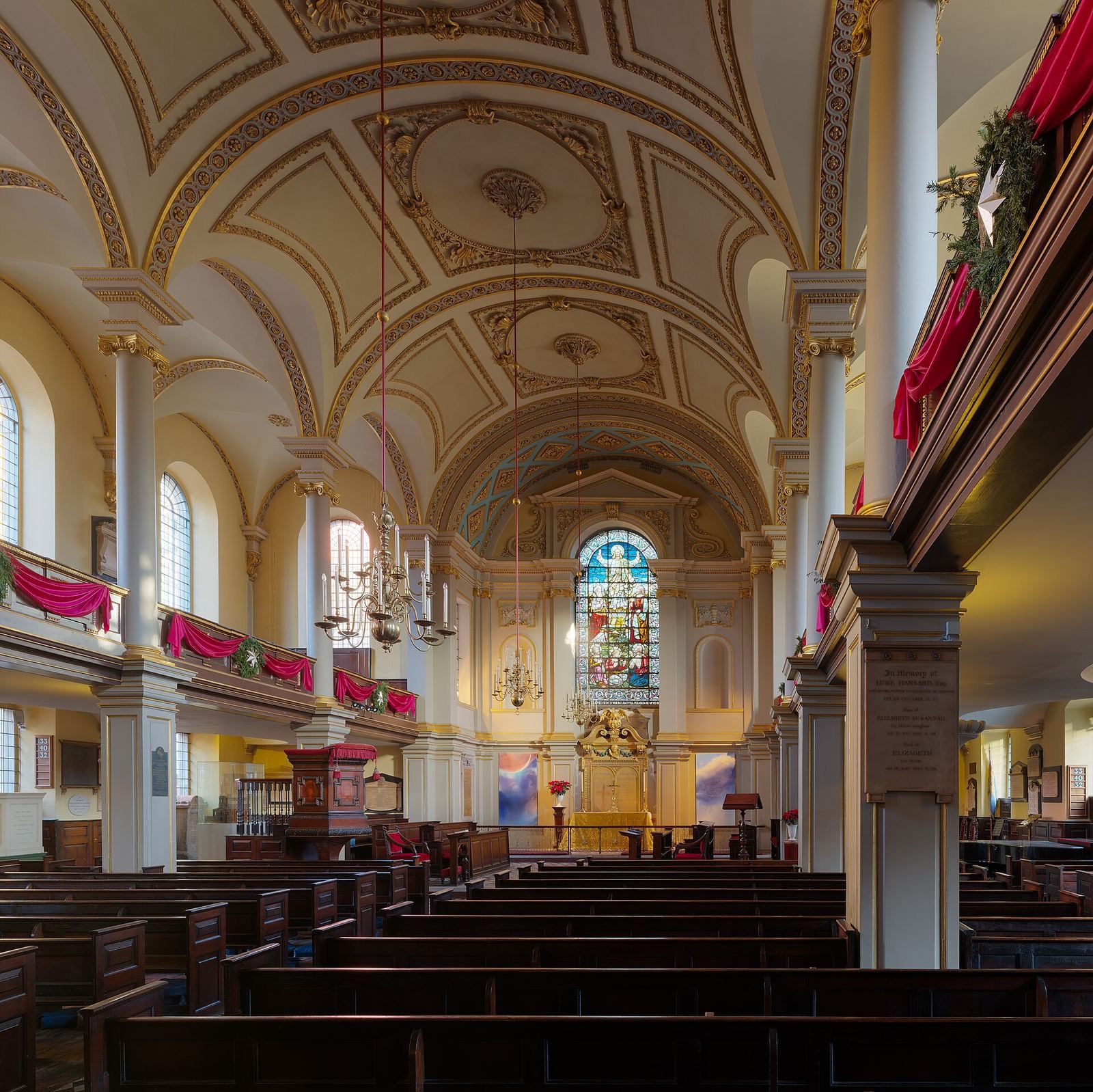
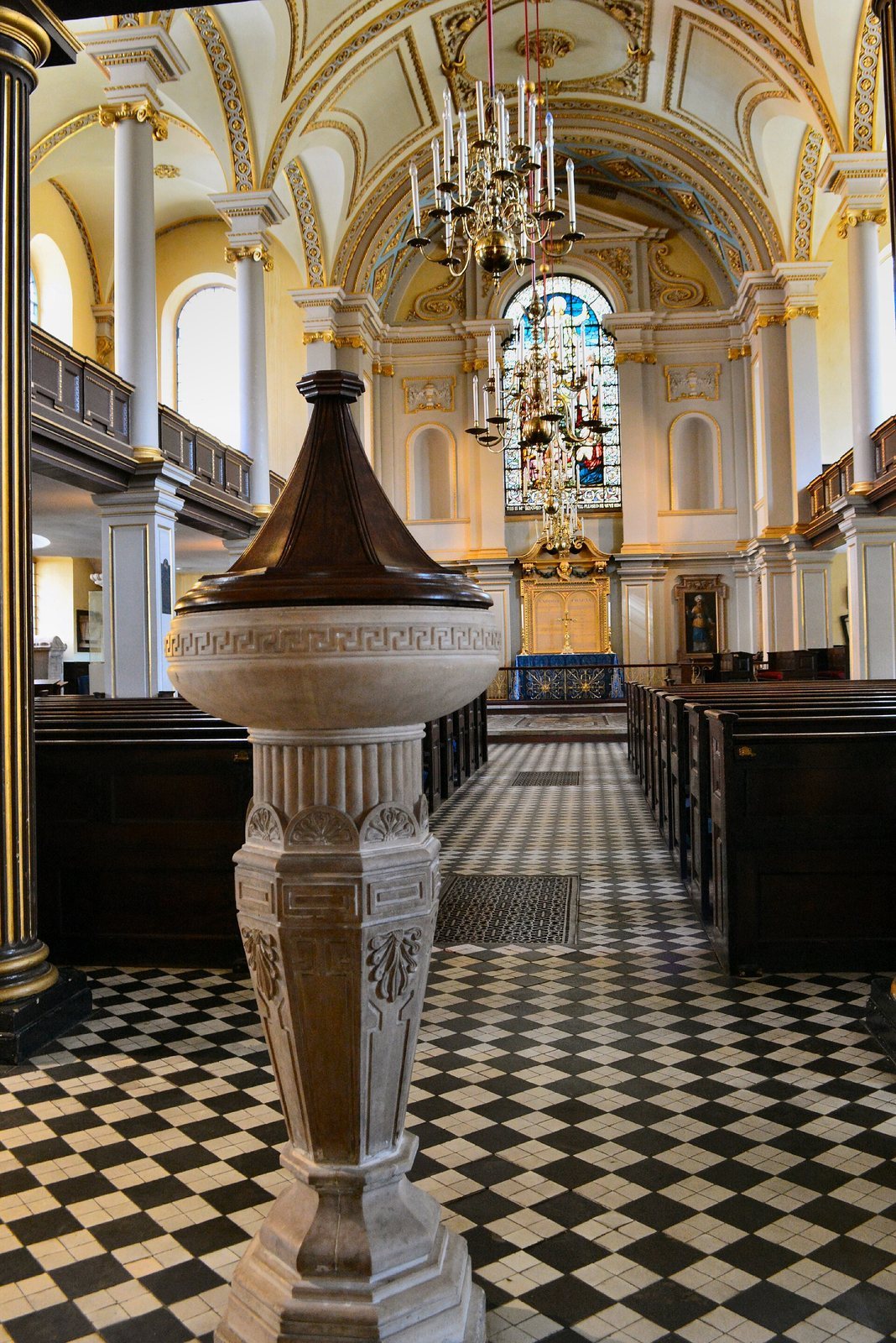
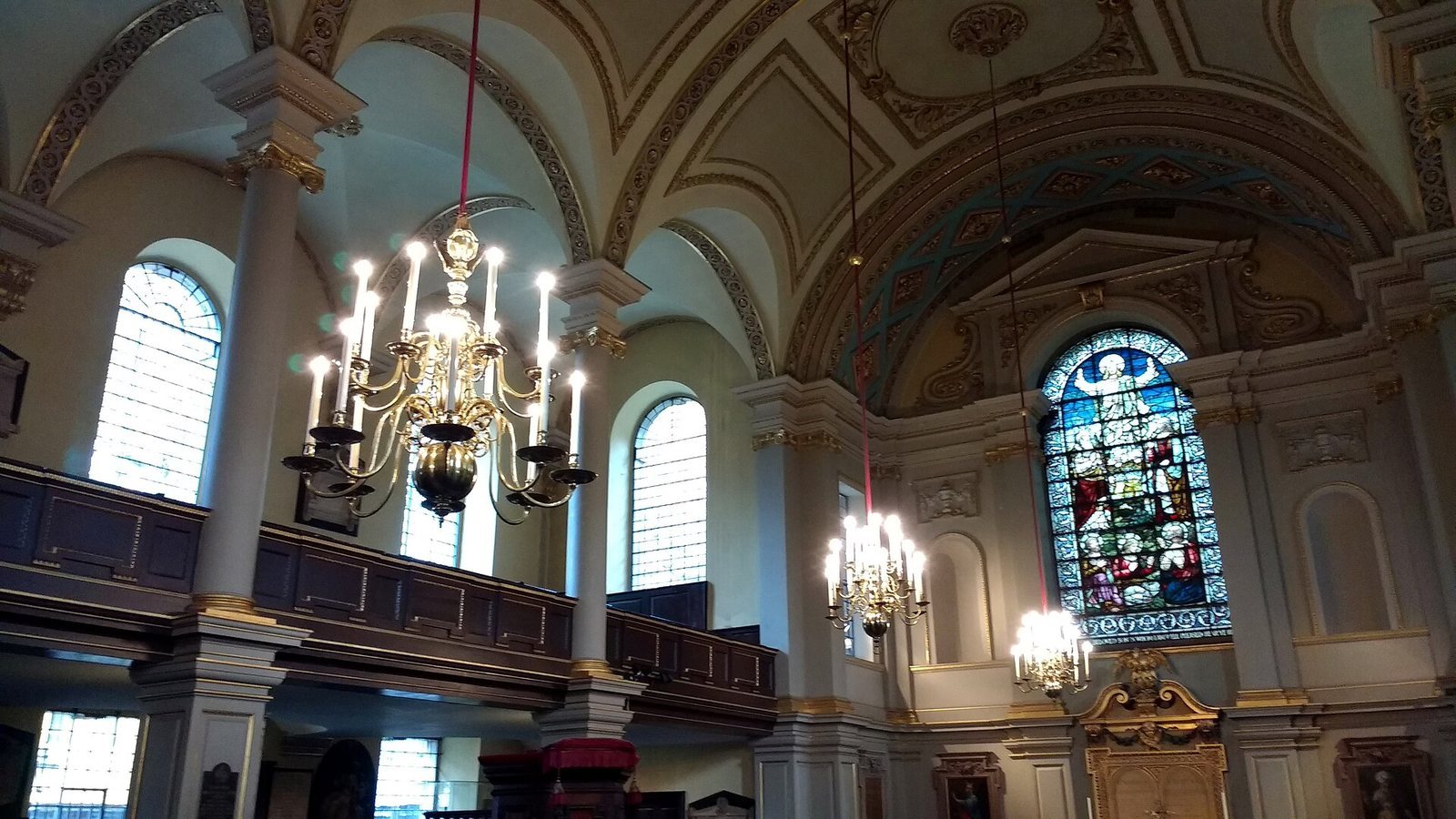
The present church is a three-aisled Palladian building, with a bell tower rising directly from the main front. South of the church, the churchyard occupies the site of the hospital’s original burial ground. Together, the building, its interior fittings, and the burial ground preserve traces of the parish’s changing religious and commemorative life.
The church and its interior
Building and design
Flitcroft’s church draws on the classical designs of Inigo Jones and the buildings of the Caroline period, the reign of Charles I. Its tower has a tent-shaped roof. For the spire, Flitcroft adapted the steeple of James Gibbs’s St Martin-in-the-Fields, altering its architectural order and giving the top a solid, belted form. A wooden model Flitcroft made to present the design to parishioners is kept in the north transept.
The church’s Georgian interior was rearranged in 1875 and again in 1896 to emphasize sacramental worship and ceremony. The restoration of 1952–1953 reversed most of these alterations. During the Second World War, blast destroyed most of the Victorian stained glass and badly damaged the nave roof. Rubble filled the Vestry House, and the rectory on Great Russell Street was destroyed.
Fittings and worship
A white marble baptismal font with Greek Revival detailing, attributed to John Soane, dates to 1810. William and Clara Everina Shelley and Allegra Byron were baptized there in 1818. The larger church pulpit dates to 1676, and John Wesley is believed to have preached from it during evening prayer. A small, whitewashed box pulpit at the east end of the north aisle is the upper part of a three-deck pulpit formerly used by John and Charles Wesley at West Street Chapel. It was transferred to St Giles after that chapel closed for worship. George Whitefield and John William Fletcher were also associated with it.
The organ has been rebuilt repeatedly, with earlier pipework retained through several changes. George Dallam built a replacement for an instrument destroyed during the Civil War in 1678, and Christian Smith rebuilt it in 1699. Gerard Smith the Younger rebuilt it for the present church in 1734, possibly with help from Johann Knopple. Gray & Davison rebuilt it in 1856, again reusing Dallam’s pipes. Its mechanical key and stop systems were replaced by electro-pneumatic action in 1960. A restoration completed by William Drake in 2006 reinstated tracker action, preserved as much older pipework as possible, and added new pipes in a seventeenth-century style.
Art and memorials
Paintings of Moses and Aaron by Francisco Vieira the Younger, court painter to the King of Portugal, flank the altar. Above the Lord’s Table, the large east window depicts the Transfiguration of Christ on Mount Tabor. The church also contains the mosaic Time, Death and Judgment, designed by G. F. Watts. It was originally made for St Jude’s Church, Whitechapel; Cecil Schott prepared the design and Salviati executed the mosaic.
Memorials in the church include a stone stele to George Chapman in the north aisle, designed and paid for by Inigo Jones. Other commemorated figures include Richard Penderel, John Belasyse, Roger L’Estrange, Andrew Marvell, John Flaxman, Luke Hansard, Thomas Earnshaw, Arthur William Devis, James Shirley, Thomas Nabbes, Edward Herbert, Mary, Countess of Kildare, Cecil Calvert, William Balmain, John Lumsden of Cushnie, and John Coleridge Patteson. An illuminated list of subscribers to the rebuilding of the 1623–1630 church also survives in the building.
St Giles holds the White Ensign flown by HMS Indefatigable when the Japanese surrender was accepted in Tokyo Bay on 5 September 1945. The ship had been adopted by the Metropolitan Borough of Holborn. In 1989, at the request of the HMS Indefatigable association, the Borough of Camden agreed that the ensign could be laid up in the church.
Hospital precinct and churchyard
Former hospital precinct
The medieval hospital precinct probably covered land now bounded by St Giles High Street, Charing Cross Road, and Shaftesbury Avenue. A gatehouse on St Giles High Street provided its entrance. The hospital church stood on the site of the present building; the Master’s House, later called the Mansion House, was to its west, and dwellings known as the Spittle Houses stood at the eastern end of the churchyard. The Angel Inn remains on its historic site within this area.
Burial ground and gate
The churchyard lies south of the church and covers less than an acre. Burials accumulated in layers over many centuries. Poor people were often placed in communal graves known as “Poor Holes,” and the burial ground also contained a plague pit holding the remains of more than 1,000 parishioners by the end of 1666. A memorial to seven Jesuits and other people buried in the churchyard was unveiled in 2019.
The Resurrection Gate stands at the churchyard’s western end, facing Flitcroft Street. This roofed Doric entrance bears a carved relief of the Day of Judgment, probably made by a woodcarver named Mr Love and commissioned in 1686. Its composition has been compared to Michelangelo’s Last Judgment and to the work of a ship-carver. William Leverton designed its rebuilding in 1810. In 1865 it was taken down and re-erected opposite the church’s west door because Charing Cross Road was expected to follow a different route. The road took another course, and the gate now faces a narrow alley.
Tombs and burial memorials
Richard Penderel’s chest tomb stands among bushes near the church’s southeast corner. Penderel helped Charles II escape after the Battle of Worcester in 1651 and died in 1671. George II ordered the tomb repaired and embellished in 1739, but it later deteriorated. Its inscribed slab was moved indoors in 1922 and is now mounted at the west end of the church beside a memorial to John Belasyse. Oliver Plunkett was also buried in the churchyard before his remains were transferred elsewhere.