Higashi Motomezuka Kofun: A Fourth-Century Burial Mound in Kobe
Site at a Glance
- Rating
- 3.2
- Popularity
- Low
- Country
- Japan
- Primary era
- Classical
- Eras represented
- Classical, Modern
- Civilizations
- Japanese, Yamato
- Site type
- Burial
- Remains
- Burial Mound
On this page8 sections
History
Fourth-century origins
Higashi Motomezuka Kofun, a Japanese burial mound in Kobe, Japan, was built in the latter half of the fourth century. It is thought to have served as the burial place of a powerful local clan.
Tradition connects the mound with Chinu Otoko, one of the suitors in the Maiden of Unara legend. This story concerns a maiden and the men who sought her hand, but the mound is thought to have been a clan burial place rather than Chinu Otoko’s tomb.
Reduction and local preservation
The mound stood on privately owned land, and earth was removed for farming and building materials. More soil was taken during construction of the Hanshin Electric Railway, which serves the Osaka-Kobe area, to create a slope for the railway’s crossing of the Sumiyoshi River. These removals greatly reduced the mound.
Public concern and a survey of scenic and historic sites led the village council to arrange an exchange involving village-owned land in January 1904. The stripped western forepart was leased for use as a flower garden, while the eastern rear part became a community dumping ground.
In 1915, residents of Sumiyoshi Village’s Naka district added soil, built a stone retaining wall, and planted more than twenty plum, pine, and maple trees to improve the site. A kindergarten opened in September 1918 under the direction of Japanese industrialist and politician Kuhara Fusanosuke.
Remains
Mound and surviving layout
The mound was keyhole-shaped, with a rectangular forepart and a rounded rear section. Its estimated total length was 80 metres; the forepart measured about 42 metres wide and 42 metres long, and the circular rear section was about 47 metres in diameter. The surviving mound has been greatly reduced from this estimated form.
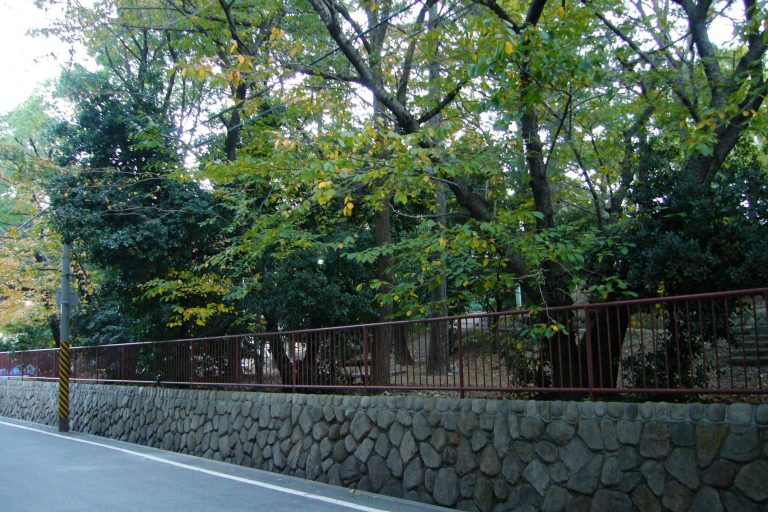
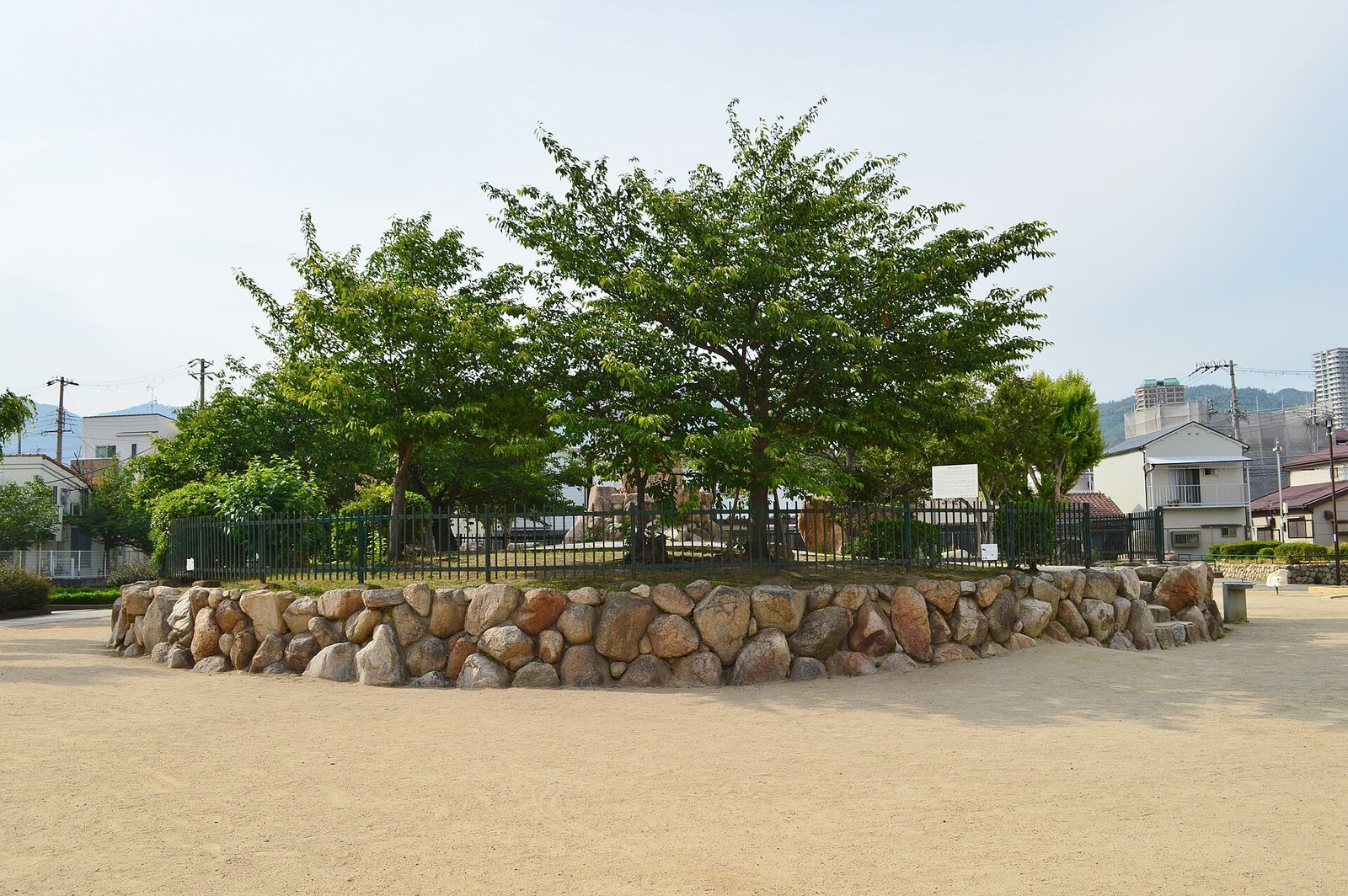
The site is in Sumiyoshi Miyamachi, Higashinada Ward, Kobe, Hyogo Prefecture. The former forepart lies within the grounds of a Kobe municipal kindergarten, while the rear part is in Motomezuka East Park. A circular remnant of mound earth, enclosed by rocks, remains, with a memorial stele to Higashi Motomezuka on top. Residents installed the memorial during their 1915 improvement work.
The 1883 Sumiyoshi Village Gazetteer gave the mound’s height as one jo and its circumference as 847 ken. It listed its area as one tan, four se, and 27 bu. Jo and ken were traditional measures of length, while tan, se, and bu measured land area.
Excavated evidence
Finds from 1872
Excavations in 1872 recovered six bronze mirrors. Four had triangular rims and designs combining deities and beasts. Other finds included beads, a sword, and a wheel-shaped object made of jasper. A replica of a triangular-rimmed mirror is also identified, decorated with a patterned band, four deities, and four beasts; the original is held by the Tokyo National Museum.
Northwestern forepart
An investigation in September 1982 examined the forepart’s northwestern corner and confirmed stone facing and a surrounding moat. The excavation also recovered Sue ware, a high-fired stoneware, and Haji ware, a low-fired earthenware.