Betlem Church: A Baroque Jesuit Church in Barcelona
Site at a Glance
- Rating
- 4.5
- Popularity
- High
- Country
- Spain
- Primary era
- Early Modern
- Eras represented
- Early Modern, Modern
- Civilizations
- Crown of Aragon, Habsburg, Habsburg Spain, Spanish
- Site type
- Religious
- Remains
- Church
On this page14 sections
History
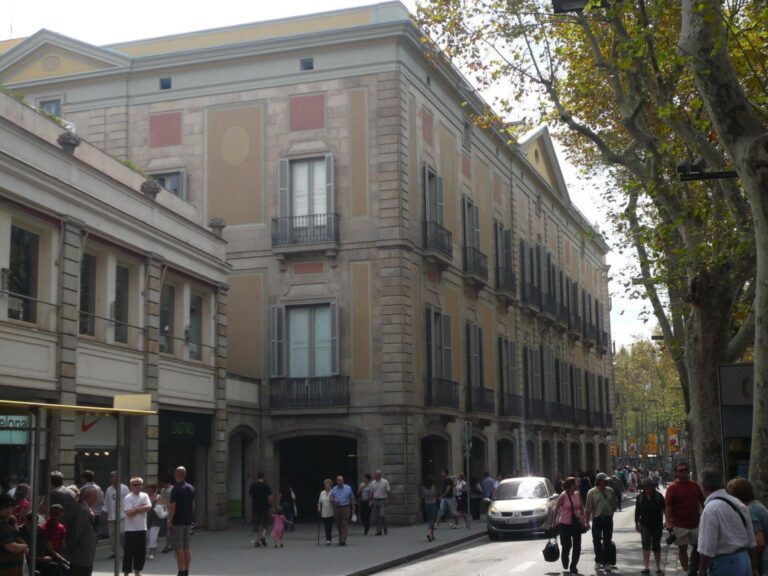
Betlem Church is a Baroque church at the junction of La Rambla and Carrer del Carme in Barcelona, Spain, built for the Jesuit College of Our Lady of Bethlehem. The present building dates to 1680–1729, with construction continuing until 1732. Founded in 1544 by Spanish noblewoman Maria Manrique de Lara, the college was the Jesuits’ first institution of higher education. The Jesuits, members of the Catholic Society of Jesus, were a religious order that operated schools and colleges.
The college and its first church
The college’s original church was built in 1553 and blessed in 1555. Smaller than the present building, it occupied only the area around the presbytery, the space surrounding the main altar. A fire destroyed it in 1671.
Construction of the present church
The present church’s first stone was laid on 8 April 1681. Bishop of Barcelona Alfonso de Sotomayor blessed the building in 1729, although work continued until 1732. The project is attributed to Barcelona master builder Josep Juli Major, with Jesuit clerics Francesc Tort and Dídac de Lacarse directing construction.
The building works required the relocation of a fountain, now at Portaferrissa, and the acquisition of land extending toward the centre of La Rambla. Houses on the Carrer del Carme side were also taken for the project.
From Jesuit institution to parish
Betlem Church initially served the Jesuit college. In 1767, King Charles III expelled the Jesuits from Spain, and the college remained closed until 1772. It then passed to the bishopric and became a Conciliar Seminary. The church itself became a parish in 1835.
Nineteenth-century changes and devotion
The interior’s decoration was replaced over the course of the 19th century, a process completed by 1855. A new gilded high altarpiece followed in 1866. The convent buildings began to be demolished in November 1874.
On 25 November 1886, Blessed Petra de San José travelled directly from Barcelona França railway station to Betlem Church to pay her respects to an image of Our Lady of the Forsaken. The Mothers of the Abandoned and Saint Joseph of the Mountain make an annual pilgrimage that retraces her first route through Barcelona.
Fire, rebuilding, and protection
A fire in 1936, during the Spanish Civil War, destroyed the church’s Baroque interior decoration and brought down its vaults. After the war, architects Francesc Folguera and Lluís Bonet i Garí reconstructed the church. The façades underwent restoration in 1991–1992.
Betlem Church is protected as a Cultural Asset of National Interest in Catalonia and was declared a Spanish Cultural Asset of Interest on 30 July 1997. Its protected setting is shared with Palau Moja, directly opposite.
Remains
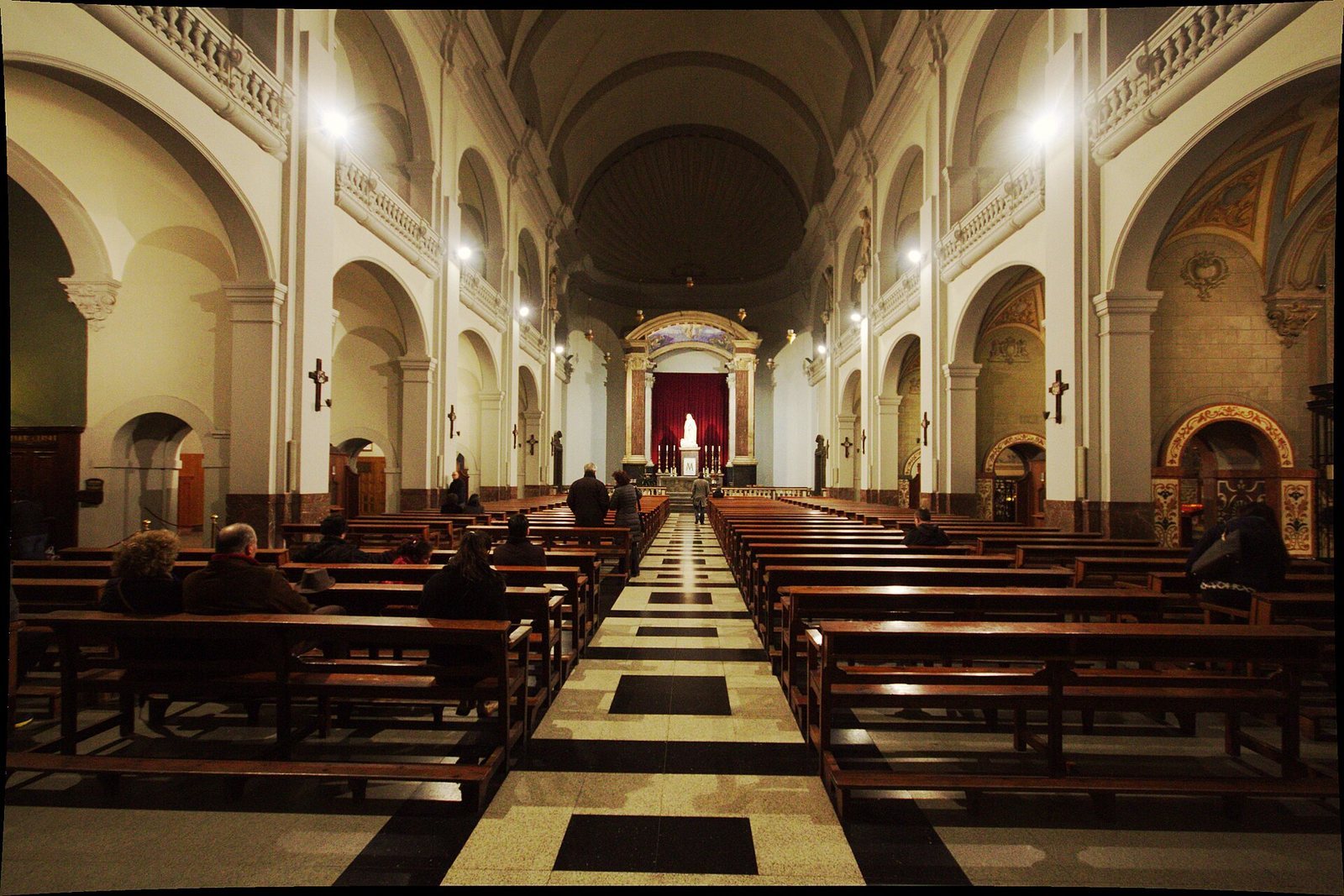
The Baroque exterior encloses a plan rooted in the tradition of Catalan Gothic churches. A single nave, or main worship hall, runs parallel to La Rambla and ends in a semicircular apse, the rounded end of the church. Side chapels sit between supporting buttresses, which are pierced to connect the chapels with one another.
Interior arrangement
The nave has six bays and a barrel vault with curved surfaces where the vault meets the walls. An entrance vestibule lies beneath the choir. The side chapels have elliptical domes topped by lanterns, small structures that admit light.
Chapels on the right
On the right side are the baptistery and chapels dedicated to Our Lady of the Forsaken, Our Lady of Mount Carmel, the Sacred Heart of Jesus, and the Adoration of the Magi. Group Flama, whose members included Albert García, Joan Lleó, and Domènec Fita, painted the baptistery murals in 1954. The chapel of Our Lady of the Forsaken contains a sculpture by Mariano Benlliure dated 1952 and two 1955 oil paintings by Vicenç Navarro, The Ships of Barcelona and The Martyrdom of Saint Vincent.
Chapels on the left
The left side contains chapels of the Holy Christ and the Blessed Sacrament, of Saint Anthony, Saint Rita, and Saint Pancras, of Our Lady of Montserrat, and of the Immaculate Conception. The Holy Christ and Blessed Sacrament chapels contain paintings by Group Flama, Llucià Navarro, and Joan Moncada, together with a relief made by Francesc Carulla in 1953. Joaquim Ros created the alabaster altar frontal in the Montserrat chapel in 1964. In the Immaculate Conception chapel, paintings by Llucià Navarro accompany a sculpture by Tomàs Bel dated 1954.
Presbytery and crypt
The crypt of Saint Ignatius lies beneath the presbytery. Above it, the high altar is dominated by a baldachin, a canopy over an altar, made by Francesc Folguera in 1960. Its associated works include a Virgin and Child by Joan Rebull, paintings by Llucià Navarro and Manuel Sans, a marble sculpture by Manuel Andreu, and mosaics by Santiago Padró. Xavier Bartumeus made nine of the twelve apostles and the crown of the Mother of God of Bethlehem. The sculptures are three metres high and use artificial stone, gold leaf, and cement.
Façades and exterior sculpture
Main façade
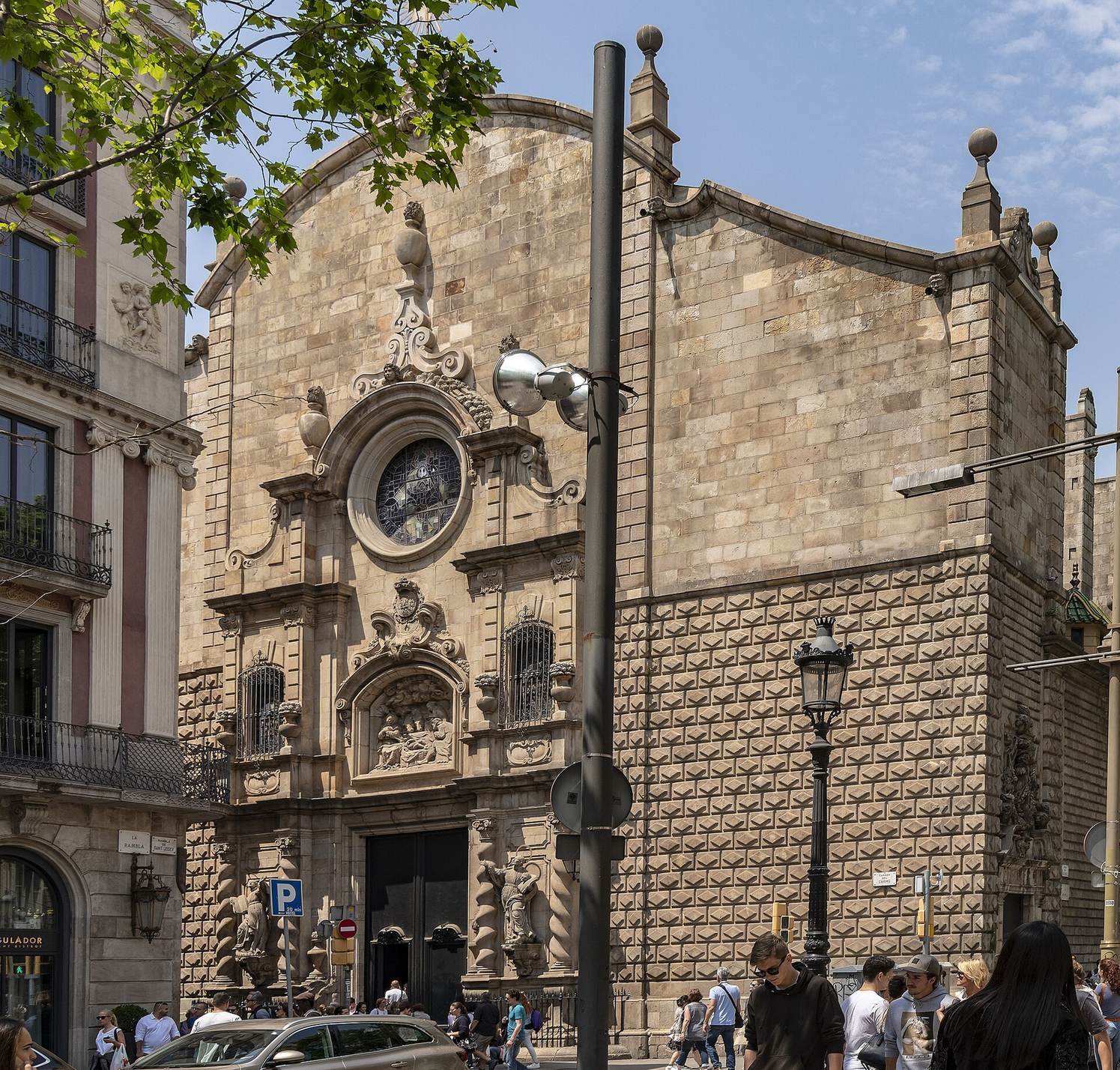
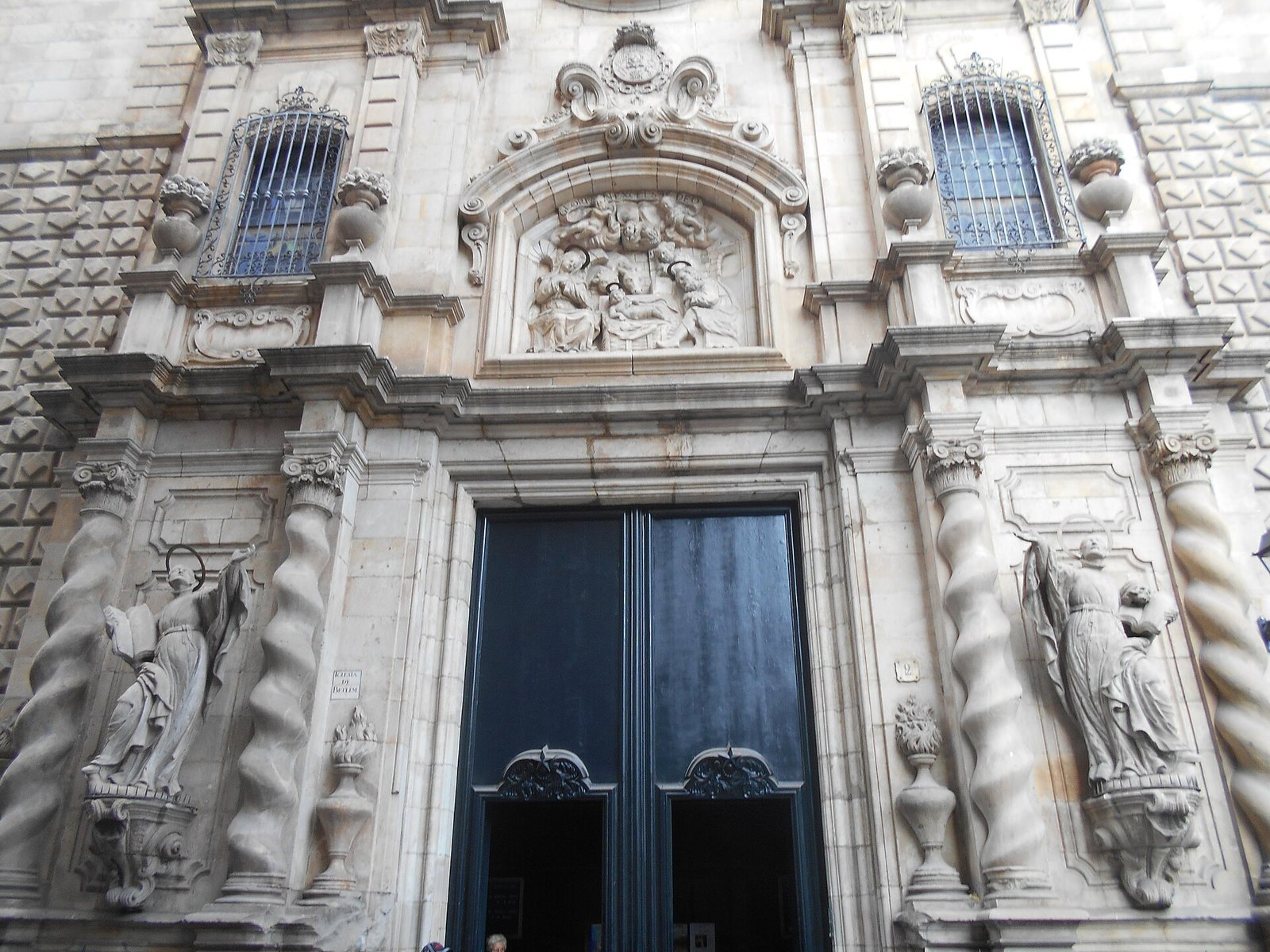
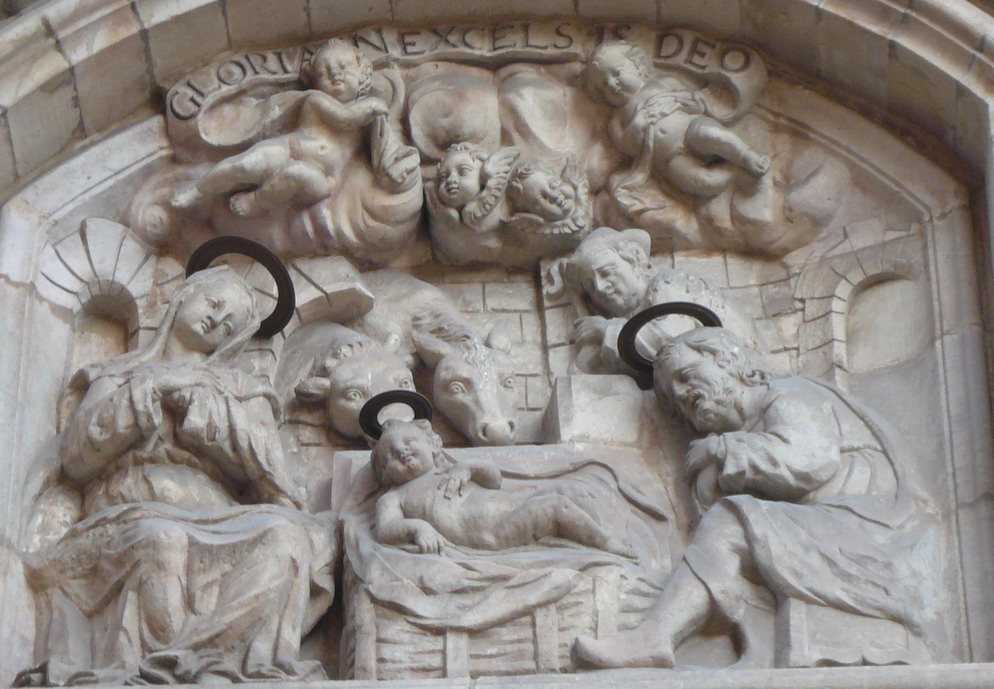
The main façade faces Carrer del Carme. Its cut stone blocks have roughened faces, and the upper outline combines curved and straight lines, with decorative spheres. The front is divided into three vertical sections, with a large portal arranged in superimposed levels at the centre. Pairs of twisting columns flank the rectangular doorway, alongside statues of Saint Ignatius of Loyola and Saint Francis Borgia attributed to Andreu Sala. A Nativity relief by Francesc Santacruz sits above the entrance, and a large rose window centres the upper level.
La Rambla façade and corner niche
The side façade along La Rambla has diamond-patterned stonework, which continues across the lower part of the main façade. One of its two doors is topped by a statue of the Infant Jesus by Francesc Santacruz. A second, similar entrance was opened in 1906 under architect Enric Sagnier’s direction and carries a statue of the child Saint John the Baptist.
At the corner with Carrer de Xuclà, a niche holds a statue of Saint Francis Xavier dated 1690. The work is attributed either to Francesc d’Assís de Santa Creu or to Francesc Santacruz.