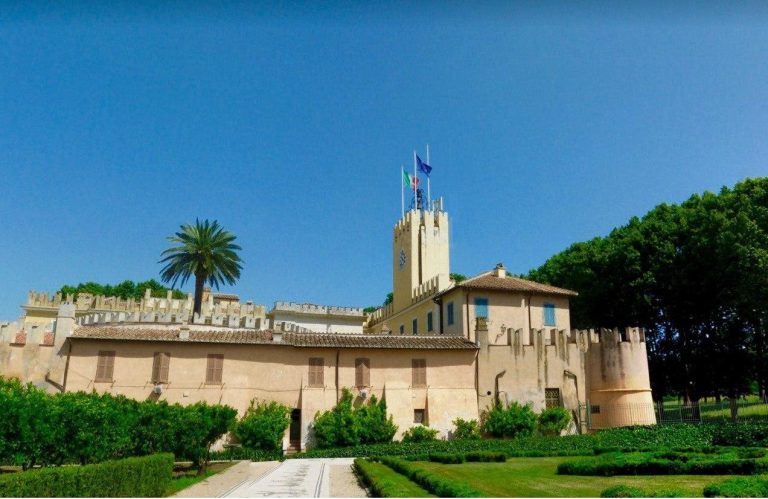
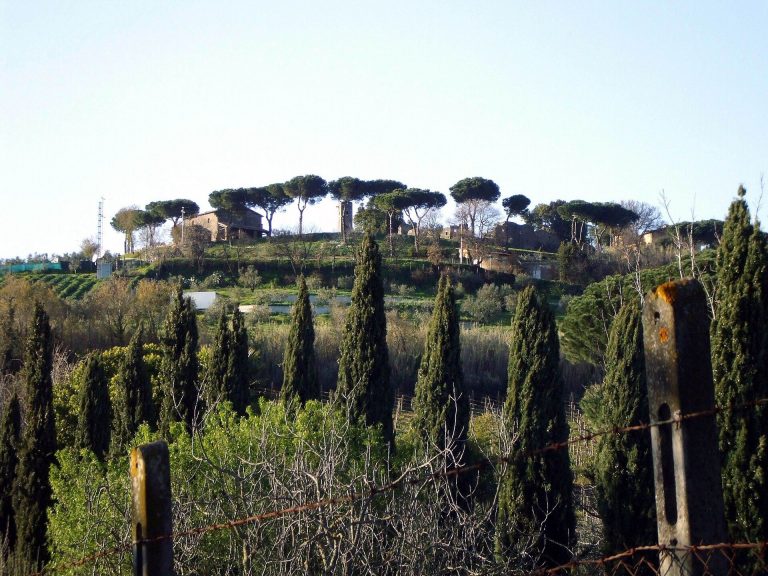
Heroon of Aeneas: A Burial Mound and Hero Shrine at Lavinium
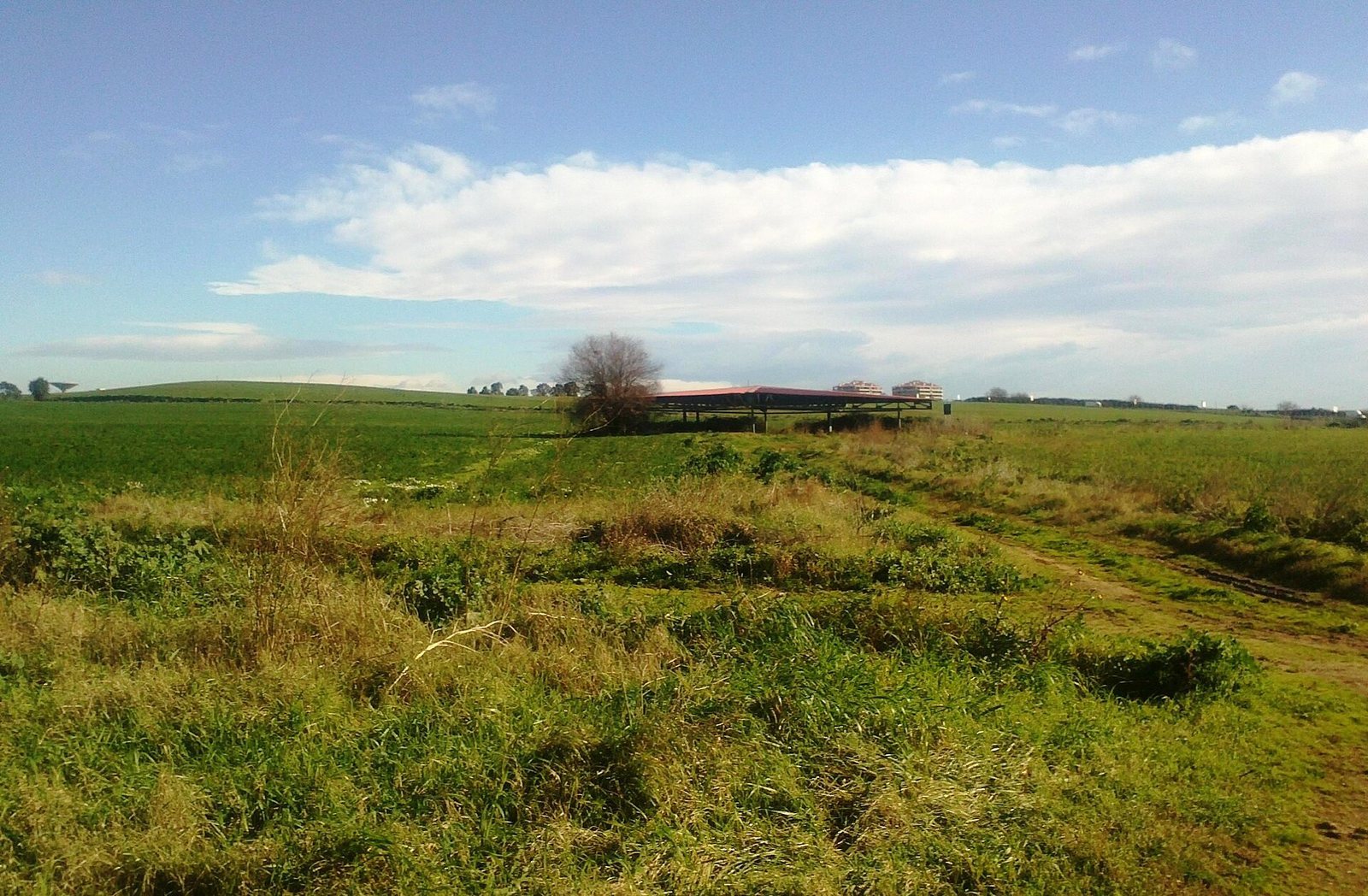
Site at a Glance
- Popularity
- Medium
- Country
- Italy
- Primary era
- Iron Age
- Eras represented
- Iron Age, Classical
- Civilizations
- Roman
- Site type
- Religious
- Remains
- Tomb
On this page14 sections
History
The Heroon of Aeneas is a burial mound later converted into a hero shrine at ancient Lavinium in Italy. A Latin aristocrat was buried there in the second quarter of the seventh century BC. The burial was not considered to be the actual grave of the legendary Trojan Aeneas; the connection between the monument and the hero developed through later ritual and interpretation.
Burial and early cult
In the mid-sixth century BC, the tomb was ritually reopened, indicating that it had acquired a religious role. Archaeologist Paolo Sommella interpreted the recovery of some grave offerings as an act of religious atonement. The mound may have become part of the nearby sanctuary as its earliest altars were being established.
The shrine and the Aeneas tradition
At the end of the fourth century BC, the mound was transformed into a heroon, a shrine associated with a hero. Sommella linked the renovation to Rome’s renewal of its treaty with the Laurentes in 338 BC. The Laurentes were the people of Laurentum, and the pact had primarily religious importance, connected with Lavinium’s sacred founding rites and Roman identity.
The identification with Aeneas draws partly on the Greek historian Dionysius of Halicarnassus, who described the monument in the Augustan period. He related that, after Aeneas fought Mezentius near the Numicus River, the hero’s body could not be found. The Latins then built a shrine with an inscription to Father Indiges, a divine ancestral figure associated with Lavinium, described as guiding the river’s course. Sommella identified the excavated mound with this shrine on textual and geographical grounds.
The identification remains disputed. T. J. Cornell argued that the mound’s reconstructed size and its distance of several hundred metres from the Numicus did not match Dionysius’s description. Sommella replied that the description of the shrine as not large was relative, especially beside major Etruscan burial mounds. J. Poucet emphasized that the inscription named Indiges, not Aeneas, and proposed that the shrine was first associated with Indiges before Augustan-era scholarship connected it to Aeneas. Sommella and Ferdinando Castagnoli, by contrast, understood Indiges as an ancient deity assimilated to the Sun.
Other interpretations place the connection with Aeneas earlier. Andrea Carandini and Mario Torelli read the sixth-century reopening as a deliberate search for the body of a local founding ancestor. Sommella considered a cultic phase at that time plausible, but argued that it could not be shown to concern Aeneas rather than Indiges. He dated the identification with Aeneas no earlier than the second half of the fourth century BC. He also regarded the monument as a cenotaph, a commemorative tomb without the honoured person’s body, rather than a literal tomb of Aeneas.
Ana Rodriguez-Mayorgas likewise noted that the inscription named Indiges, not Aeneas, and questioned whether Lavinium officially recognized the identification in the first century BC. Roman magistrates’ sacrifices at Lavinium were associated with the Penates, household and state-protecting deities, and Vesta, goddess of the hearth, rather than with Aeneas, apart from a late-antique commentary on Virgil.
Lavinium’s traditions and Roman politics
In Lavinium’s tradition, Aeneas founded the city, married Lavinia, daughter of the legendary king Latinus, and was associated with Indiges and the ancestry of Romulus. This differed from an older Greek historical tradition, beginning with Hellanicus of Mytilene, which made Aeneas the founder of Rome. Castagnoli regarded the Lavinian story as a local creation, not proof of an actual migration from the Aegean; occasional Mycenaean imports did not establish such an arrival.
Castagnoli proposed that the legend developed through local cults, including those of Indiges, the Penates, Venus Frutis, and Minerva, and that Rome later supported it for political purposes. The shrine’s conversion formed part of a wider use of Trojan traditions to bring Latin communities under Roman leadership, in the period when Rome controlled the Latian coast after its conquest in 338 BC. Karl Galinsky also argued that the cult of Sol Indiges preceded the cult of Aeneas, with Aeneas becoming linked to an older Latin ancestral figure, perhaps eventually taking that figure’s place.
The Aeneas legend became prominent in Augustan and imperial Latin poetry, including works by Virgil, Horace, Ovid, and Lucan. It also served political claims, particularly those of the Julian family, which traced its ancestry through Venus to Aeneas. Romans connected other older Lavinian monuments and objects with Trojan traditions as well.
Later use and rediscovery
The sacred complex had fallen out of use by the third century AD, when three new burials were placed within the mound’s perimeter. The ancient site of Lavinium was identified in the sixteenth century by the antiquarian Pirro Ligorio. Systematic archaeological work began in 1955–56 under Ferdinando Castagnoli and Lucos Cozza. Deep ploughing that threatened archaeological layers around the sanctuary of the Thirteen Altars prompted emergency excavations in 1968, during which the heroon was identified. Excavations led by Sommella continued until 1972.
Remains
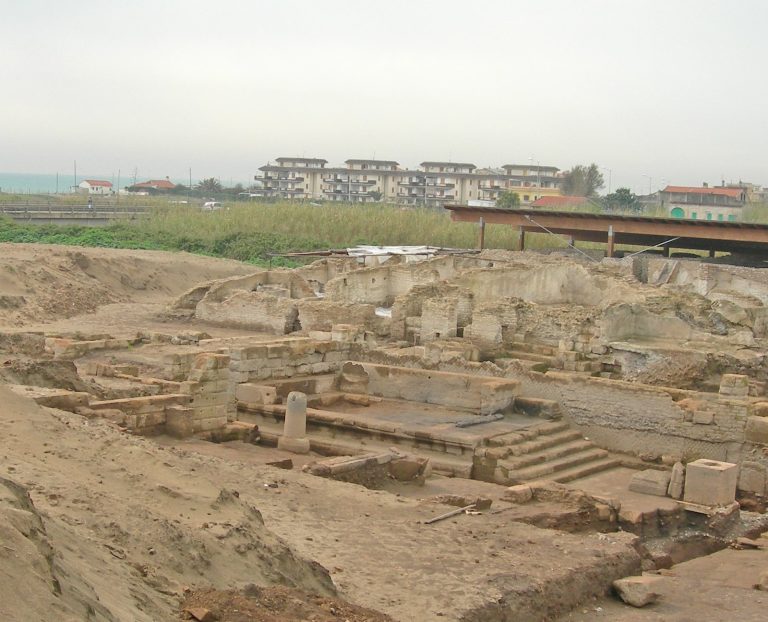
The monument combined a modest burial mound with built spaces within it. Its perimeter was marked by a ring of rough tuff blocks, of which only the eastern portion survives. The mound’s diameter is reconstructed at about 17–18 metres; Karl Galinsky gives about 20 metres across the base of the foundation ring. Inside, the arrangement included a paved rectangular room and a quadrangular room. In its later shrine form, the building had a square inner chamber about 2 metres on each side and an entrance porch roughly 5 by 2.5 metres.
The original burial and offerings
Burial chamber
The original burial was an inhumation in a rectangular stone-lined chamber about 2.50 by 1.60 metres. Its upright slabs were made of cappellaccio, a local volcanic stone, and stone slabs covered the grave. A large block shaped like three-quarters of a circle lay at the head of the burial. Sommella interpreted it as part of the sarcophagus cover, fallen inward when the tomb was opened. Torelli instead proposed that it served as a symbolic marker associated with the Sun.
Grave goods
Thin bucchero pottery, a dark ceramic, and a Middle Proto-Corinthian wine jug date the grave assemblage to the second quarter of the seventh century BC. More than sixty vessels and other objects of silver, bronze, and iron included brooches, a breastplate, weapons, cooking equipment, and remains of a chariot. Only a few objects were placed inside the burial chamber: a bronze breastplate, a silver brooch, a knife, and a sword with an antenna-shaped hilt. Most offerings were arranged around the chamber on a ledge cut into the sandy ground.
Evidence of reopening
Objects associated with the mid-sixth-century reopening include an archaic Etruscan wine amphora set into the bottom of the burial chamber and a fragment of a heavy bucchero wine jug. The latter cannot date earlier than the middle of the sixth century BC.
The later shrine
Entrance
A false monumental entrance stood on the northeast side of the mound. Its two-leaved door, made of lithoid tuff, was found fallen and would have been set into the body of the mound. Impressions preserve evidence of a wooden framework that secured the leaves from behind. Raised strips formed panels on the outer faces, and the right-hand block carried a carved handle.
Inner chamber and ritual deposits
The shrine’s inner chamber had no floor. One corner was carefully set into the earlier burial chamber without removing its upright slabs, physically joining the later structure to the older tomb. Miniature vessels, terracotta figurines, and fragments of overpainted black-glazed mixing bowls of the Phantom Group were placed at the bottom of the earlier tomb.
Sanctuary and coastal setting
The heroon formed part of a sacred complex outside Lavinium, alongside the sanctuary of the Thirteen Altars and an archaic building. The altars faced east, were built at different times, and reached their final arrangement around the second half of the fourth century BC. Bronze sheets inscribed in the area include a dedication to the Dioscuri, the twins Castor and Pollux, made without Etruscan mediation; they attest to direct Greek contacts from the first half of the sixth century BC. The wider coastal landscape included a sanctuary near Lavinium’s landing place, linked with Aeneas’s legendary arrival, and the Numician Pools, a coastal lagoon from which the Numicus, identified with the Fosso di Pratica, flowed toward the sea. The landscape’s coastal sanctuaries were reorganized as the heroon was monumentalized in the context of Roman control after 338 BC.