Qutan Temple: A Ming Buddhist Monastery in China
Site at a Glance
- Popularity
- Medium
- Country
- China
- Primary era
- Medieval
- Eras represented
- Medieval, Early Modern
- Civilizations
- Ming, Qing
- Site type
- Religious
- Remains
- Monastery
On this page19 sections
History
Qutan Temple is a Buddhist monastery in China, founded in 1392 under the Ming dynasty, which ruled China from 1368 to 1644. It grew into a major religious and political institution in Amdo, a historic Tibetan cultural region that includes parts of present-day Qinghai, and linked the Ming court with Tibetan communities in Qinghai.
Foundation and Ming patronage
The founding monk began with a small shrine at his residence, placing inside it an image of Vajradhara, a figure associated with the primordial Buddha in Tibetan Buddhism. He sent representatives to Nanjing to seek support from the Ming court. In 1393, the Hongwu Emperor gave the temple the name Qutan and appointed its founder to lead Buddhist monastic administration in Xining.
Hongwu and the succeeding emperors Yongle, Hongxi, and Xuande issued seven imperial edicts in support of the monastery. A court-backed building program, directed by eunuchs and carried out by craftsmen, took 36 years to complete. The Yongle Emperor ordered an expansion and strengthened the authority and economic privileges of the temple’s senior clergy. Hongxi and Xuande extended those privileges further.
Regional authority and Buddhist lineages
During the Ming and Qing periods, the monastery exercised authority over seven valleys. The court granted it land and forest, supplied military protection, and made repeated offerings. In the early Qing, it received most of the grain dues collected from farmers in the valleys. A family originating in Tibet came to control the monastery and became a local power in the Huanghe valley. The family’s name, Drotsang, first identified its clan and place of origin. After land in Ledu’s southern valleys was assigned to the monastery in 1427 as an incense estate, meaning land set aside to support religious services and offerings, Drotsang also came to refer to the area. Local Han Chinese called the family the Mei family. Local Tibetans used names including Drotsang Monastery and Drotsang Vajradhara Temple for Qutan itself.
Before the late Ming, Qutan belonged to the Karma Kagyu school of Tibetan Buddhism. It later joined the Gelug school, founded by the religious reformer Tsongkhapa, and developed three lineages of reincarnate lamas, teachers recognized as the rebirths of earlier religious figures. One lineage later counted the monastery’s founder as its first incarnation, although its historical succession began in the Qing reign of Kangxi. Its first historically recognized head, a monk from the local family, received an imperial title; his nephew received the same honor. Members of the lineages also held senior positions at Kumbum, a major Tibetan Buddhist monastery in Qinghai.
Qing rule and economic change
After a rebellion against Qing rule, the court imprisoned Qutan’s head in Lanzhou for seven years and took away the monastery’s seals and appointment documents. During the reign of the Yongzheng Emperor, the Qing government ended the monastery’s share of local grain dues and transferred collection to public and county authorities. This brought its governing power to an end. Qutan later bought nearly 5,000 mu, a traditional Chinese measure of land, in the surrounding area and came to depend chiefly on rents from farmers.
The monastery’s network of dependent institutions also changed over time. In 1849 it had ten subordinate establishments, including small retreat houses and two larger monasteries, one mainly devoted to scripture study and the other to meditation. Most of the smaller establishments had disappeared by 1949, when Qutan had two subordinate monasteries. Of its three reincarnate-lama lineages, two remained by then; the third had died out.
Twentieth-century changes and conservation
The monastic population declined from more than 500 in the late Ming to about 300 in the late Qing and 60 shortly before 1949. Shortly before 1958, 34 people in 18 households lived at the temple, including two reincarnate lamas and 12 monks. An abbot, a monastic official, and a chant leader oversaw religious affairs, each for a three-year term; four stewards served one-year terms and managed administration. The temple also maintained a Kalachakra college for studying the Wheel of Time system of Buddhist teachings and practices.
In 1954, the temple held irrigated, mountain, and dry land, nine woodland plots, 3,600 mature trees, oil and water mills, livestock, and money and precious metals used for lending or trade. Its landholdings in 1958 totaled 144.8 mu, including 40.5 mu held privately, and its horses and cattle together numbered 51. After 1958, Qutan was among 11 Tibetan Buddhist monasteries in Qinghai retained as religious institutions. It closed during the Cultural Revolution and reopened in 1980.
The state designated Qutan a Major Historical and Cultural Site Protected at the National Level in 1982. Qutan Hall underwent a major repair in 1985. After surveys of damage to the buildings, the largest repair project in the monastery’s history began in 1995 and continued in phases through 1998. Tibetan, Mongolian, and Tu Buddhists regard Qutan as a sacred place for worship and offerings. It is also a venue for the traditional flower-song gathering.
Remains
Setting and enclosure
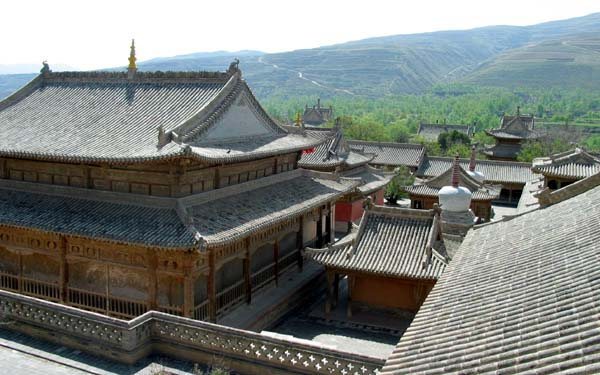
The monastery stands at the mouth of Maquan Gully, facing the Qutan River. Luohan Mountain lies behind it, with Songhuading to the north and Zhaobeishan to the south. Qutan occupies about two-thirds of a roughly square, earthen-walled enclosure called New City. The site covers about 1.5 hectares, with approximately 10,000 square metres of building space. Three successive courtyards follow a northwest-to-southeast axis, and the complex faces southeast. A foundation legend tells that the founder left his meditation staff beside a spring; when he returned, it had taken root and grown into a tree called the Pearl Tree.
Courtyard buildings
Entrance and front courtyard
The three-bay entrance gate covers about 150 square metres. In the front courtyard, Vajra Hall, named for a Buddhist ritual symbol associated with spiritual power, stands on the west side and provides a passage between the front and middle courtyards. Two imperial stele pavilions stand opposite one another in the courtyard. During repair work in 1997, excavation there uncovered an early Ming paved route, its paved edging, and drainage channels.
Qutan Hall and its neighboring buildings
Qutan Hall stands in the front part of the middle courtyard. First built in 1392, it was rebuilt and altered in 1782. The Three Buddhas Hall is northeast of it, and the Protector Hall is southwest. A small drum tower stands between Qutan Hall and the Three Buddhas Hall, while a small bell tower lies between Qutan Hall and the Protector Hall. Four white stupas, Buddhist structures associated with sacred relics and worship, stand outside the hall’s corners. The oldest is the Tara Stupa, named for Tara, a female Buddhist protector.
Baoguang Hall
At the rear of the middle courtyard, Baoguang Hall was completed in 1418. A small scripture hall stands on either side of it.
Rear courtyard and main axis
Longguo Hall
Longguo Hall, the complex’s largest building, stands on its main axis and dates to 1427. Covering about 900 square metres, it has open galleries on all four sides and a two-tier hip roof, with eaves above a roof that slopes on each side. The building rests on a platform over a Sumeru-style pedestal, which evokes Mount Sumeru, the central mountain in Buddhist cosmology. A raised platform stands in front, with flights of nine steps on either side; red sandstone railings surround the structure. Longguo Hall was modeled on the Hall of Supreme Harmony in Beijing’s Forbidden City.
Large bell and drum towers
The large bell tower and large drum tower stand on opposite sides in front of Longguo Hall. Each has lattice windows and a platform enclosed by a railing.
Nangqian courtyard
Northeast of the main temple buildings, the Nangqian courtyard served as a residence for the reincarnate lamas.
Paintings, inscriptions, and sacred objects
Mural gallery
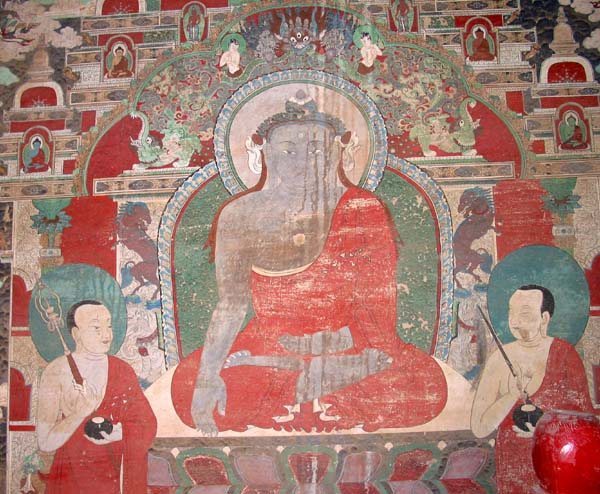
The mural gallery, also called the 72-bay corridor, is a covered passage divided into 72 sections. It contains about 400 square metres of colourful Buddhist narrative paintings. Their subjects include gods welcoming the Buddha to a celestial palace, a bodhisattva’s birth beneath an Ashoka tree, the Dragon King welcoming the Buddha, and episodes from the Buddha’s life in the palace. The figures and colours remain vivid.
Inscriptions, texts, and ritual objects
The temple preserves a Ming imperial stone monument inscribed in parallel Chinese and Tibetan text, ten plaques from the Ming and Qing periods, and a great bronze bell cast in 1427. Other objects include three incense burners, Ming cymbals, prayer beads of ivory and sandalwood, and a stone sculpture of Milarepa, an influential Tibetan Buddhist yogi and poet. The collection also includes imperial gold seals, a cloisonne vase made with coloured enamel separated by metal strips, and an ivory pagoda.
More than 300 Buddhist texts and works are preserved at Qutan. They include the Kangyur, a collection of teachings attributed to the Buddha, the Tengyur, a collection of commentaries and other treatises, and works by Tsongkhapa. Nearly 100 relics brought from India are enshrined in stupas.
Sacred tree
A white sandalwood tree on the temple grounds was planted in the late Ming or early Qing period.
Qutan is a large, well-preserved Ming monastery and the oldest surviving monastic complex in Amdo. Its overall plan resembles a miniature imperial palace complex in Beijing, while its halls, courtyards, and painted corridor preserve the particular layout of this monastery.