Dongguan Mosque: A Historic Sunni Mosque in Xining
Site at a Glance
- Rating
- 4.3
- Popularity
- Low
- Country
- China
- Primary era
- Medieval
- External website
- Open
- Eras represented
- Medieval
- Civilizations
- Chinese
- Site type
- Religious
- Remains
- Mosque
On this page8 sections
History
Ming-Dynasty Foundation
Dongguan Mosque is an active Sunni mosque in Xining, China, built in 1380 during the Ming dynasty and shaped by Chinese and Central Asian architectural traditions. It is described as the largest mosque in Qinghai. Its original Ming-period arrangement comprised a single courtyard, a prayer hall, and two multistorey minarets.
Renovation and Political Conflict
The mosque underwent renovation between the late nineteenth and early twentieth centuries. It later suffered serious damage during political conflict, after which restoration continued through the rest of the twentieth century. Ma Qi and Ma Bufang, military leaders who served as governors of Qinghai, controlled the mosque during their tenure as the province’s senior military and administrative authorities.
Dongguan Mosque also became a gathering place during religious protests. In 1989, tens of thousands of Muslims assembled around it to protest a book regarded as insulting to Islam and Chinese Muslims. In October 1993, Muslims protested at the mosque against another book, and the Chinese army subsequently entered the building and expelled the demonstrators.
Protection and Later Changes
The Qinghai provincial government designated Dongguan Mosque a protected cultural relic in 1986. In 2013, it was included in the seventh national listing of protected monuments of the People’s Republic of China.
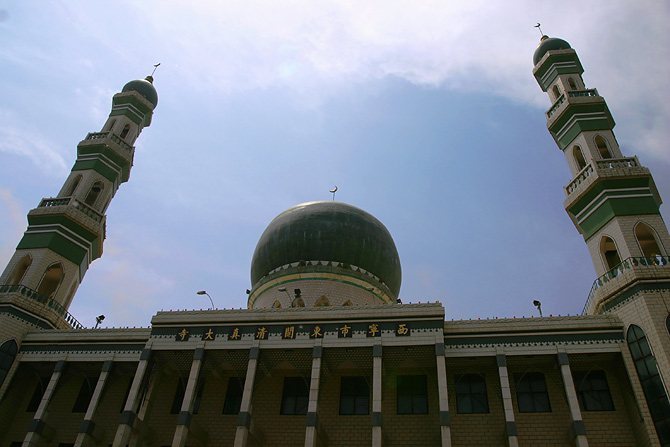
A reconstruction or remodeling in 2000 introduced the green dome and minarets associated with the mosque’s later appearance. These elements were removed in a further remodeling around 2021. The change became associated with claims that the mosque was being given a more Chinese appearance, while mosque management stated that the removed features were not part of the original structure recognized as a cultural relic.
Abdullah Ma Changqing served as the mosque’s imam, the leader of communal Islamic prayer, for many years. More than 300,000 Muslims attended his funeral, and he was buried in a Muslim cemetery in Xining.
Remains
Layout and Architectural Form
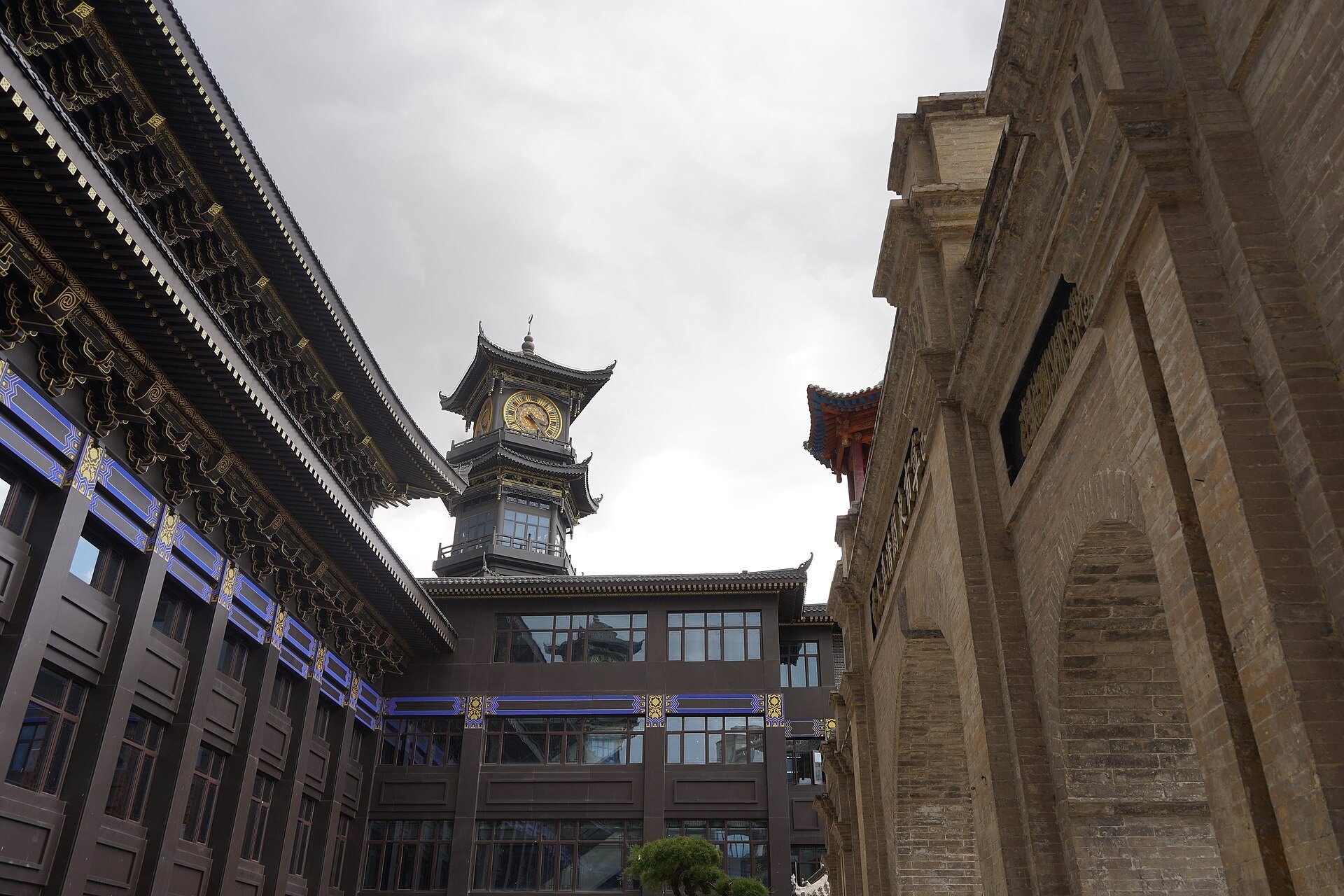
Dongguan Mosque occupies approximately 11,940 square metres. The site is organized around a principal entrance, a courtyard, and a prayer hall. Its successive architectural phases combine Chinese and Central Asian elements, while its modern form has also been described as Chinese Islamic architecture incorporating Western influences. The current style is characterized as Chinese in contrast with the earlier Islamic appearance.
Entrance and Courtyard
The principal entrance leads into the mosque complex and its courtyard, an open space adjoining the prayer hall. The broad exterior is marked by white arches, giving the entrance and surrounding buildings a distinctly Chinese appearance in the mosque’s current form.
Prayer Hall and Towers
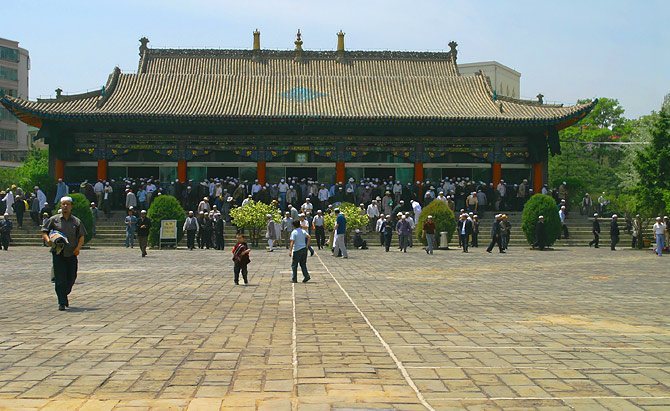
The prayer hall is finished with glazed and blue tiles and forms the principal worship space, with a stated capacity of approximately 3,000 worshippers. The historical arrangement included two tall minarets, towers traditionally associated with mosques, together with a green-and-white dome. The dome and minarets connected with the 2000 reconstruction were removed during the remodeling around 2021.