Ponte Santa Trinita: A Historic Road Bridge over the Arno in Florence
Site at a Glance
- Popularity
- High
- Country
- Italy
- Primary era
- Early Modern
- Eras represented
- Early Modern, Modern
- Civilizations
- Duchy of Florence, Grand Duchy of Tuscany, Holy Roman Empire, Italian
- Site type
- Infrastructure
- Remains
- Bridge
On this page9 sections
History
Ponte Santa Trinita is a stone road bridge across the Arno in Florence, Italy. Its present design was built between 1567 and 1570 for Cosimo I de’ Medici, with Bartolomeo Ammannati responsible for the project. The crossing had already served the city for centuries before this design took shape.
Early bridges
In 1252, Lamberto de’ Frescobaldi commissioned a wooden bridge with the approval of Filippo Ugoni, Florence’s podestà, or chief magistrate. That bridge was lost later in the thirteenth century and replaced by a stone structure. A major flood destroyed the stone bridge in 1333. Its successor, attributed to the Florentine artist and architect Taddeo Gaddi, was built over a long period, from 1356 to 1415.
Cosimo I’s bridge
A flood swept away the bridge again in 1557. Cosimo I, the Medici ruler of Tuscany, commissioned a replacement from Ammannati, who may also have received advice from Michelangelo. The new crossing was intended to bring the route between Via de’ Tornabuoni and Via Maggio into a unified line. This route was favored for ducal processions and avoided the crowded, unhealthy market district and Ponte Vecchio. Construction of the present design began in 1567 and ended in 1570. In 1608, statues representing the four seasons were placed at the bridge’s ends for the wedding of Cosimo II de’ Medici and Maria Magdalena of Austria.
Wartime destruction and reconstruction
Retreating German forces destroyed the bridge with explosives during the night of 3–4 August 1944. British Royal Engineers erected a temporary Bailey bridge, a portable prefabricated structure used by military engineers, on the remains; it served until the permanent crossing was rebuilt. Debate over the replacement focused on whether to restore the historic design or construct a modern bridge. A committee organized by Florentine antiquarian Luigi Bellini and chaired by art historian Bernard Berenson advocated rebuilding the old form. The proposal faced opposition from Italy’s Civil Engineering Corps and critics including Carlo Ludovico Ragghianti and Ranuccio Bianchi Bandinelli.
The reconstruction received approval in 1952, and work began in 1955 under architect Riccardo Gizdulich, with engineering calculations by Emilio Brizzi. The bridge was completed in 1958. Later work on its base took place from 1978 to 1980, and its stone facing was cleaned in 2010. A masonry curb installed in 2016 to separate the cycle lane on the roadway prompted public controversy.
Fair and civic heritage
For centuries, a fair for Saint Martin’s day, 11 November, was held on the bridge and at the start of Via Maggio. It continued into the early decades of the twentieth century, with small traders and craftspeople selling trabiccoli, wooden frames used with a brazier to warm or dry linen. In 1901, the bridge was included on Italy’s list of monumental buildings considered part of the nation’s artistic heritage.
Remains
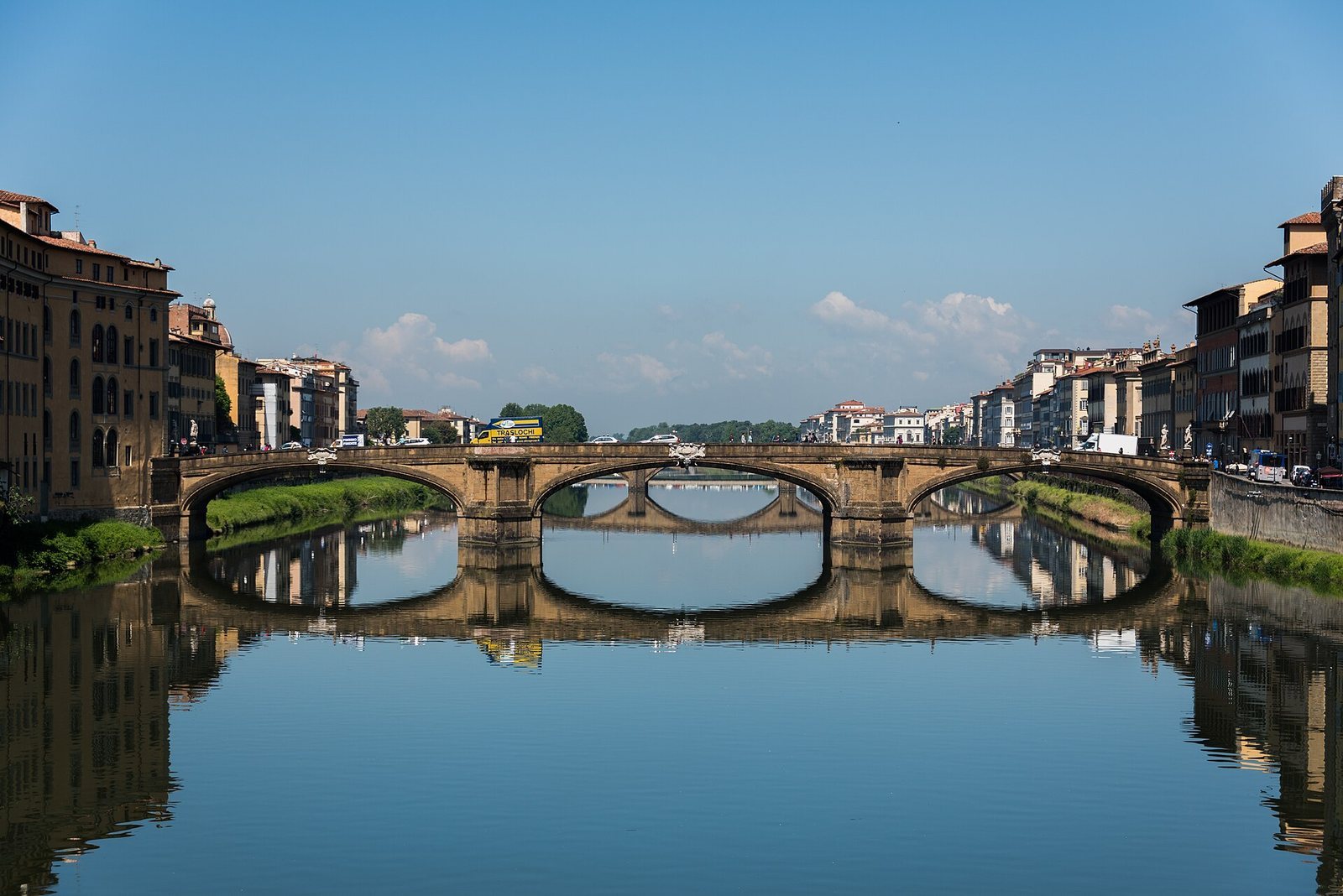
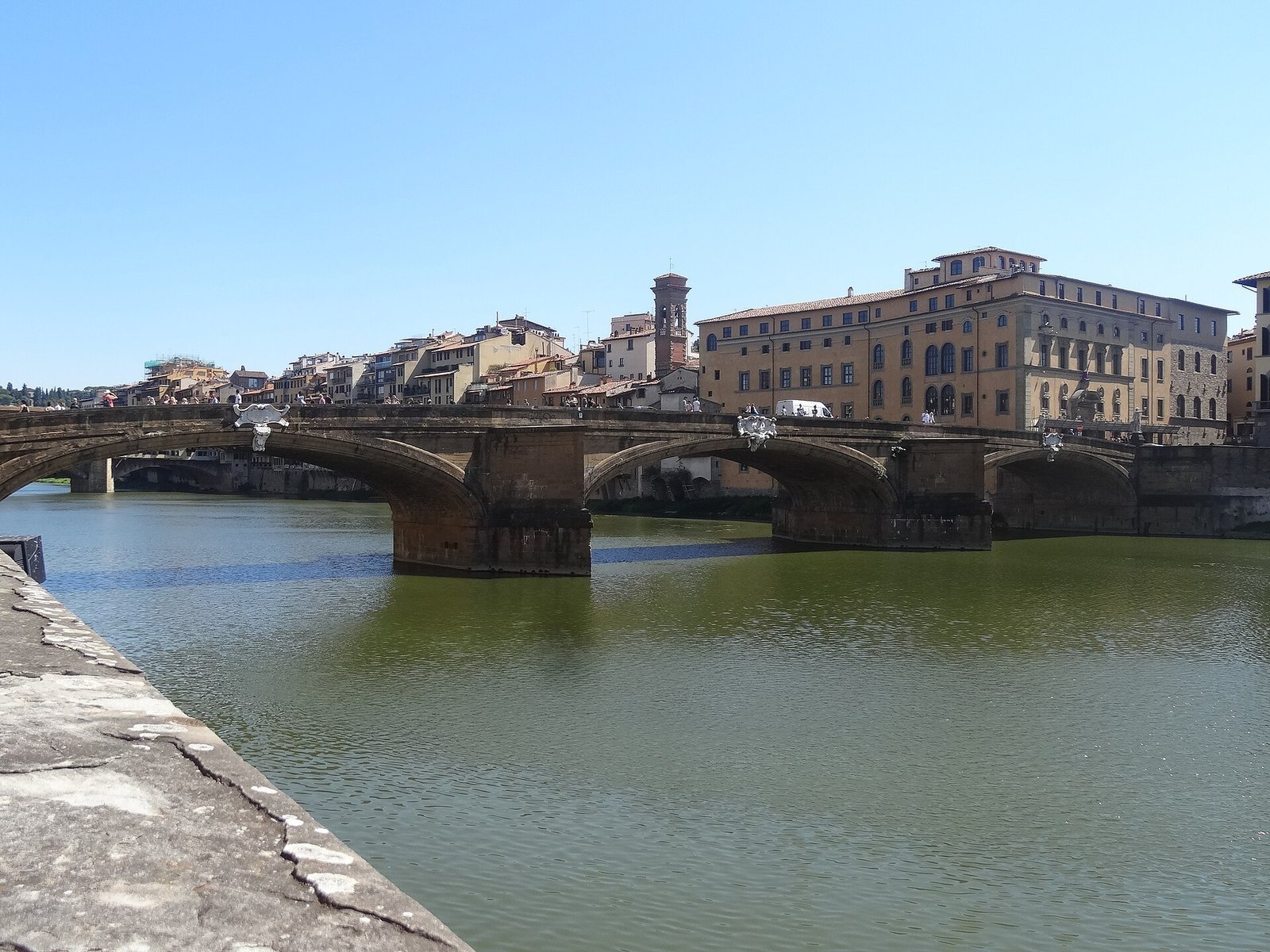
The bridge crosses the Arno on three low arches, with a central roadway flanked by raised pedestrian walks. Its stone construction uses a characteristic yellow-brown Florentine building stone, and its overall form gives the crossing a shallow profile.
Arches, piers, and roadway
The bridge is about 100 metres long, 11 metres wide, and 10.7 metres high. Its outer arches each span 29 metres, while the middle span measures 32 metres. These shallow basket-handle arches are shaped from several circular arcs; their span-to-rise ratio, which compares horizontal width with vertical height, is about 7:1. The bridge is the world’s oldest with this type of arch. Their broad curves allow a gentler roadway for carriages while providing structural resistance. Substantial piers with sharply angled cutwaters, projecting faces that help prevent flood-borne trunks from catching against them, divide the spans. The roadway has a broad central passage for carriages and animals, with a narrower, raised pedestrian walk on each side.
Stonework and inscriptions
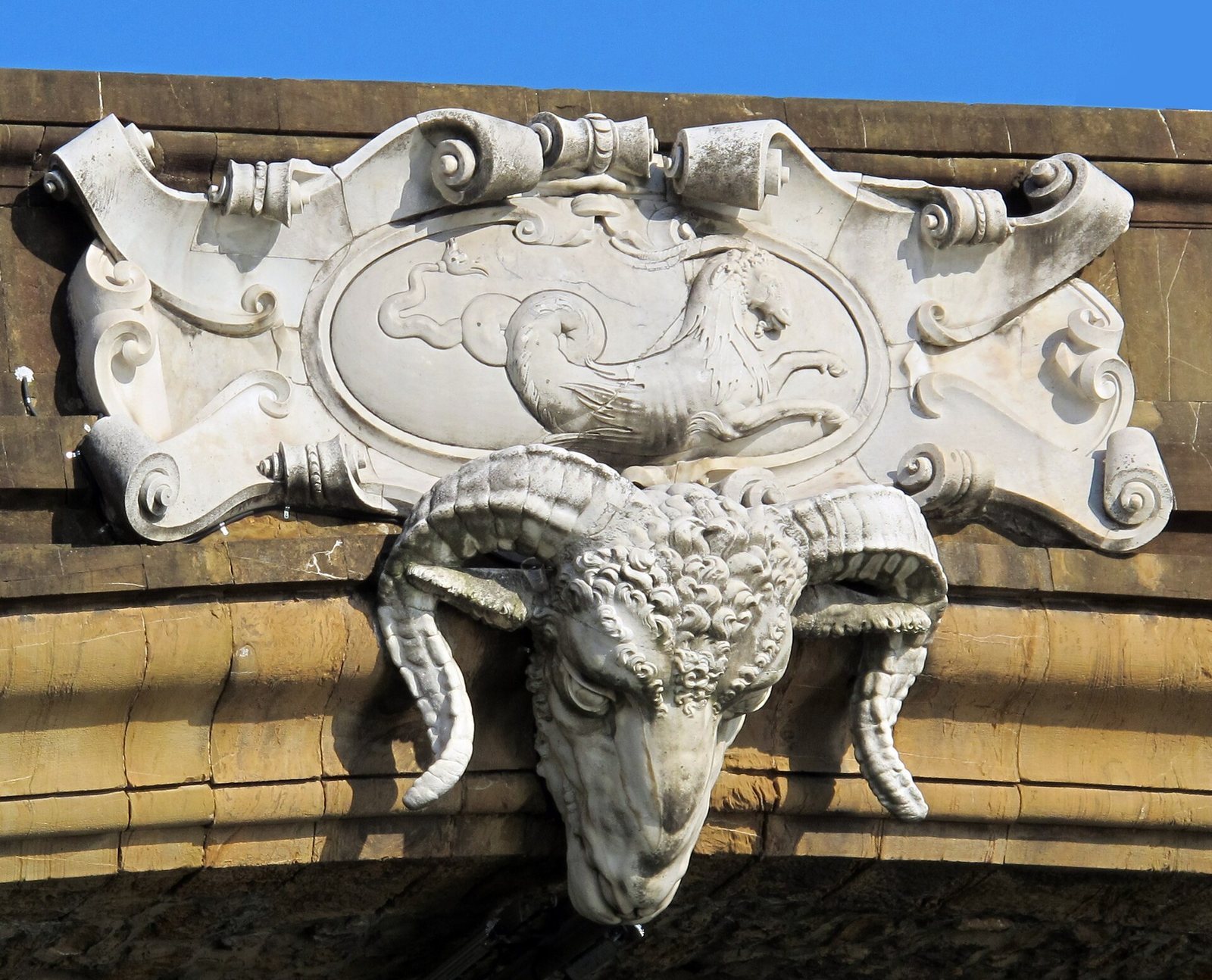
Large marble cartouches, ornamental framed panels, mark the arches. Four marble plaques, two on each side, carry inscriptions dated 1569 and dedicated to Cosimo I. Together, they praise his restoration of the bridge after river damage, its rebuilding in an improved form, and his contribution to the city’s appearance and the convenience of its residents.
Seasonal statues and reconstructed fabric
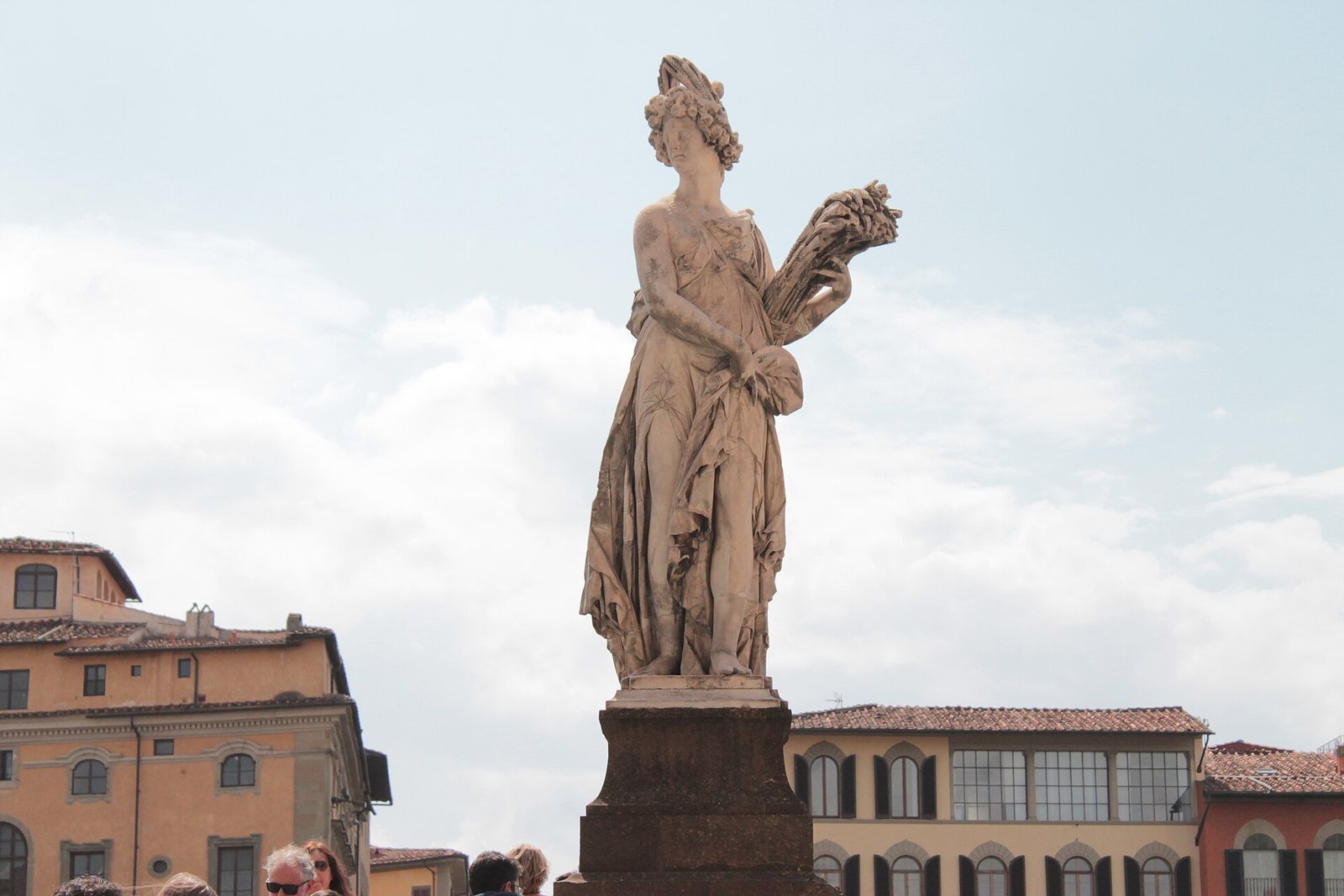
Four statues at the bridge’s ends personify the seasons. Pietro Francavilla sculpted Spring, Giovanni Battista Caccini made Summer and Autumn, and Taddeo Landini created Winter. The statues were recovered from the Arno after the 1944 destruction; Spring’s head was found several dozen metres downstream in 1961. During reconstruction, Gizdulich retained original cutwaters that survived the demolition and recovered substantial quantities of stone from the riverbed. New stone came from the same quarry in the Boboli Gardens that supplied the original material. Archival plans, photographs, drawings, and paintings informed the work, and Gizdulich also recorded surviving fragments, including 21 plaster pieces raised from the river.