Column of Abundance (Colonna dell’Abbondanza): A Market Monument in Florence
Site at a Glance
- Popularity
- Medium
- Country
- Italy
- Primary era
- Medieval
- Eras represented
- Medieval, Early Modern, Modern
- Civilizations
- Grand Duchy of Tuscany, Italian, Republic of Florence
- Site type
- Civic
- Remains
- Monument
On this page12 sections
History
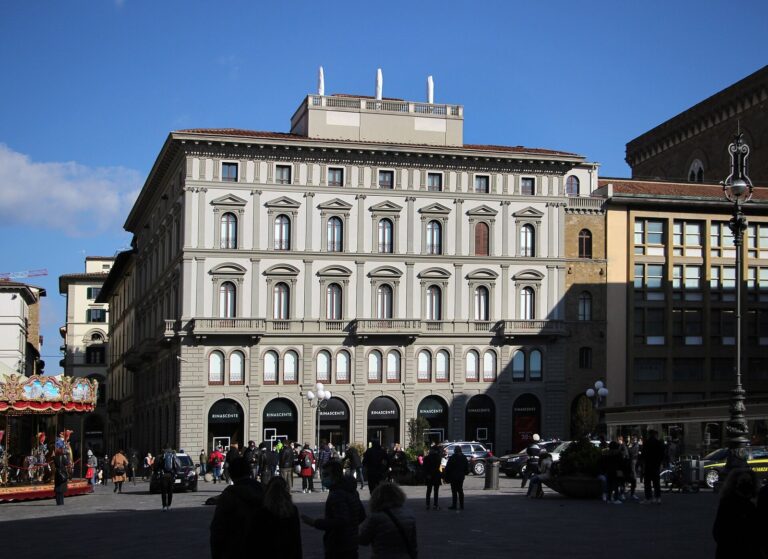
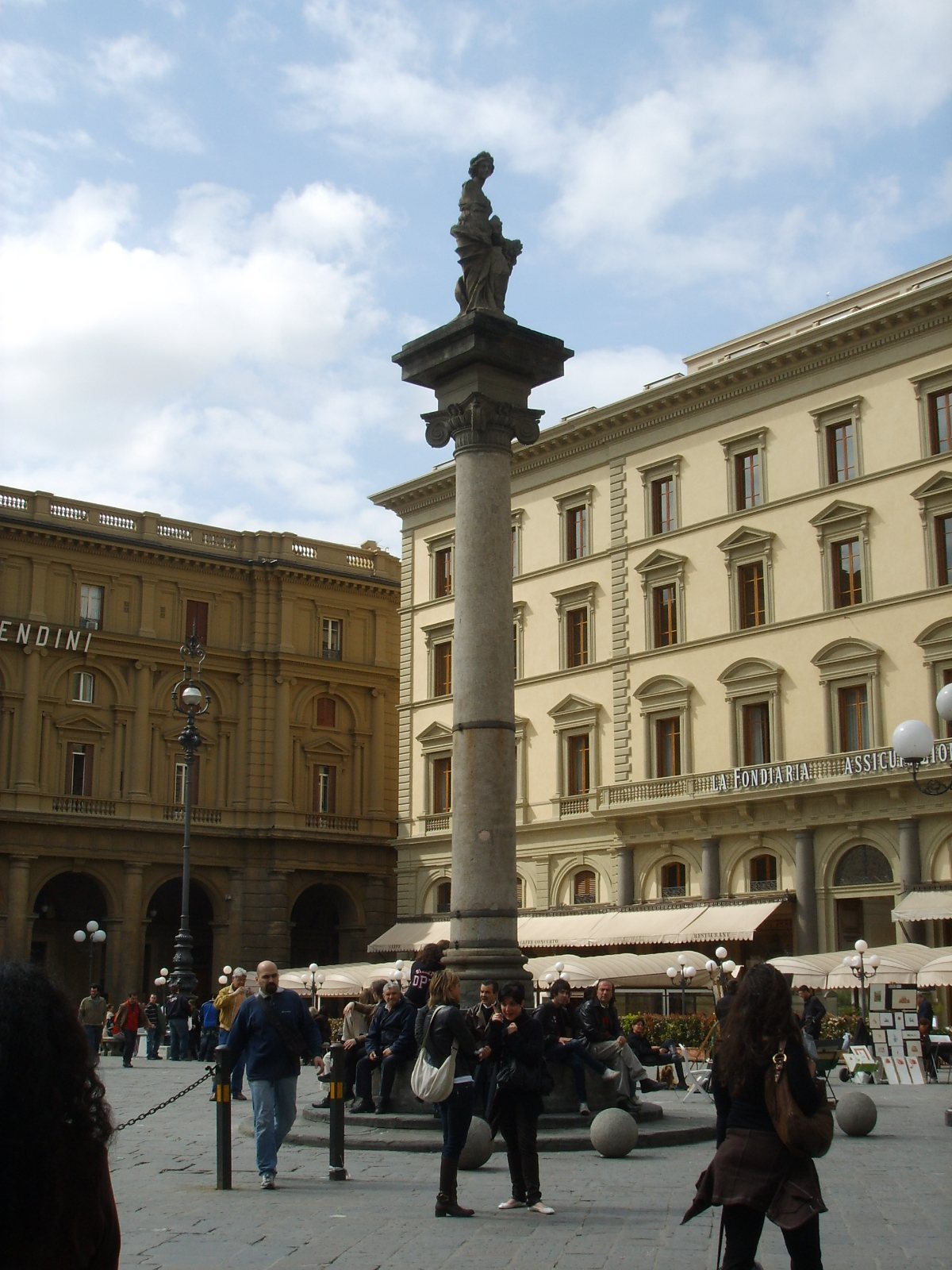
The Column of Abundance, known in Italian as the Colonna dell’Abbondanza, stands in Piazza della Repubblica in Florence, Italy. Florentine civic officials erected it in 1430 at the crossing of the main north–south and east–west streets of Roman Florentia, the ancient name for Florence. Traditionally regarded as the city’s center, the spot later became a focal point of the Mercato Vecchio, where the monument connected the sale of food with civic ideas of prosperity and generosity.
Roman crossroads and earlier traditions
A monument may have stood at this crossroads in antiquity, but its existence and form remain uncertain. Medieval legends tell of an ancient column that survived into that period and was either taken to the Baptistery with a statue of Mars or broken up for use in the base of a later column. A fifteenth-century document also describes an earlier column being moved from the site to Piazza San Felice. That was distinct from the Column of San Felice, which was newly quarried and erected in the sixteenth century.
The Florentine column and its statue
In 1429, officials responsible for Florence Cathedral’s works authorized the Ufficiali di Torre, or Tower Officials of the civic administration, to use a column stored near Giotto’s bell tower. The city’s Wool Guild intervened on their behalf. The column’s earlier provenance is disputed. Giorgio Vasari, a Renaissance artist and writer, traced it to the Baptistery; its resemblance to columns inside that building has also prompted the suggestion that it was surplus material stored at Santa Maria del Fiore.
The monument was inaugurated on 30 March 1430, shortly after the Florentine New Year, observed on 25 March. Its statue represented Abundance, whose fruits referred to goods sold in the market. The image also carried a civic meaning: Leonardo Bruni and other Florentine writers presented prosperity as the result of citizens’ work, and as a basis for generosity and Christian charity.
The date of the statue has been debated. Vasari placed its creation before Donatello, a leading Florentine Renaissance sculptor, left for Padua in 1443. A later reading of the Rustici Codex suggested that Donatello made it after returning in 1454. A drawing in the manuscript and a reference in a religious play instead support a date close to the column’s erection, during Donatello’s association with Michelozzo and his work on the pulpit at Prato.
Market life and public discipline
For centuries the column served as a landmark in the Mercato Vecchio. As shops grew around it, the monument was built into one of them, with its upper shaft, capital, and statue rising above the roof. In early June 1504, two chains and an iron ring were fastened to the shaft to subject dishonest traders, swindlers, and debtors unable to pay to public humiliation. The chains were removed in 1786, after Grand Duke Pietro Leopoldo abolished torture and corporal punishment.
A bell attached to the column served the market’s food trade. Each day, two hours before noon, a magistrate of the Grascia, the authority overseeing food supply and trade, rang it to tell farmers from outside Florence that they could sell their remaining produce wholesale to greengrocers and then leave. Until that signal, the farmers were allowed to sell only at retail.
Replacement and dismantling
By 1720–21, Donatello’s statue had badly deteriorated. It may have fallen in poor weather, or it may have been taken down because of its condition. Around that time, the Captains of the Guelph Party, a Florentine civic authority, commissioned sculptor and architect Giovanni Battista Foggini to create a new statue and capital. Both were installed on 19 November 1721.
Between 1881 and 1895, the clearance of the Mercato Vecchio and the Jewish Ghetto altered the setting around the column. After an arm of the statue fell, the monument was dismantled in March 1885. The statue and capital went into the Museum of San Marco’s collection of stone fragments, while the shaft was kept in warehouses near Porta Romana.
Reassembly and later care
A city plan approved in 1950 proposed rebuilding the column in Piazza Gaetano Salvemini, near the Loggia del Pesce. That scheme was cancelled in 1952. In 1954, Mayor Piero Bargellini revived the project for the monument’s original location, and the reassembly was completed on 17 April 1956. A copy of Foggini’s statue, made by Mario Moschi, was placed on top.
In 1980 the city’s Fine Arts Office replaced Moschi’s statue after its head detached. The column was restored in the late 1990s. On 4 January 2012, part of the stone block beneath the statue fell and shattered; safety work that year consolidated stone elements and secured the sculpture.
Remains
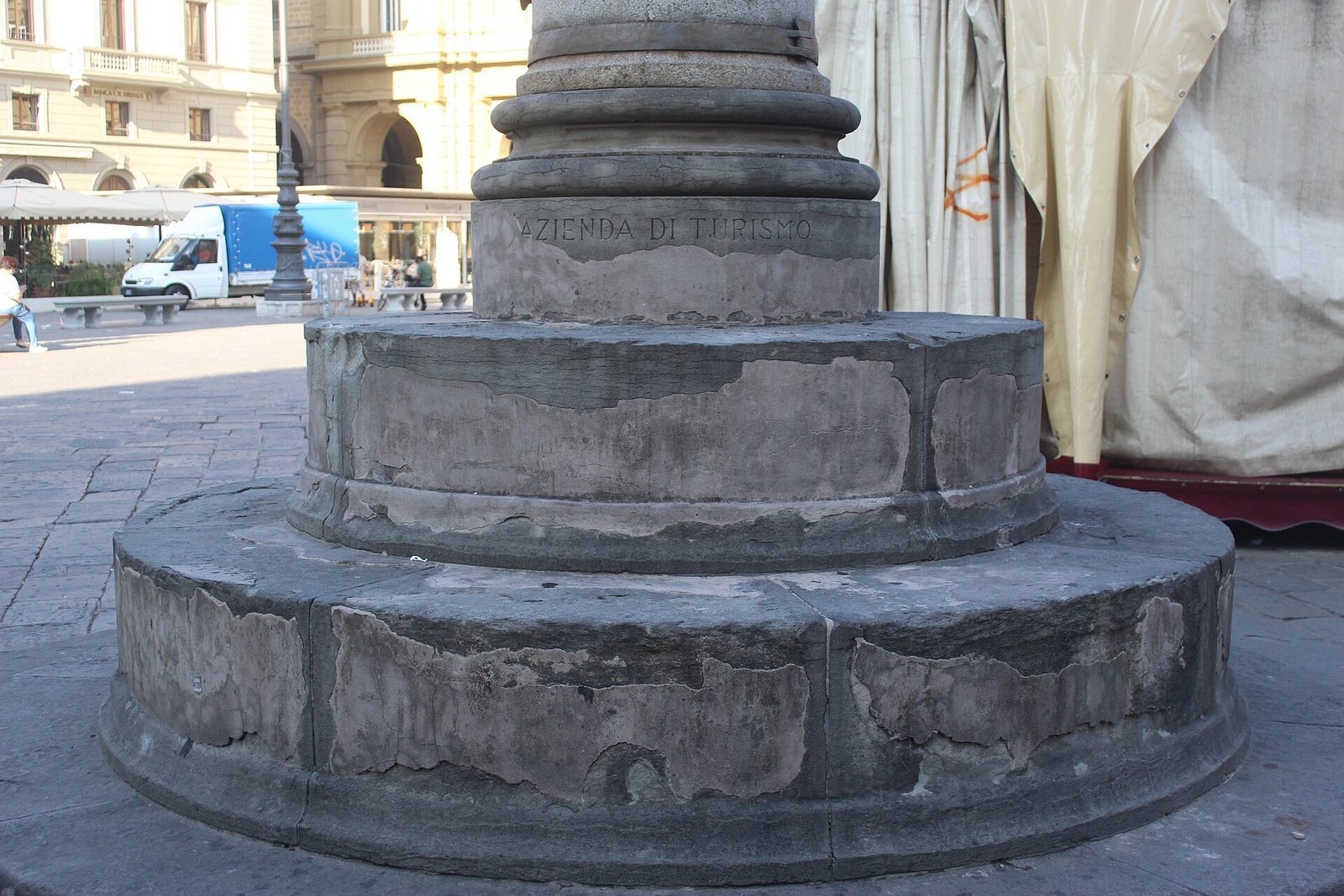
The monument consists of a granite shaft with a sculptural crowning. It was reassembled about two metres from its former position to accommodate traffic. The shaft is made of gray granite from Elba. Its original stepped base also served as a street bench.
Shaft and former fittings
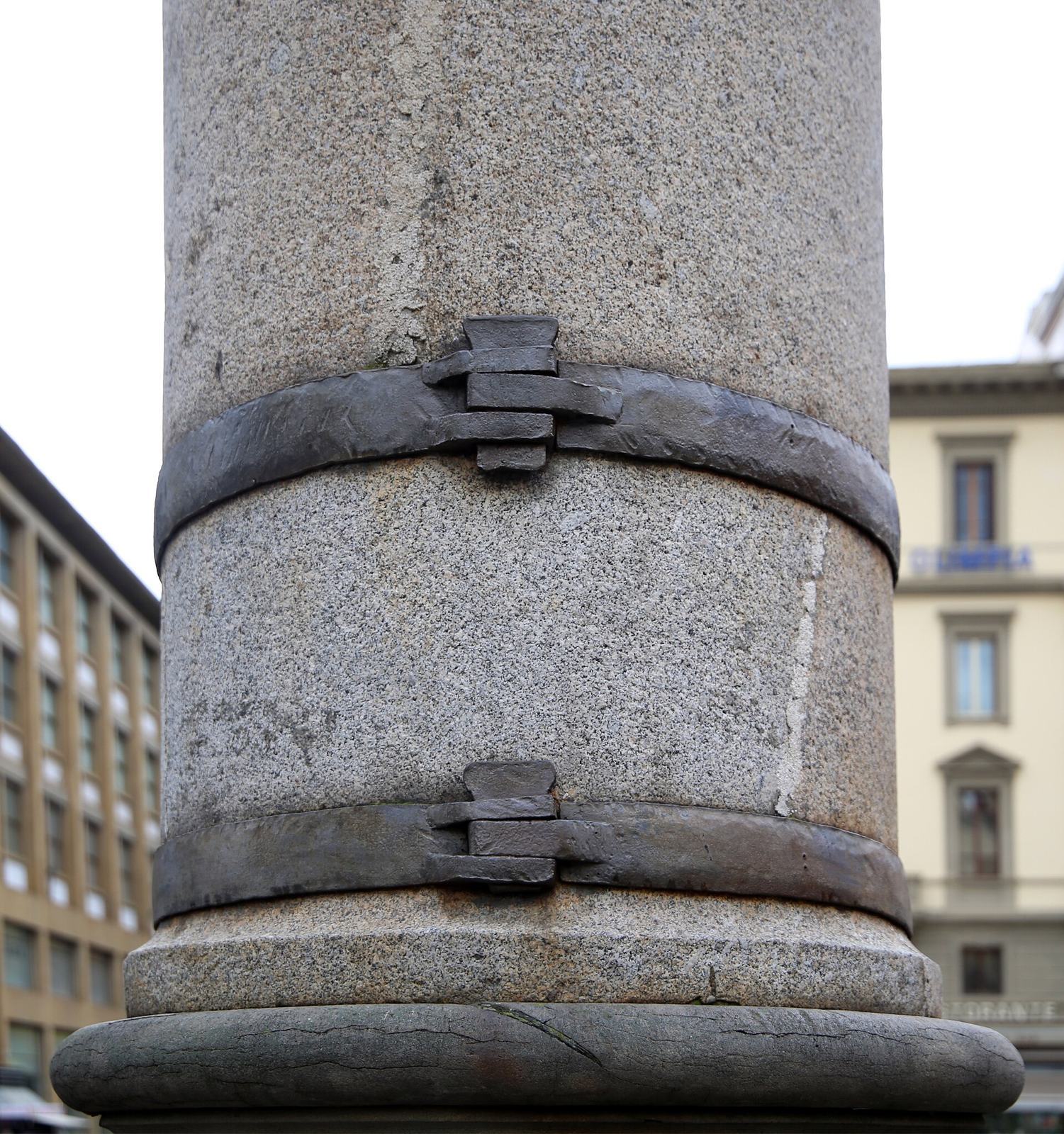
Several marks on the shaft relate to its earlier uses. Plugged holes at mid-height show where the pillory chains were fixed, while three bands added during reassembly strengthen vulnerable points. Higher up, patches and hooks relate to the former bell; its hooks were still visible in the nineteenth century. A small mountain and cross, symbolizing Calvary, is carved at a tilted, nearly inverted angle. It may have been cut when this upper part of the shaft could be reached above the shop roof.
Donatello’s original figure
The original statue, attributed to Donatello, was carved from gray Tuscan sandstone. It showed a standing woman holding a horn-shaped cornucopia, an emblem of plenty, in her left hand and raising a basket of fruit above her head with her right.
Foggini’s statue and capital
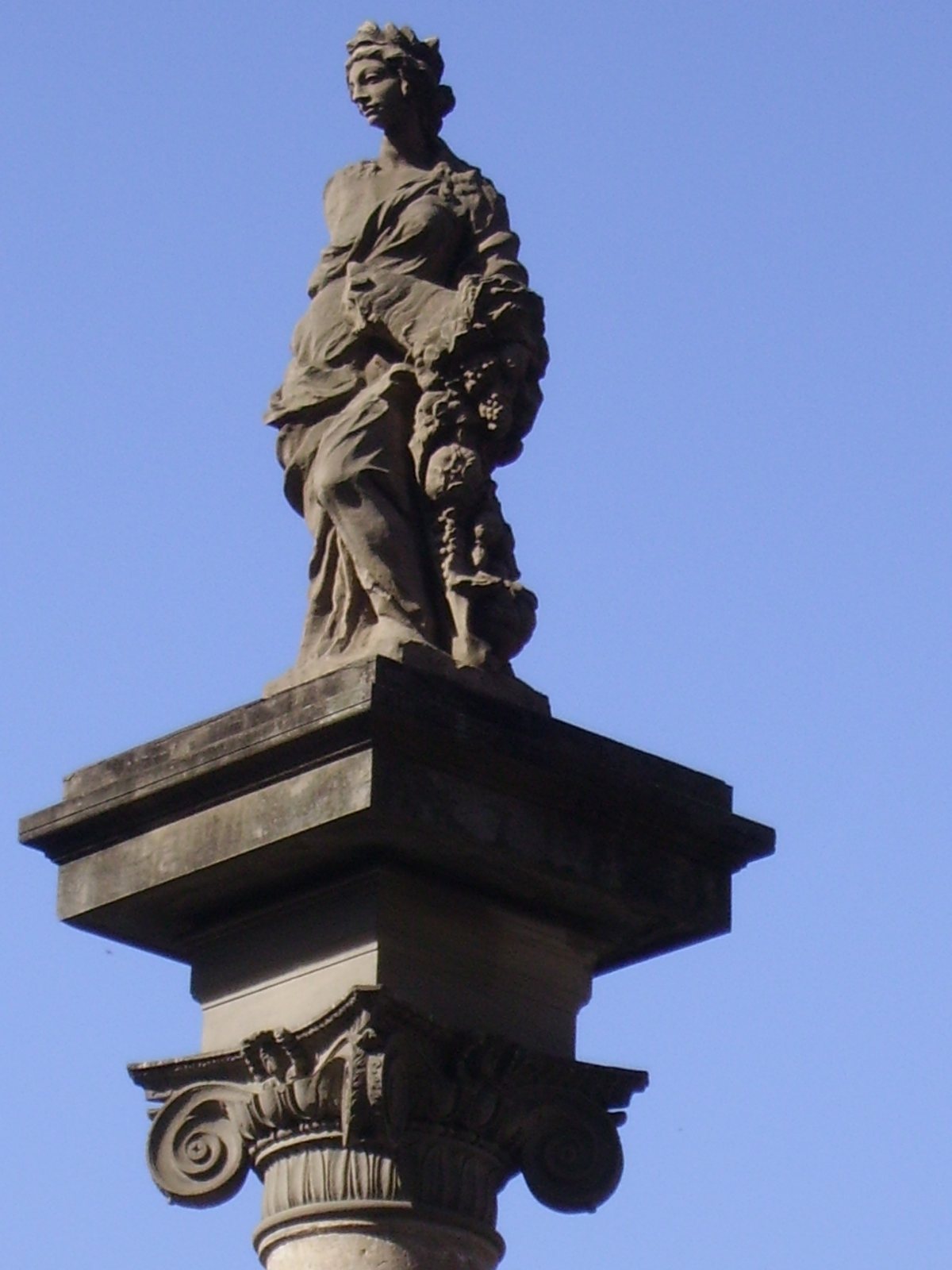
Foggini’s replacement was a different design, showing a slender woman crowned with wheat ears and holding an inverted cornucopia in both hands. This figure was also made from gray Tuscan sandstone. An arm that held the cornucopia broke away after exposure to weather. The column’s first capital was Corinthian and may have reused an ancient piece; Foggini’s replacement was Ionic. A stonemason carved the replacement capital alone beside a road in the Mugello. Foggini’s statue and capital are now at the central headquarters of the Cassa di Risparmio di Firenze on Via Bufalini.
The reconstructed crowning
At the top of the rebuilt monument, a raised cushion-shaped stone block supports the statue above the capital. Moschi’s copy of Foggini’s figure, made in the 1950s, is now in the cloister of the Oblate complex near the municipal library. The figure currently atop the column is a fiberglass replica modeled on the sandstone version.
Roman-period remains below the piazza
On 3 March 1887, archaeologist Luigi Adriano Milani began excavating beneath the column. At a depth of about three metres he found a granite fragment set in mortar that continued a further four metres to a Roman-period floor. Milani proposed that the fragment came from a portico in the Roman forum, perhaps opposite the Capitoline temple, Rome’s principal temple to Jupiter. Other interpretations linked it to the uncertain ancient honorific column, while fragments beneath the nearby tabernacle of Santa Maria della Tromba supported the portico theory. The remains were later reburied. Excavation during the column’s 1956 reassembly exposed large slabs of Carrara marble from the Roman forum about five metres below the present piazza floor.