Fort Amherstburg: A British Military Post on the Detroit Frontier
Site at a Glance
- Popularity
- Medium
- Country
- Canada
- Primary era
- Modern
- Eras represented
- Modern
- Civilizations
- British
- Site type
- Military
- Remains
- Fort
On this page16 sections
History
Establishment and British frontier role
Fort Amherstburg is a former British military fort in Canada, established on the Detroit frontier. Work by the Royal Canadian Volunteers began in 1786, and the fort is also dated to 1795. After the 1784 Indigenous land grant, Governor Sir Frederick Haldimand selected the ground opposite Bois Blanc Island for a strategic post. The Reverend Thomas Nattress later maintained that Indigenous people had already used the area as a defensive position.
Following the 1795 Jay Treaty, British forces left Fort Detroit and moved to the new post. It was formally named Fort Amherstburg in January 1797, in honor of General Lord Amherst. Although that name was never officially replaced, local residents often called it Fort Malden, after the township. The fort was intended to sustain British influence among Indigenous peoples in the west and became Britain’s main defensive position on the Detroit frontier. Before the War of 1812, it expanded to include the King’s Navy Yard.
In 1807, Black militia deserters from Detroit came to work at the fort. They were neither segregated nor denied promotion. Black Canadians also served there during the War of 1812 and the later rebellions.
The War of 1812 and the retreat of 1813
Fort Malden entered the War of 1812 on 2 July, when British forces seized the American schooner Cuyahoga in the Detroit River. On 16 July, a patrol from the fort fought American troops at River Canard. Two British soldiers died, the war’s first fatalities. Major General Sir Isaac Brock took command at the fort in August and met with Tecumseh, a Shawnee war leader, to prepare an attack on Fort Detroit. Their forces crossed the river on 16 August, and Detroit surrendered after a brief siege. The victory helped secure First Nations support for the British at Fort Malden.
The fort also served as a staging point for the British victory at Frenchtown in January 1813 and for attacks on Fort Meigs and Fort Stevenson. In September, the British defeat on Lake Erie cut off Major General Henry Procter’s supplies. He ordered the fort destroyed and withdrew east. Most of its guns had been loaded onto British squadron vessels and were lost in the battle. The captured flagship, HMS Detroit, had been built at the King’s Navy Yard. Tecumseh viewed Procter’s retreat as a betrayal of their First Nations allies. He and his men followed the British east, and Tecumseh was killed at the Battle of the Thames on 5 October.
American forces occupied Amherstburg and the fort site after the retreat, using the area to support raids into nearby parts of Upper Canada and beginning to rebuild near the original position. The Treaty of Ghent, which ended the War of 1812, returned the area to British rule. American troops left on 1 July 1815.
Rebellion, garrison, and pensioners
The fort returned to military service during the Upper Canada Rebellion, an uprising against colonial government in 1837 and 1838. It helped defend the border against American sympathizers linked to the Hunters’ Lodges, organizations associated with raids into Upper Canada. In 1838, under Major H. D. Townshend’s supervision, buildings were constructed and earthworks repaired. The 24th and 32nd Regiments were stationed there, along with a third regiment that included the Royal Artillery.
On 9 January 1838, American Hunter Patriots crossed the Detroit River aboard the schooner Anne in an attempt to raid Amherstburg. Regiments, local militia, and Indigenous warriors defended the town; twenty Americans were captured, including their commander, Edward Alexander Theller. Royal Artillery detachments also went to defend Fighting Island and Pelee Island. The Second Essex Company of Coloured Volunteers served at the fort from Christmas Day 1837 until May 1838 and took part in the capture of the Anne. The Royal Artillery left in June or July 1839, followed by the 32nd Regiment.
Further development took place under Sir Richard Airey from 1839 to 1840, including new barracks and storehouses. A plan to replace the fort with another defense installation in Amherstburg was dropped after the 1842 Webster–Ashburton Treaty settled border issues between Britain and the United States. The Royal Canadian Rifle Regiment, composed of veteran English soldiers, was stationed at the fort from 1842 to 1851.
From 1851 to 1859, Amherstburg participated in the British Army Pensioner Scheme. About 350 retired soldiers and their families settled in the town, receiving homes and small land grants in return for police work and temporary military service. Many were Irish Catholics, and their presence contributed to local economic and cultural life into about the 1890s.
The asylum and the Black community
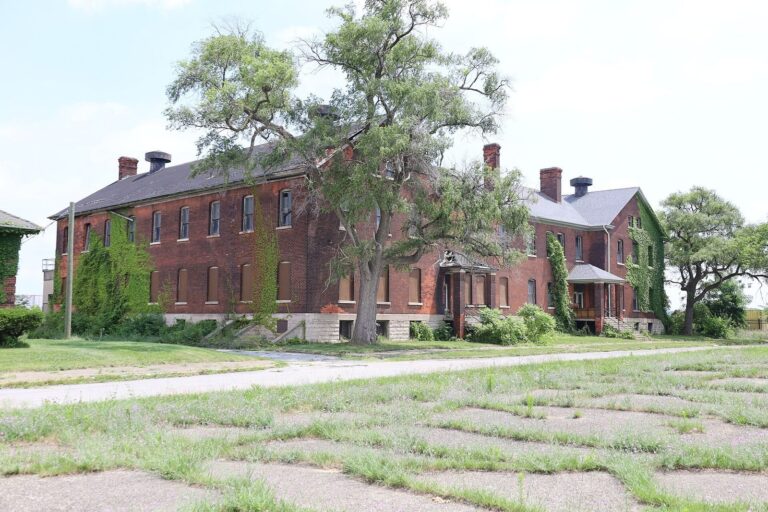
In 1859, Britain ended the pensioner program and transferred the fort to the provincial government. An order dated 8 June made it a branch of the provincial asylum system, intended to take surplus patients from Toronto. Known as the Malden Lunatic Asylum, it was a nineteenth-century institution for people with mental illness. Architect Kivas Tully supervised early alterations, with some patients working on the building. The first medical superintendent, Dr. Andrew Fisher, oversaw further construction and work on the grounds.
Fisher provided recreation, a library, weekly dances, and religious services, and avoided solitary confinement. Patients also repaired buildings and did domestic work. The asylum’s 1862 accounts listed spending of $95.13 on narcotics and $1,125.88 on liquor. About 260 patients were treated over the institution’s lifetime. In 1861, 219 were registered, most born in Ireland. Average stays across the Toronto, Malden, and London asylum system were eighteen years during the 1860s, and the discharge rate reached 60 percent by 1869.
Fisher resigned in 1867 amid allegations of financial irregularities. His successor, Dr. Henry Landor, changed how some buildings were used and ended the policy of admitting only quiet, long-term patients, accepting people with more acute and severe conditions. Dr. Milligan later shared the superintendent’s duties. The asylum employed thirty people, including some former pensioners. Deceased patients were buried briefly on the grounds before Rose Hill Cemetery was completed. The branch closed in 1870, and its patients were transferred to the London asylum. Its loss hurt Amherstburg, where it had been a major employer and buyer of local goods.
Fort Malden also became an important crossing point for people escaping slavery in the United States. After the Fugitive Slave Act of 1850 made capture and return possible even for people living in free states, escapees and those helping them faced greater danger. About thirty people a day crossed to the Amherstburg area by steamboat after 1850. The Sultana made frequent Great Lakes trips, and its captain, C. W. Appleby, helped bring fugitives from Lake Erie ports. Many moved on, but the area’s African-Canadian population was estimated at 400 to 500 in 1855. By the start of the American Civil War, about 800 Black residents lived in the area, representing roughly 40 percent of its population.
Subdivision and preservation
After the asylum closed, the former fort remained largely vacant. A caretaker looked after the grounds and buildings until 1875, when the town surveyed the former military reserve, divided it into eleven lots, and sold them at auction. Laird Avenue, North Street, and Dalhousie Street were laid out to serve the new properties. Ontario reserved Lots A and B, leasing them to Amherstburg for a park and agricultural fairs; the main fort complex became Lot 4.
Andrew Borrowman bought Lot 4 and leased it to John R. Park and William Borrowman for a lumber mill. The former laundry became the mill, while other asylum-era buildings were destroyed or adapted for industrial use. The mill fell idle during the First World War. In 1918, a daughter of one of its owners sold the property to Franklin A. Hough, who converted the mill into a private residence and substantially changed its appearance.
Lots 1, 2, and 3, including the former medical superintendent’s house, were bought by John McLeod. After his death in 1891, his widow sold the land gradually. The Falls family acquired much of it in 1900 and subdivided it further. W. S. Falls bought the former superintendent’s residence in 1908 and began building houses there in 1917. In 1926, the family sold Lot 3 to Malcolm McGregor, who altered the property and developed homes along the waterfront.
Amherstburg residents began campaigning to preserve the fort by at least 1904, when they petitioned for its land to become a park. A second petition followed in 1912, and a delegation met Prime Minister Robert Borden in 1913. The First World War interrupted progress. The Historic Sites and Monuments Board recognized the fort in 1921 and recommended a plaque, which was installed more than a decade later on the Webber property. A local committee formed in 1938 to press for improvements and a museum; the museum was completed in 1939.
Federal acquisition gradually brought parts of the former fort back together. Amherstburg transferred the Webber property to the federal government in 1917. In the 1930s, the town acquired land on the north section of the northeast bastion and transferred it to the federal parks division. A 1940 federal order designated Fort Malden a National Historic Park. The federal government acquired Lot 4 after Hough’s death in 1946 and the McGregor House from his estate in 1958. The fort is now a National Historic Site of Canada. The Amherstburg Royal Naval Dockyard is separately recognized as a National Historic Site of Canada.
Remains
Site layout and defenses
The historic complex covers 4.5 hectares (11 acres) and includes the fort, the Brick Commissariat, King’s Navy Yard Park, and a stone lighthouse. Its surviving defenses include earthworks, defensive structures made of earth, and a bastion, a projection that extends outward from a fortification. A former southeast bastion and its ditch were landscaped as a botanical garden. The fort’s southeast portion was removed to make way for waterfront houses. Several pensioners’ cottages survive on the grounds and around King’s Navy Yard.
Buildings within the fort complex
Brick Barracks
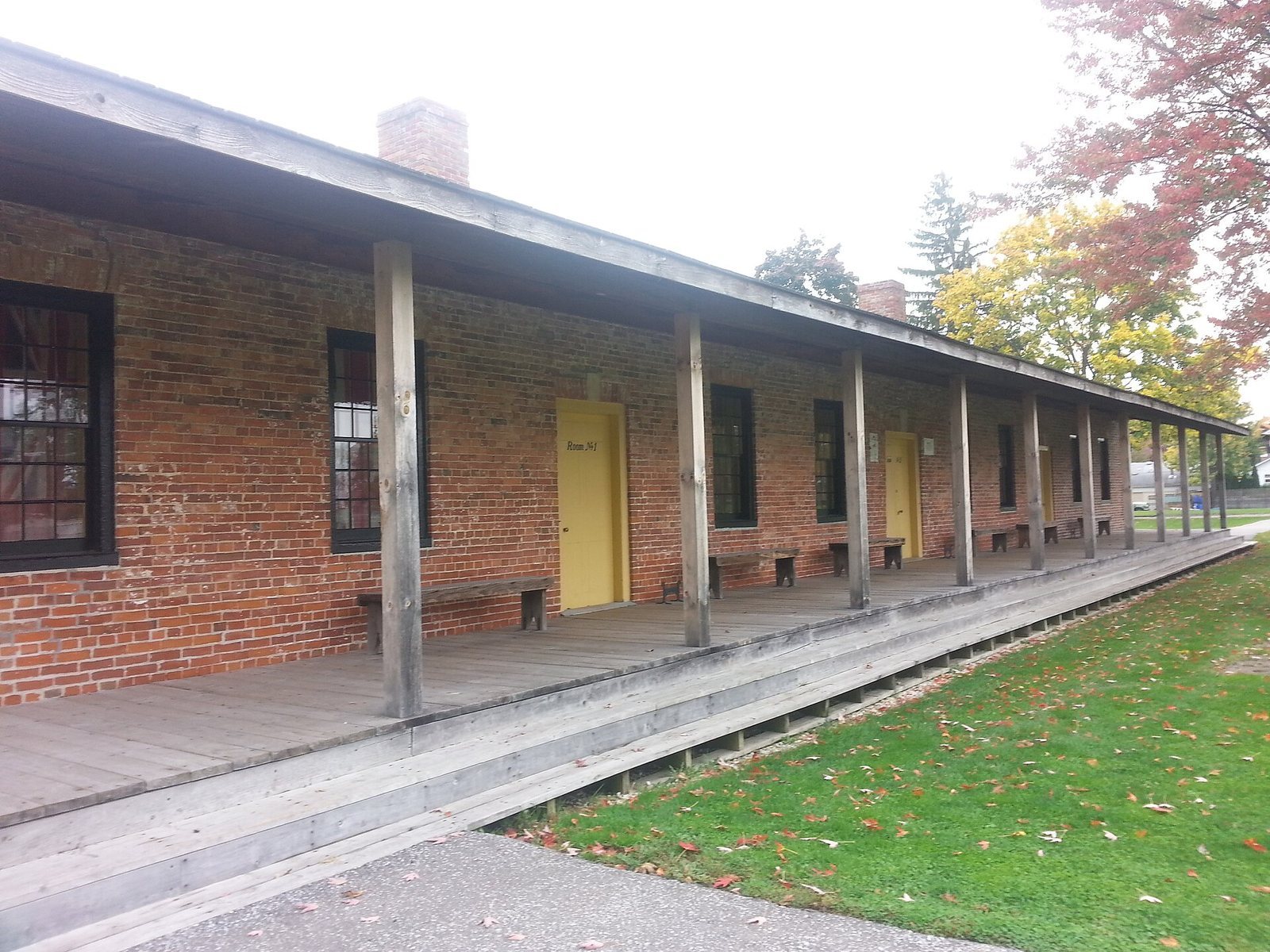
The Brick Barracks dates to 1819 and has been restored to represent barracks from 1839. Its long rectangular plan and red-brick exterior follow a standardized nineteenth-century military bungalow layout. Bay windows run along the entrance side, with a front porch and wooden doors. Restoration work altered the interior, refinished the hardwood floors, and repaired all three core sections. Chimneys, doors, and windows were reconstructed.
Hough House
Hough House began as a late-nineteenth-century building and was later adapted from a lumber mill into Hough’s residence in Colonial Revival style, which draws on colonial-era forms. The two-and-a-half-storey structure combines masonry and wood detailing beneath a wood-shingle roof, with stone accents and Palladian-style windows. Each Palladian window has a central arch flanked by smaller openings. The house stands among the earthworks and contains records and archives relating to the fort.
Visitor Centre
The Visitor Centre is a single-storey rectangular building in Colonial Revival style. Its limestone exterior, stone chimneys, and multi-pane windows, together with trimmed front and rear gardens, follow the architectural character of other buildings in the complex. It formerly housed the museum before the exhibits and archives were moved to Hough House.
Brick Commissariat
The Brick Commissariat, also called Callam House, was built in 1831 in the Amherstburg Navy Yard. In the mid-nineteenth century it served as an office administering service contracts for military personnel. Designed by Captain Philpotts of the Royal Engineers, it resembles the barracks but has no verandah. Parks Canada restored its exterior in the 1980s while retaining the original interior layout and design.
Waterfront features
Stone lighthouse
A stone lighthouse built in 1836 is among the site’s listed components.
King’s Navy Yard and park
The Amherstburg Royal Naval Dockyard lies outside the fort and overlooks the Detroit River. Built in 1796 as a British military supply depot and shipbuilding center, it built and serviced vessels used during the War of 1812 before being demolished in 1813. Most of its land later became privately owned estates. The area has since been restored as a community park, with gardens, gazebos, recreational areas, and plaques recalling its history.