Theodelinda Chapel: A Fourteenth-Century Chapel in Monza Cathedral
Site at a Glance
- Popularity
- High
- Country
- Italy
- Primary era
- Medieval
- Eras represented
- Medieval, Modern
- Civilizations
- Duchy of Milan, Holy Roman Empire, Italian
- Site type
- Religious
- Remains
- Chapel
On this page10 sections
History
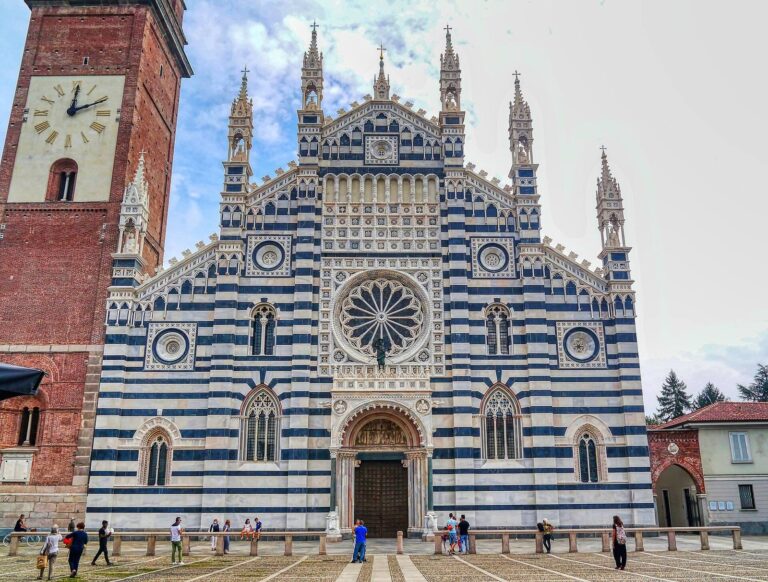
The Theodelinda Chapel is a Roman Catholic chapel in Monza Cathedral, in Monza, Italy. Built in the fourteenth century as part of a late-medieval reworking of the cathedral’s apse end, it is known for its fifteenth-century paintings of Theodelinda, a Lombard queen. The Lombards were a Germanic people who ruled much of Italy in the early Middle Ages.
The chapel and its painted program
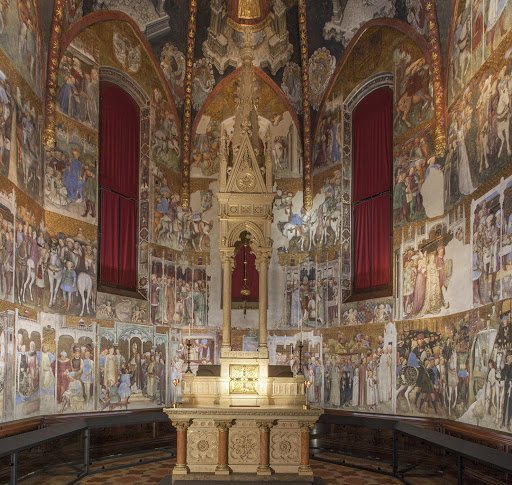
The chapel formed one of a pair created during the cathedral’s late-fourteenth-century alterations. The matching chapel on the right was dedicated to the Virgin. The painted decoration of Theodelinda Chapel was executed between about 1441 and 1446, apparently in two stages, from 1441 to 1444 and from 1444 to 1446.
A notarial document names Franceschino Zavattari as the project’s leader, assisted by his sons Gregorio and Giovanni. Franceschino, who had connections in Monza and was associated with the local Rabia family, probably shaped the overall design. Ambrogio is credited with the final scenes, although the notarial document does not name him.
The broader decorative scheme was planned to include the paired chapel, the main apse, and the central nave’s triumphal arch. Its patronage remains uncertain. The Visconti emblem and lettering read as “FI MA” may point to Filippo Maria Visconti, duke of Milan, as patron. Alternatively, local support may have reflected hopes for succession through his daughter Bianca Maria, who married Francesco Sforza in 1441. The Visconti and Sforza were ruling dynasties in Milan. The cycle’s wedding scenes have been read as an allusion to Bianca Maria’s marriage and the transfer of power from the Visconti to the Sforza, a comparison that could help legitimize Francesco’s rule.
The Lombard narrative
The painted story draws on Paul the Deacon’s History of the Lombards and a late-fourteenth-century legend by Monza chronicler Bonincontro Morigia. It begins with Authari, a Lombard king, seeking a wife. He first asks for Inganda, sister of Childebert, a Frankish king, but she has already been promised to the son of the king of Spain. Authari then sends envoys to Garibald, duke of Bavaria, to request his daughter Theodelinda. After Garibald agrees, Authari visits Bavaria in disguise. Theodelinda offers him a welcoming drink without knowing who he is.
The story next shows Childebert making war on the Lombards and defeating Garibald. The duke, Theodelinda, and her brother flee to Italy. Authari meets Theodelinda near Verona, and they marry there on 15 May 590. After celebrations in the city, the narrative depicts Authari’s conquest of Reggio Calabria and his death by poisoning at Pavia on 5 September 590.
After Authari’s death, Theodelinda is confirmed as queen and allowed to choose her next husband. She selects Agilulf, duke of Turin. They meet at Lomello, where Agilulf gives up Arianism, a Christian tradition distinct from Catholic orthodoxy, and converts to Catholic Christianity. He takes the name Paul before his coronation as king of the Lombards. Their marriage and wedding feast follow.
The later story recounts the royal couple’s hunt and Theodelinda’s dream that a dove representing the Holy Spirit would show her where to build a church. The scenes portray her searching for the site, seeing the dove, and laying the cathedral’s first stone. They also show her turning pagan idols into the church’s Christian treasury and making gifts to the cathedral. Her son Adaloald presents further treasures on the day of his coronation. After Agilulf’s death, Pope Gregory I, leader of the Catholic Church from 590 to 604, sends relics and books through a church minister named John. John delivers them to Monza’s bishop in Theodelinda’s presence, and the story concludes with her death. The final scenes depict the Byzantine emperor Constans setting out to expel the Lombards from Italy. A hermit predicts that he will fail, and Constans leaves without fighting.
The paintings underwent restoration from 2008 to January 2015.
Remains
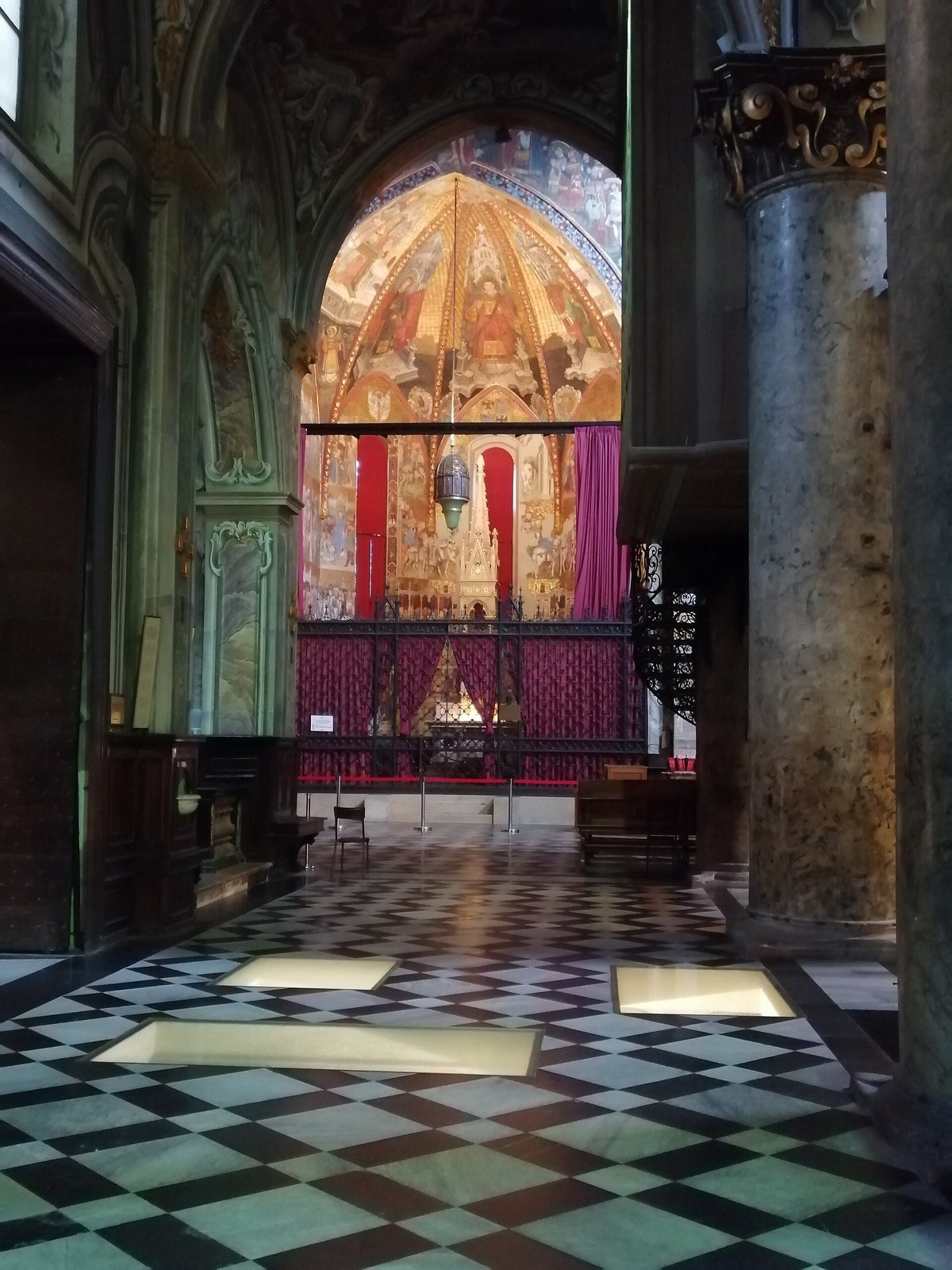
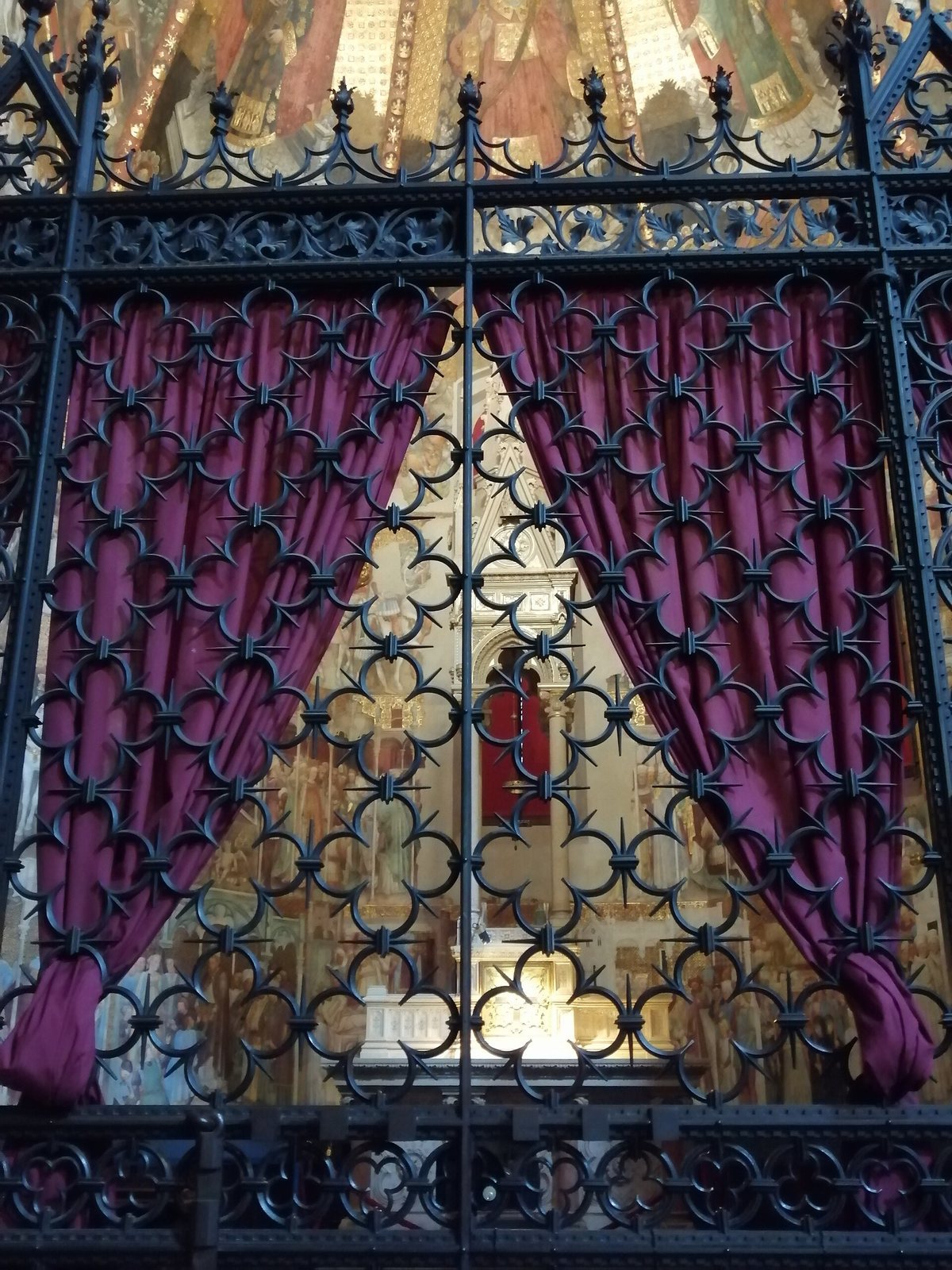
The chapel lies to the left of the cathedral’s central apse, the sanctuary end of the church. Its polygonal space is covered by a Gothic ribbed vault, a ceiling supported by intersecting ribs. The wall paintings extend around the door jambs as well as across the walls, while a grille designed by Luca Beltrami in the late nineteenth century encloses the chapel.
Painted architecture and decoration
Wall-painting cycle
The walls carry 45 scenes arranged in five horizontal tiers, with about 800 figures across roughly 500 square metres. The sequence begins at the upper left and proceeds from north to south. The painters combined fresco, paint applied to wet plaster, with tempera applied to dry plaster, raised decoration, and gilding in gold leaf and pastiglia, raised ornament made from gesso or similar paste. Together, these methods give the scenes the fine, layered finish of an enlarged miniature.
The figures occupy idealized settings, often wearing clothing associated with the Visconti period and standing against gold backgrounds. The style reflects a late adoption of the manner of Lombard painter and illuminator Michelino da Besozzo. Its features include elegant lines, subdued color, close attention to detail, and figures that seem suspended and stunned. Scene 32 bears the Zavattari family’s collective signature and the date 1444.
Entrance arch and vault
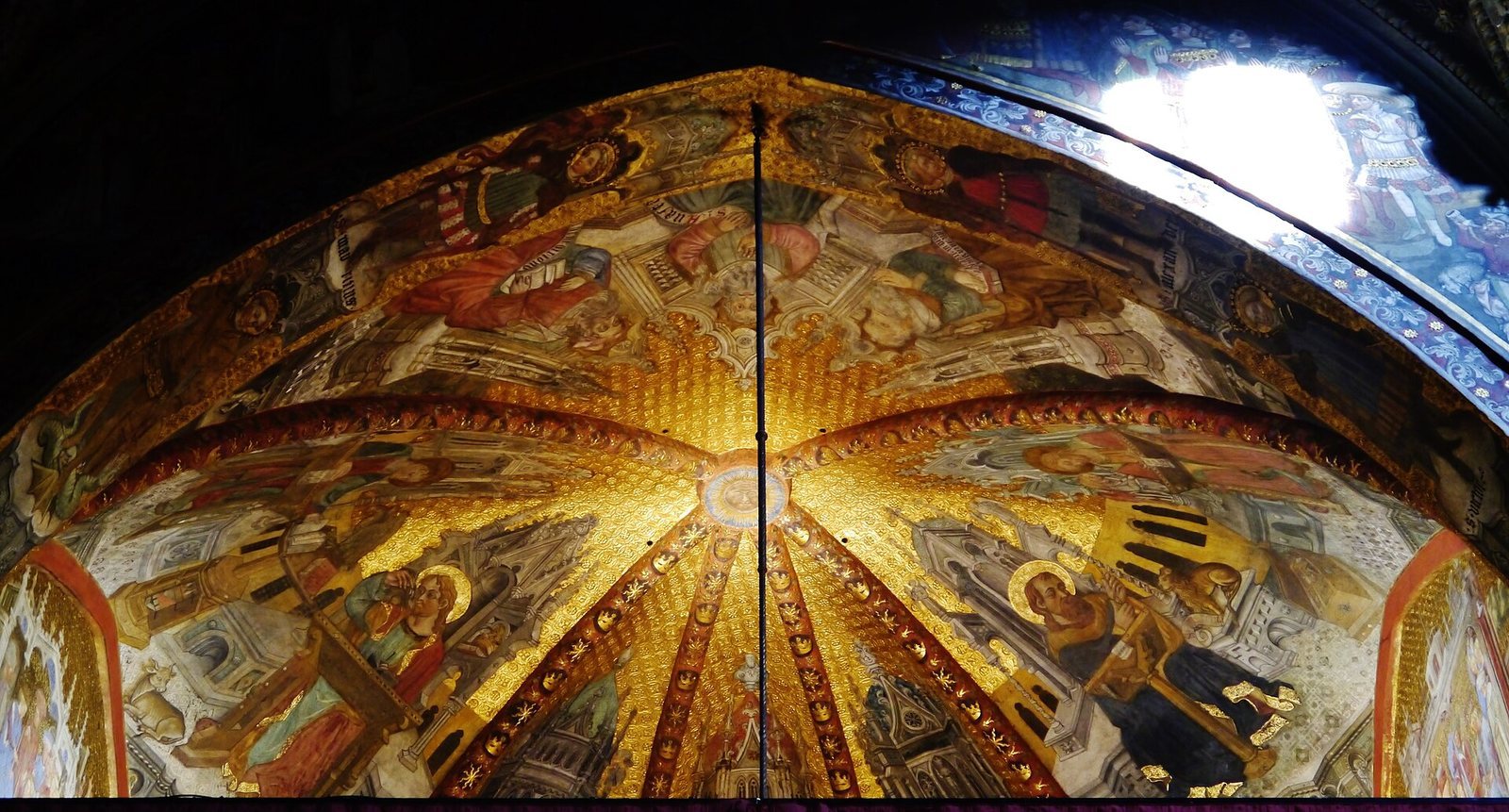
The large arch opening toward the transept, the crosswise part of a church that intersects its main body, begins the cycle with a monumental Saint John the Baptist. Theodelinda and Agilulf are shown worshipping him; John is the cathedral’s dedicatee. The entrance-arch front and the vault also carry paintings of saints and Evangelists by an anonymous fifteenth-century painter. The Evangelists occupy sections of the vault. An inscription states that the Zavattari painters did not execute this part of the decoration. These paintings may date to the consecration, in 1433, of an altar dedicated to Saint Vincent.
Altar and burial
Altar and Iron Crown
A Neo-Gothic altar stands at the chapel’s centre. Luca Beltrami designed it in 1888 at the request of King Umberto I. A case on the altar contains the reliquary of the Iron Crown of Lombardy, a historic crown associated with the coronations of Lombard kings, kings of Italy, and Holy Roman Emperors. The Holy Roman Empire was a Central European political entity that lasted from the Middle Ages into the modern era.
Sarcophagus and recovered objects
Behind the altar, against the rear wall, stands the sarcophagus that received Theodelinda’s remains in 1308, transferred from their original burial in the Lombard basilica. An examination in 1941 found bones identified as those of an adult woman and a young male, interpreted as Theodelinda and her son Adaloald. The examination also recovered a spear point, a small tube, small gold nails, fragments of Lombard gold decoration, and fine gold threads from decayed textiles.
Other finds included terracotta roof tiles from the ancient oraculum, a place of prayer or worship associated with Theodelinda, and 17 coins dating from the twelfth and thirteenth centuries. Issued under Conrad III, Frederick Barbarossa, Henry VI, and Frederick II, the coins reflect later periods than the chapel’s foundation. The recovered objects are kept in the Museum and Treasury of Monza Cathedral.