Kibitsu Shrine: Principal Shrine of Former Bingo Province
Site at a Glance
- Popularity
- High
- Country
- Japan
- Primary era
- Early Modern
- Eras represented
- Early Modern
- Civilizations
- Tokugawa
- Site type
- Religious
- Remains
- Sanctuary
On this page25 sections
History
Kibitsu Shrine is a Shinto shrine in Japan that served as the ichinomiya, or principal shrine, of former Bingo Province, a historical province in western Japan. Tradition dates its foundation to 806, when Kibi Province was divided into three, and says a sacred presence was transferred to it from Kibitsu Shrine in Bitchu Province.
Foundation and provincial standing
The traditional first site was at Habu in Ashida District, but the shrine’s beginnings remain uncertain. It is not listed in the Engishiki shrine register, compiled between 905 and 967, the earliest surviving reference to it dates to 1148, and excavated material dates no earlier than the twelfth century.
A record from 1165 calls the shrine Kibitsu-no-miya and identifies it as the only shrine in Bingo required to pay annual dues to the Jingikan, the central government office for kami worship. The shrines assessed in the record were provincial principal or secondary shrines, indicating Kibitsu’s standing as the province’s ichinomiya. The earliest text to explicitly give it that title is the Illustrated Biography of Ippen.
The principal deity is Ōkibitsuhiko-no-mikoto, a kami associated with Kibi traditions. The shrine also venerates Ōyamato Nekohikofuto-no-mikoto, identified as the legendary Emperor Kōrei and Ōkibitsuhiko’s father; Kuwashi-hime, identified as Kōrei’s empress but not Ōkibitsuhiko’s mother; and Wakatake-hiko-no-mikoto, his younger brother. The shrine was affiliated with the Buddhist temples Chukoji and Jinguji, also known as Jinganji, reflecting the historical overlap between Buddhist and kami worship.
Medieval religious and landholding roles
Tradition dates the shrine’s Lotus lectures, religious talks on the Lotus Sutra, to 1014. In 1148 it served as an endowment estate supporting such lectures at Gion Shrine in Kyoto. A record from 1193 describes the shrine among lands taken from the Taira clan and granted to Bomon Hime, sister of Minamoto no Yoritomo; her children inherited the estate after her death. The record links the shrine’s property to the Taira side during the Genpei War, a late-twelfth-century conflict between the Taira and Minamoto warrior houses.
The Buddhist priest Ippen visited in 1287, when the shrine hosted a performance of Qin King Breaks the Battle Formation. In 1297 it received land assessed at 16,000 kan, a measure used for land value. Shrine musicians performed at the rebuilding of Jodoji’s main hall in 1306. Jodoji may then have held the shrine’s betto, a Buddhist clerical office connected with shrine administration.
Uprising, rebuilding, and later grants
In the early 1330s, the imperial loyalist Sakurayama Koretoshi raised troops at the shrine in support of Emperor Go-Daigo’s effort to restore imperial rule. After receiving a false report that the commander Kusunoki Masashige had been defeated at Akasaka Castle, Koretoshi killed himself along with his wife and children, and the shrine was burned. In 1934, the shrine precinct, the area behind it around Tobi-o Castle, and the area of Sakurayama Castle to the south were designated a National Historic Site as the traditional location of the uprising.
Records show that Kō no Moroyasu ordered Bingo’s provincial military governor in 1346 to stop abuses against the shrine by its own personnel. A record from the following year describes the people who prepared its offerings planning to carry the sacred palanquin to Jodoji. Rebuilding took place in 1376 and again in 1392. The sponsor of the first project is uncertain, while the second was ordered by provincial governor Hosokawa Yoriharu and carried out by a warrior family from the Sanyōdō region.
In 1440, land belonging to the shrine was granted to Shōgakuin, a subtemple of Chukoji, and a local warlord gave it a bell in 1540. Mōri Terumoto confiscated the shrine’s former estate, assessed at 16,000 kan, in 1591, but granted it 300 koku, a measure of rice yield. In 1600, Fukushima Masanori replaced that grant with 33 koku, 1 to, and 5 sho. Mizuno Katsunari granted 50 koku in 1619, and the Tokugawa shogunate granted a further 3 koku, 3 to, and 2 sho in 1670.
Names and modern classifications
Before the Meiji period, the shrine was also known as Kibitsuhiko Shrine, Kibitsuhiko Ōmyōjin, Ichinomiya Daimyōjin, and Kibitsu-no-miya; it adopted the name Kibitsu Shrine thereafter. In Japan’s prewar shrine classification system, it became a village shrine for Ashida and Jinseki districts in 1869, a prefectural shrine in 1876, and a shrine supplied with food and cloth offerings in 1907. It was classified as a nationally endowed minor shrine in 1928 and became a Beppyo shrine, a special category selected by the Association of Shinto Shrines, in 1985. The honden is a National Important Cultural Property, and the kagura-den is designated a cultural property by Hiroshima Prefecture.
Remains
Setting and layout
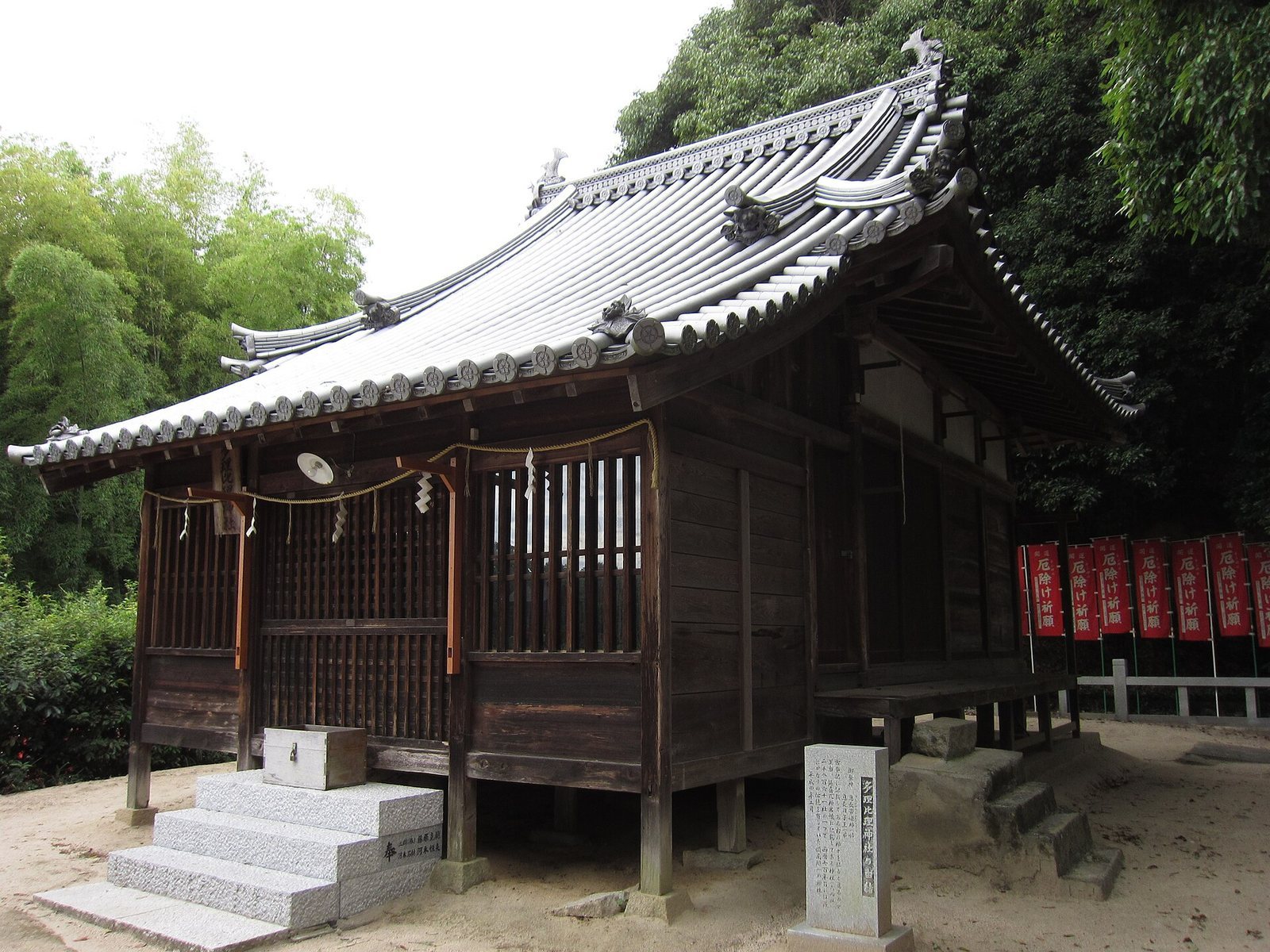
The precinct covers about 17,881 square metres on a plain in the downstream area of the Ashida River, with a mountain behind it. Its east-facing buildings stand high enough to overlook Miyauchi. The main sanctuary is above the worship hall, followed downhill by the kagura-den; gates and the stone entrance torii continue along the shrine’s central axis. The historical area associated with Koretoshi’s uprising lies behind the shrine around Tobi-o Castle and extends to the area of Sakurayama Castle to the south.
Main shrine buildings
Honden, or main sanctuary
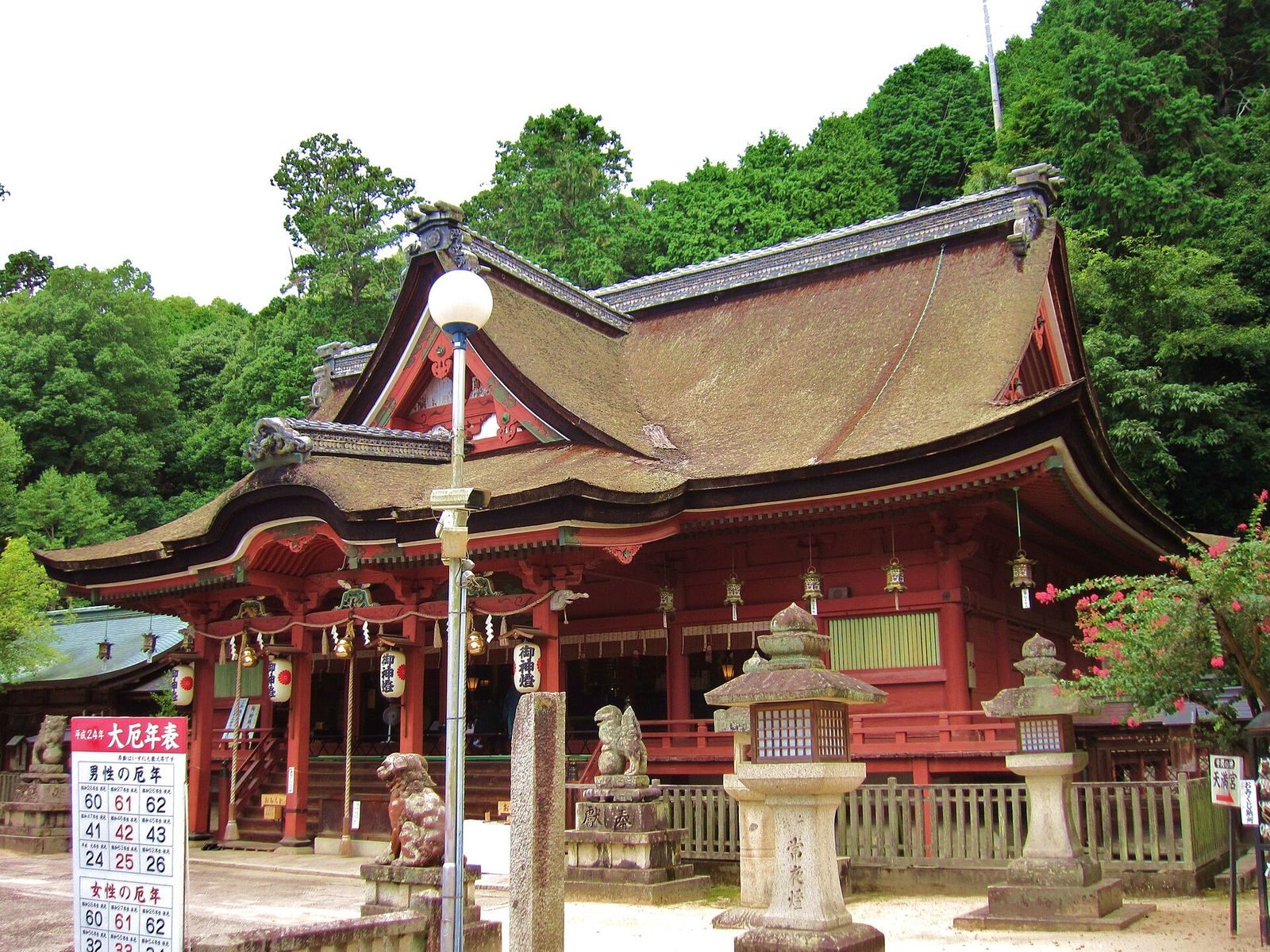
Mizuno Katsunari built the honden in 1648. It has a cypress-bark roof combining sloping sides with gabled ends and measures about 9.7 by 18.48 metres. Its structure has seven bays along its length and four across its width, with each bay marking the interval between columns. A three-bay front porch has a small gable above it and a curved gable along the eaves. Inside, the sanctuary floor rises in stages: the inner sanctuary is about 0.55 metres above the outer one, and the innermost sanctuary rises by the same amount above the inner sanctuary.
Haiden, or worship hall
Built below the honden in 1648, the haiden has a gabled roof, a five-bay front, and four-bay sides. Its roof is covered with copper sheets. Three corner posts from the porch of the honden’s 1376 predecessor were reused in its construction. Repairs were carried out in 1961 and 1971.
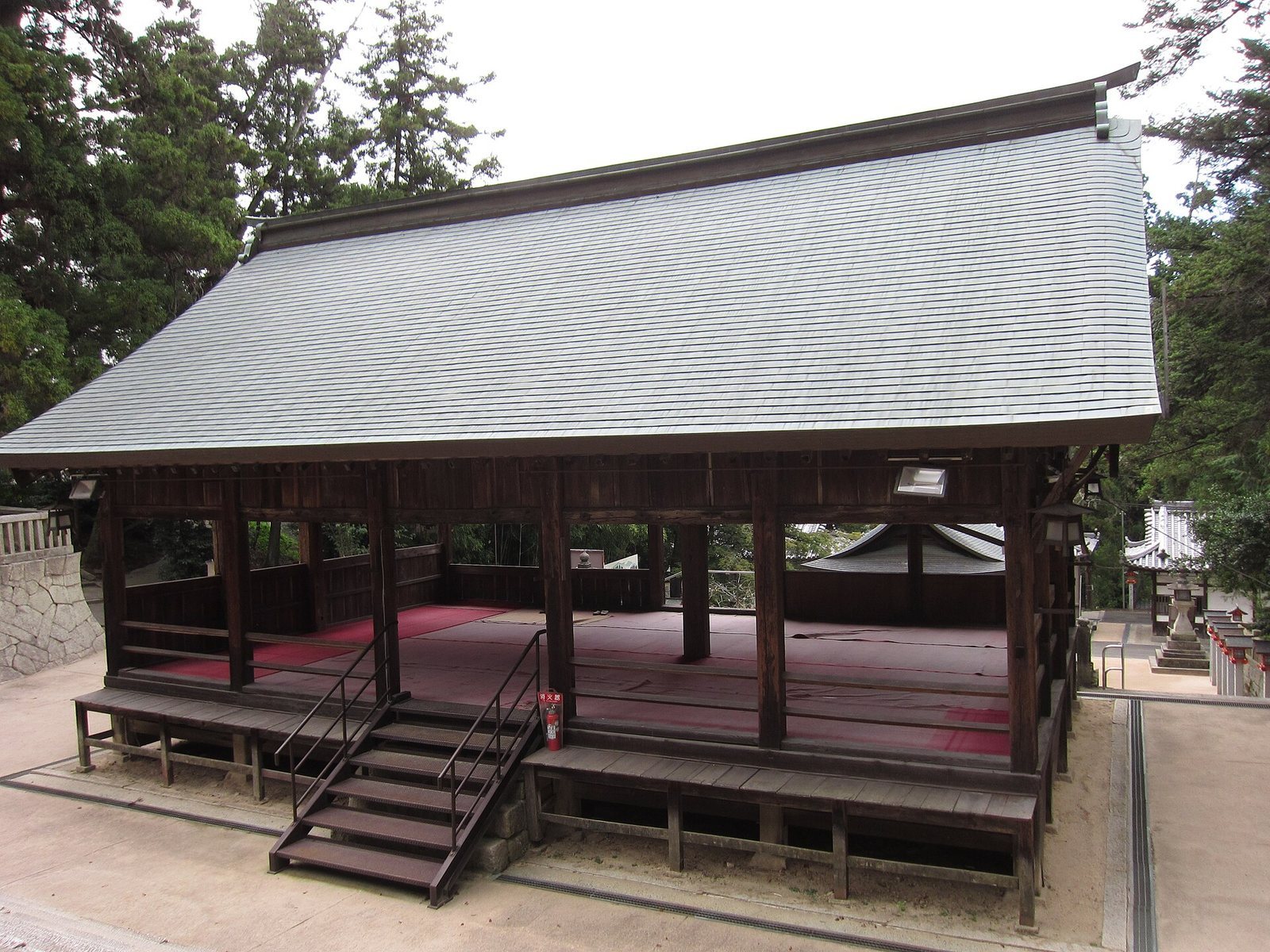
Kagura-den performance hall
The kagura-den was built below the haiden in 1673. Its raised performance stage spans two bays across the front and one along the side. The building has a hip-and-gable roof and an entrance at the gable end. Its original cypress-bark roofing was later replaced with copper sheets.
Gates and stone features
Entrance torii
The granite entrance torii was erected in 1648 in the Myōjin style, which has a curved upper lintel. It stands 5.8 metres high, with a top lintel 6.25 metres long and pillars 54 centimetres in diameter. A bronze plaque carries the inscription Kibitsu Ichinomiya.
Upper guardian gate and musicians’ rooms
The upper zuishin gate, a shrine gate associated with guardian figures, stands in front of the kagura-den. Musicians’ rooms flank it and are thought to have served for gagaku performances and changing clothes.
Lower guardian gate
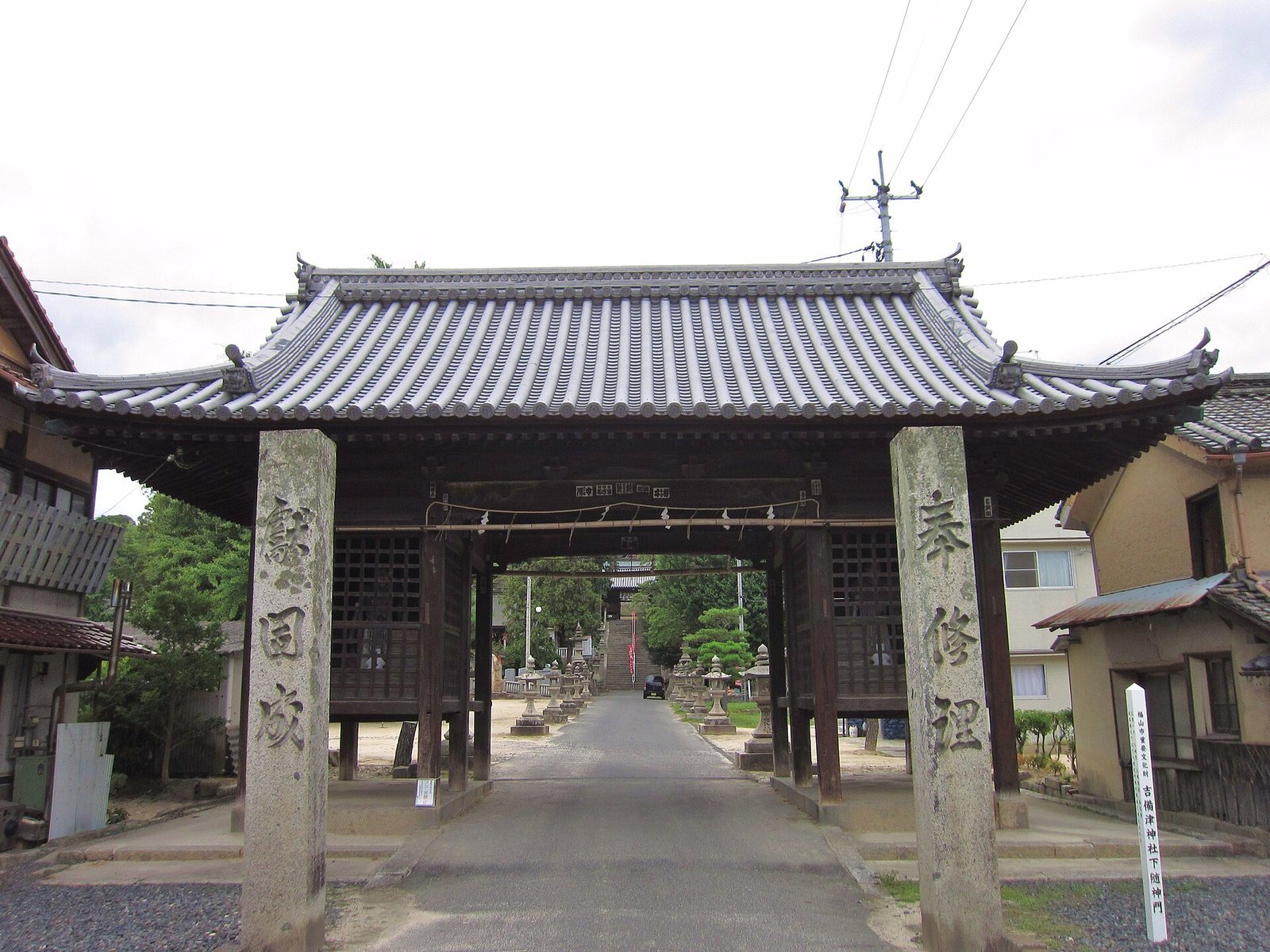
Just inside the torii stands the lower zuishin gate, a tiled structure with three bays and eight supporting posts. It was probably built around the eighteenth century.
Stone lanterns
Two hexagonal granite lanterns stand in front of the honden. Each is 2.9 metres high and 82 centimetres wide. Mizuno Katsunari donated them in 1649 to mark the completion of the honden, and they are the oldest dated stone lanterns in the precinct.
Trees, ponds, and subsidiary shrines
Trees and water features
A ginkgo and a nagi tree grow in the precinct. Beneath the ginkgo in front of the honden is a smallpox-related breast-deity shrine. The Sacred Pond lies beside the kagura-den, while Oike Pond is beyond the torii, across a prefectural road. In February and September, reflected light from the sacred object follows the shrine’s central axis, passes through the worship hall, kagura-den, and both guardian gates, and reaches a point near the stone torii about 100 metres away.
Tarihiri Shrine
The precinct’s Tarihiri Shrine is a proposed identification for the Tarihiri Shrine of Bingo listed in the Engishiki. Its former location is disputed: it may have been moved from Hattori village after falling into disuse, or it may originally have stood at Miyauchi. A second candidate is Tarihiri Shrine at Atashima Hachiman, which may have been transferred from Kamiyamori in 1336, or may have been the destination of a transfer in the opposite direction. A marker erected at Atashima Hachiman in 1894 asserted that shrine’s claim. Proposed identities for Tarihiri’s deity include the legendary Empress Jingū and another kami with a similar name.
Sakurayama Shrine
Sakurayama Shrine in the precinct enshrines Sakurayama Koretoshi and 23 other spirits.
Other subsidiary shrines
The Twelve Shrine commemorates twelve members of Ōkibitsuhiko’s family and Ōnamochi, while the Tomari Futahashira Shrine honors twelve of his relatives. Other shrines include Inari, Manai, Mountain Thunder, Yamazumi, Akiba, Four Shrines, Ebisu, Itsukushima, Fortune, White Beard, and Sata-Hiko. Deities associated with these shrines include Ukanomitama, the well deity Mi-i-no-kami, a thunder deity, Ōyamatsumi, Kagutsuchi, Kōya Myōjin, Niū Myōjin, Kehi Myōjin, Itsukushima Myōjin, Kotoshironushi, the three Munakata deities, and Sarutahiko. Further shrines honor Sukunahikona, Takeuchi no Sukune, Prince Shōtoku, Sugawara no Michizane, ancestors of the shrine family, and war dead from the Meiji period onward.
Associated sculptures and objects
Wooden komainu
Three wooden komainu, guardian figures commonly placed at shrines, are associated with Kibitsu Shrine. Made in the Heian period, they measure 78, 80, and 82 centimetres high. All three are on deposit at the Tokyo National Museum.
Long swords
Four kenukigata tachi, a type of Japanese long sword, are associated with the shrine and are attributed to the late Muromachi period. Two bear inscriptions naming Bichū Onomichi Goami Nagayuki and the date 1555; their blades measure 60.8 and 60.2 centimetres. The other two are signed Masamitsu and have blades measuring 61.6 and 61.5 centimetres. The blades are on deposit at the Okayama Prefectural Museum.
Copper Buddhist staff head
A copper head from a Buddhist staff with suspended rings is dated to the late fifteenth century. It has a circular ring at the top, curved projections at the shoulders, and diagonal rings. A five-ring Buddhist monument is cast at the top, with a pagoda and flower vases represented along the shaft below it. Six smaller rings, three on either side, remain intact.