Église Saint-Ferréol les Augustins: A Gothic Church in Marseille
Site at a Glance
- Popularity
- Medium
- Country
- France
- Primary era
- Medieval
- Eras represented
- Medieval, Early Modern, Modern
- Civilizations
- County of Provence, French, Holy Roman Empire
- Site type
- Religious
- Remains
- Church
On this page16 sections
History
Église Saint-Ferréol les Augustins is a Roman Catholic church in Marseille, France, built in the Gothic style, a medieval tradition associated with pointed arches and vertical forms. The Augustinian hermits, a Catholic religious order following the Rule of Saint Augustine, began building it in 1447, and work continued until 1588. Once outside the old city near the port, it became more central as Marseille expanded.
Augustinian settlement and construction
The Augustinians established themselves in Marseille soon after their order was formally united in 1256. Their first premises stood near the upper end of Rue d’Aubagne, with support from Robert I of Naples, Count of Provence. In 1361, authorities cleared the district to prevent armed bands from using it as a base, so the monks moved inside the city walls.
They sought property once held by the Knights Templar and later transferred to the Hospitallers. Pope Urban V authorized negotiations with the Hospitallers, and the Augustinians had secured the former Templar premises by 1369. They remained there until the French Revolution. Construction of their church began slowly in 1447. Jean de Villages, a nephew of Jacques Cœur, supplied timber from a decommissioned galley for its roof. On 28 October 1533, Pope Clement VII and Catherine de’ Medici were received in the unfinished church as Catherine traveled to marry Francis I’s son, the future Henry II.
The church was consecrated on 15 January 1542 by Barthélemy Portalenqui. Its main body, or nave, still had a simple timber roof. This has been interpreted either as a result of financial hardship or as an expression of the Augustinians’ commitment to poverty. Building work continued until 1588.
Worship, confraternities, and burials
After Louis XIV ordered Marseille’s expansion in 1666, the church stood within the growing city. Under the Ancien Régime, France’s pre-revolutionary monarchy and social order, local trade confraternities, lay religious associations organized around devotion or shared membership, held patronal observances there. The bakers’ confraternity established a chapel under an act dated 5 July 1489 and celebrated Saint Honoratus of Amiens on 16 May. Blacksmiths and related trades, including farriers, saddlers, bridle-makers, and carriage-makers, gathered at an altar to Saint Eligius, whose feast fell on 1 December.
Porters dedicated an altar to Saint Peter, associating the apostle’s keys to heaven with their own work carrying goods. Esparto-cordage makers worshipped at the church and could soak their esparto material in the sea at the inlet now called Vallon des Auffes; they held their feast on the first Sunday in March. Tinsmiths observed Saint John of Sahagún on 12 June, while cobblers celebrated Saint Lupus of Troyes on 29 July.
The church also served as a burial place. About 115 vaults lay beneath the nave. Members of the religious community were buried near the altar, while noble families and confraternities used the side chapels.
Revolution and urban change
On 8 July 1791, Marseille’s municipal council proposed demolishing the church, whose sale near the port might raise substantial funds. A decree on 16 August instead made it the seat of a parish named Saint Augustine. Architect Ponge’s 1793 plan proposed extending the old Rue des Augustins by removing the eastern part of the church. Much of the convent was demolished for a new street, first called Rue Neuve des Augustins and later Rue des Augustins. The earlier street of that name became Rue du Beausset. The convent buildings beside the choir and bell tower were spared.
The church was sold to merchant Charles Guinot on 20 July 1796, but he lost his purchase rights after failing to pay. It was assigned to the forage service on 9 April 1799. Around 1801, workers removed the fifth structural section and built a new façade. The former church of Saint-Ferréol, at the end of the street and square named for it, had been demolished in 1794. In 1803, Archbishop Jérôme-Marie Champion de Cicé transferred its dedication to the Augustinian church, which then took the name Saint-Ferréol les Augustins. The church later returned to Catholic worship.
Nineteenth century to the present
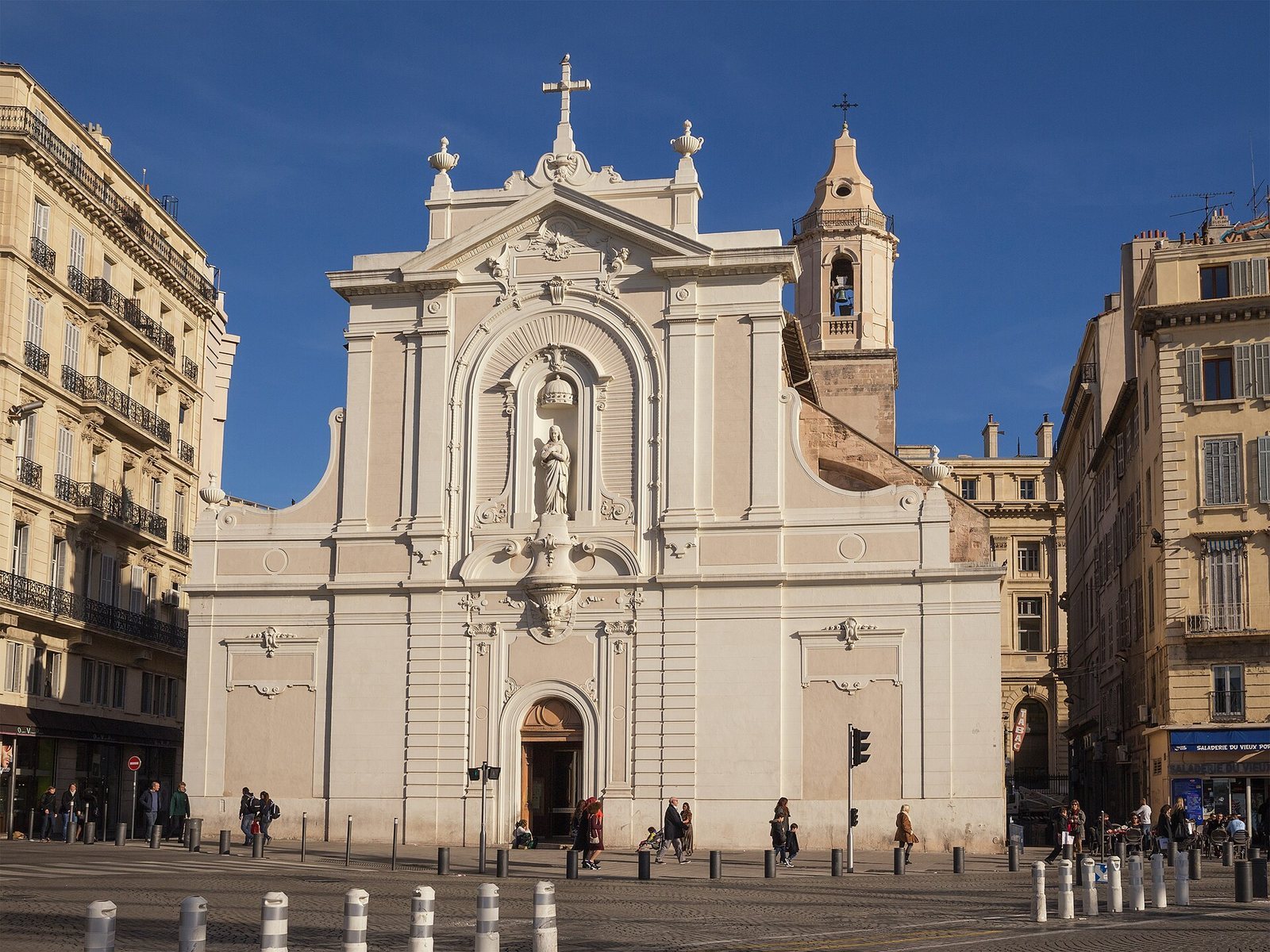
In 1840, a proposal to build a customs house on the site threatened the church. Construction of Rue Impériale, now Rue de la République, also endangered it. The street works shook the building but cleared structures at the foot of the new road, opening the church façade toward the port. The façade was rebuilt in 1874 and given a cement facing in 1875.
The church was listed as a historic monument in 2024. Since September 2017, the Archbishop of Marseille has entrusted it to the Jesuits, members of the Society of Jesus. It remains a Roman Catholic church within the Archdiocese of Marseille.
Remains
Layout and exterior
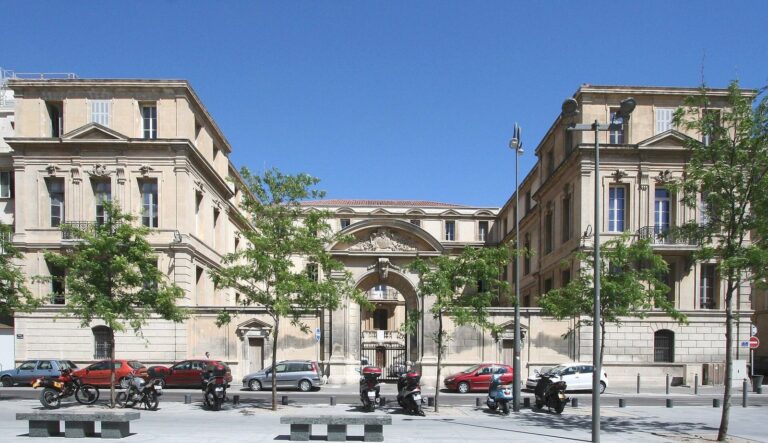
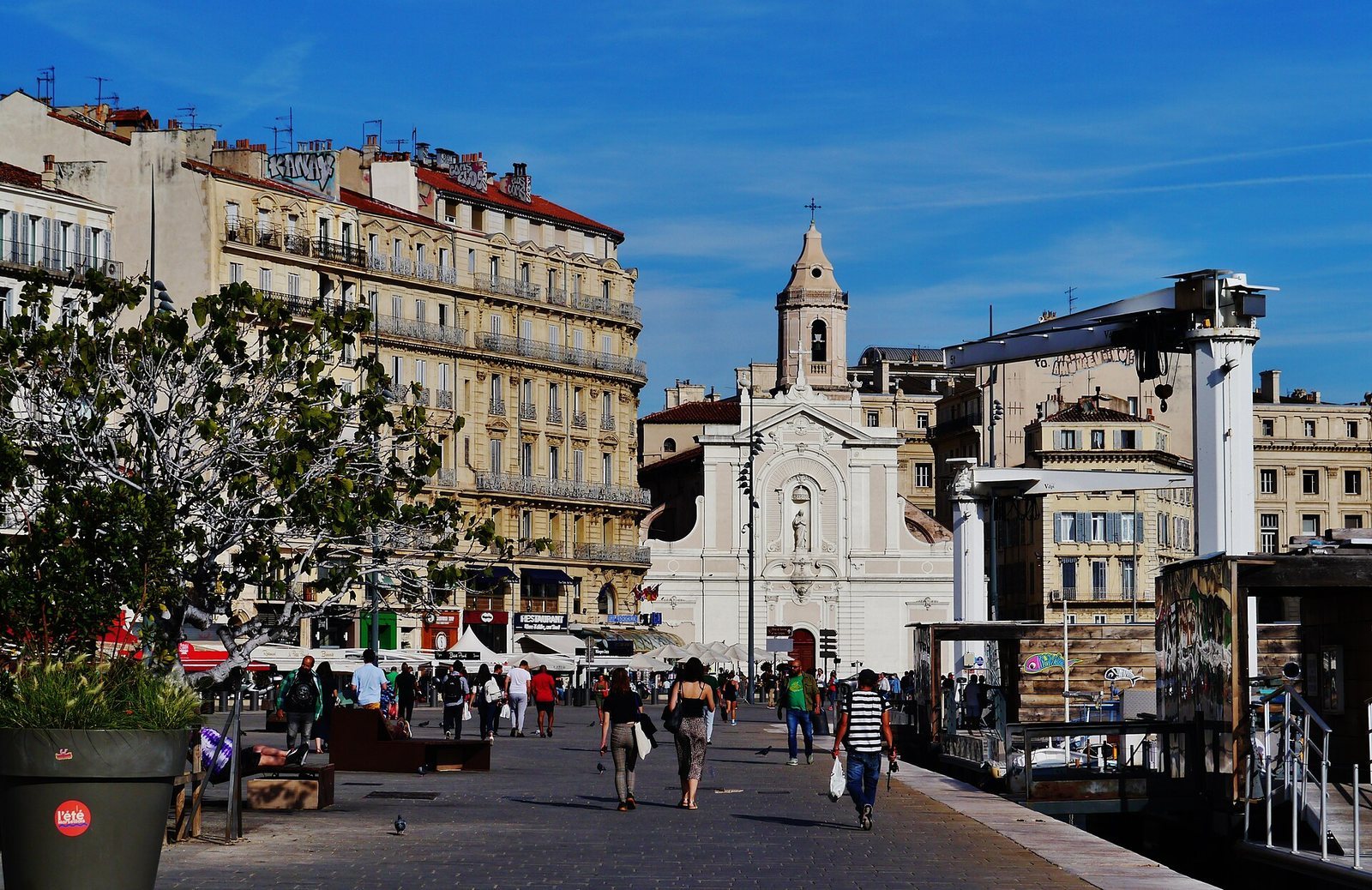
The church stands on Quai des Belges in Marseille’s Old Port area, between Rue du Beausset, Rue de la Reine Élisabeth, and Rue des Augustins. Its central nave is flanked by six side chapels, three on each side. The present façade is neoclassical, drawing on Greek and Roman forms, and has a cement surface. Before the fifth section was removed, the main entrance was on the north side and faced the former Rue des Augustins, which turned at a right angle before reaching it. That former street is now Rue du Beausset; the present Rue des Augustins lies south of the church.
The building occupies ground near Plan Fourmiguier, once used for shipyards and later for the galley arsenal. Alluvium and unstable fill underlie the site, which lies within a former horn of the harbor that silted up during the Middle Ages. The harbor’s former extremity can be seen in the Jardin des Vestiges.
Side chapels and memorials
First chapel on the left
A block of black marble in this chapel once supported the Montolieu family mausoleum, dated to 1695. The chapel’s altar for the porters has an altarpiece, an artwork associated with an altar, painted by Michel Serre. It shows Saints Peter and Paul appealing to the Virgin Mary under her title Our Lady of Graces, with Peter on the left and Paul on the right.
Second chapel on the left
This chapel contains the Vincent and de Candolle family tombs. Cleaning the walls in 1978 revealed flat-backed burial niches and two coats of arms carved in relief. One shield is divided into gold and blue quarters; the other combines the de Candolle and Vincent family arms.
Third chapel on the left
The remains of the Mazenod family tomb, dated to 1564, lie beneath an altarpiece in the style associated with the reign of Louis XIII. The chapel also holds a reliquary, a container for sacred remains, of Saint Louis of Anjou, the medieval Franciscan bishop also known as Louis of Toulouse. An eighteenth-century wooden bust with a gilded surface depicts Saint Ferréol, venerated as a third-century Christian martyr. Michel Serre’s painting of Saint Margaret is also kept here. Saint Ferréol’s relics were taken to Spain in 1423, returned to Marseille in 1956, and stolen in 1993.
First chapel on the right
A baptismal font in this chapel has a raised figure of an angel at its center.
Second chapel on the right
The chapel contains Louis Botinelly’s statue of Joan of Arc and Élie-Jean Vézien’s statue of Saint Thérèse of the Child Jesus.
Third chapel on the right
Michel Serre’s painting of the Rest during the Flight into Egypt came from a chapel in the Oratory house. It belonged to a group of three paintings on the childhood of Jesus. The chapel also holds a statue of the Holy Family by Yves Le Pape.
Other furnishings
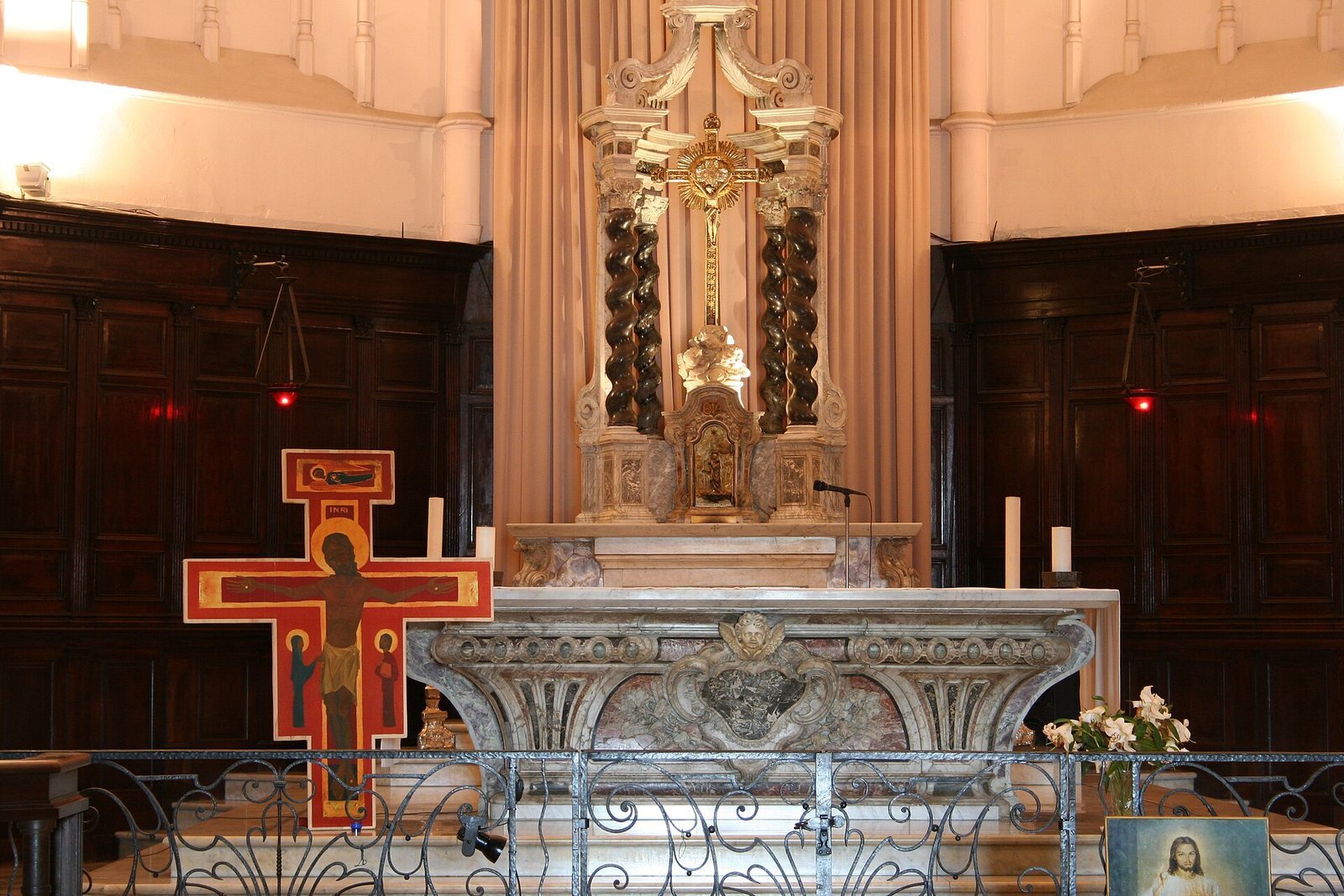
The carved wooden pulpit dates to the seventeenth century and came from the former church of Saint-Hommebon, once on the site now occupied by the Alcazar. Dominique Fossaty designed the high altar and the altars of the Augustinians and porters. Other features include a statue of Saint Augustine and an ivory crucifix.
Grand organ
Augustin Zeiger’s grand organ was installed above the entrance in 1844. This neo-Gothic gallery instrument revives Gothic forms and has two hand keyboards, each with 54 notes, a 30-note foot-operated keyboard, and 23 stops, controls that select sets of pipes to shape the sound. Changes in 1911 and 1953 altered its mechanism, keyboard range, console, and stops. Silent since 1985, the organ was restored to its original state and inaugurated on 12 February 2015. It is functional and maintained.