Tell Qaramel: An Early Settlement in Syria
Site at a Glance
- Popularity
- Very High
- Country
- Syria
- Primary era
- Stone Age
- Eras represented
- Stone Age
- Civilizations
- Unclassified
- Site type
- Settlement
On this page17 sections
History
Tell Qaramel is an archaeological settlement in Syria whose earliest activity dates to the twelfth millennium BCE, during the Epipaleolithic, a period between the Paleolithic and Neolithic in parts of the Near East. Its stone buildings provide evidence of permanent settlement before farming and animal domestication, practices once thought to mark the beginning of settled life.
Early occupation and the first towers
The oldest activity identified in the southern excavations belongs to the regional Epipaleolithic. Archaeologists distinguish this early phase as Horizon 0, followed by four early Neolithic layers, Horizons 1–4. A horizon is an archaeological label for a phase or layer. The earliest tower phase is dated broadly from the eleventh millennium BCE to about 9670 BCE.
On the current radiocarbon chronology, Tell Qaramel’s earliest structures predate Göbekli Tepe, a prehistoric site in southeastern Turkey. The earliest tower is also dated roughly two millennia before Jericho’s stone tower, which had previously been regarded as the oldest known tower.
Chronology and changing interpretations
Radiocarbon results indicate that some Neolithic layers overlapped in time. The sequence remains difficult to date precisely: several of 57 charcoal samples analyzed at the GADAM laboratory in Gliwice, Poland, were rejected because their dates conflicted with the order of the deposits and structures. Some very early results also appear earlier than dates for comparable cultural phases elsewhere, while comparisons between laboratories produced differences in both directions.
Archaeologists have argued that settlement at Tell Qaramel developed continuously, challenging a strict division between Pre-Pottery Neolithic A and B. They use “Early Aceramic Neolithic” for the Proto-Neolithic, early communities in transition toward Neolithic ways of life, and Pre-Pottery Neolithic A (PPNA). Aceramic means “without pottery.” “Late Aceramic Neolithic” groups Pre-Pottery Neolithic B (PPNB) and C (PPNC).
Later occupation and excavation
A survey in the late 1970s identified occupation extending from early Neolithic phases into the Hellenistic period, the era of Greek cultural influence that followed Alexander the Great’s conquests. The survey also revealed that activity in later periods was closely associated with the tell mound, while the earlier settlement covered a broader area.
At its greatest extent, the settlement may have supported about 1,000 people. Detailed investigation of its Neolithic remains began in 1999, with a Polish-Syrian team led by archaeologists Ryszard F. Mazurowski and Youssef Kanjou. The team investigated six areas and excavated four, together covering about 1.5 percent of the site. Work was suspended after 2011 because of the Syrian civil war.
Remains
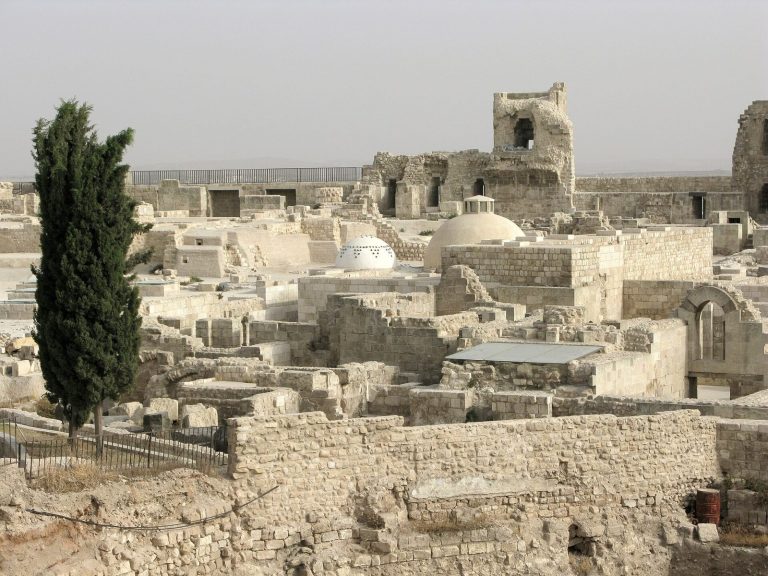
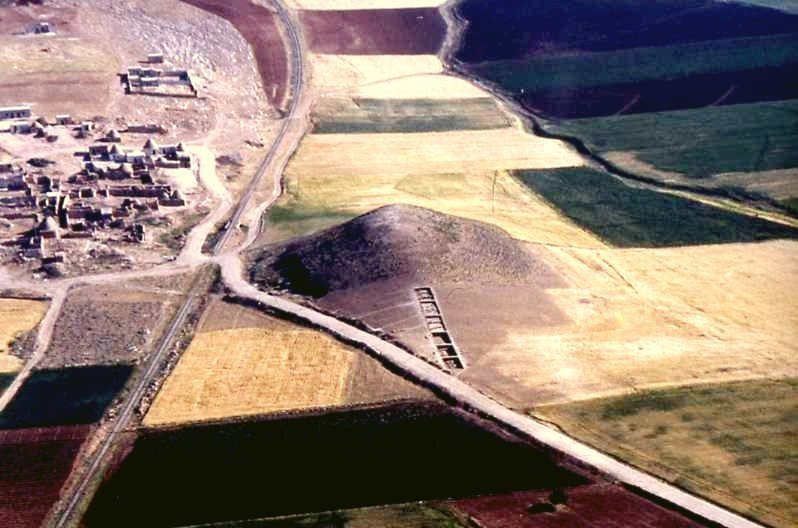
The site combines a tell mound with a lower Neolithic settlement area to its south. Excavations have revealed round stone structures, round and oval houses, open hearths, and storage pits. The remains lie in a fertile river valley that served as an important trade route.
Setting and settlement layout
The tell lies between the present-day village and the Queiq River to the east, and its summit reaches 444 metres above sea level. The Neolithic settlement extends south of the mound across about 3.5 hectares, roughly 20 metres below the summit. The site measures approximately 190 by 160 metres. Later Bronze and Iron Age deposits cover parts of the Neolithic area to depths of as much as 2.5 metres, and a railway crosses the Neolithic site between the village and the tell.
Round stone structures
Excavators identified five successive round stone structures as towers. Their form and construction vary, and some were built over or altered the remains of earlier structures.
Earliest round structure
The oldest measured structure was about 5–6 metres in diameter, with walls approximately half a metre thick. Its remains include a circular pit lined inside with large pebbles, and a layer of large pebbles may have formed the floor. The structure was leveled when Tower 0 was built.
Tower 0
The third structure in the sequence, called Tower 0, measured more than 5 metres across. Its walls, about 1 metre thick, were made from small pebbles without special foundations. A fired-clay floor rested on a bed of small pebbles. In the southeast corner, a crescent-shaped stone bench was coated with mud; in front of it stood a circular hearth carefully lined with clay and coated inside with white lime. The floor and hearth appear to have been repaired during the building’s use. Its plan and workmanship have led to the suggestion that it served as a gathering place for cult practices as well as, or instead of, a defensive refuge.
Largest tower
The fourth structure was the largest, measuring about 7.5 metres in diameter, with stone walls approximately 2.25 metres thick. It had no internal features. Fire damaged the building, which was subsequently rebuilt; it may have served a defensive purpose.
Houses and shared spaces
Houses
Round and oval houses stood near the towers. Some were sunken into the ground, while others were built above ground.
Hearths and storage pits
Round hearths set within stone surrounds lay in open spaces between houses, and round storage pits were also found. One pit, lined with mud to limit damp, held the burned skeletal remains of an entire aurochs, an extinct type of wild cattle.
Objects and other finds
Tools, vessels, and figurines
Everyday objects made from flint, bone, and stone include millstones, handstones, mortars, pestles, grinders, polishing slabs, axes, needles, miniature cosmetic vessels, and an adze, a cross-bladed tool used for shaping wood. Finds also include decorated chlorite vessels, made from a group of minerals, limestone vessels and bowls, a clay bird figurine, and stone tools for straightening arrow shafts, decorated with geometric designs. Other objects carry depictions of snakes and humans.
Copper and marine finds
A polished copper nugget from Horizon 2 was shaped into a bead measuring 52 × 40 × 26 millimetres. It is among the earliest known metal finds from an archaeological site. Malachite was also recovered, and the copper may have come from the same, unidentified source. An attempt to drill the copper using a method employed for stone beads shows that the available technique was not yet suited to working the metal. Finds also included an octopus, shells, and turtles, although the site lies about 180 kilometres from the Mediterranean.
Burials and human remains
Twenty-three graves from PPNA Horizon 3 contained the remains of 34 people, all adults. Their radiocarbon dates fall between 11,770 and 10,660 calibrated years before 1950. The adult-only group may mean that children were buried elsewhere or received different treatment. Most of the dead had been decapitated, either soon after death or after the body had decomposed. In some cases, the first neck vertebra remained attached to the skull, while in others vertebrae and the lower jaw stayed with the body. These differences suggest more than one timing for head removal, and analysis of two skeletons indicates that stone tools were used in some cases. The practice and its timing are not fully understood. The burials have been interpreted as evidence of a head cult, a ritual focus on human heads also known at other Pre-Pottery Neolithic sites.
Tooth wear and cavities on some skulls are consistent with a grain-based, carbohydrate-rich diet. Better-preserved teeth on other remains may point to a pre-Neolithic diet.