St. Hyacinth’s Church: A Dominican Church in Warsaw
Site at a Glance
- Popularity
- High
- Country
- Poland
- Primary era
- Early Modern
- Eras represented
- Early Modern
- Civilizations
- Polish–Lithuanian Commonwealth
- Site type
- Religious
- Remains
- Church
On this page13 sections
History
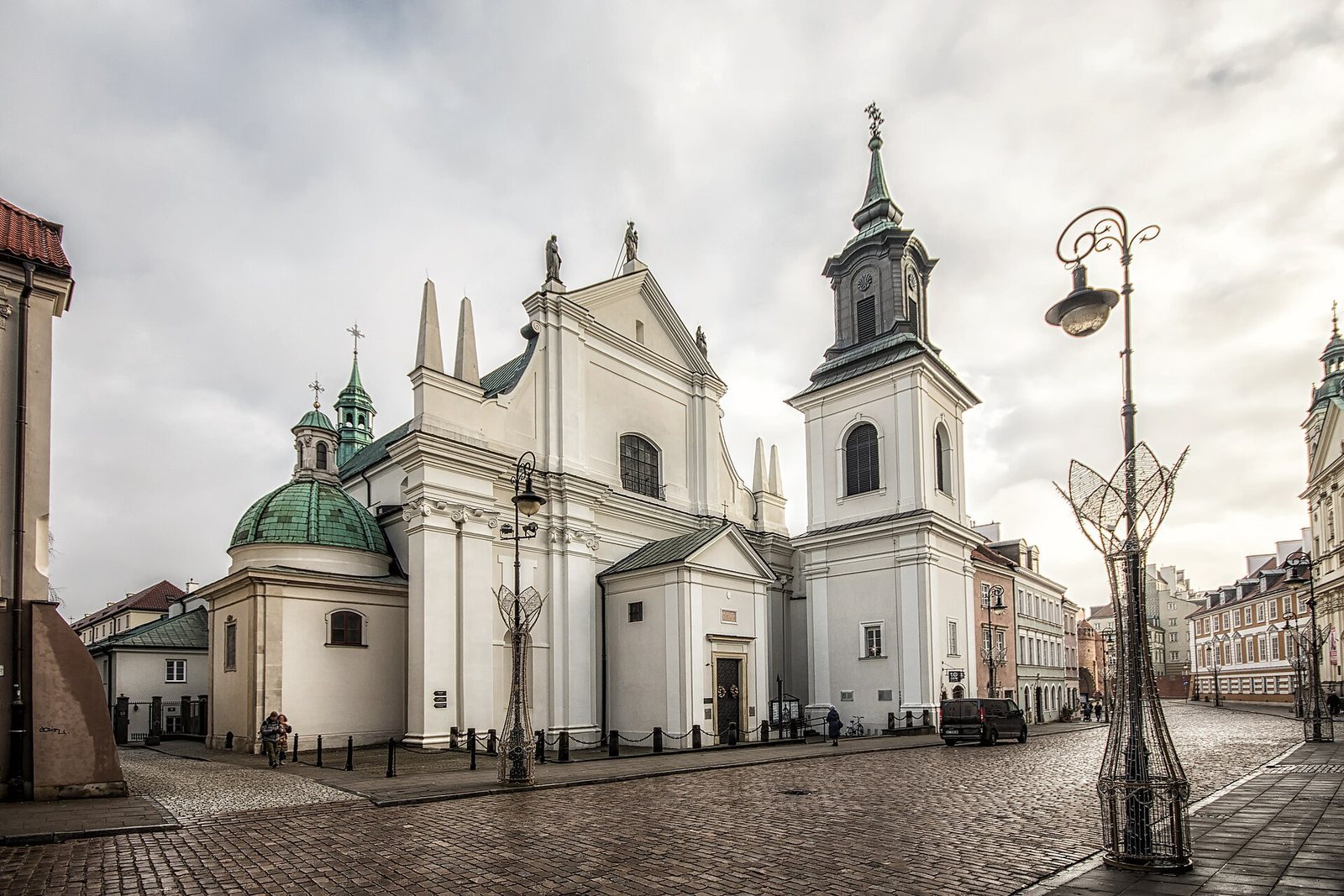
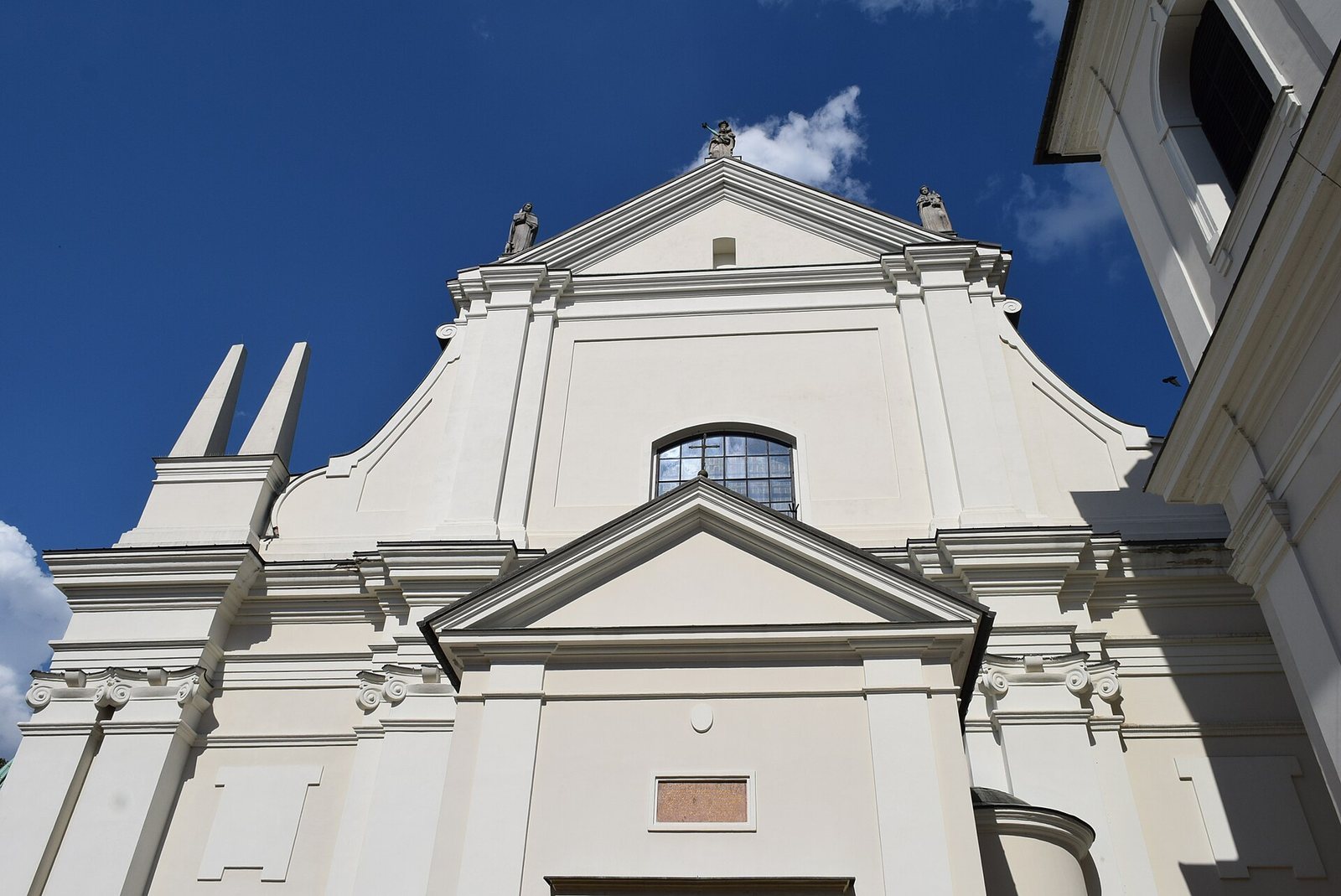
St. Hyacinth’s Church in Warsaw, Poland, is a Roman Catholic church founded by the Dominican Order in 1603. Its design is chiefly early Baroque, a style associated with dramatic ornament, with Renaissance features that revive classical forms and Gothic Revival elements in the apse, the sanctuary end. It was the first church in the world dedicated to St. Hyacinth of Poland, a medieval Dominican friar and saint.
Foundation and construction
In 1603, a Dominican meeting in Poznań resolved to establish a church and monastery in Warsaw and entrusted the work to friar Abraham Bzowski. The Dominicans purchased a courtyard and orchard from physician Wincenty Oczko and his brother Szymon, then acquired additional houses to extend their property to Freta Street. Bishop Wawrzyniec Goślicki authorized construction on August 4, and King Sigismund III Vasa exempted the friars from public burdens. Bzowski established a timber chapel, a residence, and a bell tower; worship began on November 8 using a portable altar.
Warsaw townspeople helped fund the church. A brickworks on land donated by Maciej Pracki near the Vistula supplied building materials and provided income. Mason Jan Włoch managed the works, whose plans drew on St. John’s Church. Goślicki laid the cornerstone on September 22, 1605. The first Mass in the new church took place on October 22, 1606, around the time relics of St. Hyacinth arrived in Warsaw. Royal cook Wojciech Baryczka paid for an altar dedicated to the saint.
Construction began in 1603 and the church was completed by 1639, although finishing work continued. Giovanni Battista Trevano probably designed it. Prior Jacek Baryczka began the brick monastery, planned in a Z shape, with help from his family, and brought the church and monastery works to completion in 1647. Bzowski, who served twice as prior, is regarded as the monastery’s founder.
Chapels were added during and soon after the main construction. Jadwiga Mińska founded the Holy Cross Chapel, also called the Dark Chapel, in 1627. The Royal Musicians established the Chapel of Our Lady of the Snows in 1651.
War, consecration, and Dominican life
In 1655, Swedish and Brandenburg forces captured Warsaw. They ransacked and burned the church, while Swedish troops occupied the monastery. On September 8, Swedish envoys and the Warsaw magistrate negotiated the city’s surrender in the monastery’s great refectory, its communal dining hall. The occupation lasted until July 1, 1656, and caused extensive damage. A tradition links an image of Our Lady of Graces, blessed in February 1651 by papal representative de Torres, to the violence: a Swedish soldier reportedly fired at it, but the bullet rebounded and killed him.
Wojciech Tolibowski, bishop of Poznań, consecrated the church on June 26, 1661. Cholera outbreaks led the Dominicans to leave the complex in 1662 and again in 1677; during the latter epidemic it remained almost empty for nearly two years. In 1690 Adam Kotowski founded the chapel that bears his name, also known as the St. Dominic Chapel.
Jacek Baryczka established a formal course of study in theology and philosophy, named the Baricianum in his honor. It had two theology professors and one philosophy professor. In 1700 it became a studium generale, a higher-learning institution with privileges comparable to those of a university, including the University of Kraków. The monastery flourished during the eighteenth century, and its library was regarded as holding Poland’s richest book collection before the books were later destroyed.
In 1702, before Swedish forces again entered Warsaw during the Great Northern War, a conflict between Sweden and a coalition of northern and eastern European powers, the Dominicans moved valuable objects to Gdańsk. They returned to Warsaw in 1713.
Destruction and rebuilding
During the 1944 Warsaw Uprising, an armed revolt against German occupation, the church and monastery served Polish forces as a field hospital. German bombing struck them repeatedly, killing more than a thousand civilians and insurgents. The church was destroyed that year, although its Gothic Revival façade survived the war.
Rebuilding took place from 1947 to 1959 under Halina Kosmólska and restored an early Baroque appearance. The surviving Gothic Revival façade was demolished during the work. The church and monastery entered Poland’s register of monuments in 1965, and the church received Historic Monument of Poland status in 1994. It remains a Roman Catholic church within the Archdiocese of Warsaw and belongs to the Parish of the Visitation of the Blessed Virgin Mary.
Remains
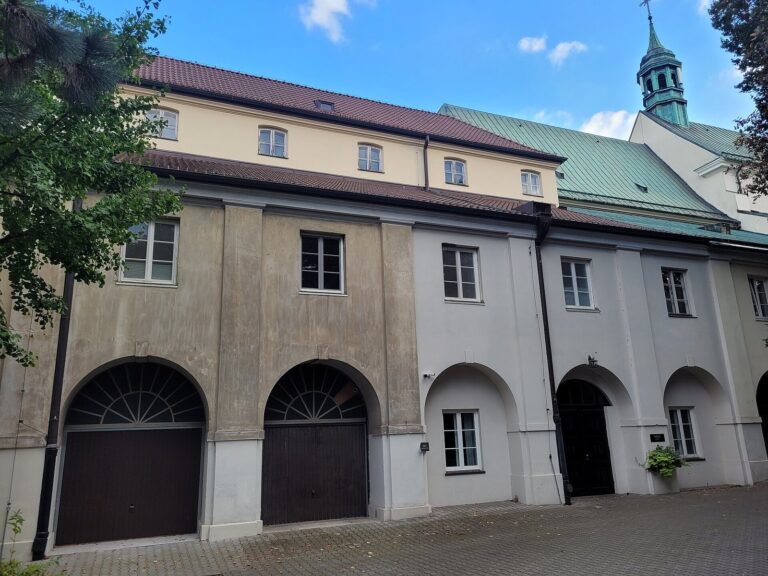
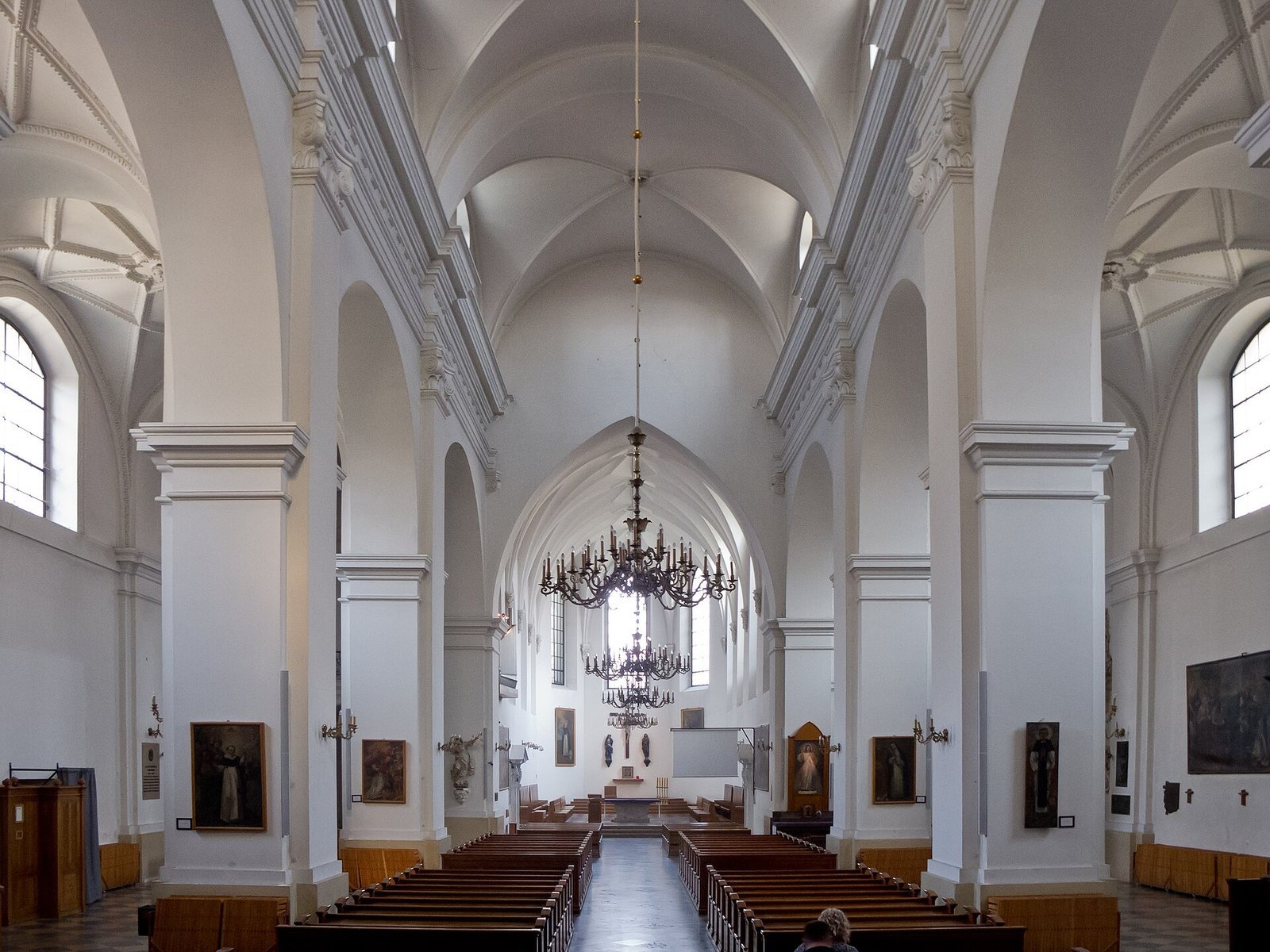
The brick church stands beside the Dominican monastery on Freta Street in Warsaw’s New Town. Its overall design is chiefly early Baroque, with Renaissance features and Gothic Revival arches and vaults in the apse. The monastery follows a Z-shaped plan and includes the great refectory. An early timber chapel, residence, and bell tower formed the first complex; a later bell tower was built beside the church in 1662. The interior is largely modern, since few of the original furnishings survived.
Chapels and interior furnishings
Early chapels
The complex included the Holy Cross Chapel, also known as the Dark Chapel, and the Chapel of Our Lady of the Snows. These chapels were established during the church’s construction and in the years shortly afterward.
Kotowski Chapel
Founded by Adam Kotowski in 1690, the chapel was built between 1691 and 1694. Tylman van Gameren designed it, and Józef Szymon Bellotti carried out the work. Restored during the postwar rebuilding, it has abundant stucco, or decorative plasterwork, a black-marble altar, and a portal. The chapel became the home of a venerated image of Our Lady of the Rosary, brought from Czortków and also known as the image of Our Lady of Czortków.
The chapel also contains an eighteenth-century wooden Ecce Homo statue by Antoni Osiński. Its title means “Behold the man” and refers to Christ shown before his crucifixion. The statue was brought from the Dominican church in Lviv.
Memorials and tombs
Tomb of Katarzyna Ossolińska
The 1607 tomb of Katarzyna Ossolińska, née Kosińska, is in the Mannerist style, a late Renaissance approach marked by deliberate artifice and complexity. It has been only partly reconstructed.
Tomb of Anna Tarnowska
Made around 1616 from brown Chęciny marble, Anna Tarnowska’s tomb depicts her in a sleeping pose characteristic of Polish funerary art.
Memorial to Regina Sroczyńska
A black-marble epitaph, an inscription commemorating the dead, bears the date 1689 and commemorates Regina Sroczyńska, a wealthy merchant from Kraków. It originally included her portrait on a tin plate.
Memorial to Jakub Minasowicz and his wife
A bronze epitaph from the late seventeenth century, inscribed in Armenian, commemorates Jakub Minasowicz, who died in 1683, and his wife, who died in 1671.