The King’s Church in Studenica: A Serbian-Byzantine Monastery Church
Site at a Glance
- Popularity
- Medium
- Country
- Serbia
- Primary era
- Medieval
- Eras represented
- Medieval
- Civilizations
- Serbian
- Site type
- Religious
- Remains
- Church
On this page9 sections
History
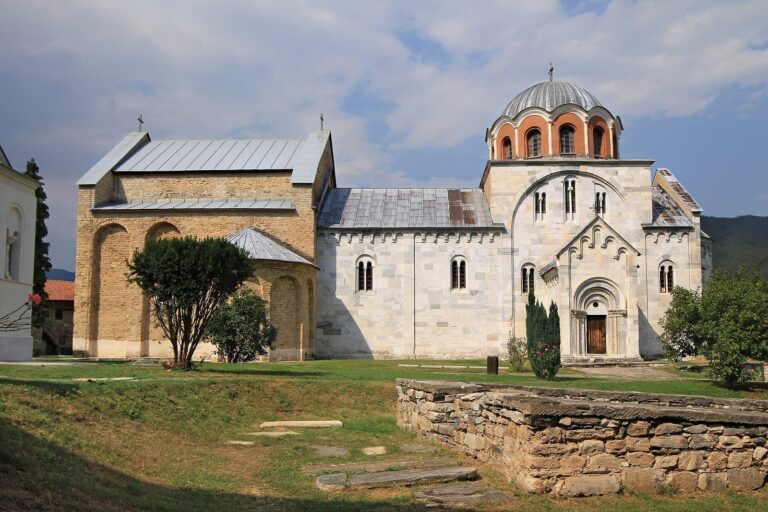
The King’s Church in Studenica is a Serbian-Byzantine church built within Studenica Monastery in Serbia in 1314 by King Milutin (Stefan Uroš). Dedicated to Saints Joachim and Anne, traditionally regarded as the parents of Mary, it is called the King’s Church because Milutin was its patron. Its design belongs to the Palaiologan period, a revival of Byzantine art and culture associated with the Palaiologan dynasty. Milutin reigned from 1282 to 1321.
A carved inscription names Milutin as the builder and presents his ancestry, identifying him as the great-grandson of Saint Simeon, the monastic name of Stefan Nemanja, the grandson of Stefan the First-Crowned, and the son of King Uroš. It describes Milutin as king of the Serbian and coastal lands and says his donations to the church were recorded in chrysobulls, formal charters issued under an imperial gold seal. The inscription also threatens a curse against anyone who alters the church. Abbot John supervised construction. The inscription identifies him as an archimandrite, a senior monastic cleric, and a protosyncellus, a senior church official who could serve as a bishop’s deputy.
The church’s frescoes were painted in 1314 by Milutin’s court painters Michael and Eutychios, led by Michael Astrapas, an artist from Thessaloniki.
Remains
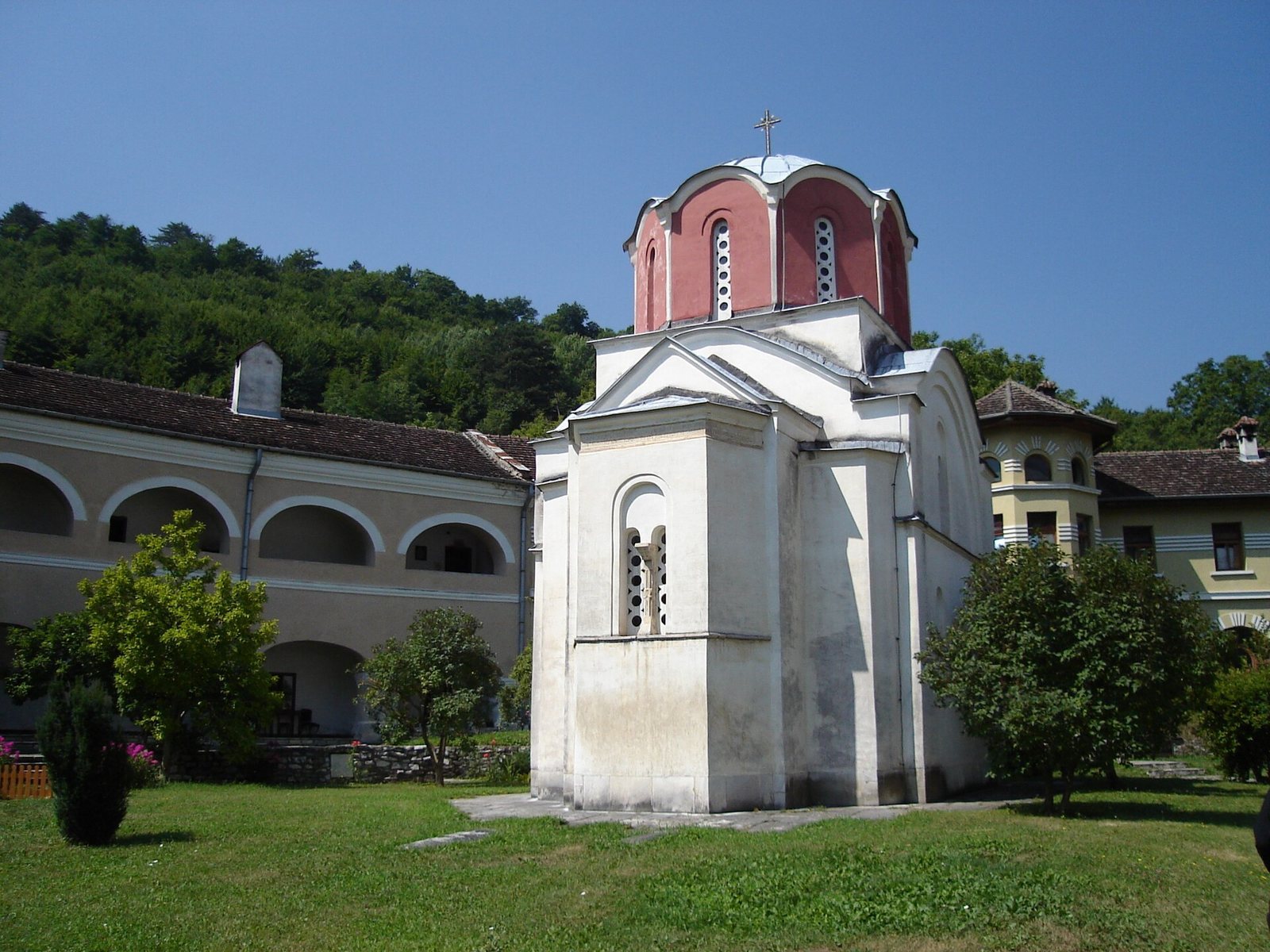
The church has a compact cross-shaped plan enclosed within a square footprint. Its cubic body carries a single dome, while three apses, projecting rounded spaces, extend from the east end. The middle apse is larger than the two flanking it.
Architecture and exterior
Plan and construction
Rubble stone and tufa, a porous calcareous stone, form the building. The exterior walls are plastered and painted white, while the dome is left outside this treatment. Lines cut into the plaster create the appearance of marble blockwork, echoing the exterior decoration of Studenica’s main church, dedicated to the Virgin Mary.
Dome and façades
The building’s exterior rises in stages toward the dome, with gables on each side of its base. The dome stands on a raised base above the cross-shaped body. Its drum, the structure beneath a dome, is circular inside and octagonal outside; small columns divide its tall exterior, with narrow, high windows between them. Projecting horizontal cornices divide the north and south façades into two levels. Each lower level has two simple, rounded windows. Above them, recessed decorative arches without openings frame paired windows. A carved inscription naming the founder sits on the east façade below the roof cornice.
Frescoes
The frescoes cover the walls and dome and remain largely preserved, retaining their original appearance without later repainting. Their consistent style is regarded as a major achievement of fourteenth-century Serbian art and a high point of the Palaiologan Renaissance.
Scenes across the church
The painted program places major Christian feasts, from the Annunciation, the announcement to Mary that she would bear Jesus, to the Dormition, the Virgin Mary’s death, in the upper parts of the church and its vaults. Scenes from Mary’s life occupy the middle zone, with individual saints below. At the crown of the dome, Christ Pantocrator, an image of Christ as ruler of all, appears from the waist up.
Altar area and dome
The eastern vault before the altar shows the Ascension. In the altar area, images of the liturgy, the church’s formal Eucharistic service, and the Communion of the Apostles appear in the lower composition, alongside individual deacons and senior church clerics. The highest part of the apse depicts the Virgin enthroned with Christ and surrounded by angels. Old Testament prophets occupy the dome’s drum, while the ancestors of Christ, beginning with Adam and Eve, appear around its base. Two images above the pendentives, curved supports that carry a dome over a square space, show Christ in forms traditionally regarded as not made by human hands. The pendentives themselves contain the four Evangelists.
Rulers and saints
In the lower zone, Milutin holds a model of the church and appears with Queen Simonida and his ancestors Saint Simeon and Saint Sava, who became the first archbishop of the Serbian Church. Other images include Joachim and Anne, the Virgin with Christ, selected warrior saints, and Emperor Constantine with his mother, Empress Helena. Both Constantine and Helena are venerated as saints in Eastern Christianity.