Merthen Manor: A Historic House and Estate
Site at a Glance
- Popularity
- Medium
- Country
- United Kingdom
- Primary era
- Early Modern
- Eras represented
- Early Modern, Modern
- Civilizations
- British, English
- Site type
- Domestic
- Remains
- Manor House
On this page7 sections
History
Merthen Manor is a historic manor house and estate in the United Kingdom, associated with the Reskymer and Vyvyan families. Its name is also rendered in Cornish as Merdhin, meaning “sea fort.”
Land and the Reskymers
Merthen’s land once belonged to the manor of Winnianton. In 1225, Henry III, king of England from 1216 to 1272, granted Winnianton to his brother Richard, 1st Earl of Cornwall, a noble with a high-ranking hereditary title. Richard later exchanged it with Gervase de Tintagel for Tintagel Castle.
Ralph Reskymer acquired Merthen in the early fifteenth century, and the manor became a seat of his family. John Leland, a sixteenth-century English antiquary and travel writer, described the manor house as ruinous and its park as fair. A chart from the mid-sixteenth century shows Merthen among woodland, marked as Reskymer and depicted with four towers.
The house and its later owners
The present manor house is thought to have been built in 1575 by John Reskymer and his wife, Grace. Its date may be earlier: the Reskymer arms above the entrance could indicate that an existing house was remodelled or reduced rather than replaced.
Grace died in 1627, ten years after her husband. In 1629 the manor was sold to Sir Francis Vyvyan of Trelowarren, and it remained in the Vyvyan family thereafter.
Later changes and recognition
The house was remodelled in the early nineteenth century, and its interior was renovated in the twentieth. Merthen’s medieval deer park was later disparked; two rectangular enclosures on the estate were still known as the deer parks in the twentieth century.
The manor house received Grade II* listing in 1957, a high-level designation in England for buildings of particular importance. In 1972, Merthen Woods and the Helford River shoreline were designated a Site of Special Scientific Interest, a legally protected area recognized for natural features such as wildlife.
Remains
The manor house
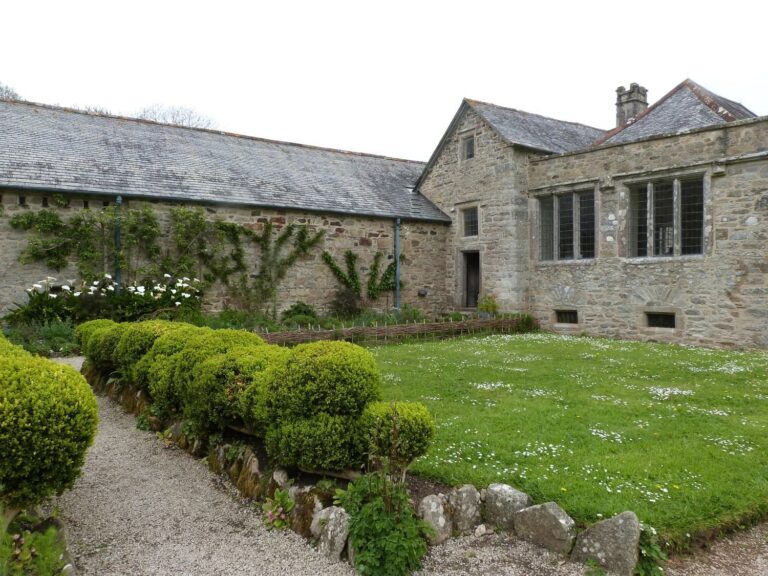
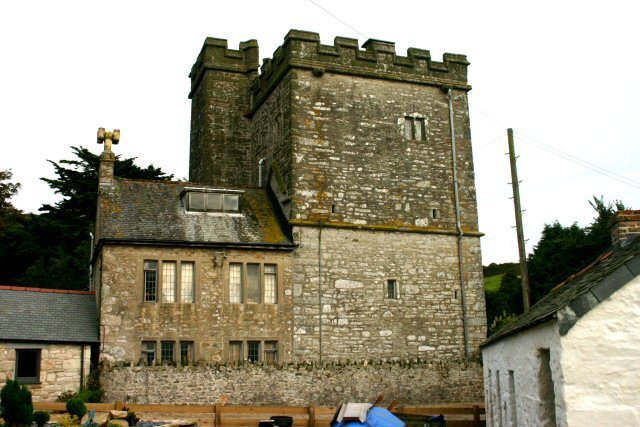
The house stands within more than 100 acres (40 hectares) of woodland. Its north front has a two-storey porch and numerous windows divided into separate sections by upright stone or timber supports. Above the entrance is the Reskymer family coat of arms. Its designs are given either as three red bars and a blue running wolf on silver, or three silver bars and a silver walking wolf, also described as a wild dog, on blue. The east front dates to the nineteenth century.
Woodland estate
Merthen Woods covers 72.2 hectares (178 acres), including woodland south of the house along the Helford River banks and shoreline. Sessile oak (Quercus petraea) is characteristic of the woods. Other plants include bastard balm (Melittis melissophyllum), nationally uncommon, and the nationally rare mosses Fissidens curnowii and Hookeria lucens. The woodland along the Helford River is the only place in Britain where the rare weevil Anchonidium unguiculare occurs, and the area supports Britain’s largest population of it. Two rectangular enclosures also lie on the estate.