Abbey of Monte Oliveto Maggiore: Olivetan Benedictine Monastery
Site at a Glance
- Rating
- 4.7
- Popularity
- Very High
- Country
- Italy
- Primary era
- Medieval
- Eras represented
- Medieval, Early Modern
- Civilizations
- Grand Duchy of Tuscany, Republic of Siena
- Site type
- Religious
- Remains
- Fortified Monastery
On this page22 sections
History
Hermit community and foundation
The Abbey of Monte Oliveto Maggiore is an Olivetan Benedictine monastery in Italy, whose construction began in 1320 after a hermit community formed there in 1313. The community’s church was originally designed in Italian Gothic forms. That earlier development began when the Sienese nobleman Bernardo Tolomei withdrew to his family estate, the Deserto di Accona, with Ambrogio Piccolomini, Patrizio Patrizi, and other companions. They sought a hermit’s life away from Siena, and their community became the foundation of both the monastery and the Olivetan Benedictine congregation.
In 1319, Guido Tarlati, bishop of Arezzo, approved the foundation and placed the monks under the Benedictine Rule, the code organizing their communal religious life. Pope Clement VI confirmed the congregation in 1344, and Monte Oliveto Maggiore became its motherhouse. The Olivetans established monasteries across Italy; by the mid-seventeenth century, six were in Tuscany. Members of the congregation devoted particular attention to the arts in service of the liturgy.
Jurisdiction and later history
In 1765, Pope Clement XIII made Monte Oliveto Maggiore an abbey nullius dioecesis, exempt from the ordinary authority of a diocesan bishop. The abbey did not then have a territory or dependent parishes, but the abbot’s authority covered the church, monastery, and people living there, including monks, affiliated lay members called oblates, and lay servants. An eighteenth-century manuscript, the Libro Nullius, recorded the abbot’s exercise of this local jurisdiction.
In 1809, the Olivetan order was suppressed, and the library’s original collection was dispersed. The collection now held at the abbey came from the suppressed Olivetan monastery of Santa Maria di Monte Morcino Nuovo near Perugia. The abbey church is recognized as an Italian national monument.
Wartime refuge and territorial abbey
After German forces occupied Italy and the Italian Social Republic was established in September 1943, the abbey sheltered people resisting conscription, political and military refugees, and two Jewish families from Siena. When the monastery was searched, a few weeks before the front passed through, the monks’ protection and an emergency plan helped shield those being sought. It was the monastery’s only search during this period.
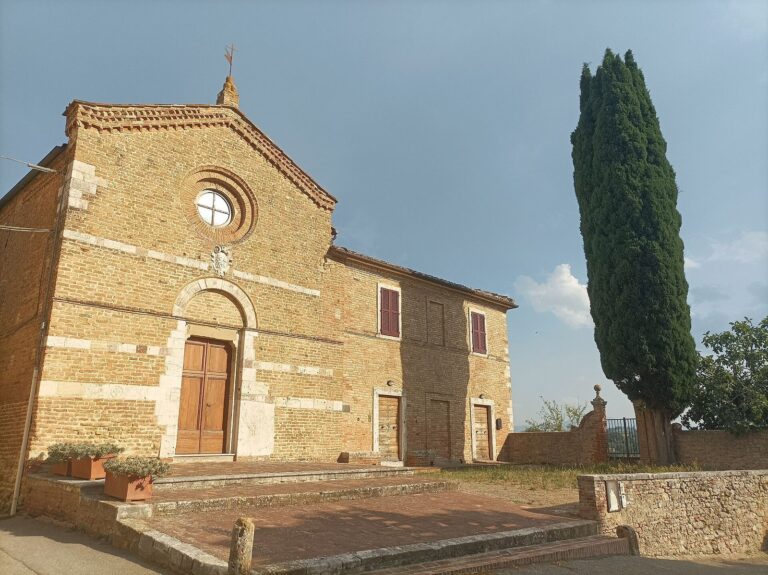
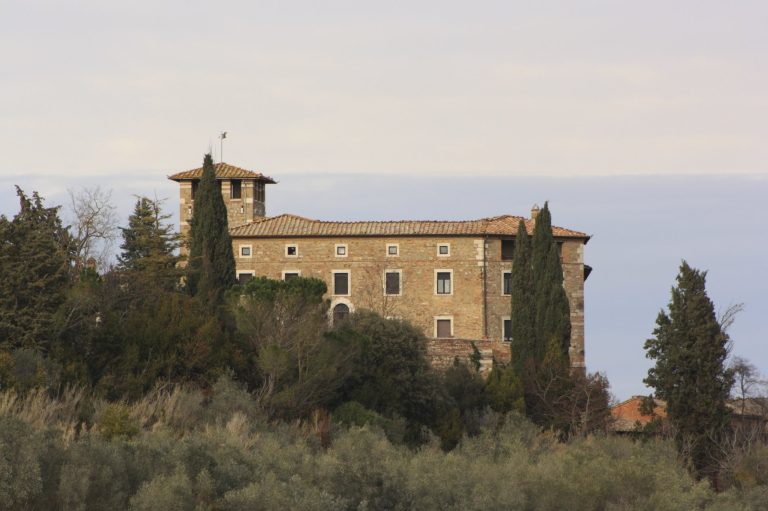
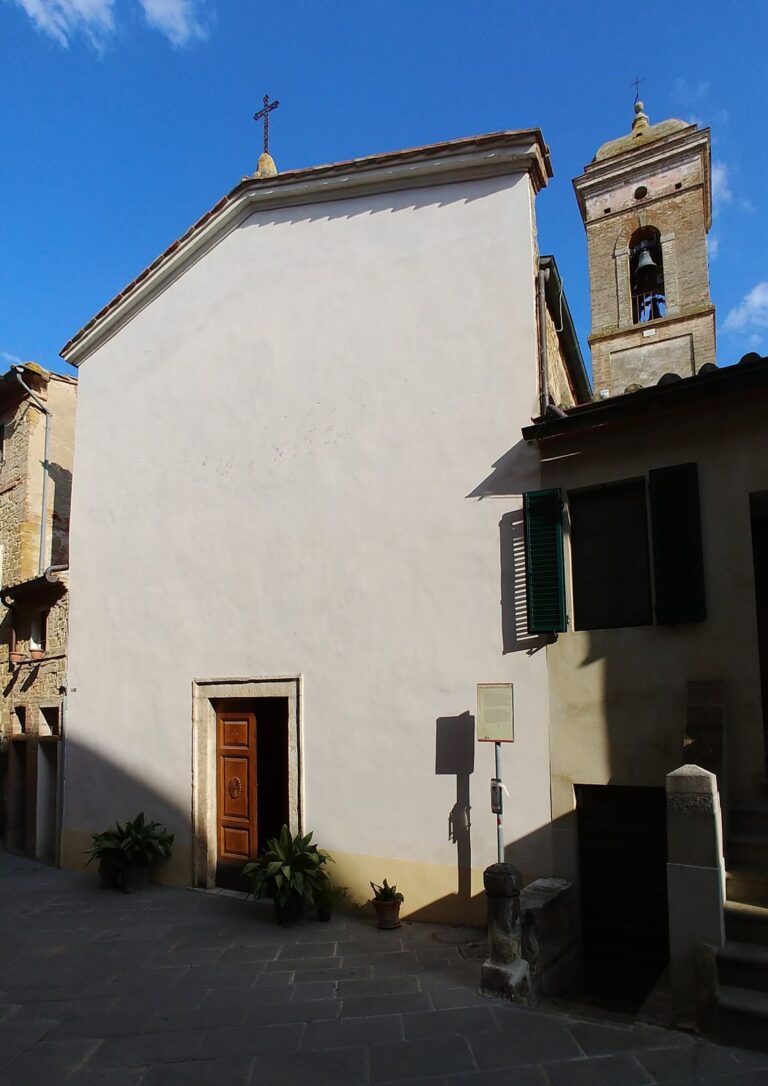
Rural parishes were attached to the abbey in 1947, 1963, and 1975. Pope Pius XII established a chapter of canons in the abbey church in 1953 through the bull Nullus hominum ignorat. The territorial abbey is directly subject to the Holy See, the central governing authority of the Catholic Church, and belongs to Tuscany’s ecclesiastical region. Its four parishes in the municipality of Asciano are the Church of the Nativity of Mary at Monte Oliveto, San Florenzo at Vescona, San Giovanni Battista at Pievina, and San Michele Arcangelo at Chiusure.
Remains
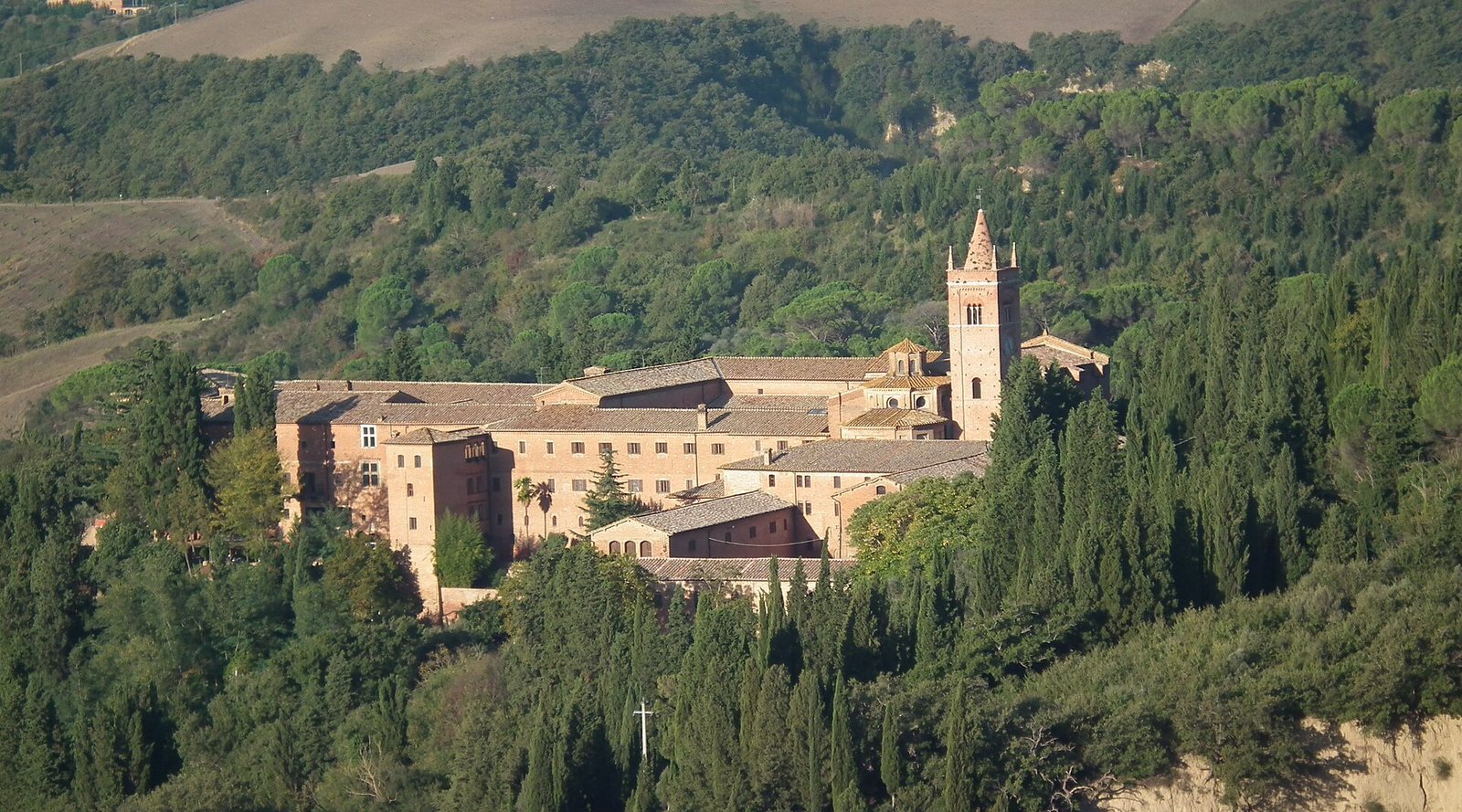
The monastery stands on elevated ground overlooking the Crete Senesi, a landscape of clay hills, amid cypresses, oaks, and pines. Its approach runs from a fortified brick gateway along a cypress avenue toward the church. Cloisters and monastic rooms form the principal architectural groups, with the abbey church attached to the Great Cloister.
Gateway and approach
Fortified entrance
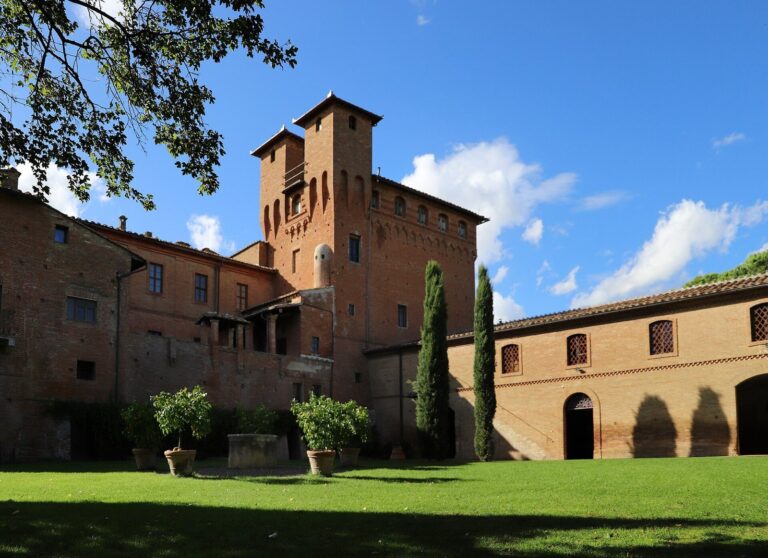
The medieval entrance is a red-brick building reached by a drawbridge and crowned by a massive square tower. Projecting defensive works and battlements reinforce its appearance as a fortified gateway. Construction began in 1393 and was completed in 1526; the building was restored in the nineteenth century. Above the entrance arch, an enamelled terracotta shows the Madonna and Child with two angels and is attributed to the Della Robbia family. A nearby terracotta depicts Saint Benedict giving a blessing.
Cypress avenue and chapels
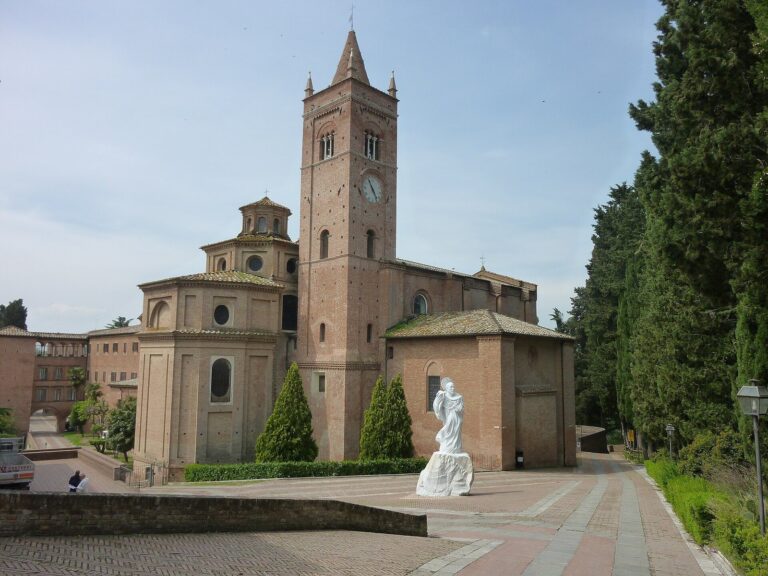
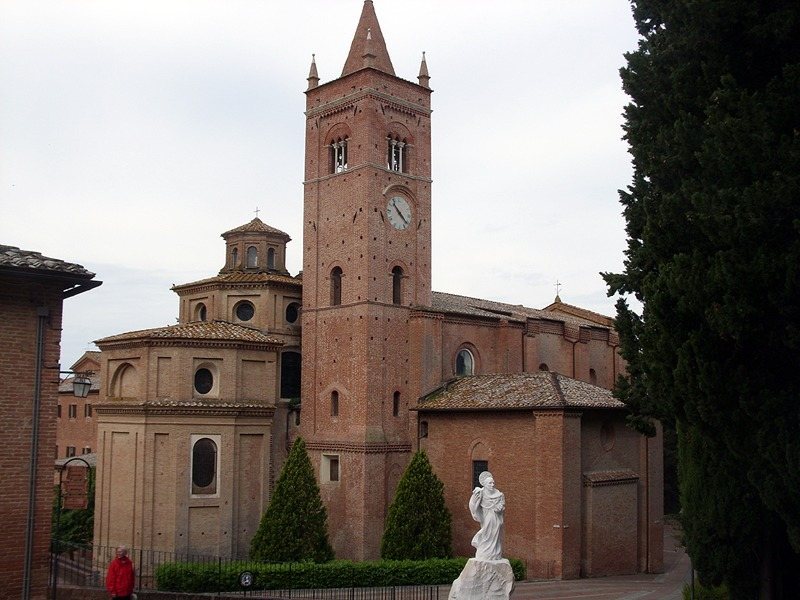
A long avenue of cypresses leads toward the church. Along it are a botanical garden associated with the monastery’s former pharmacy, a fishpond dating to 1533, and chapels dedicated to Our Lady of Onigo, Saint Benedict, Saint Bernardo Tolomei, the Holy Cross, Saint Frances of Rome, and Saint Scholastica. At the avenue’s end stand the Romanesque-Gothic bell tower and the church’s late Gothic apse, its curved end. A statue of Saint Bernardo Tolomei by Massimo Lippi was placed in the apse area in 2009.
Cloisters
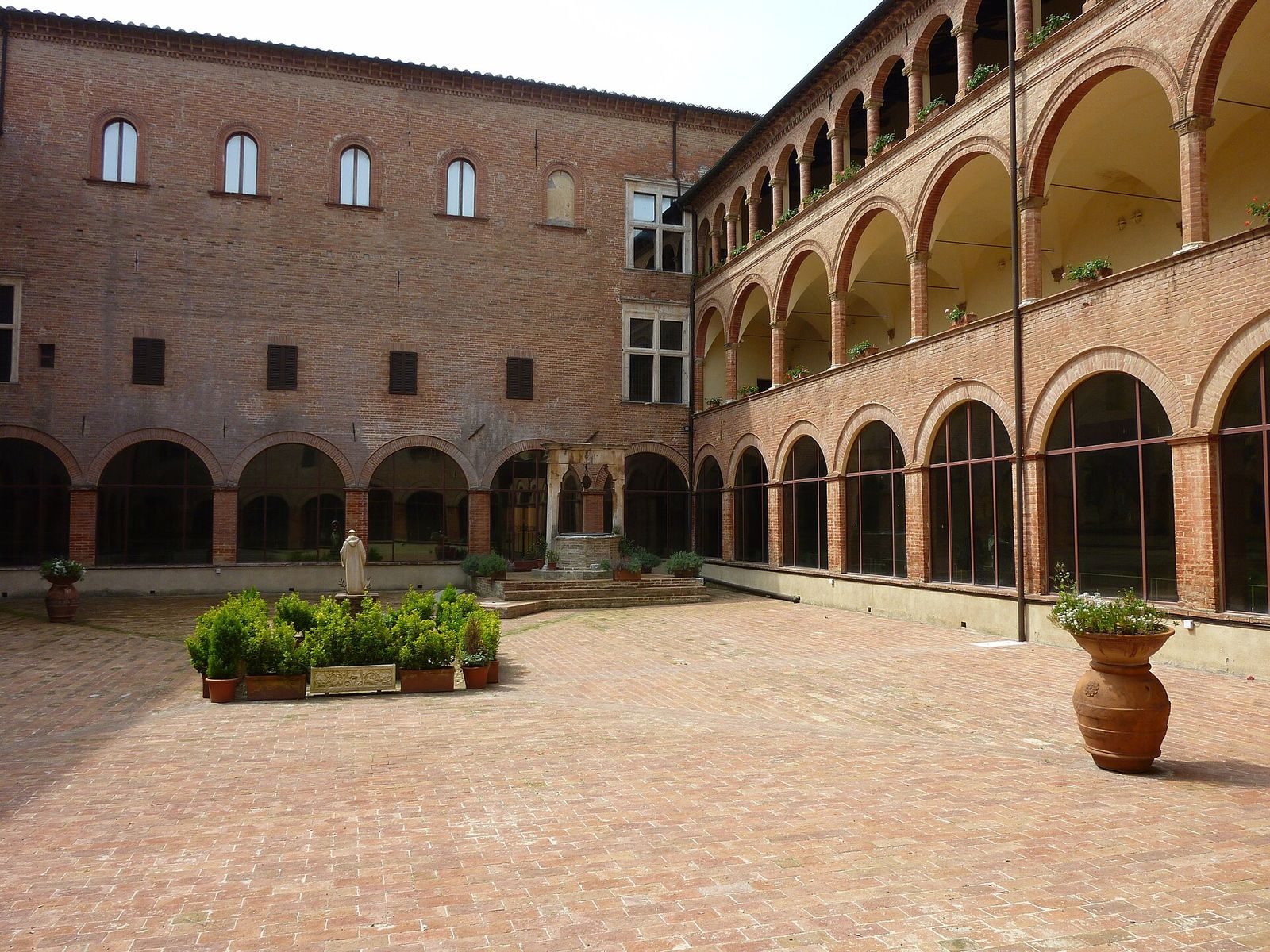
Chiostro Grande, the Great Cloister
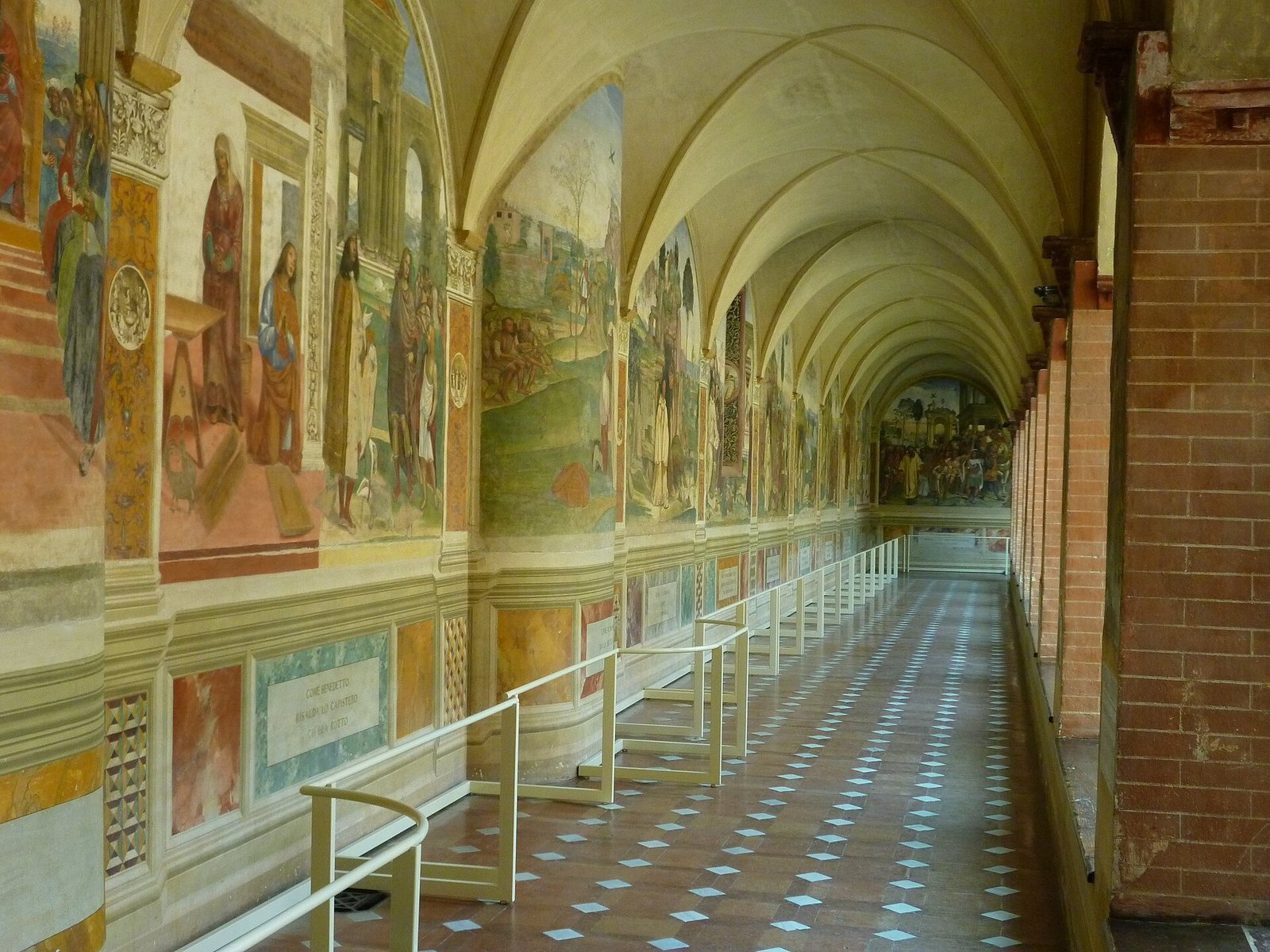
The rectangular Great Cloister was built between 1426 and 1443. A marble statue of Saint Benedict stands at its centre, near a marble wellhead made in 1439. Along the oldest side, two levels of open gallery have round arches supported by brick columns with stone capitals, the shaped tops of the columns. Frescoes covering the walls of all four ground-floor galleries depict the Stories of Saint Benedict. Luca Signorelli painted eight in 1497–98; Antonio Bazzi, known as Il Sodoma, began the remaining work in 1505.
Chiostro di Mezzo, the Middle Cloister
The fifteenth-century Middle Cloister lies partly beyond the monastery’s enclosure. Its covered walkway has round arches resting on octagonal pillars, and a fifteenth-century painting of the Madonna and Child with angels hangs above the entrance. In the adjoining atrium, a sixteenth-century washbasin stands near a fresco by Riccio that was transferred from the Paradiso, the abbey church’s former crypt. That underground space has since been extensively altered.
Abbey church
Church and interior
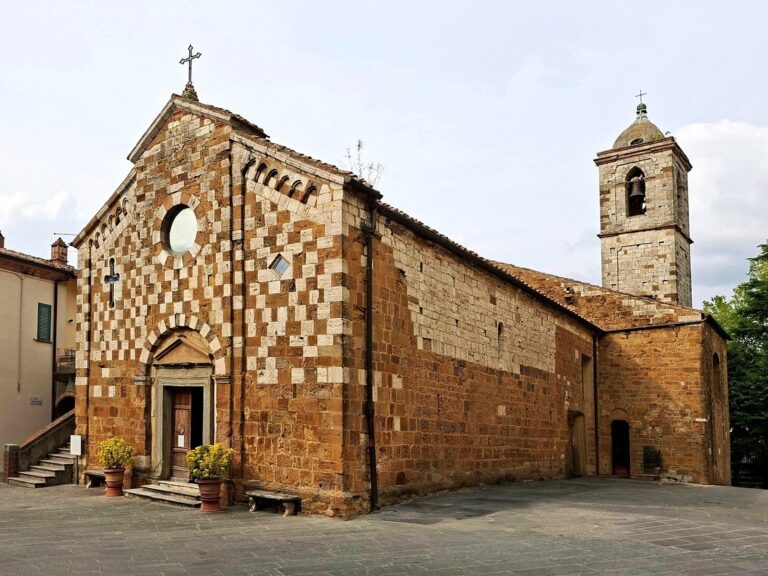
The church was built between 1400 and 1417 and consecrated in 1417. It stands beside the abbey buildings, joined to the Great Cloister. Its plan forms a Latin cross, with a nave, transept, the crosswise arms of the church, and apse. The original design included polychrome frescoes along the nave walls and in the apse. In 1772, Giovanni Antinori renovated the church in Baroque forms, shaping its light-filled interior.
Passage and atrium
A passage from the Great Cloister into the church contains two frescoes by Il Sodoma, one showing Jesus carrying the cross and the other Jesus at the column. The same painter depicted Saint Benedict giving his Rule to the founders of Monte Oliveto. The atrium occupies the site of an earlier church dating to 1319. Its walls bear frescoes of the Desert Fathers, early Christian ascetics associated especially with the deserts of Egypt, and the Miracle of Saint Benedict. Painted in 1440 by an unidentified artist of the Sienese school, these works share the space with a sculptural group by Fra Giovanni da Verona of the enthroned Madonna and Child.
Choir, chapel, and sacristy
Fra Giovanni da Verona made the church’s carved and inlaid wooden choir between 1503 and 1505, creating an important European example of decorative wood inlay. Other works include a lectern by Fra Raffaele da Brescia and two canvases by Jacopo Ligozzi: the Assumption and a Nativity of Mary dated 1598, placed behind the high altar. The transept opens into the Chapel of the Blessed Sacrament, which contains a colored wooden crucifix from the first half of the fourteenth century. The sacristy, a room for preparing church services, has an inlaid wooden ceiling dated 1417.
Monastic rooms and collections
Refectory
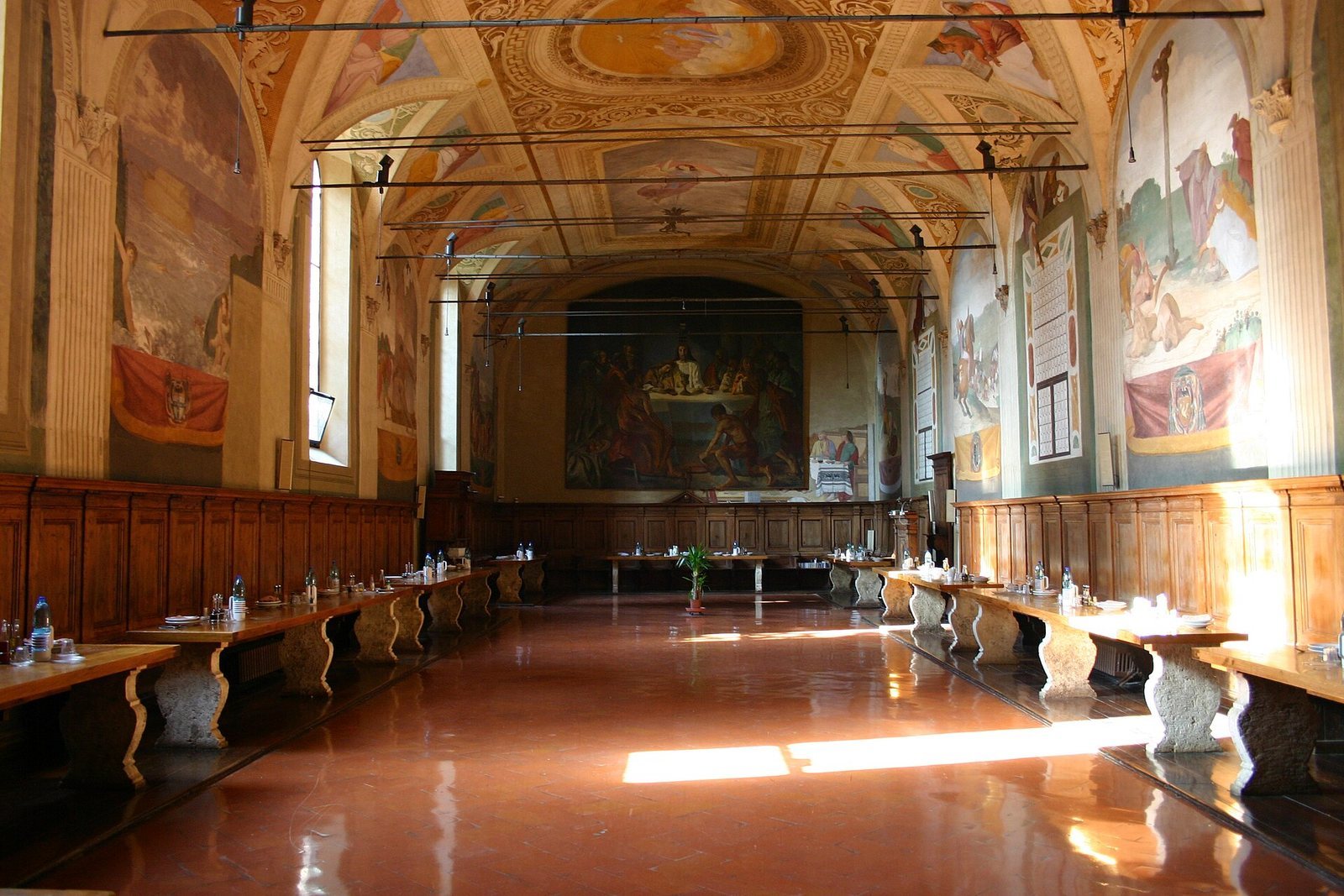
Built in 1387–90, the refectory is a single large room with a low barrel vault, a curved ceiling extending lengthwise, and lunettes, curved sections where the vault meets the wall. Large rectangular windows light the left-hand wall. Fra Paolo Novelli painted the frescoes on the walls and ceiling in 1670. A canvas of the Last Supper by Lino Dinetto, dated 1948, hangs on the end wall.
Library
Abbot Francesco Ringhieri commissioned the library in 1515, and Fra Giovanni da Verona designed it as a long room divided into three aisles. A barrel vault covers the central aisle, while the two side aisles have groin vaults, formed where two curved ceilings intersect. The supporting columns lean toward a wall to carry their load, because the refectory below has no columns. Fra Giovanni carved the grey-blue sandstone capitals, the entrance door, and a cabinet for choir books on the rear wall. A wooden candlestick dated 1502 stands in the room. The collection contains 40,000 pamphlets, volumes, and incunabula, books printed before 1501.
Pharmacy
The sixteenth-century pharmacy is reached by a double staircase passing through a large arch. Its medicinal herbs are kept in white-and-blue ceramic jars bearing the Olivetan arms; the jars date to the seventeenth century. Two large carved and gilded icons by an artist of the fifteenth century hang on the side walls. On the rear wall, Giovanni de Maria’s sixteenth-century painting shows the Madonna giving the monastic habit to Saint Bernardo Tolomei.
Chapter room and sacred art
The Definitorio, or chapter room, dates to 1498 and houses a small museum of sacred art. A sixteenth-century fresco by Matteo Ripanda of the Madonna and Child with Saints occupies the rear wall. The collection includes a Madonna and Child by Segna di Bonaventura, the Maestà by the Master of Monteoliveto, Saint Bernardino by Neroccio di Bartolomeo, a Sienese-school fresco of Saint Sebastian, and a Madonna and Child by Vincenzo Tamagni.
Aula del Tribunale, the Tribunal Hall
The Tribunal Hall served the monastery’s internal affairs and the exercise of its jurisdiction. Bartolomeo Neroni, known as Riccio, painted its frescoes around 1535–40. The ceiling has fanciful human, animal, and plant motifs on a white ground, alongside small panels with allegories and virtues. At the far end, an altar bears Riccio’s fresco of Christ and the Adulteress.
Historical archive
The abbey’s historical archive preserves the eighteenth-century Libro Nullius and the papal bull establishing the abbey’s jurisdictional status.