Jarlshof: A Multi-period Archaeological Settlement in Shetland
Site at a Glance
- Popularity
- High
- Country
- United Kingdom
- Primary era
- Iron Age
- Eras represented
- Bronze Age, Iron Age, Medieval, Early Modern
- Civilizations
- Kingdom of Scotland, Norse, Norwegian
- Site type
- Settlement
- Remains
- Village
On this page16 sections
History
Jarlshof is a multi-period archaeological settlement near the southern tip of Mainland, Shetland, in the United Kingdom. Human activity there reaches back to about 2500 BC, and the sequence of settlement extends through the 17th century AD. Its remains represent successive prehistoric communities, Pictish-period inhabitants, Norse settlers and people living under Scottish rule.
Prehistoric settlement and Roman-era references
Neolithic pottery is the earliest known evidence of activity at Jarlshof, although the main settlement developed in the Bronze Age. A break in occupation separated that phase from later use, and Iron Age inhabitants built over part of the earlier settlement. They constructed a broch, a prehistoric Scottish tower, and later settlement included roundhouses and a wheelhouse complex. The wheelhouses began to develop around 200 BC, with other parts added in later centuries.
Roman writers also described islands understood to be Shetland. In AD 43, Pomponius Mela referred to seven islands called Haemodae; in AD 77, Pliny the Elder used the name Acmodae. Tacitus wrote in AD 98 that a Roman fleet had sighted Thule during a voyage that included the Orkneys. In 1926, William Watson interpreted Thule as southern Shetland, probably the area of the brochs around Jarlshof.
Pictish and Norse periods
Pictish-period activity preceded Norse settlement. Some drawings found in deposits associated with the Viking period have a Pictish style, leaving open whether they were made earlier or reflect continuity in artistic practice. Norse people are believed to have occupied Jarlshof continuously from the 9th to the 14th century. They farmed and fished, with regular deep-water fishing in the later part of their occupation.
Scottish rule and the name Jarlshof
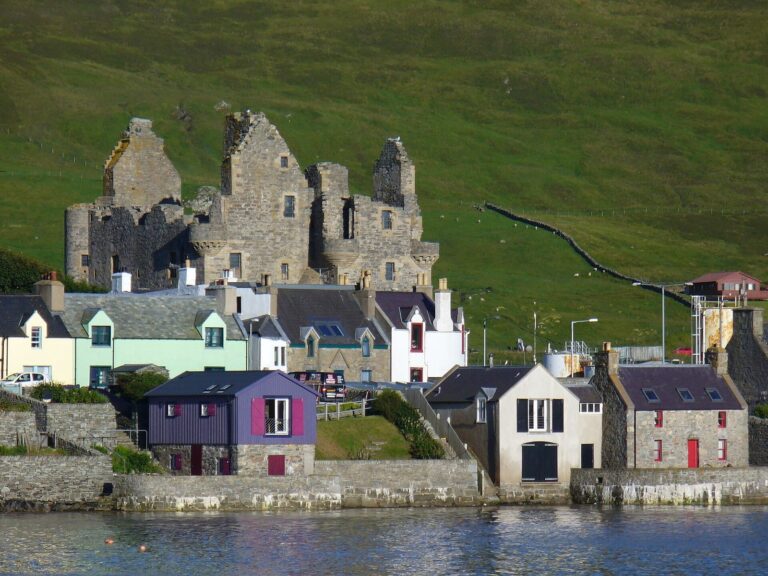
The later Scottish-period building began as a medieval stone farmhouse. After Scotland annexed Shetland, Robert Stewart, 1st Earl of Orkney, converted it into a fortified house in the 16th century and named it New Hall. His son Patrick Stewart, 2nd Earl of Orkney, modernized the house in the early 17th century and renamed it the Old House of Sumburgh. It later passed into the keeping of John Buchanan and Margaret Hartsyde, and was abandoned in the late 17th century.
Walter Scott visited in 1814 and coined the name “Jarlshof,” meaning “Earl’s Mansion,” from a Scottish-period term for a landowner’s house. The name appeared in Scott’s 1821 novel The Pirate, which set a 17th-century story in the Old House of Sumburgh. Later excavations established Norse settlement at the site, but the name does not show that a Norse earl lived there.
Excavation and modern recognition
A storm in the late 19th century stripped away part of the shoreline and exposed buildings that had long been concealed. Formal excavation began in 1925, uncovering Bronze Age remains. Alex Curle’s work in the 1930s revealed the first confirmed Norse longhouse in the British Isles. Excavations from 1949 to 1952, among the first modern scientific investigations at a broch site, clarified the sequence of construction, although earlier digging had disturbed deposits inside the broch. Further work in the 1950s found evidence of fishing and farming. No excavations have taken place since the early 1950s. In 2012, Jarlshof, Mousa and Old Scatness joined the United Kingdom’s tentative list of proposed World Heritage Sites.
Remains
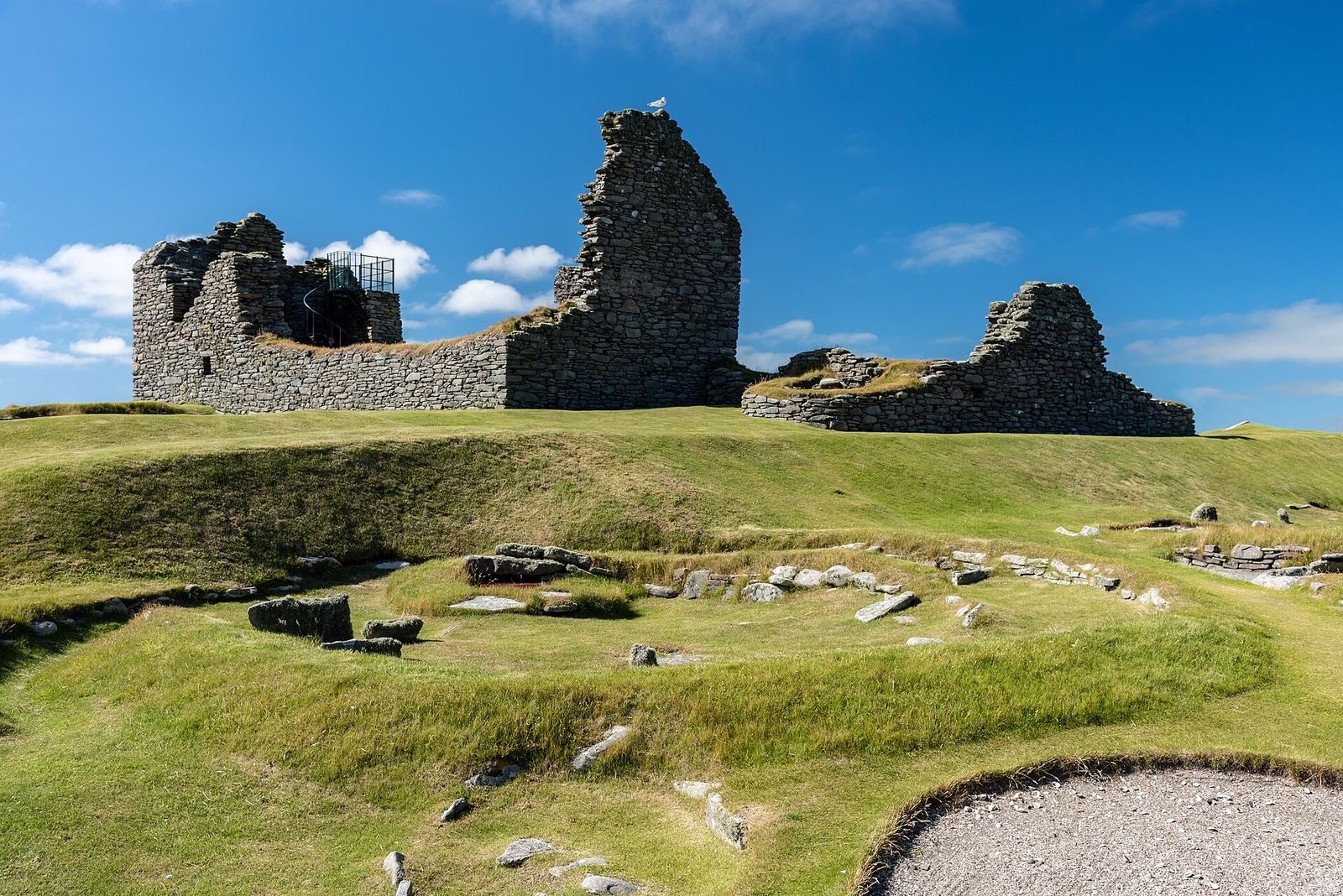
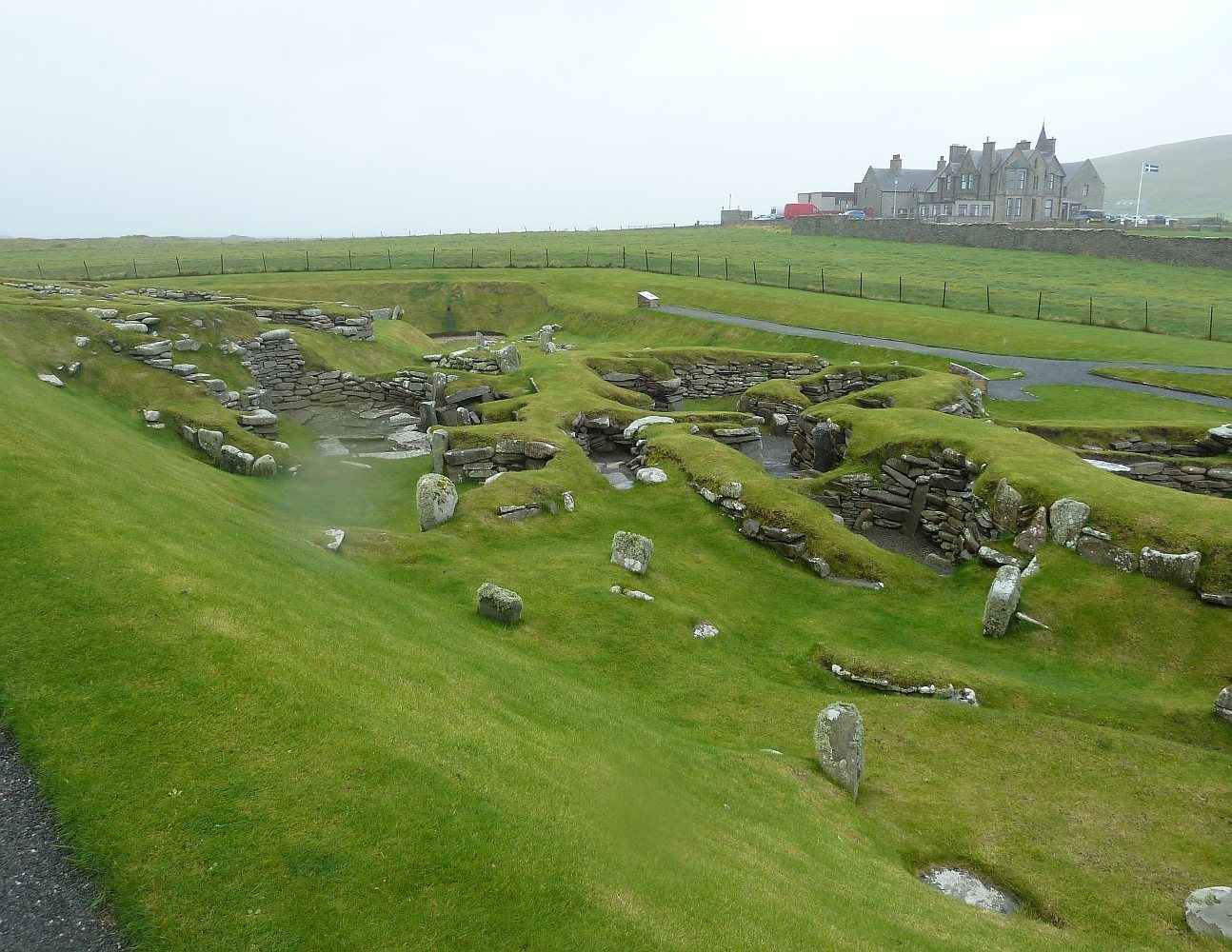
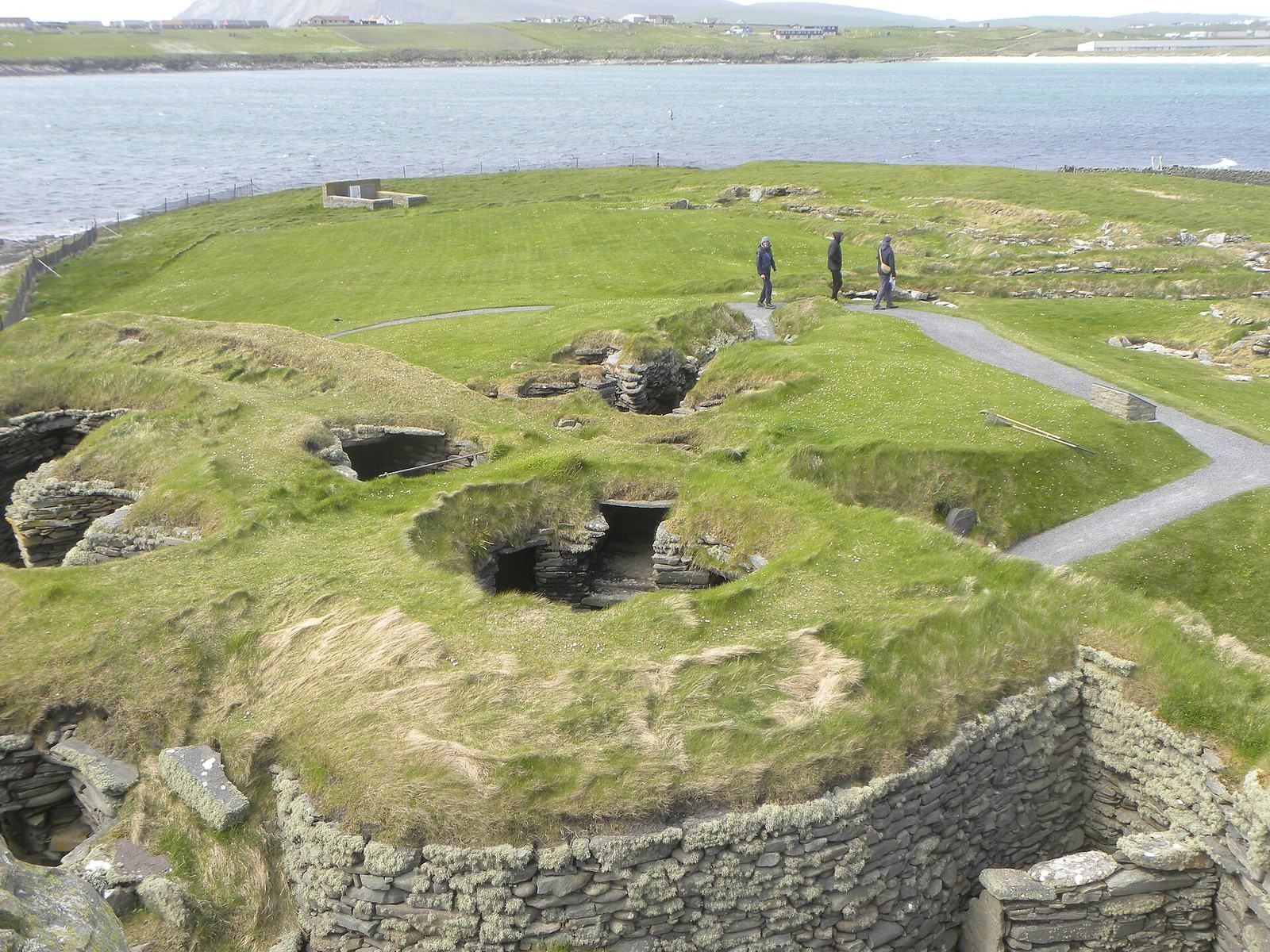
The archaeological remains occupy coastal ground overlooking the West Voe of Sumburgh. Freshwater springs and stone available on the beach helped make the location suitable for settlement; the southern part of Mainland also offered favourable ground for cultivation. The surviving site includes Bronze Age houses and work areas, Iron Age towers and round buildings, Norse houses and outbuildings, and the Scottish-period house.
Bronze Age settlement
Houses and work areas
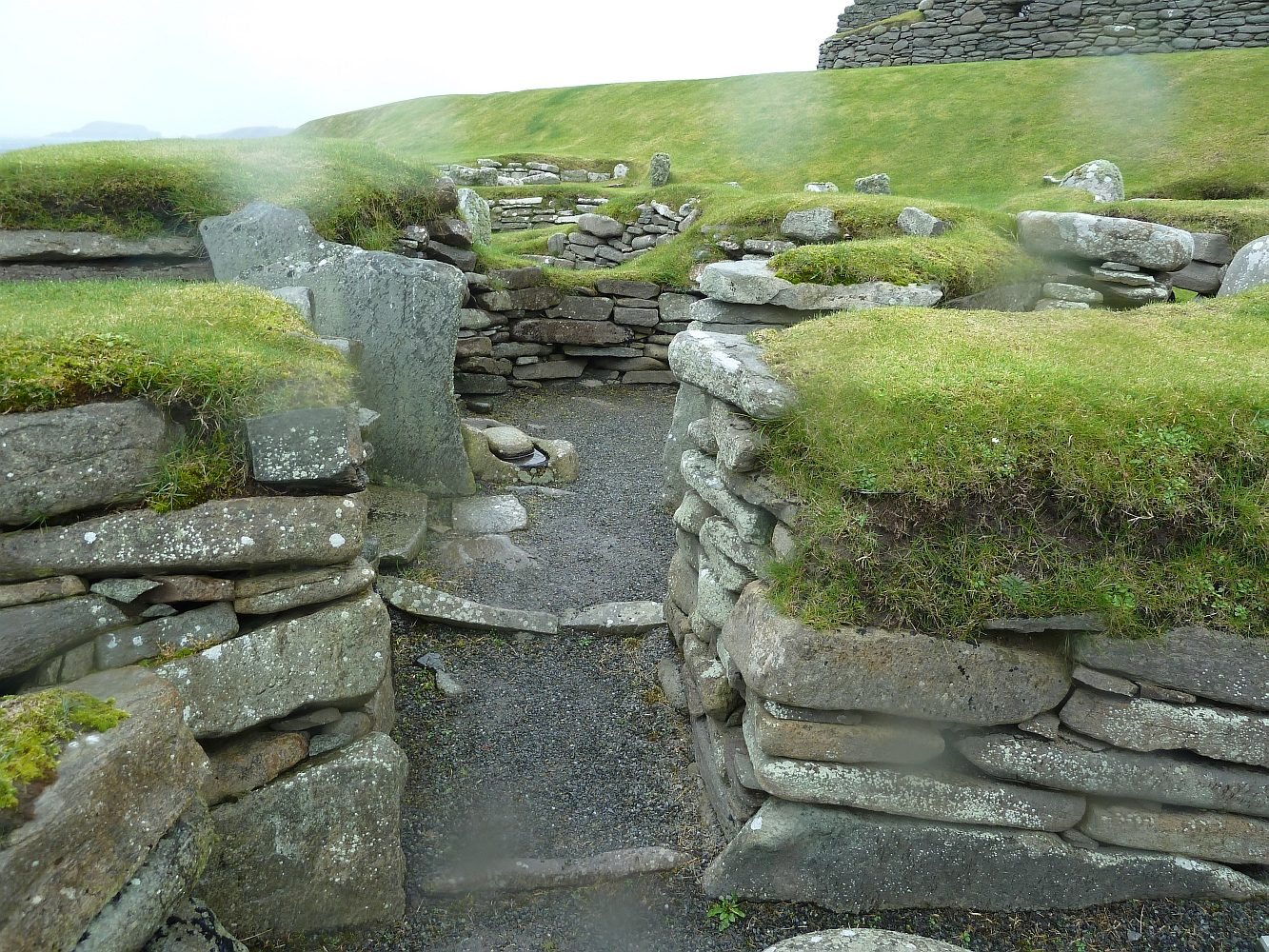
Several small oval houses from the late Bronze Age have thick stone walls. They are later and smaller than the buildings at Skara Brae in Orkney, though the two sites have some architectural similarities. The earliest phase of occupation may have included houses set partly below ground. A layer of sand separates the Bronze Age structures from later settlement.
The Bronze Age work areas include a smithy and a cattle stall. A channel carried waste from the stall to a tank in a courtyard, and a whale vertebra set into a wall may have served to tether animals. Broken moulds show that metalworkers made axes, knives, swords and pins. Finds include a bronze dagger, bone pins and awls; together, the objects point to a smith trained in an Irish style of metalworking.
A decorated bone plaque, five centimetres long, has three holes near its ends and linear patterns. Its purpose is unknown.
Iron Age buildings
Broch and roundhouses
The broch was probably at least 13 metres high. Coastal erosion has removed part of the structure, and sea defences have since been built. Its position gave views across the surrounding sea. An outer defensive wall enclosed a substantial but poorly built house and cattle shed before being reused in the construction of a large roundhouse sheltered by the broch.
A complex roundhouse was later replaced by an aisled roundhouse, a circular building whose internal supports define aisles. Neither has a firm date. Querns, hand-operated stone mills for grinding grain, suggest that the later building may have been constructed before 200 BC.
Wheelhouses
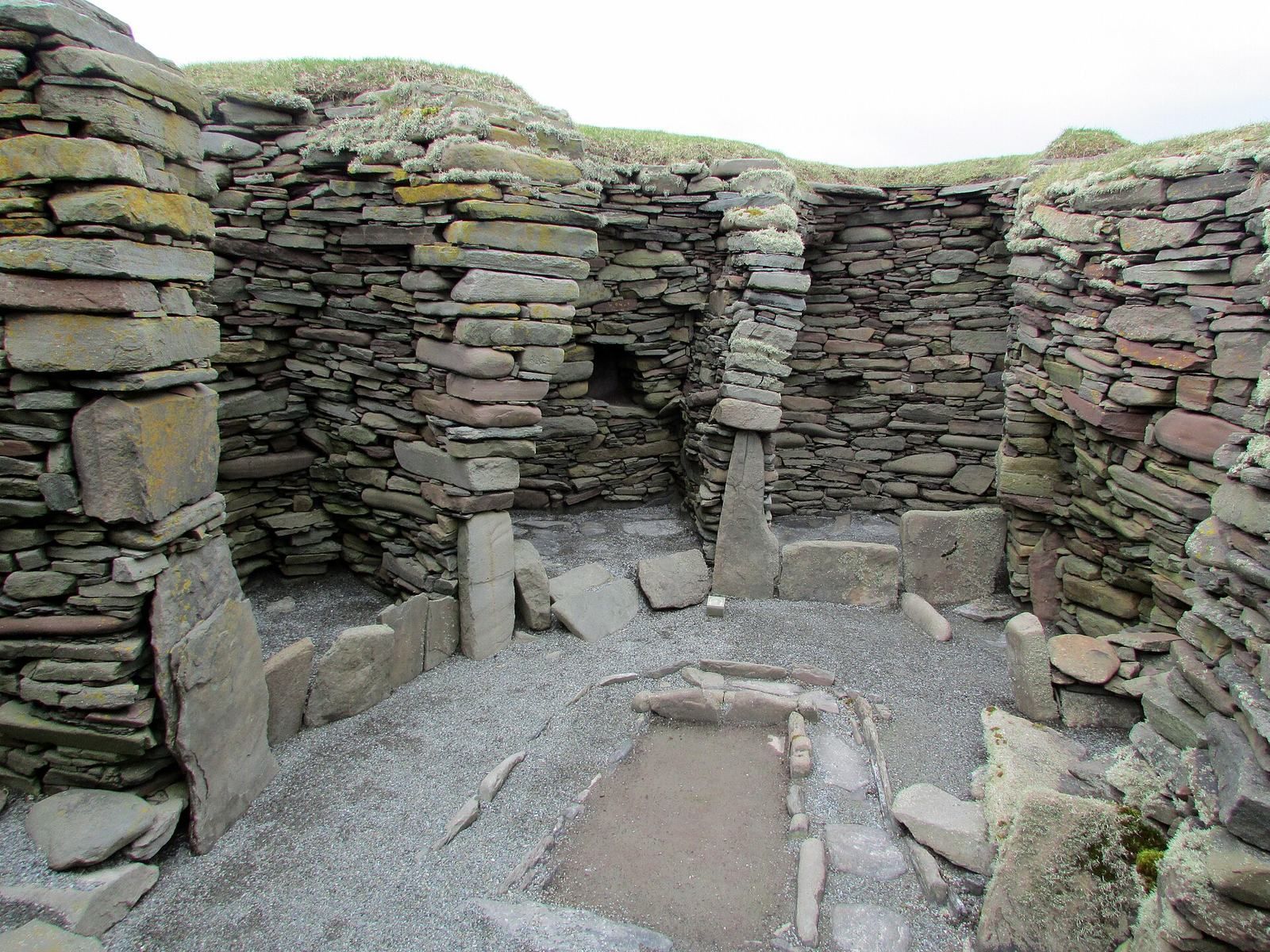
The wheelhouse complex was built using stone taken from the broch. A wheelhouse is a round building with interior supports arranged around its central space. One of the best-preserved structures retains much of its stone roof and a series of bays formed by courses of masonry projecting inward. Another began as a circular building, with supports radiating from the centre added later, perhaps reflecting a less stable early design.
In one wheelhouse, the internal supports alternate between rectangular and V-shaped forms; another has only V-shaped supports, a pattern that may indicate a change in style. Unlike many Scottish wheelhouses, which were built partly into the earth, those at Jarlshof appear to have been raised from ground level.
Pictish-period finds
Finds include a bone pin dated to AD 500–800, pottery with flat-rimmed bowls, a painted rectangular slate bearing a cross and two small scrolls, and one of Shetland’s two known Pictish symbol stones. The stone has a double-disc and Z-shaped rod design. Pottery from the period after AD 10 includes buff-coloured ware; before Norse settlement, pottery became thinner-walled and more roughly made.
Norse buildings and objects
Houses and outbuildings
Seven Norse houses have been identified, although no more than two were used at the same time. The largest is a rectangular chamber measuring 20 by 5 metres. It has doors opposite one another, timber benches along the long walls and a central hearth. In a later phase, it was adapted as an animal shelter, with a paved centre and stalls at the sides. Its cattle-shed doorway has a narrow base that widened higher up, a form also found at Easting on Unst.
Later houses stood at right angles to the longhouse. Their form and size resemble Shetland croft houses, which remained common until the mid-19th century. The Norse buildings had ridged timber frames, unlike the conical thatched roofs of earlier structures. A small square building with a large hearth may have served as a sauna; it was later replaced by two outbuildings. Another outbuilding has been interpreted as a corn-drying room.
Craft and subsistence evidence
Finds associated with Norse occupation include 150 loom weights, used to tension threads, later fishing-line weights, spindle whorls, vessels and iron tools. The tools include shears, scissors, sickles, a fish-hook and a knife. The iron ore was bog iron, formed in wetland deposits. Hazel, birch and willow grew locally, while pine and oak were probably obtained as driftwood or brought to the site.
Animal remains include sheep, cattle, pigs and ponies, as well as whale, seal and dog bones. Fish remains include Atlantic cod, saithe and ling; chicken bones are rare in the Norse layers. Slate pieces bear scratched drawings of ships with dragon-shaped prows, two male figures and a four-legged animal. Although these pieces came from Viking-period layers, their Pictish style leaves their date and cultural relationship uncertain. Viking-style weaving and spinning objects and vessels were found alongside stone discs and other objects of Pictish design. A bronze-gilt harness fitting made in Ireland in the 8th or 9th century was also found at Jarlshof. Many Norse-period objects are now held by the Shetland Museum.
Scottish-period house
The principal Scottish-period building is also called Jarlshof House, the laird’s house or Stewart Mansion. Its visible walls are among the most prominent surviving structures at the site.