Nysa: An Ancient Greek City in Caria, Turkey
Site at a Glance
- Popularity
- Medium
- Country
- Turkey
- Primary era
- Classical
- Eras represented
- Classical, Medieval
- Civilizations
- Byzantine, Roman, Seleucid
- Site type
- Settlement
- Remains
- City
On this page19 sections
History
Nysa was an ancient Greek city in Caria, north of the Maeander River in present-day Turkey. Its Hellenistic refoundation, in the period following Alexander the Great’s conquests, is attributed to Seleucid king Antiochus I Soter in the third century BCE. Under Roman rule, the city belonged to the province of Asia and became an important center of culture and learning.
Hellenistic foundation and Roman cultural life
Antiochus I is said to have refounded Nysa on the site of the earlier settlement of Athymbra. The city took its name from Nysa, one of the king’s wives, while Athymbra remained in use as a name for the settlement until the second half of the third century BCE. A separate foundation tradition tells of three Spartan emigrants, Athymbrus, Athymbradus, and Hydrelus, who established settlements north of the Maeander. Because their populations were small, the settlements later joined, and Nysa absorbed them. Nysa’s inhabitants especially honored Athymbrus as their founder.
Nysa flourished as a place of literary and philosophical study, with particular attention to Homer and the interpretation of epic poetry. The Greek geographer and historian Strabo spent much of his life there and studied with Aristodemus of Nysa. The city remained an important cultural center in the second century CE. It was also associated with Dionysus, the Greek god of wine and viticulture. In myth, Hermes, the messenger god, entrusted the infant Dionysus to nymphs to be raised at Mount Nysa.
Byzantine bishopric
Nysa had a bishopric by the fifth century. It was a suffragan see, meaning that it was subordinate to the metropolitan see of Ephesus, within the Patriarchate of Constantinople. Bishops of Nysa took part in church councils over several centuries. Theodotus attended the Council of Ephesus in 431, and Maeonius the Council of Chalcedon in 451. Sisinnius was present at Constantinople in 680 and at the Trullan Council in 692; later bishops included Theodosius at Nicaea in 787 and Nicholaus at Constantinople in 869. Michael attended the Photian Council of Constantinople in 879, a gathering concerned with the status of Patriarch Photius I.
Turkish rule and modern fieldwork
After passing through Seleucid, Roman, and Byzantine rule, Nysa came under Turkish rule. Timur, a Central Asian conqueror whose campaigns reached western Asia, sacked the city in 1402. Nysa was subsequently abandoned. In 1933 its bishopric was nominally restored as a Latin Catholic titular see, a title preserving the name of a former diocese without a functioning local diocese. It has remained vacant.
Excavations began in 1907 under German archaeologist Walther von Diest. Greek teams led by Konstantinos Kourouniotis worked there in 1921 and 1922, during the Greek occupation of the area in the Turkish War of Independence. The İzmir Museum undertook further work in the 1960s, followed by the Aydın Museum in the 1980s. From 1990 to 2010, excavation and restoration led by Vedat İdil, with Musa Kadıoğlu as deputy, brought part of the city to light. A team led by S. Hakan Öztaner continued excavation and restoration from 2012.
Remains
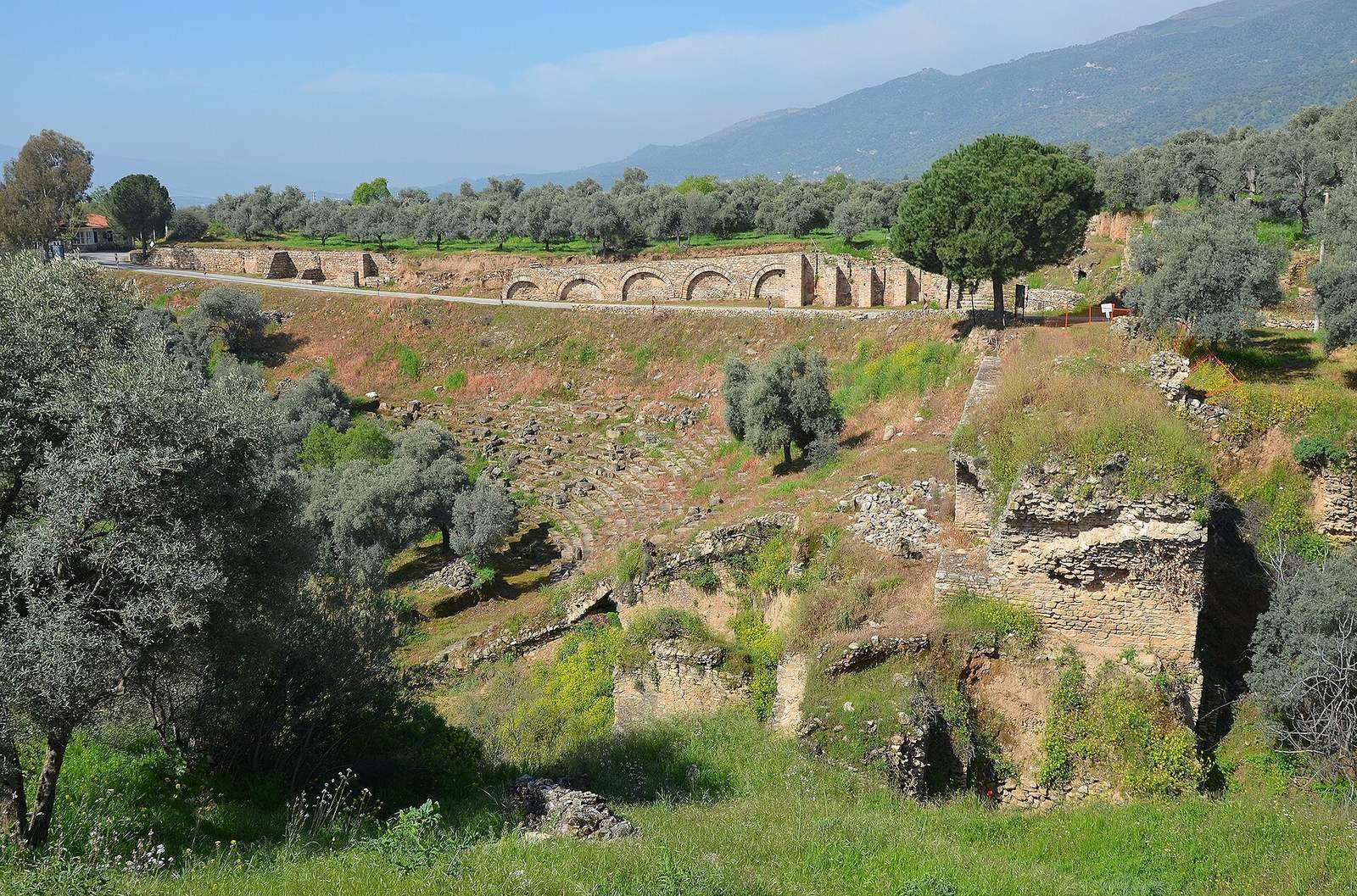
Nysa occupied a fertile basin on the southern slope of the Cevizli-Aydın range, also called Mount Messogis, with a plain extending to the south. The Maeander, now known as the Menderes River, lay to the city’s south. A deep ravine cut through Nysa and shaped its layout: buildings, streets, and squares on the steep sides rested on vaulted supports, while bridges connected the two halves.
Urban setting and infrastructure
Ravine and bridges
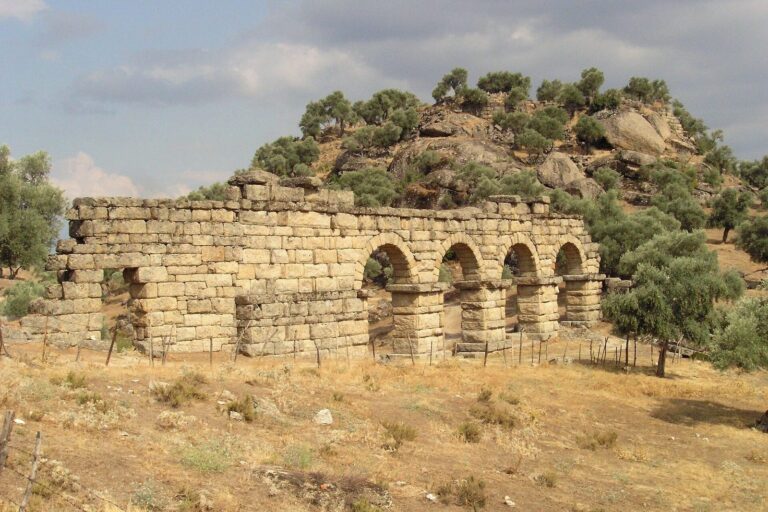
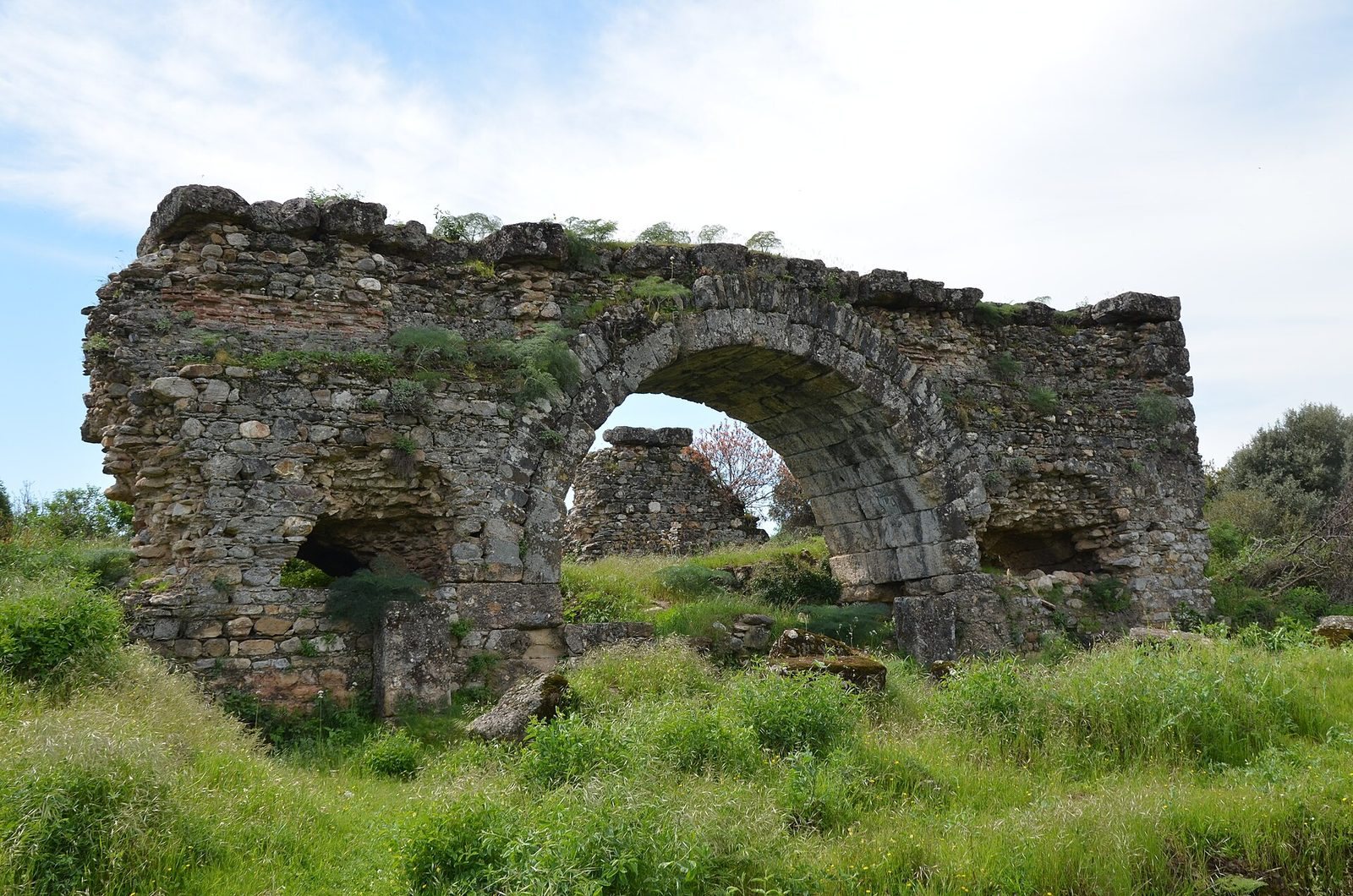
The torrent Eudon, a tributary of the Maeander, ran through the gorge that divided the city. Three bridges connected its sides in the Roman Imperial period. A surviving bridge, about 100 metres long, is among the longest examples of its kind in antiquity. A separate tunnel-like structure, also about 100 metres long, was built in the torrent bed south and southeast of the theater. Roman-period additions elsewhere in the city also used vaulted supports.
Districts and cemetery
Nysa lay roughly midway between Tralles and Antioch on the Maeander, and about 50 kilometres east of Ephesus. The western side included a gymnasium, while a Byzantine building and the library lay farther north, with the theater beyond them. The civic square and marketplace, council building, and baths stood east of the ravine. The western cemetery lay along the road to Akharaka, a sanctuary at Salavatlı.
Performance, learning, and training buildings
Theater
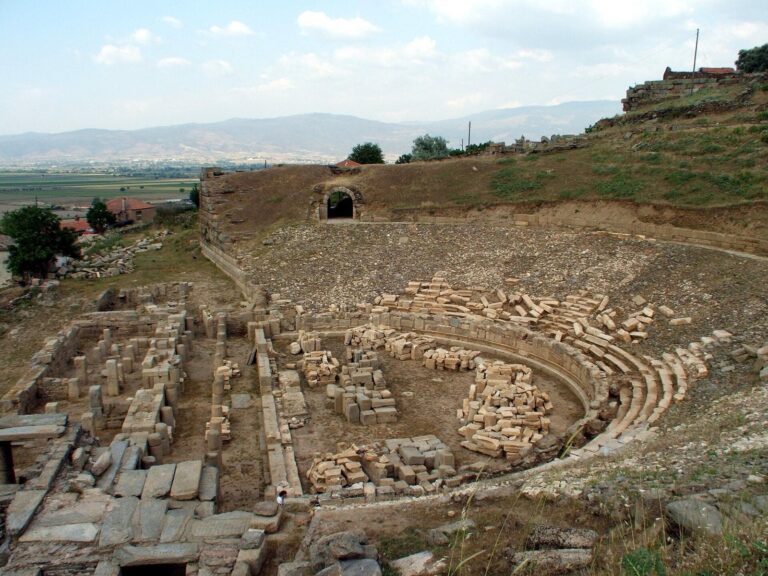
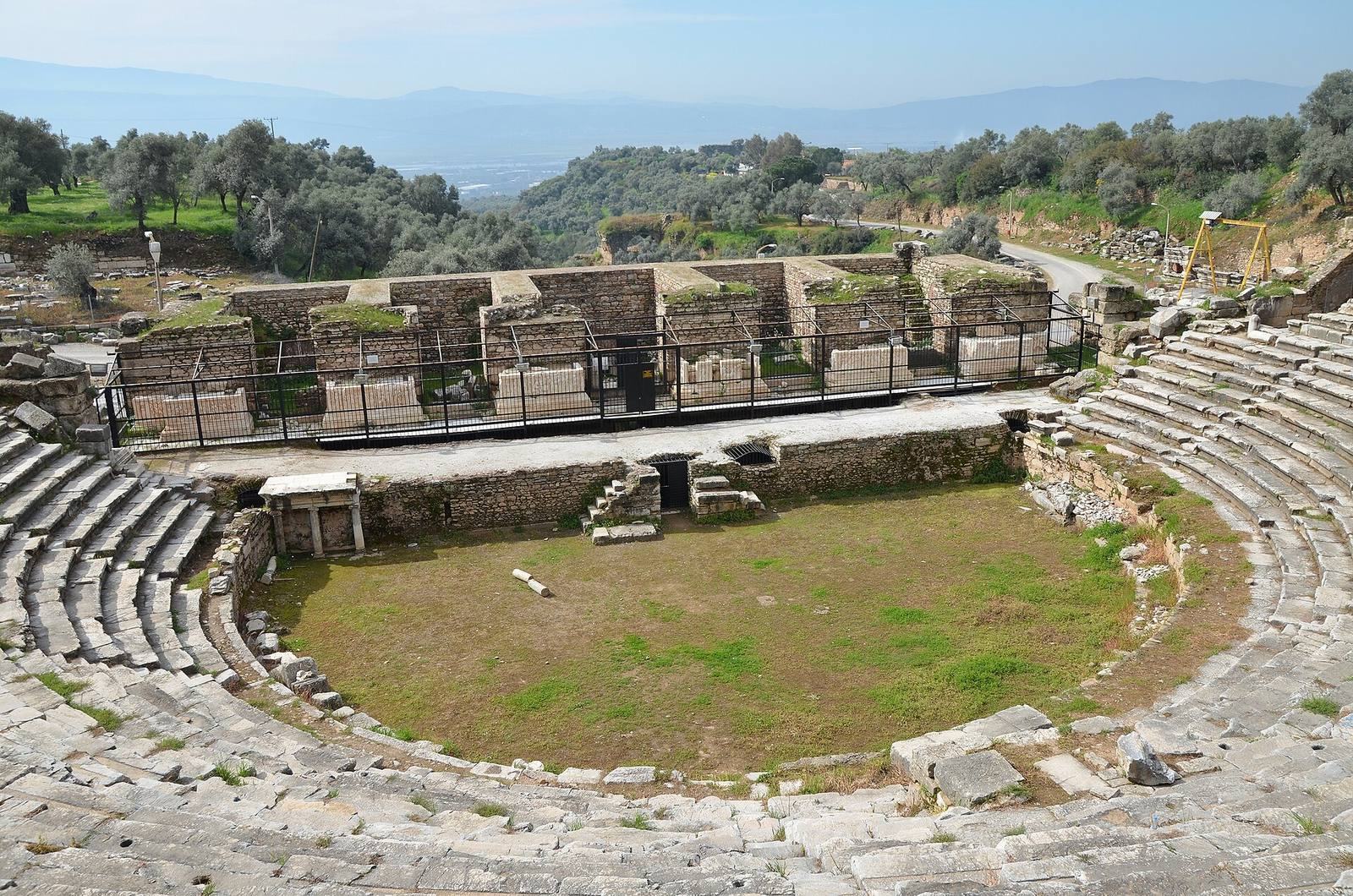
Nysa’s theater originated in the late Hellenistic period, and much of its surviving architectural form dates to the second century CE. Its marble seating area had 35 rows and could hold 12,000 spectators. The stage was about 27 metres wide, and surviving reliefs on its base show episodes from the life of Dionysus. The theater is well preserved. Restoration work also repaired and reset broken seating blocks and blocks from a staircase beside the western wall that supports the seating.
Library
The library dates to the second century CE and retains wall niches. It is considered the second-best-preserved ancient library structure in Turkey, after the Library of Celsus at Ephesus.
Gymnasia
Two training and education complexes stood on elevated ground beside the theater, one for young people and one for adults. One was built on a terrace and restored during the Byzantine period.
Civic and religious buildings
Gerontikon
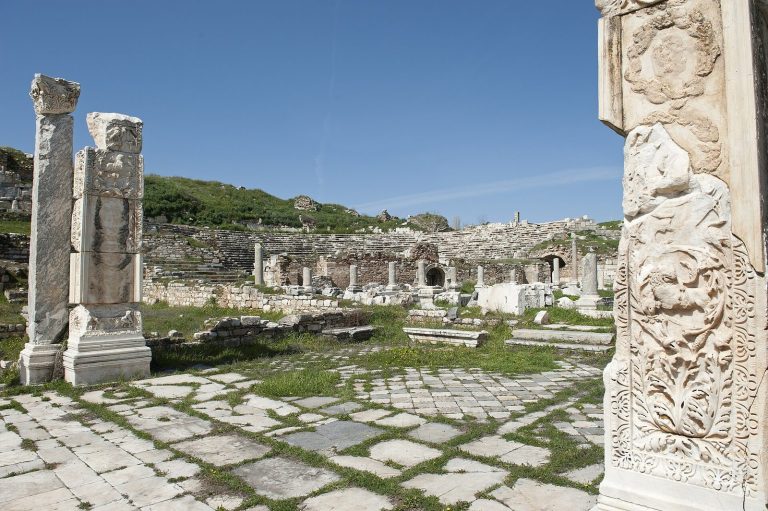
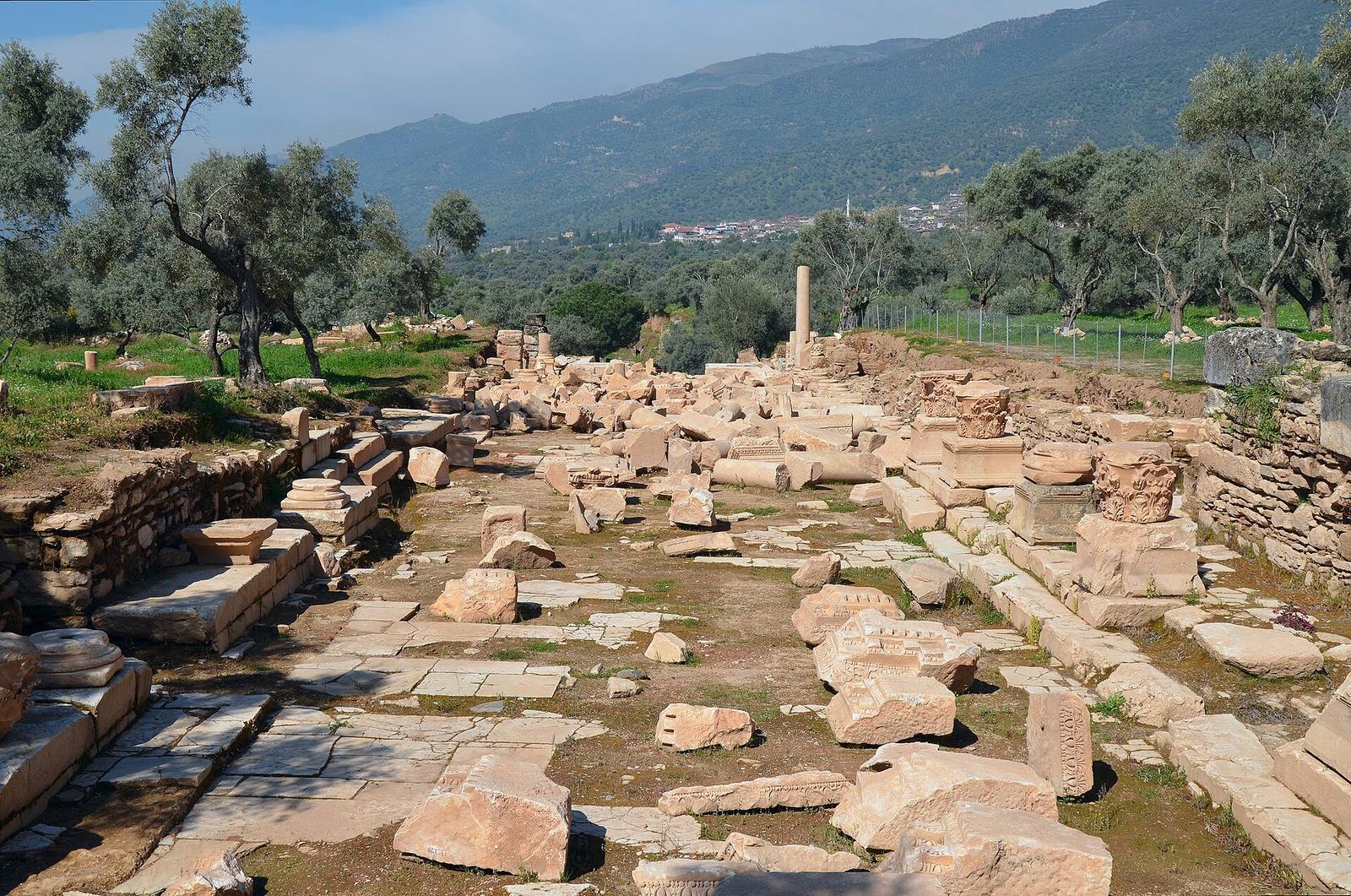
The Gerontikon was Nysa’s council building. It had 12 rows of seating and could accommodate about 600 to 700 people. It was later adapted as a roofed venue for musical or recitative performances. A two-storey stage front formed part of the building.
Marketplace and north colonnade
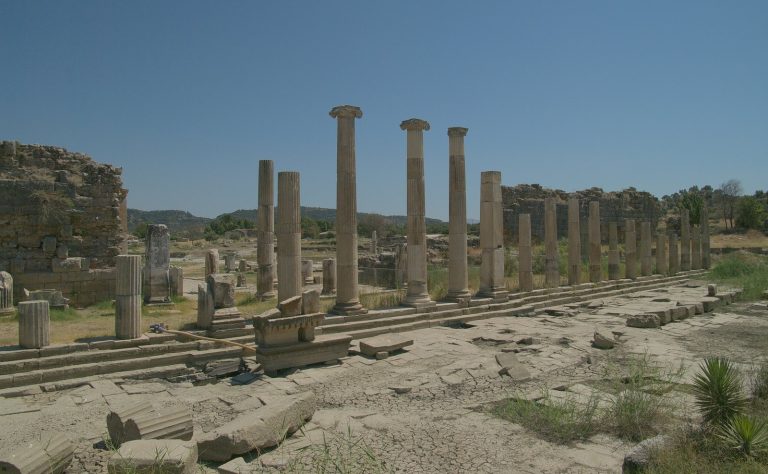
The marketplace included a north colonnade with shops. In 2008, later floor layers were removed from Shop 1 to examine finds beneath them and help establish the floors’ dates. A new excavation trench was opened south of Shops 3 and 4 to locate the central line of columns in the colonnade.
Stadium, baths, and basilica
The stadium could accommodate 30,000 people and was partly damaged by flooding. Other surviving remains include Roman baths and a Byzantine basilica.
Excavated features and conservation
Gerontikon restoration
Conservation work on the Gerontikon included floor mosaics in the rear chamber of its propylon, a monumental entrance, and in the east stoa, a covered colonnade. The two southern blocks of the first marble stair from the street were secured in their original positions with lime mortar. Repairs also reset damaged seating blocks and staircase blocks. On the stage front, the second and third raised platforms were restored, and gaps in the wall joints behind them were filled with lime mortar. The crown of the third platform, a single marble block that had broken into pieces, was reassembled and returned to its original position. Other façade blocks were sorted in the forecourt and repaired, apart from the columns.
Stage sculptures
Two statues associated with the Gerontikon were transferred from the İzmir Archaeology Museum to the Aydın Museum in 2008. A right arm-and-shoulder fragment found in the marketplace’s north colonnade fitted the attachment socket of a toga-clad male statue identified as Marcus Aurelius. The match showed that the fragment originally belonged to the sculpture group on the Gerontikon’s stage front, although it had later been reused in a wall. After conservation, the associated works were fitted with bases and delivered to the Aydın Museum.