Rupertsberg Monastery: A Benedictine Nunnery Founded by Hildegard of Bingen
Site at a Glance
- Popularity
- High
- Country
- Germany
- Primary era
- Medieval
- Eras represented
- Medieval
- Civilizations
- Electorate of Mainz, Holy Roman Empire
- Site type
- Religious
- Remains
- Monastery
On this page7 sections
History
Rupertsberg Monastery was a Benedictine nunnery founded around 1150 by Hildegard of Bingen and twenty other nuns in Germany. It stood on the Rupertsberg beside the Nahe, near the river’s confluence with the Rhine, along routes connecting the two river valleys. Benedictines followed the Rule of Saint Benedict, and the nunnery belonged to the Diocese of Mainz, the area under a bishop’s religious authority. Its church was Romanesque, a medieval style associated with rounded arches and substantial masonry, and was consecrated in 1152.
The palatine outpost and foundation
Before the monastery, the site served as an outpost of the Ingelheim Imperial Palace. A count palatine, a senior official who exercised a ruler’s authority in a region, administered it until the 10th century. A chapel connected with the palatine estate held the remains of Rupert III, a count palatine born around 781 who died before 834.
Between 1147 and 1150, Hildegard left Disibodenberg with twenty other nuns to establish a new community. The foundation, made under the influence of the Spanheim family, a medieval noble family, was built over the palatine chapel, which initially served as the nuns’ church. To lend the site religious authority, Hildegard fashioned a saint’s legend around Rupert. He came to be popularly venerated as Saint Rupert, although the historical Rupert lived for more than fifty years, unlike the figure in her legend.
Hildegard’s community
By the church’s consecration in 1152, Hildegard’s first work, Liber Scivias, a visionary theological work, was already widely known. She composed most of her writings at Rupertsberg. The monastery’s writing room produced copies that circulated widely, including across Europe.
In 1165 Hildegard established a second monastery at Eibingen, across the Rhine near Rüdesheim. Rupertsberg lost some of its standing after her death in 1179. In the late Middle Ages, however, a reported blood miracle involving an image of a saint drew renewed popularity to the monastery.
Destruction and later use
Swedish forces destroyed Rupertsberg in 1632 during the Thirty Years’ War, a major Central European conflict fought from 1618 to 1648. The monastery was never rebuilt. Its estate became agricultural property of the Eibingen monastery, and the ruined buildings supplied stone for farm structures. The last nuns eventually fled to Eibingen, taking Hildegard’s remains, writings, and other relics. Her remains were buried in an altar there.
The church ruins survived until 1857, when construction of the Nahe Valley Railway by the Rhine-Nahe Railway Company required their removal. Blasting the rock also destroyed the burial crypt beneath the choir. A large part of the abbey archive is now held at the Landeshauptarchiv Koblenz, the state archive in Koblenz.
Remains
Monastery church
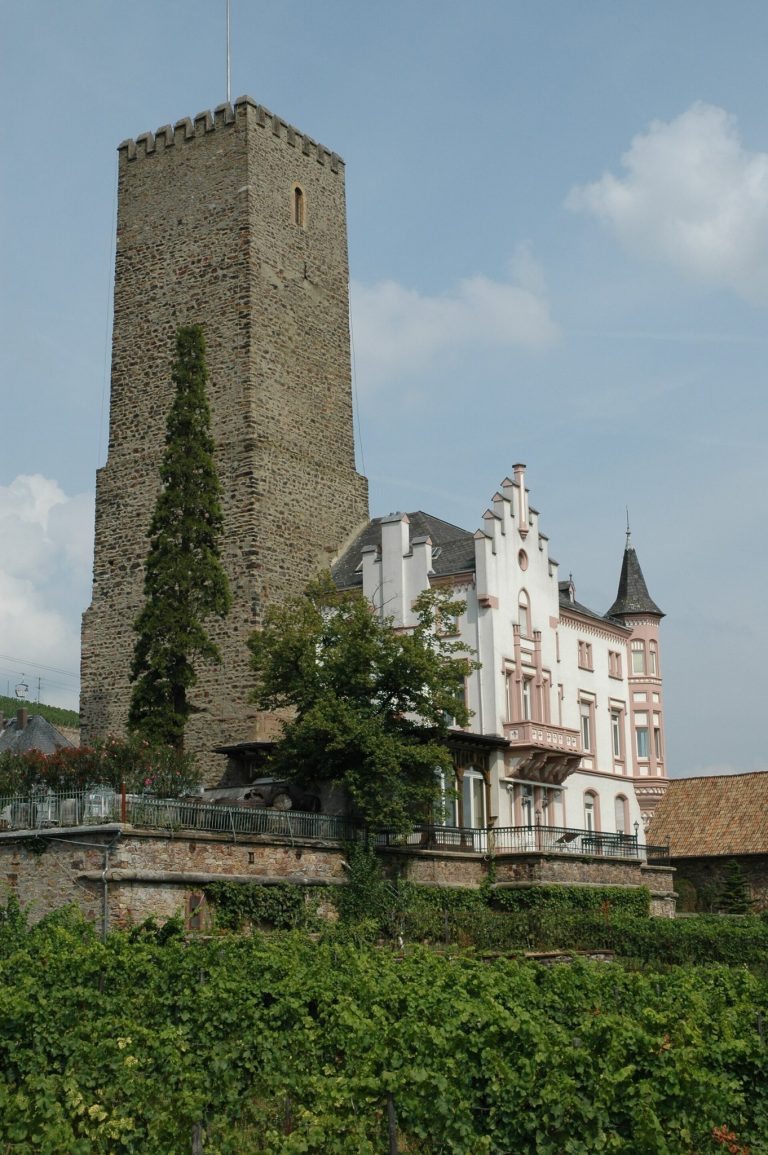
The church had three aisles and one altar. Five arcades, rows of arches, survive in a vaulted-basement complex within the Villa am Rupertsberg. The earlier palatine chapel served as the nuns’ church while the larger monastic complex developed. The Nativity panel of the Isenheim Altarpiece, a multi-panel religious painting by German Renaissance artist Matthias Grünewald, depicts the monastery church behind Mary and the child.
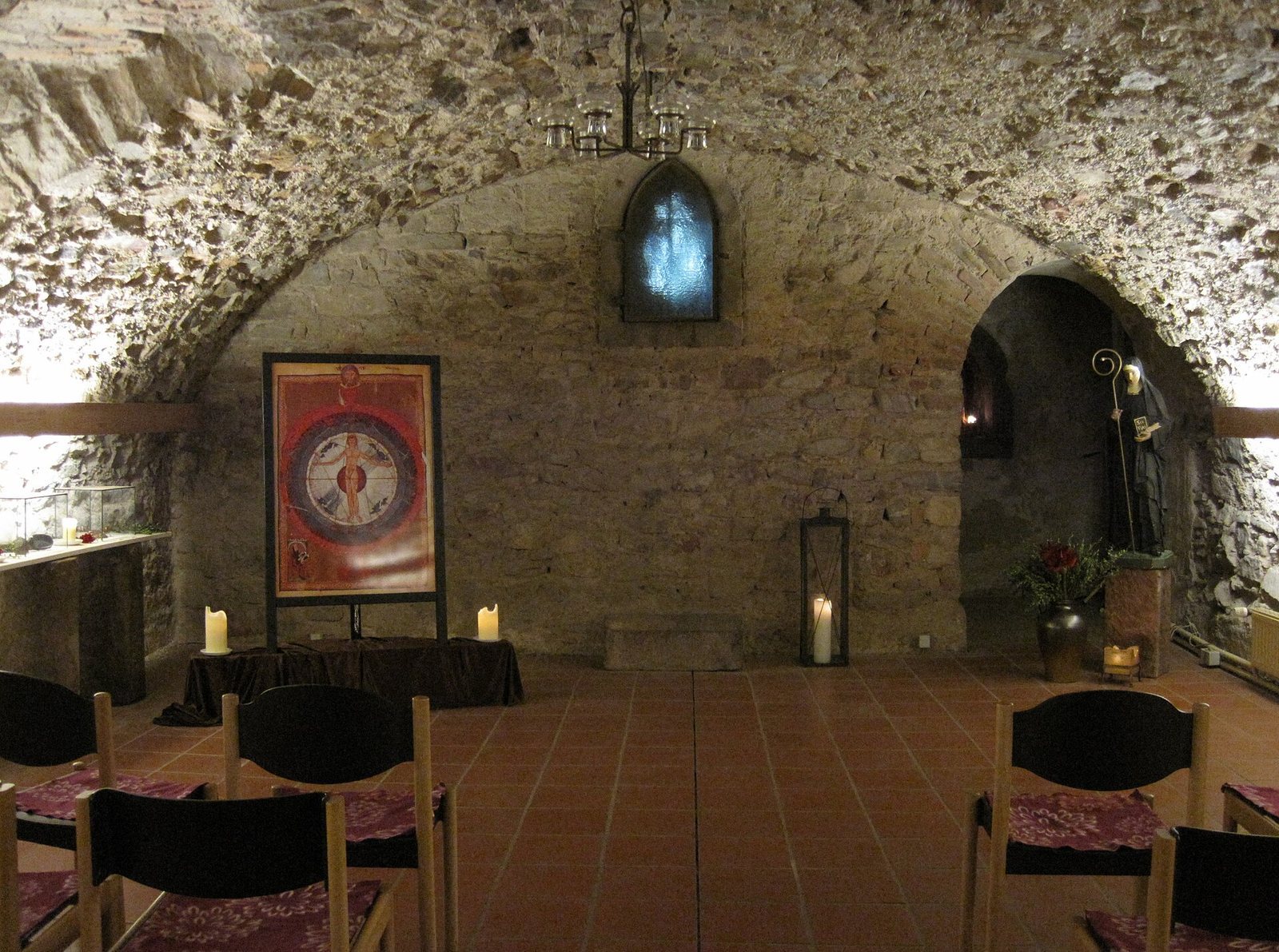
The so-called Hildegard Vault Cellar
The so-called Hildegard Vault Cellar dates to the 18th century, after Rupertsberg’s destruction, and is not part of the medieval monastery. A 2016 art-historical investigation overturned the long-standing local attribution of the cellar to Hildegard’s house.