Taktsé Castle: An Early Tibetan Fortress and Center of Political Power
Site at a Glance
- Popularity
- Medium
- Country
- China
- Primary era
- Medieval
- Eras represented
- Medieval
- Civilizations
- Tibetan
- Site type
- Military
- Remains
- Castle
On this page10 sections
History
Taktsé Castle is a Tibetan fortress on Chingwa Taktse Mountain in Chingwa, Chonggyä district, central Tibet, China. Its history is closely associated with the emergence of Tibetan imperial power in the early seventh century. The government of the Tibetan Empire initially held the stronghold.
Early Tibetan political power
The Old Tibetan Chronicle, a historical work about Tibet’s early past, places the origins of the power that developed into the Tibetan state at Taktsé. It recounts that, in the early seventh century, a group persuaded Tagbu Nyazig to rebel against Gudri Zingpoje, a dependent ruler of the Zhangzhung kingdom under its Lig Myi ruling house. The rebellion succeeded.
Namri Songtsen, also known as Namri Löntsän, then led his clan in subduing neighboring clans. Taktsé’s defensible position served his military aims. Before his assassination around 618, he controlled the area around present-day Lhasa, helping prepare the way for his son Songtsen Gampo to build a regional state that became the Tibetan Empire. The government based at the castle sent embassies to China’s Sui dynasty, which ruled from 581 to 618, in 608 and 609. These missions marked Tibet’s appearance on the international scene.
Royal traditions and the move to Lhasa
Tradition holds that Tibetan kings lived at the castle for several centuries under the Yarlung dynasty, an early Tibetan ruling line. Songtsen Gampo later moved the capital and administration to Lhasa. Legends also credit an early Tibetan king with building the castle.
Another legend concerns Totori Nyantsen (374–494), a figure in traditions about Tibet’s early kings. At age sixty, he was said to have stood on the castle tower as the sky filled with color, music sounded, and flowers fell. A basket descended carrying a stupa, a Buddhist shrine or reliquary, and the sacred formula “Om mani padme hum.” The story says that Totori became sixteen again through their power and ruled for another sixty years.
Later history and modern record
Lobsang Gyatso (1617–1682), the Fifth Dalai Lama, was born at Taktsé in 1617. His aristocratic family had made its home at the castle. In 1949, British diplomat Hugh Edward Richardson photographed the fortress while representing the Mission of India in Lhasa. Reconstruction of Riwo Dechen monastery began in 1985.
Remains
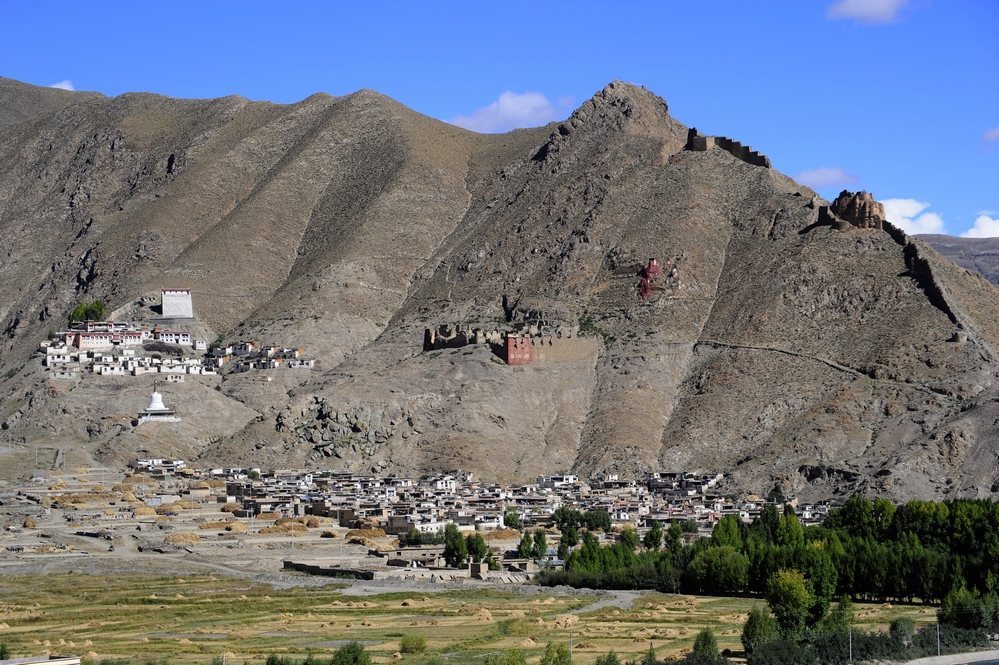
Taktsé Castle is a Tibetan dzong, or fortified building, on Chingwa Taktse Mountain. The surviving features include the ruined castle and Buddhist monastic buildings on the mountain, with other historic sites nearby.
Castle and monastic remains
Taktsé Castle
The castle itself is in ruins. Its position on Chingwa Taktse Mountain is part of the site’s physical setting.
Riwo Dechen monastery
Riwo Dechen, a monastery of the Gelug school of Tibetan Buddhism, stands on the same mountain. It is partly ruined and includes a large wall used to display a Tibetan Buddhist religious painting.
Sanga monastery
Sanga is a Tibetan Buddhist monastery built among the castle ruins.
Nearby royal tombs
The castle is near Rechung Puk and the Valley of the Kings. The valley, at Chongye, contains the tombs of early Tibetan kings.