Auberive Abbey: A Cistercian Monastery in Haute-Marne
Site at a Glance
- Rating
- 4.4
- Popularity
- Medium
- Country
- France
- Primary era
- Early Modern
- Eras represented
- Medieval, Early Modern, Modern
- Civilizations
- French
- Site type
- Religious
- Remains
- Monastery
On this page20 sections
History
Auberive Abbey is a Cistercian monastery in Auberive, Haute-Marne, France, founded in 1135 by Bernard of Clairvaux. The Cistercians sought a disciplined form of communal religious life, and Auberive became Clairvaux’s 24th daughter house. It belonged to the Diocese of Langres, a Catholic district overseen by a bishop, and was under the patronage of Notre-Dame, a title for the Virgin Mary.
Foundation and medieval estates
The bishop of Langres and local lords granted land for the abbey. The monks settled in a wooded, marshy valley without a village, making room for the monastery and its farmland. In the thirteenth century, the abbey’s possessions reached their greatest extent. They included 11 granges, or monastic farms, four town houses, 14 mills, 13 ponds, and an iron mine. The house also had salt-extraction interests at Lons-le-Saunier and vineyards near Dijon, including at Ruffey-lès-Échirey, and at Mussy-sur-Seine.
War and commendatory abbots
The Hundred Years’ War, a prolonged series of conflicts between England and France, damaged the abbey’s economy. Its flock declined from 2,540 sheep in 1386 to 600 in 1418. With too few lay brothers, the monks leased most of their holdings.
The 1516 Concordat of Bologna transferred to Francis I, king of France, the right to appoint commendatory abbots, a power held by the pope since the late fourteenth century. A commendatory abbot held an abbey’s title and income without necessarily living as part of its monastic community. Auberive had 14 such abbots between 1519 and 1791. Income was divided roughly into thirds for the commendatory abbot, the resident clergy, and building upkeep. The first, Louis de Rye, built an abbot’s palace outside the monastic enclosure. Martial de Lévis, appointed in 1553, became a Cistercian monk and resident abbot in 1563.
The French Wars of Religion, conflicts between Catholics and Protestants, brought further upheaval. Auberive was pillaged in 1567 and 1587, making it difficult to collect the abbey’s income.
Eighteenth-century rebuilding
In the eighteenth century, two campaigns almost entirely rebuilt the abbey, following a trend associated with Saint-Denis Abbey from around 1700. The work was partly financed by timber rights that allowed cutting across 1,700 hectares of the abbey’s 5,000 hectares of forest. The east wing was rebuilt between 1781 and 1787.
Revolution and industrial reuse
The abbey was suppressed during the French Revolution. Its last eight monks left in late 1790, and the house was dissolved in 1791. An inventory listed 857 library volumes, 17 farms, a forge, and 10 houses in the village that had grown around the abbey. The estate was sold as national property, while the abbey’s 5,000 hectares of forest passed to the state.
Abel François Nicolas Caroillon de Vandeul, an industrialist and son-in-law of Denis Diderot, bought the buildings and established a cotton-spinning mill there between 1797 and 1807. Mechanized mule-jenny spinning machines arrived in 1797 with cotton shipped from Le Havre. Water power drove the machinery after the mill’s waterfall was modified. After about a decade of operation, Caroillon de Vandeul turned the abbey into a country residence for himself and his wife, Marie-Angélique Diderot. She retained the estate until her death in 1824.
Ironmaster Bordet bought the abbey as a country residence in 1825. In 1835, he dismantled the eighteenth-century church to supply material for a blast furnace at La Thuilière, six kilometres away. He enlarged the mill building in 1844 for use as an orangery, and the abbey was offered for sale about ten years later.
Prison and juvenile colonies
On 18 October 1856, the state decided to acquire Auberive and convert it into a central prison for women. The prison was intended to relieve overcrowding at Clairvaux, Auberive’s parent house, which had become a central prison earlier in the nineteenth century. Adaptations took place in two campaigns. The perimeter walls were strengthened, punishment cells were installed in the east wing, and communal dormitories occupied its first and second floors. A chapel behind the abbey provided space for worship, education, and meals, with capacity for as many as 600 prisoners.
Prisoners had to work, and private employers contracted for their labor for periods of up to nine years. Women at Auberive mainly made clothing for the army and also maintained and ran the prison. Their day began at 4:30 a.m. in summer and 6 a.m. in winter. They ate twice, at about 9 a.m. and 4 p.m.; meat was served on Sundays and public holidays, at roughly 80 grams per person. They could buy extra food, but daily spending was capped at 20 centimes and deducted from their wages.
In 1871, Louise Michel was transferred from the overcrowded prison at Versailles with about 20 other women, to await deportation to New Caledonia. She remained at Auberive from 24 December 1871 to 24 August 1873. Deeply affected by the suppression of the Paris Commune, the revolutionary municipal government in Paris in 1871, she helped other prisoners write letters and taught them. At Auberive she began The Book of the Penal Colony and a collection of stories, The New Year’s Day Book. She also contacted the president of the Acclimatization Society to send observations about New Caledonia’s plants and animals. Republican activist Sophie Poirier was held there under a deportation sentence and remained until her death. Marie Chiffon was imprisoned at Auberive before being deported to New Caledonia.
From 1885 to 1891 the site housed an industrial colony for girls classified as juvenile delinquents. It became an agricultural colony for boys from 1894 to 1924. A law passed on 5 August 1850 had established such institutions for young people aged 7 to 16, aiming to separate them from ordinary prisons and prepare them for industrial or agricultural work. At Auberive, boys combined farm labor with elementary lessons. Younger boys worked land at the rented Cude farm, while older boys were placed as farmhands. An average of 100 to 200 boys lived there, including juvenile offenders and children with developmental disabilities. Limited teaching resources, difficulties supervising the boys, and frequent escapes contributed to the state’s conclusion that juvenile colonies had failed nationally and should close.
Monastic return and later uses
After the abbey was put up for sale in 1926, it returned to monastic use from 1927 to 1960. Romanian Catholic priest and religious founder Vladimir Ghika established a mixed community called the Brothers and Sisters of Saint John to welcome people with early or late religious vocations and assist those in distress. The community remained for four years, then sold the abbey in 1930 to the Benedictines of Sainte-Marie in Paris. Before the Second World War, the house served mainly as a summer retreat for novices and a place for convalescent monks. In 1950 it became a daughter house of Sainte-Marie, with about ten religious residents.
In 1954, the Cistercian community of Sainte-Marie de Pont-Colbert at Versailles, facing expulsion, bought the abbey from the Benedictines. The Solvay company at Tavaux acquired it in 1960 as a holiday colony for its employees. Parts of the abbey have been classified as Historic Monuments, a French state heritage-protection designation, since 1956, with further registration in 2004 and 2006. The Volot family now owns the property and has undertaken its cultural rehabilitation, including its use as a contemporary art centre.
Remains
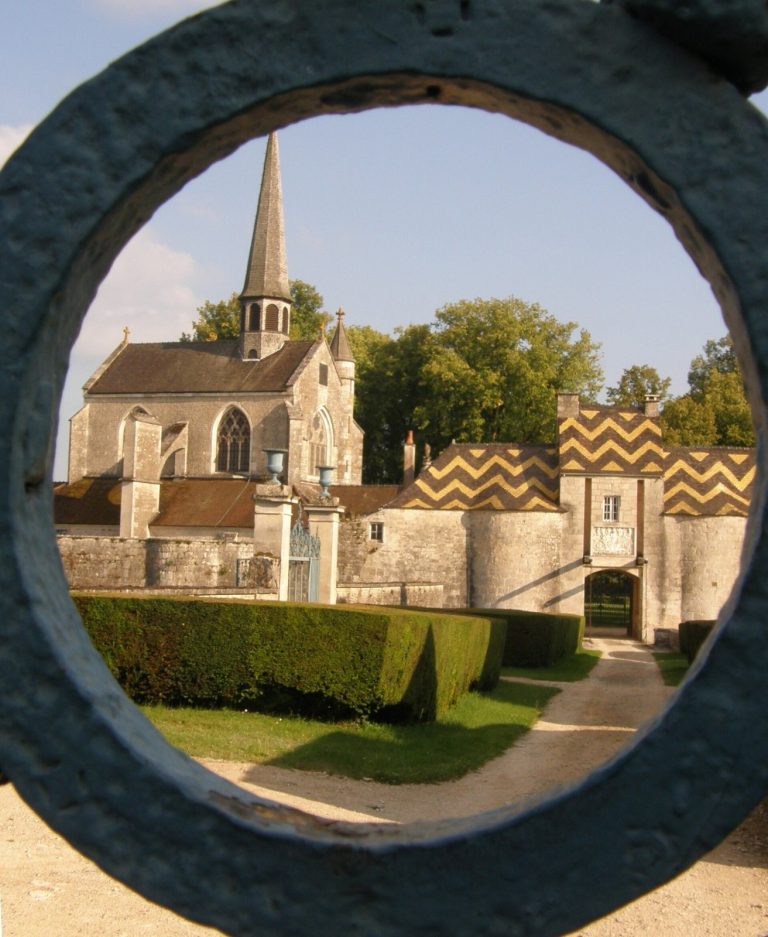
Auberive occupies a valley of the Aube near the river’s source. The site follows a Cistercian plan, with the church and monastic buildings arranged around a cloister, and combines medieval remains with extensive later rebuilding.
Valley setting and waterworks
When the abbey was founded, the Aube ran through the area now occupied by the cloister. It was diverted to the south side of the valley, where a channel was dug for it. A mill race, a channel carrying water to a mill, ran parallel to the river, while buried channels conveyed wastewater from the abbey into the Aube.
Medieval structures
Church sanctuary
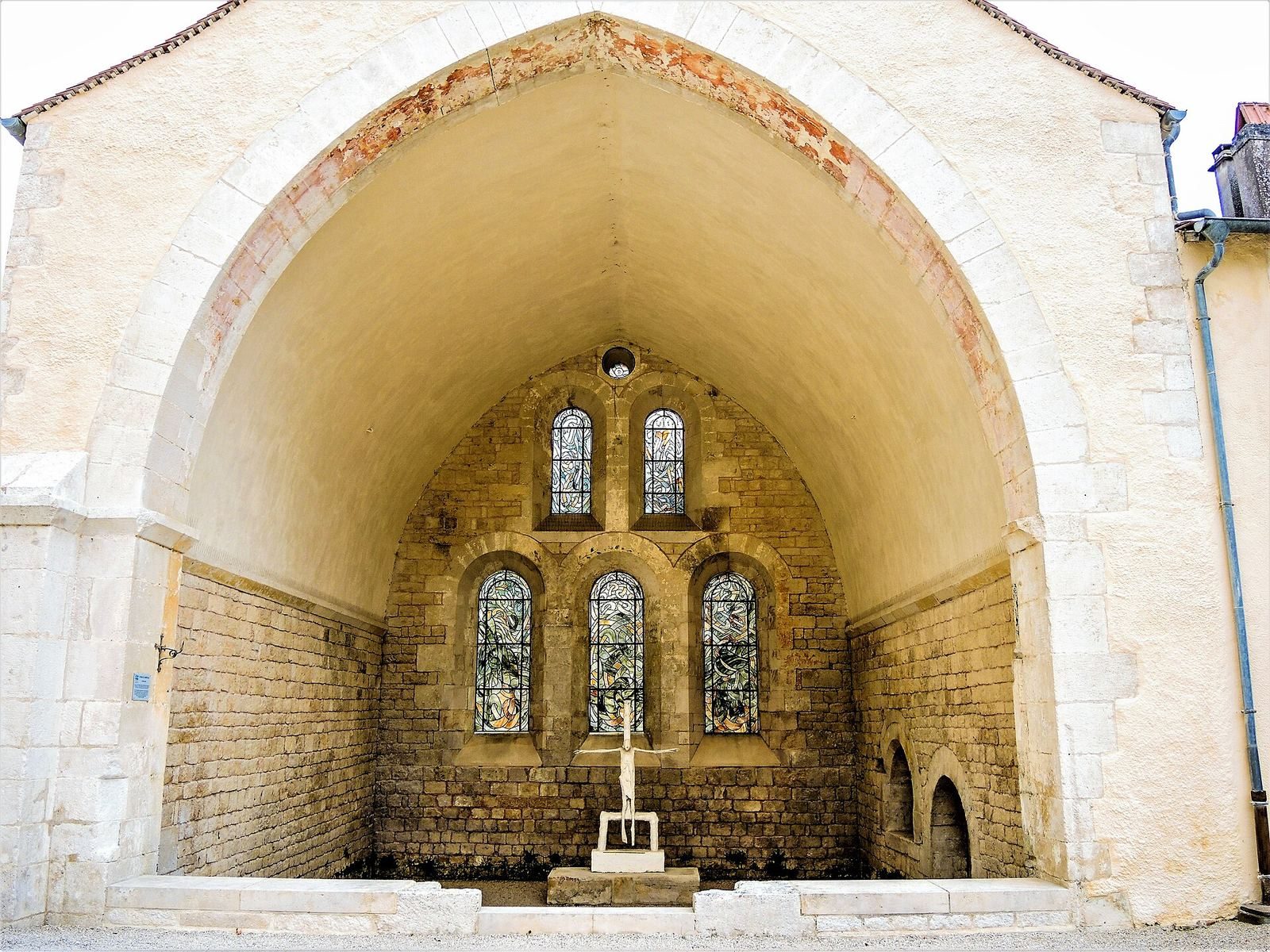
The surviving medieval part of the church is its sanctuary, or choir. It has a flat-ended plan and a pointed barrel vault, a continuous ceiling with a pointed cross-section. Two rows of round-arched windows and a small circular window light the space.
Cloister and refectory entrance
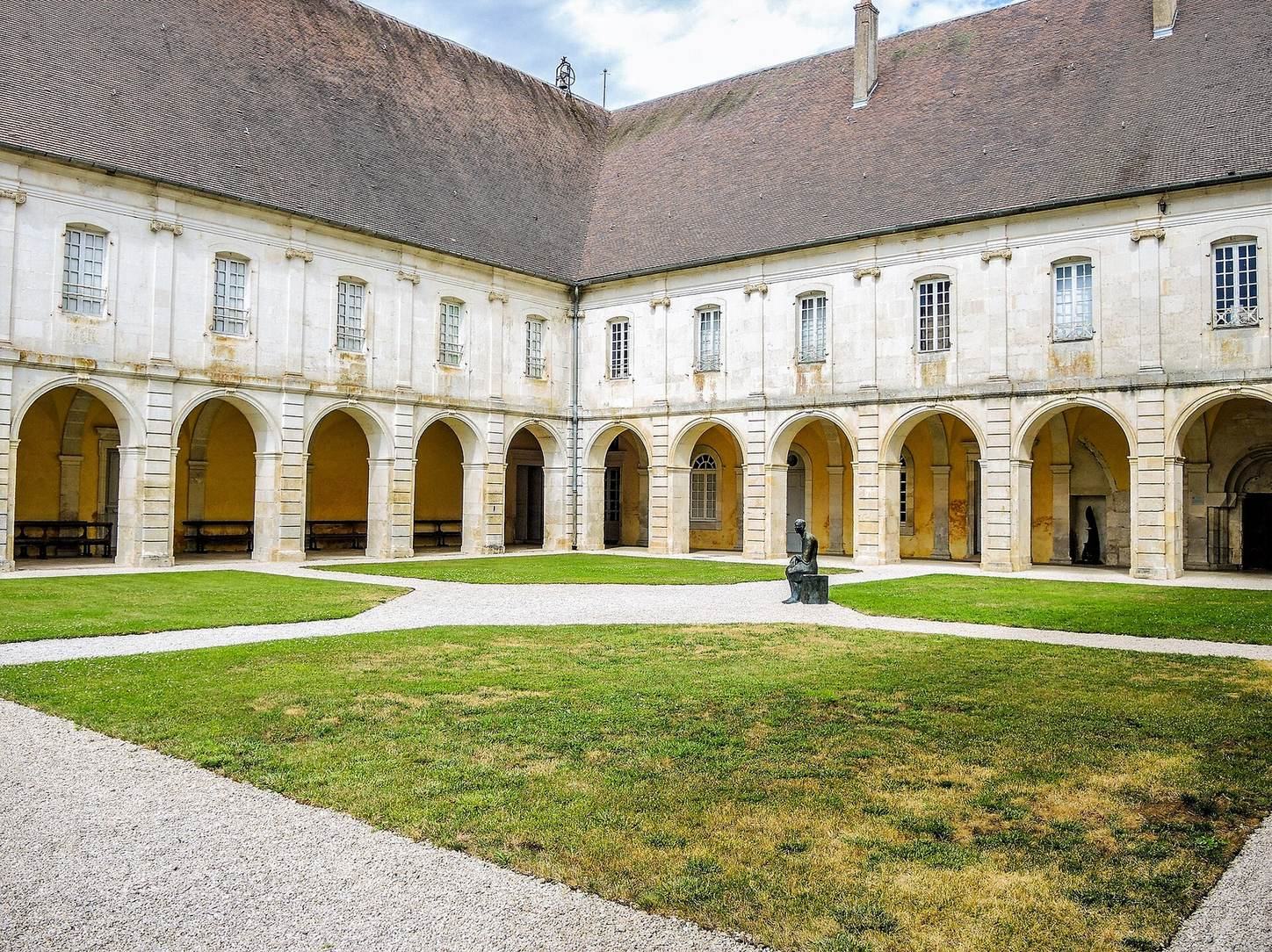
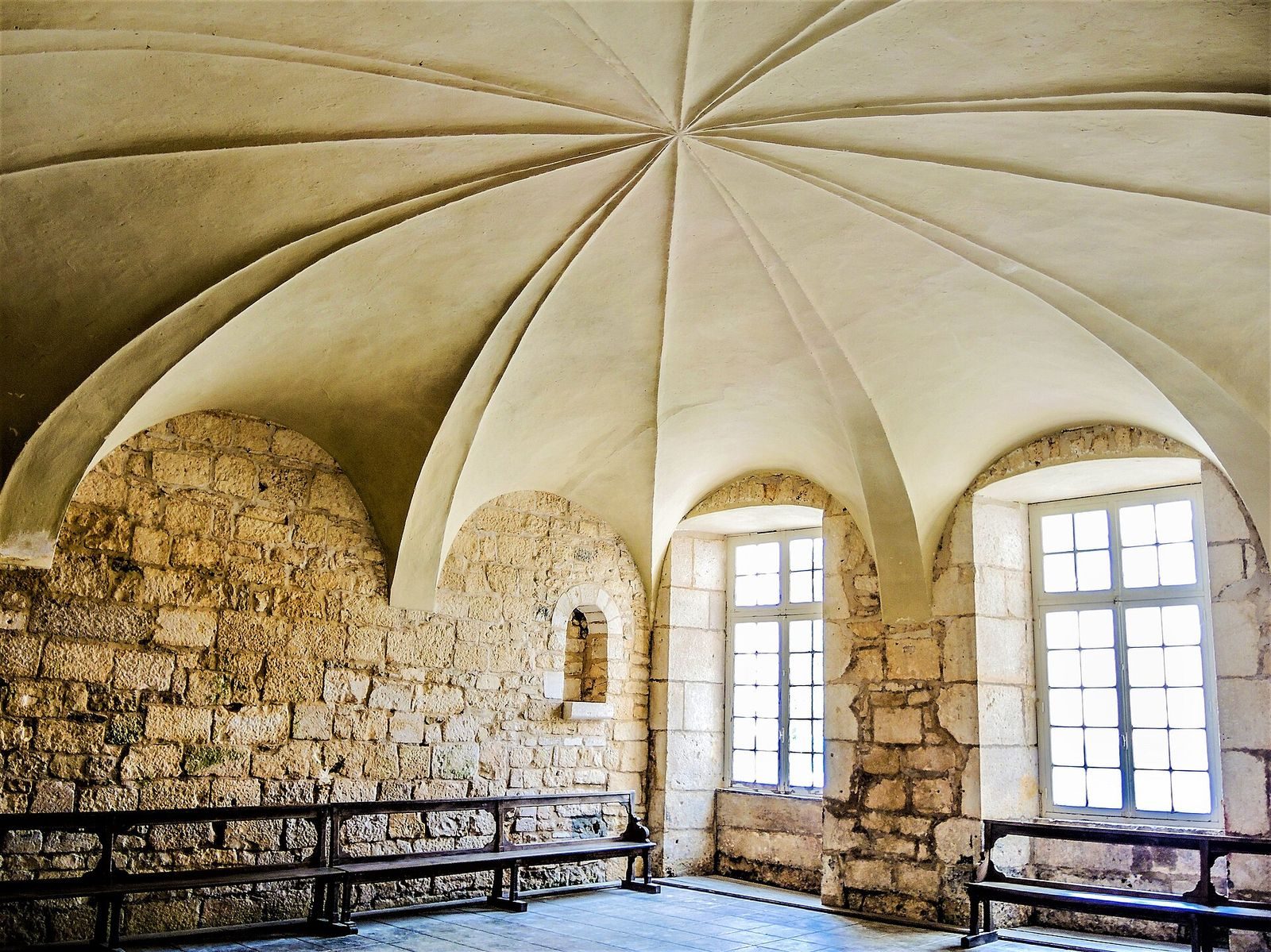
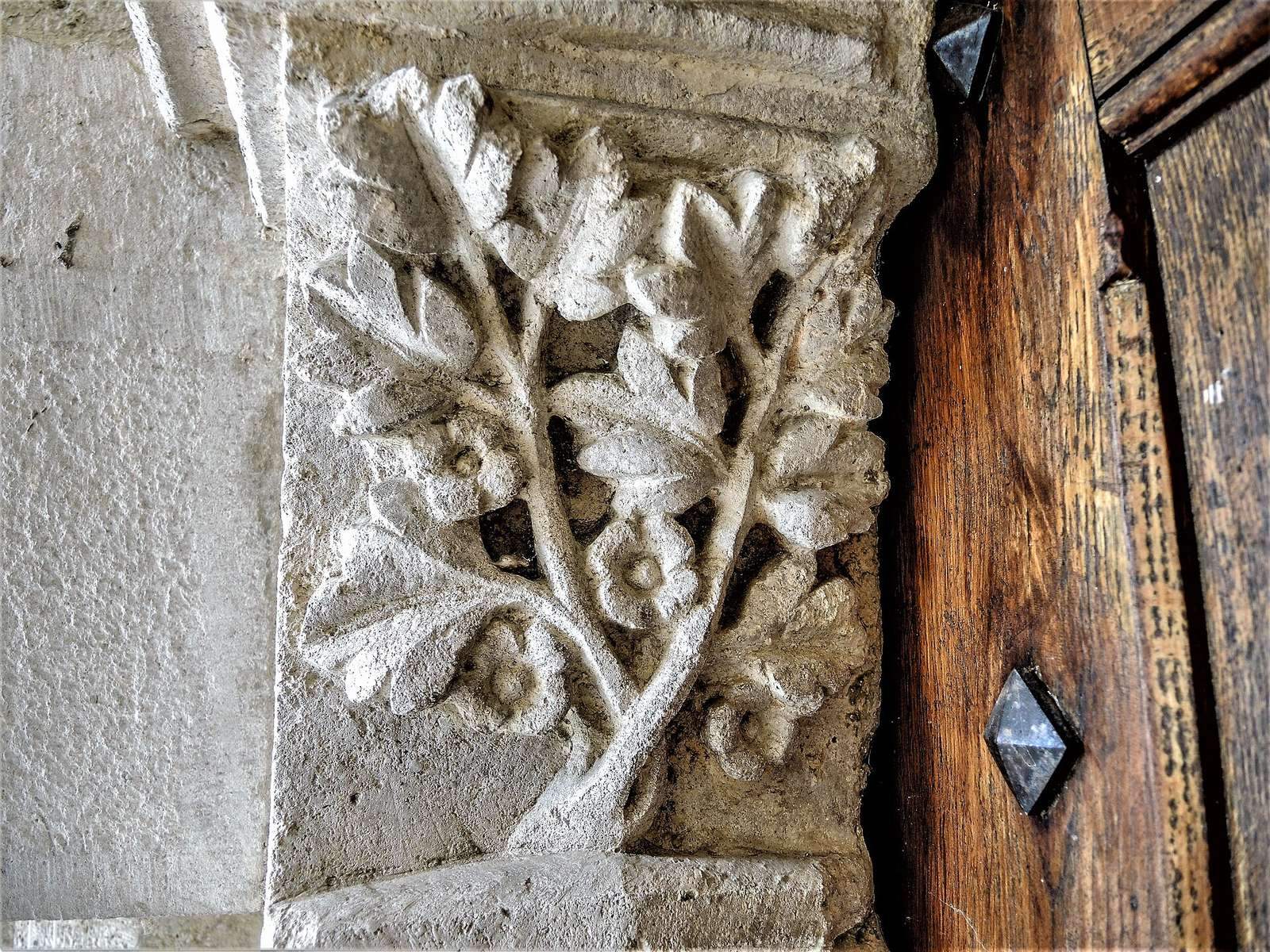
Three wings of the seventeenth-century cloister remain north of the church. They include the chapter house, the room where the monastic community met, with Gothic vaults. The surround of the monks’ refectory doorway is another surviving medieval feature.
Eighteenth-century rebuilding
Church and monastic wings
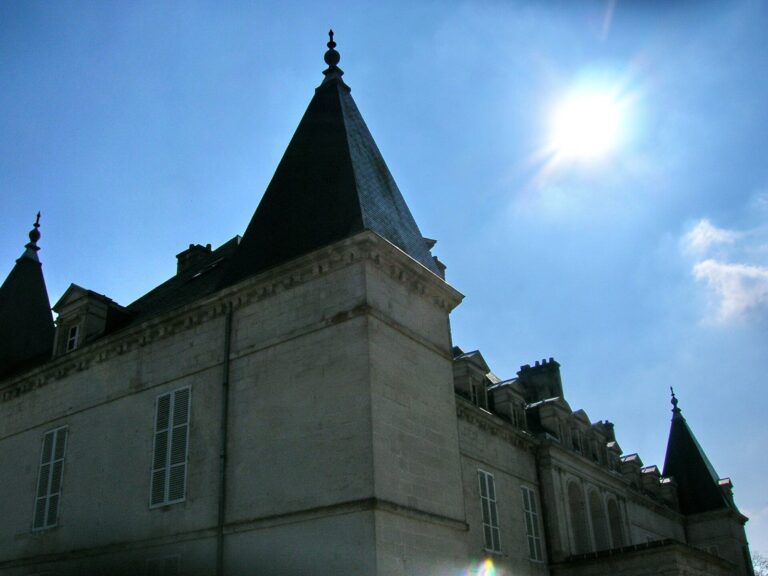
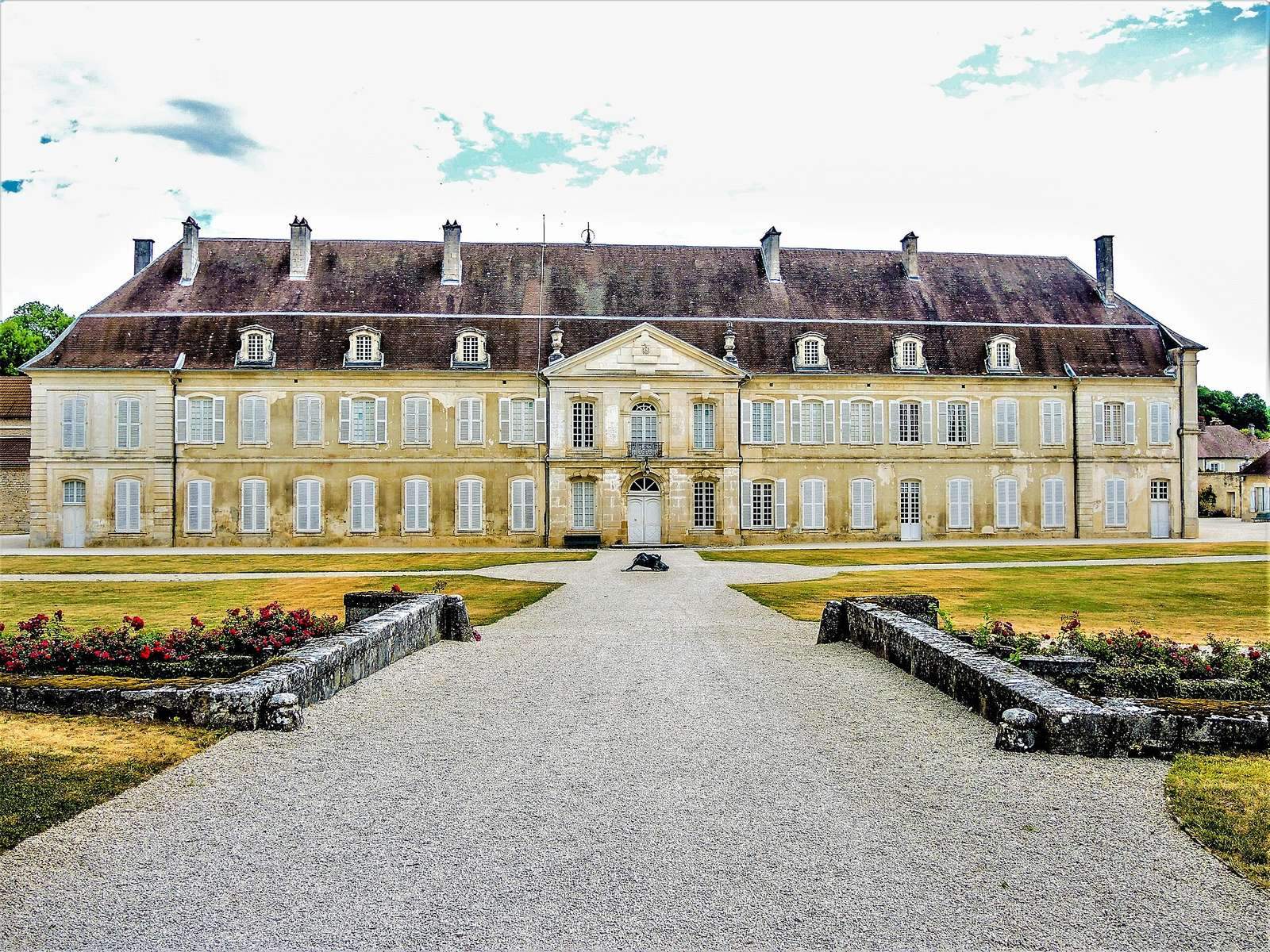
The eighteenth-century rebuilding gave the complex much of its present general appearance. The church was reconstructed on a north–south axis, parallel to the east and west wings. It continued the enclosure of the cloister while opening toward the abbey square. The west wing became a guest wing with a monumental classical façade. The east wing was raised by half a storey to address damp conditions.
Bridges and dovecote
The bridges crossing the Aube and the mill race, along with the abbey’s dovecote, were rebuilt during the eighteenth-century works.
Other buildings and landscape
Abbot’s palace
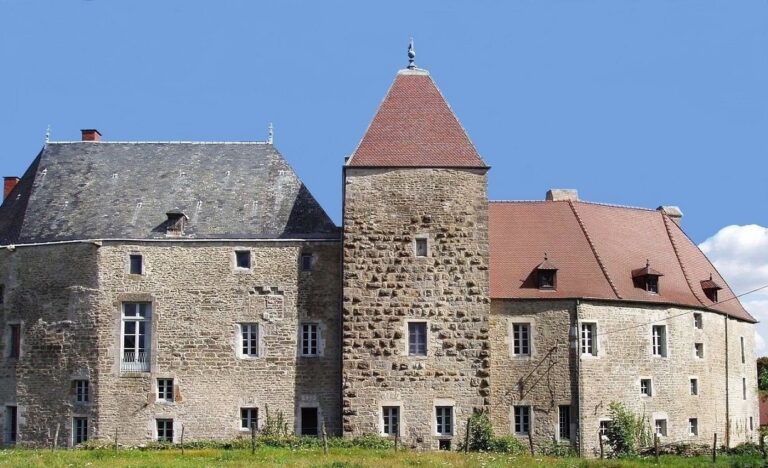
The former abbot’s palace stands outside the monastic enclosure. Built in the sixteenth century, it has mullioned windows, divided into sections by vertical bars, characteristic of the first half of that century. It now houses an inn.
Watermill
A watermill building also remains. Enlarged in 1844, it was adapted for use as an orangery, a building used to shelter plants.
Prison chapel
A chapel was built behind the abbey during its conversion to a prison. It was designed to accommodate worship, education, and meals for up to 600 prisoners.
Park and orchard
The abbey’s park covers six and a half hectares. It includes a conservation orchard with about 40 varieties of apple, pear, and plum, among them the Auberive apple.