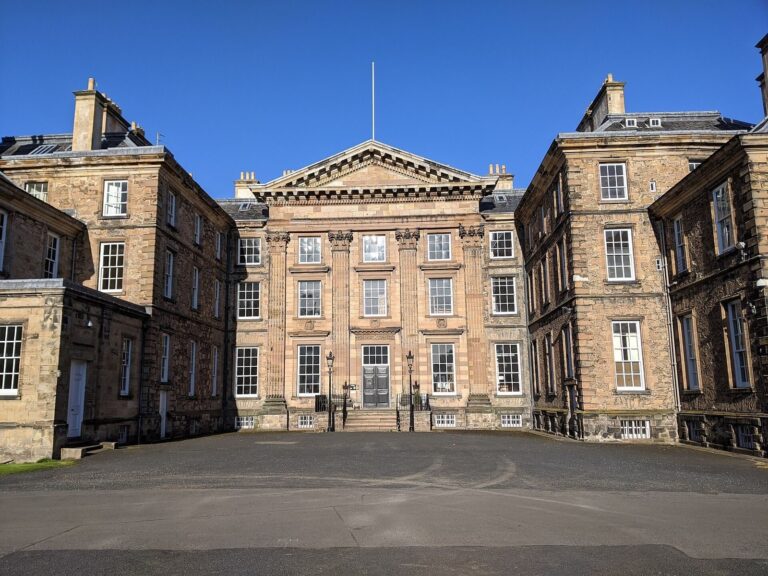
Hawthornden Castle: A Scottish Castle and Writers’ Retreat
Site at a Glance
- Popularity
- Medium
- Country
- United Kingdom
- Primary era
- Early Modern
- Eras represented
- Bronze Age, Classical, Medieval, Early Modern, Modern
- Civilizations
- British, Kingdom of Scotland
- Site type
- Military
- Remains
- Castle
On this page12 sections
History
Hawthornden Castle is a castle and later country house near Rosewell in the United Kingdom, shaped by Scottish noble ownership, conflict, and literary life. The surrounding area had been inhabited for millennia, and medieval tradition associated the caves beneath the castle with refuge for Scottish forces.
Medieval lordship and conflict
The Abernethy family held Hawthornden from the thirteenth century, before the estate passed to the Douglas family in the fourteenth. In 1540, John Douglas sold timber from Hawthornden Wood to James V for shipbuilding.
English troops under Edward Seymour, Earl of Hertford, sacked the castle in 1544 and again in 1547 during the Rough Wooing, the mid-sixteenth-century conflict between England and Scotland. These attacks brought repeated destruction to the site during the wars between the kingdoms.
The Drummonds and literary associations
Around 1600, James VI granted the Hawthornden fief, land held under feudal obligations, to Sir John Drummond, a royal household official. His son William Drummond, the poet, added the present house to the older tower in 1638. In the late 1610s, the English playwright Ben Jonson walked from London to visit William at Hawthornden, helping establish the castle as a place associated with writers.
Between 1626 and 1636, William gave much of his private library to the University of Edinburgh. The collection contained about 800 works, including early printed editions of Shakespeare and books on literature, history, religion, philosophy, law, medicine, science, and geography. Later visitors included William II of Orange, Samuel Johnson, James Boswell, Robert Burns, Lord Byron, Dorothy and William Wordsworth, Walter Scott, and William Turner.
Queen Victoria and Prince Albert visited on 14 September 1842. Passages below the castle were lined with red velvet for their journey to the caves and carved stones, and Victoria was reportedly deeply impressed. Sir William Allan later depicted the royal visit in a painting now held by the Scottish National Gallery. In 1859, Charles Dickens was reportedly refused entry because he had arrived without the required prior approval.
The Hawthornden apple also takes its name from the estate. This chance-grown seedling appeared there in the mid-eighteenth century and reached German-speaking countries around 1790. People there called it the “hawthorn apple,” finding Hawthornden difficult to pronounce; the name refers to its origin, not to a cross with hawthorn.
Literary patronage and modern use
Alice Warrender, born at Hawthornden, established the Hawthornden Prize in 1918 or 1919 to encourage young writers of imaginative work. Usually awarded annually for a literary work published in the preceding twelve months, it is the United Kingdom’s oldest literary prize. In 1935, Warrender transferred her wealth to a foundation supporting the award. The Hawthornden Foundation also provides loans, scholarships, and pensions, and is based at the castle.
The Drummond family retained the castle until around 1970. The last Lord Drummond left it to his butler, who sold it to Edinburgh art and antiques dealer Douglas Adamson. The Adamson family lived there until 1985 and opened parts of the building to the public. Arts patron Drue Heinz acquired the property afterward. Restoration work took place during the 1980s, followed by an extensive campaign in 1990 that also used reclaimed stone from Edinburgh’s demolished Caledonian Railway station.
The Hawthornden International Writers’ Fellowship began at the castle in 1982. It gives selected writers from around the world four-week residencies as a retreat from everyday distractions, with hospitality but no financial support. The property remains privately owned: the Heinz family uses it as a residence for part of each year, while the fellowship uses it as a writers’ retreat for the rest. The castle entered Scotland’s highest listed-building category in 1971, and parts of the site remained a Scheduled Monument until 2018.
Remains
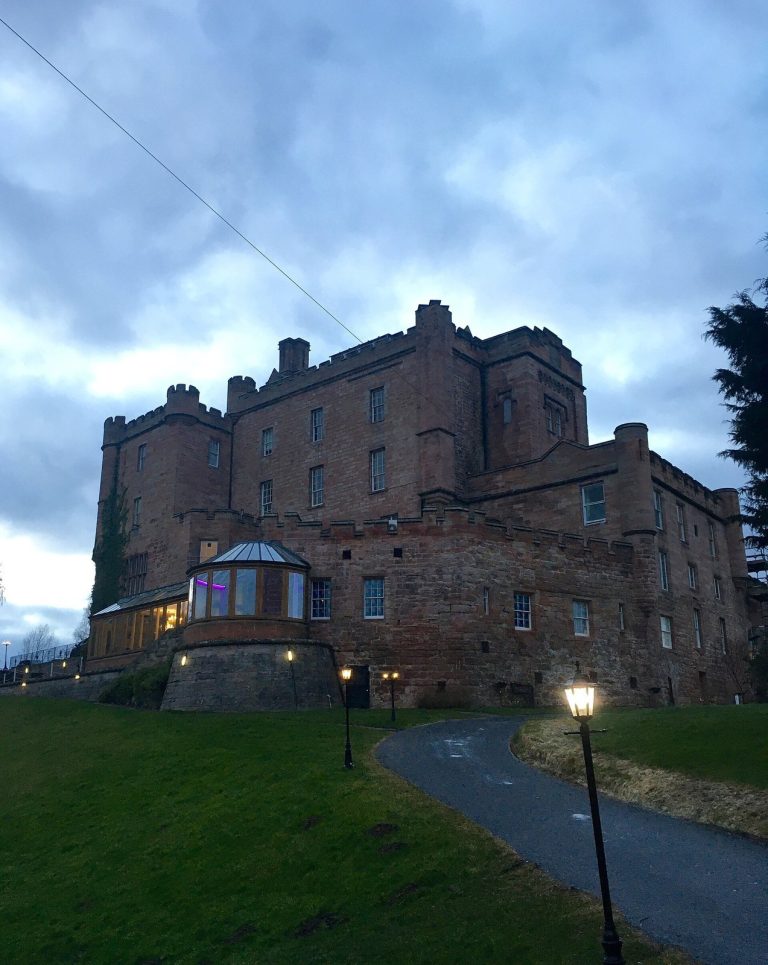
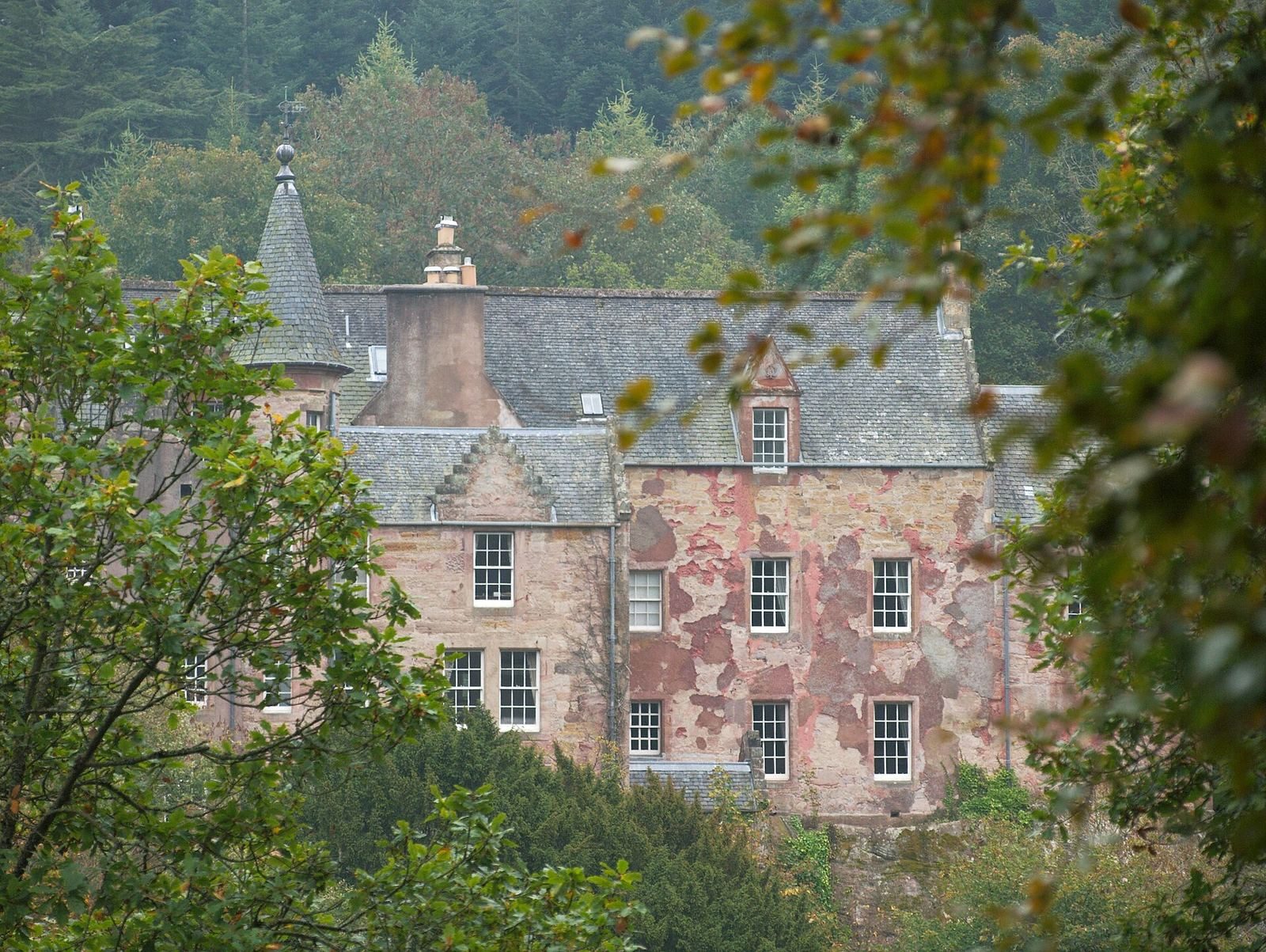
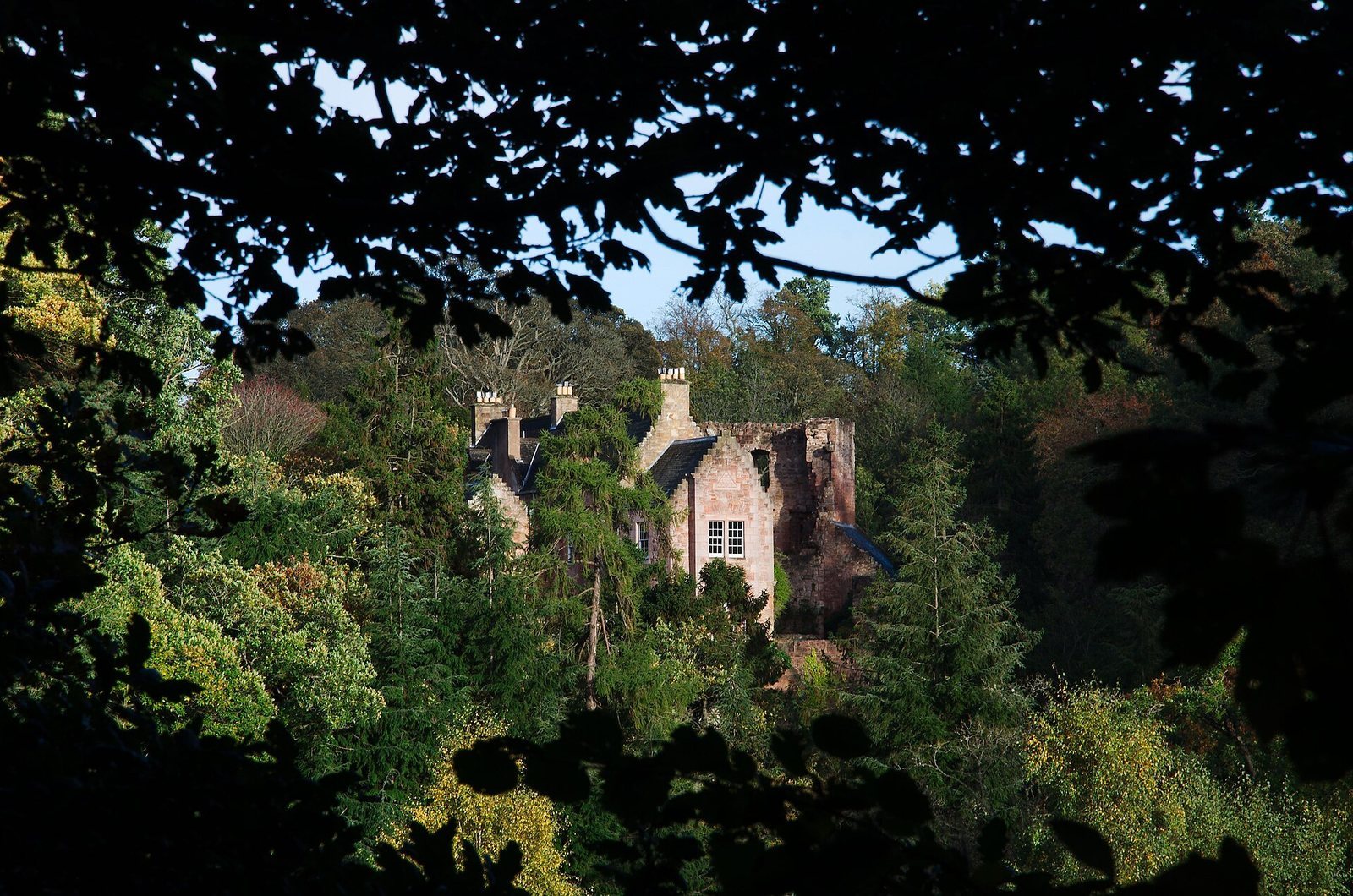
The castle occupies a rocky promontory above the wooded gorge of the North Esk. Its roughly triangular courtyard projects northwest and measures about 24 metres long by 12 metres across at its widest. Pink sandstone rubble forms much of the structure, with carefully dressed stone used for trim.
Courtyard and castle ranges
Medieval tower and south wall
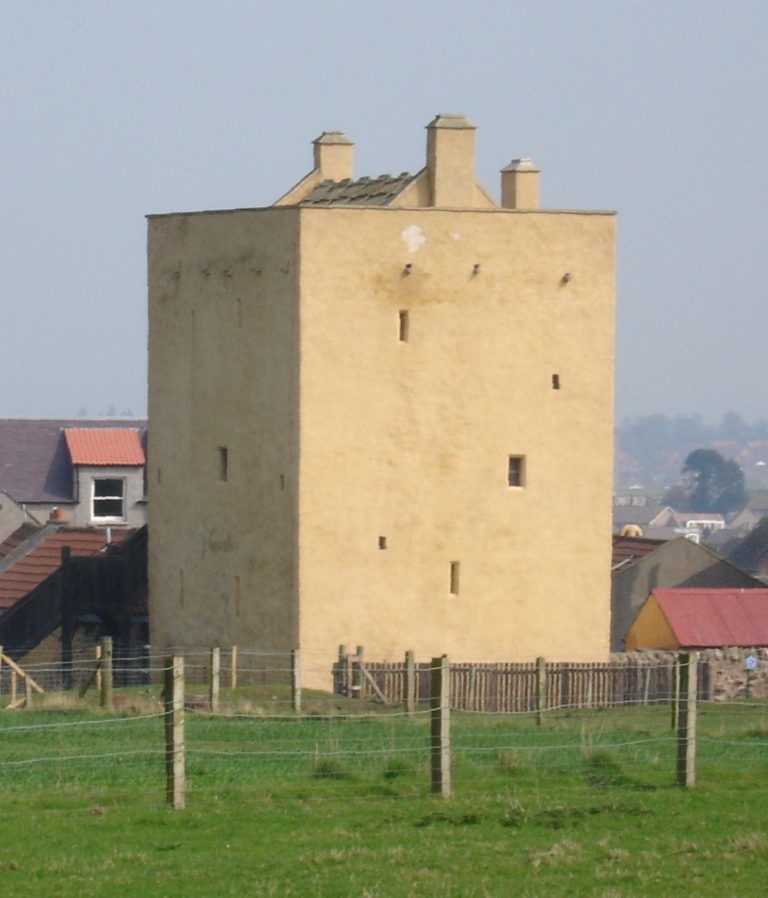
The oldest surviving structures date to the fifteenth century. A ruined tower of about eight metres square stands at the courtyard’s southeast corner and rises through three storeys. Beneath it is an underground prison chamber with a ceiling supported by stone ribs. During modern restoration, the tower basement was fitted out as a library.
The courtyard’s south defensive wall belongs to the same early phase. Its windows indicate that a range of buildings once stood along this side. A well at the courtyard’s west end provided water.
North range and entrance
The L-shaped north range, William Drummond’s addition to the house, has three storeys and an attic and probably replaced earlier buildings on that side of the courtyard. It was originally covered with a rough exterior coating. A sixteenth-century wall connects the range to the tower and contains the entrance. Three openings for firing guns flank the doorway, with another in the tower.
The entrance has a later doorway in the Renaissance style, drawing on classical Greek and Roman forms, and an iron knocker. The knocker bears the initials of Sir William Drummond, the poet’s son, and his wife, Dame Barbara Scott.
West range and family memorial
A final range was added on the courtyard’s west side in the late eighteenth or early nineteenth century, and the house underwent substantial modernisation in the mid-nineteenth century. In 1795, William Abernethy Drummond placed the Abernethy family arms above a doorway and added a memorial to his ancestors, Sir William Drummond and Sir Lawrence Abernethy of Hawthornden.
Rock-cut caves and carved stones
Dovecote cave
Artificial caves cut into the rock lie beneath the castle. One was used as a dovecote, a structure for keeping pigeons or doves, and contains 370 compartments.
Wallace’s Cave and Pictish stones
A nearby cave is known as Wallace’s Cave, after Scottish resistance leader William Wallace. The caves also contain Pictish symbol stones dating from the fifth to ninth centuries. The Picts were peoples of northern and eastern Scotland, and their symbol stones bear distinctive carved designs.