St Catharine’s College: A Constituent College of the University of Cambridge
Site at a Glance
- Popularity
- Very High
- Country
- United Kingdom
- Primary era
- Early Modern
- Eras represented
- Early Modern, Modern
- Civilizations
- British, English
- Site type
- Civic
- Remains
- University
On this page8 sections
History
Foundation and early teaching
St Catharine’s College is a constituent college of the University of Cambridge in Cambridge, United Kingdom, formally founded in 1473 as Lady Katharine Hall. Robert Woodlark, then provost, or head, of King’s College, began preparing the new institution in 1459 by acquiring tenements. He paid much of the cost from his own fortune and was suspected of diverting funds from King’s College. The foundation was consequently reduced to three fellows, senior members of a college, whose studies were restricted to theology and philosophy.
King Edward IV granted the college a royal charter of incorporation in 1475, formally recognizing it as a legal corporation. Woodlark may have chosen its name in honour of Catherine of Valois, the mother of Henry VI, king of England. A connection to Catherine of Alexandria is considered more likely. She was an early Christian saint associated with learning, whose devotional following grew during the Renaissance, a European period of renewed interest in classical learning and the arts.
Woodlark initially prioritized the fellows’ welfare, and the college had no undergraduates for many years. By 1550 it had junior students, and teaching increasingly focused on undergraduates.
Expansion and institutional change
At the start of the seventeenth century, St Catharine’s remained among Cambridge’s smallest colleges. Growth in its fellowship and student body, alongside support from successive Masters, the heads of Cambridge colleges, and benefactors, prompted building work. Short-lived additions followed in 1622. In 1630, decaying buildings began to be demolished and work started on a new court. Further redevelopment between 1675 and 1757 reshaped the site around a large court.
In 1637 the college acquired the George Inn on Trumpington Street, later known as the Bull Hotel. Thomas Hobson, who managed its stable, required customers to take the horse that had been there longest. The practice gave rise to the expression “Hobson’s choice,” meaning that a person must accept the offered option or have none.
New statutes in 1860 accompanied the adoption of the college’s present name. The following year, Master Henry Philpott left after becoming Bishop of Worcester. In the election to replace him, Francis Jameson voted for Charles Kirkby Robinson, while Robinson voted for himself and won. The episode harmed the college’s reputation for several years, but Robinson remained Master until his death in 1909. A proposed merger with neighbouring King’s College was rejected in 1880. It might have given King’s more rooms and St Catharine’s a stronger financial base, but Robinson opposed it.
Twentieth-century growth and recent changes
The college began admitting women in 1979. Building work included a major rebuilding in 1966, accommodation at St Chad’s on Grange Road from 1981, and further rooms there in 1998. New facilities were completed in 2013. Dame Jean Thomas became the college’s first woman Master in 2006.
Renovation of the Trumpington Street facilities took place from September 2020 to August 2022 as part of the Central Spaces project. During the COVID-19 pandemic, the college also worked with Cambridge Women’s Aid to house women escaping domestic abuse. From 27 April to 3 September 2020, women and children spent a combined 1,456 nights in college accommodation.
Remains
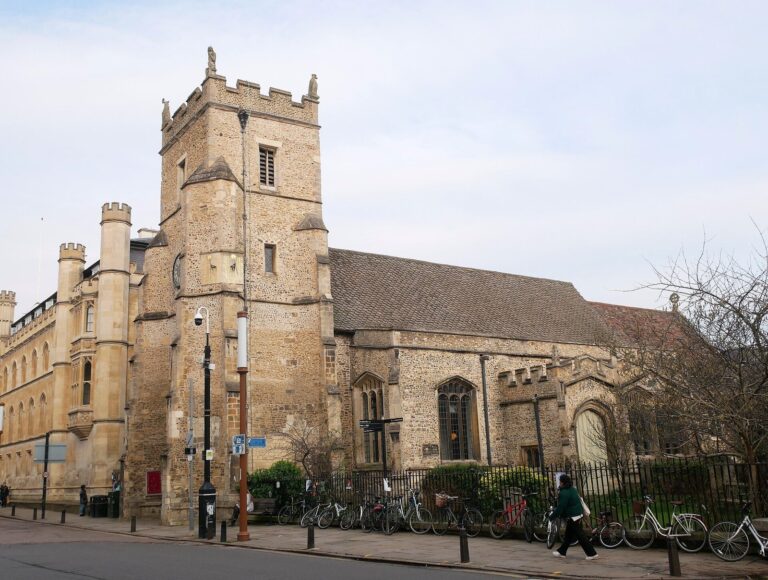
The college lies in Cambridge’s historic centre, just south of King’s College and across Trumpington Street from Corpus Christi College. Its buildings include the main court on Trumpington Street and accommodation at St Chad’s on Grange Road.
Main court
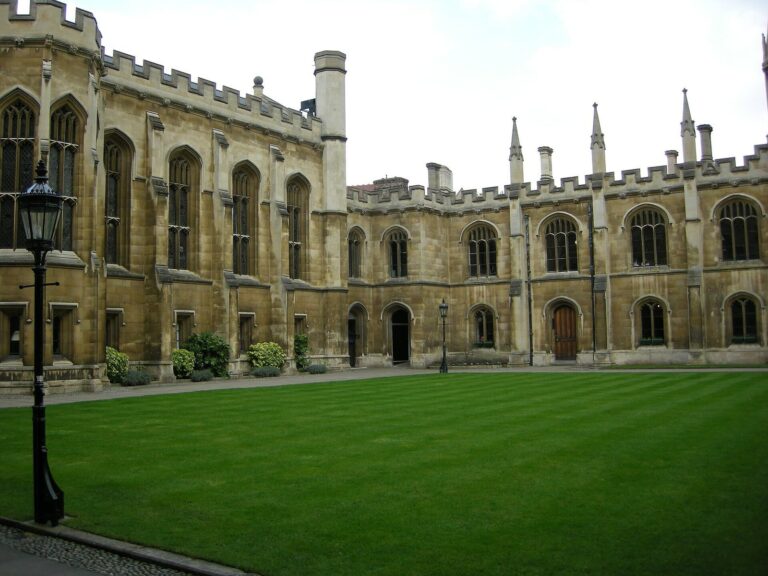
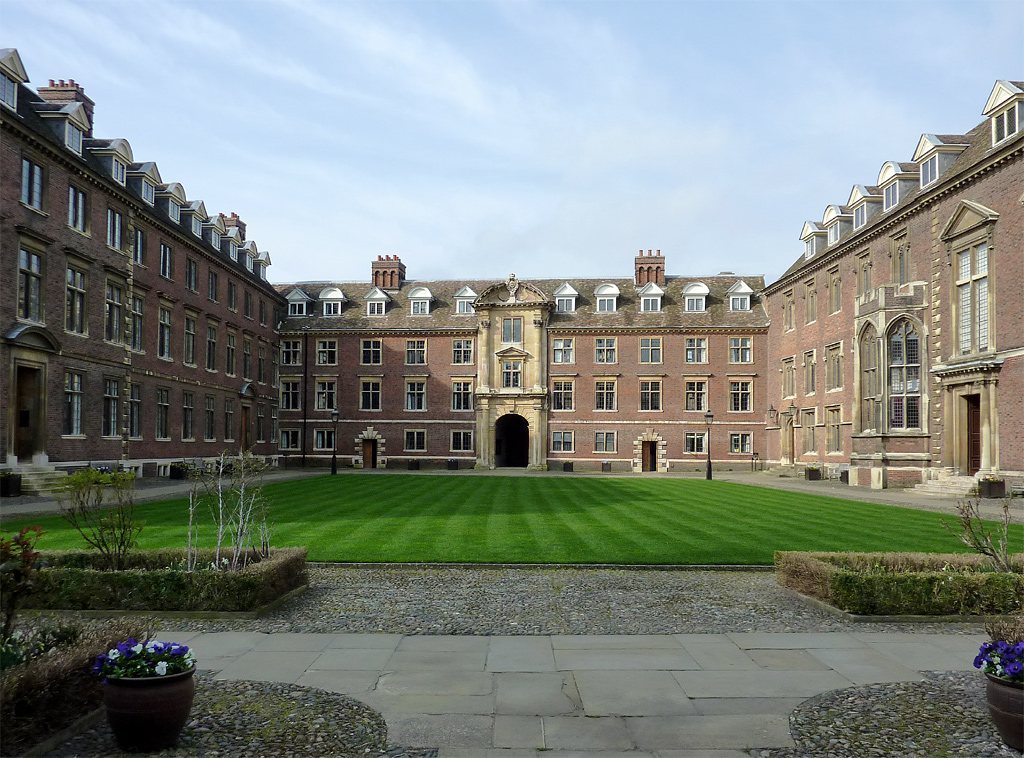
The large main court faces Trumpington Street and has three sides, rather than forming a closed quadrangle. It was built on Cambridge’s former High Street, and its construction left one side of Queens’ College facing a back alley. Proposals to complete the court with another side of buildings have been made repeatedly. During the recent renovations, a temporary, tent-like hall stood in the court. Known as the Catzebo, its name combined Catz, a college nickname, with gazebo.
Accommodation and facilities
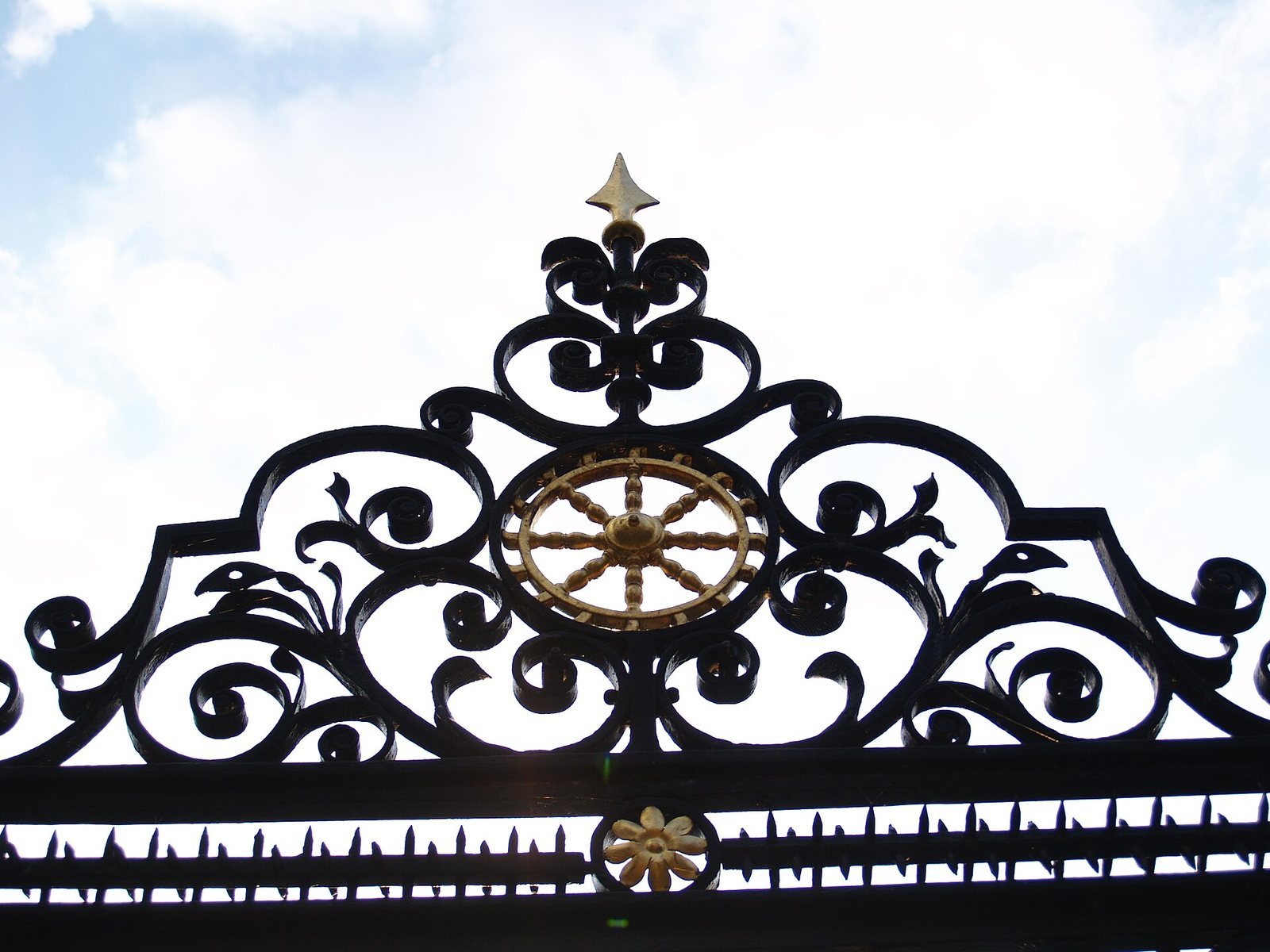
The 1966 rebuilding produced a larger hall, new kitchens and an accommodation block shared with King’s College. At St Chad’s, the accommodation includes octagonal rooms shaped to resemble the wheel on the college arms. Facilities completed in 2013 included a lecture theatre, a college bar and a Junior Common Room, the undergraduate common room also known as the JCR.
Former George Inn
The George Inn, later the Bull Hotel, stood on Trumpington Street, with its stable behind it.